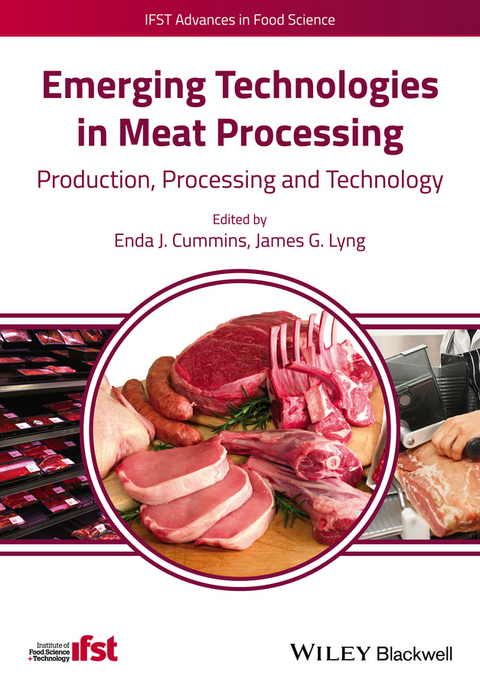
Emerging Technologies in Meat Processing (eBook)
John Wiley & Sons (Verlag)
978-1-118-35077-5 (ISBN)
This book provides a comprehensive overview on the application of novel processing techniques. It represents a standard reference book on novel processing, packaging and assessment methods of meat and meat products. It is part of the IFST Advances in Food Science book series.
Meat is a global product, which is traded between regions, countries and continents. The onus is on producers, manufacturers, transporters and retailers to ensure that an ever-demanding consumer receives a top quality product that is free from contamination. With such a dynamic product and market place, new innovative ways to process, package and assess meat products are being developed. With ever increasing competition and tighter cost margins, industry has shown willingness to engage in seeking novel innovative ways of processing, packaging and assessing meat products while maintaining quality and safety attributes. This book provides a comprehensive overview on the application of novel processing techniques. It represents a standard reference book on novel processing, packaging and assessment methods of meat and meat products. It is part of the IFST Advances in Food Science book series.
Dr. Enda Cummins (BAgrSc MEngSc PhD) has worked in University College Dublin since completing his PhD in 2004. He has extensive experience with regard to food processing, food safety and risk assessment and has been involved in the safety evaluation of new technologies for use in the food industry. He has managed a number of research projects in relation to food safety, processing effects and traceability of foodstuffs. He lectures undergraduate and postgraduate courses in Product development, Food Physics (including novel processing and packaging techniques) and also in the area of Food Safety and Quantitative risk assessment. Dr Cummins is also the programme coordinator for the postgraduate Masters programme in Food Engineering (MEngSc) in the College of Engineering within UCD. He has published extensively in the area of food safety, including meat safety and quality aspects. Dr. James Lyng (BAgrSc PhD) is based at University College Dublin, and is a food scientist with extensive experience in the use of novel technologies for processing food and their impact on food quality and also the measurement of physical properties of foods which govern interaction between these technologies and the food product. He obtained his PhD degree in meat processing using high intensity low frequency ultrasound. Since 1997 Dr. Lyng has been a UCD lecturer delivering courses in Food Process Technology, Food Engineering and Food Physics. Dr. Lyng has an extensive range of publications in the measurement of electrical conductivity and dielectric properties which are both physical properties relevant to some of the technologies which will be covered in the proposed book.
List of Contributors
Chapter 1 Emerging Technologies in Meat Processing
Chapter 2 Irradiation of Meat and Meat Products
Chapter 3 High pressure processing of meat and meat products
Chapter 4 Electroprocessing of meat and meat products
Chapter 5 Application of Infrared and Light Based Technologies to Meat and Meat Products
Chapter 6 Ultrasound Processing Applications in the Meat Industry
Chapter 7 Application of hydrodynamic shock wave processing associated with meat and processed meat products
Chapter 8 Robotics in meat processing
Chapter 9 Packaging systems and materials used for raw and cooked meat products with particular emphasis on the use of oxygen scavenging systems
Chapter 10 Smart packaging solutions encompassing nanotechnology
Chapter 11 Probiotics functionality in meat
Chapter 12 Rapid methods for microbial analysis of meat and meat products
Chapter 13 The Use of Hyperspectral Techniques in Evaluating Quality and Safety of Meat and Meat Products
Chapter 14 On-line meat quality and compositional assessment techniques
Chapter 15 Meat Authenticity
Chapter 16 Regulation and legislative issues
Index
Chapter 1
Emerging technologies in meat processing
Enda J. Cummins1 & James G. Lyng2
1Biosystems and Food Engineering, UCD, Dublin, Ireland
2Institute of Food and Health, UCD, Dublin, Ireland
1.1 Context and challenges
Meat is a global product, which is traded between regions, countries and continents. The onus is on producers, manufacturers, transporters and retailers to ensure an ever-demanding consumer receives a top-quality product that is free from contamination. With such a dynamic product and market place, new innovative ways to process, package and assess meat products are being developed. In some instances, industry uptake of new technologies is stifled by a lack of knowledge about these new technologies and their impact on product quality and safety. With ever-increasing competition and tighter cost margins, industry has shown willingness to engage in seeking novel innovative ways of processing, packaging and assessing meat products while maintaining quality and safety attributes. Several new technologies have emerged with regard to meat processing, packaging and quality assessment, which have the potential to improve production efficiency while maintaining meat safety and quality. A number of novel thermal and non-thermal technologies designed to achieve microbial safety while minimising the effects on its nutritional and quality attributes have also become available.
Minimising changes in quality and safety during processing is a considerable challenge for food processors and technologists. Thus, there is a requirement for detailed industrially relevant information concerning emerging technologies in meat product manufacture. In addition, industrial adoption of novel processing techniques is in its infancy. Applications of new and innovative technologies and resulting effects to those food products either individually or in combination are always of great interest to academic, industrial, nutrition and health professionals.
1.2 Book objective
The primary objective of this book on Emerging Technologies in Meat Processing is to provide a comprehensive overview of the application of novel processing techniques as applied to the meat industry. The book evaluates recent advances on how meat is produced, processed and stored and is a benchmark reference book on novel processing, packaging and assessment methods of meat and meat products.
1.3 Book structure
Meat processors have a major responsibility to consumers when it comes to producing quality, nutritious and particularly safe foods. Conventional methods of meat processing and preservation (e.g. heat processing, low-temperature preservation or dehydration) have been used for hundreds of years. However, the last century has witnessed a dramatic increase in the development of new technologies, which have, in many cases, been hyped as replacements for conventional methods. However, in spite of much excitement relating to their discovery and potential, the anticipated uptake by industry has not occurred. In many cases, alternative technologies are still expensive in terms of capital outlay and are therefore not attractive options for processors, although they are generally becoming cheaper as time progresses. The reason for the lack of uptake most likely runs deeper than financial, as in many cases the alternatives are more economic or produce a higher quality product than conventional methods so that processors could recoup the initial capital outlay in reduced running costs or by charging higher prices for a premium quality product. It is most likely that the biggest obstacle these technologies face is a lack of basic understanding of their potential and, more importantly, when it comes to preservation, an unwillingness to trust the alternative methods compared to the tried and tested conventional methods. This book does not set out to try and convince food processors to drop conventional methods and replace them with alternatives. Instead, in Part 1, it sets to review alternative or novel processing techniques reinforcing the positive aspects of each operation and also discussing areas of weakness. Part 2 sets out an overview of alternative packaging solutions and meat functionality, clearly listing advantages and disadvantages and providing the reader with case studies where these technologies have been used. Part 3 reviews advances in assessment techniques for improved meat quality and safety.
Part 1 (processing techniques) consists of a number of chapters on novel processing techniques for the meat industry. Recent developments in irradiation, high-pressure processing, electroprocessing, light-based technologies, ultrasound, robotics and other emerging technologies are discussed with emphasis on operational principles and inherent strengths and weaknesses of the technologies. In Chapter 2, the various sources of ionising radiation are described and distinguished. The mode of action is described and the advantages and disadvantages of irradiation are considered. The chapter finishes with a section outlining the author's view of the future for irradiation. Chapter 3 reviews the history of high preservation, and typical pressures used for meat preservation is put in context. The mode of action of high pressure in meat preservation is discussed, as are its advantages and disadvantages. While a lot has been published, more work needs to be done (e.g. pressure resistance problems, which can be overcome by combining pressure with either mild heat or cold) and the future for high pressure is considered in the final section of this chapter.
Electroprocessing has seen many technological developments in recent years. Chapter 4 begins with the classic categorisation of the different forms of electroheating in terms of the electromagnetic spectrum and then goes on to clearly describe and distinguish the heating mechanism of each. A central portion of the chapter is the presentation of case studies outlining situations where each of the electroheating technologies has been used to preserve products commercially or has undergone research and development to a form, which is suitable for commercial application. Chapter 5 focuses on the application of infrared and light-based technologies to meat and meat products. It has been suggested that magnetic UV, IR and high-intensity light pulses all have potential in meat preservation. Some forms are not always suitable for direct application but still have an important role to play in preservation as they can be used for applications such as sterilising packaging, contact surfaces or air within packaging equipment. These forms of electromagnetic radiation can be used in a number of forms (e.g. near vs far infrared) and the identification of where the various forms fit into the electromagnetic spectrum is achieved using a standardised electromagnetic spectrum diagram. This chapter explores the application, interactions and equipment associated with these light-based technologies in addition to illustrating practical case studies.
Chapter 6 begins where the fundamentals of ultrasonics are outlined and high-intensity versus low-intensity forms of ultrasound are distinguished. This is followed by a section in which ultrasonic equipment and specific industry-relevant case studies are discussed. The use of ultrasound for the decontamination of meat forms a central part of this chapter. It finishes with conclusions regarding the possible future for ultrasonics in meat preservation. Chapter 7 introduces the operational principles of emerging technologies such as the hydrodynamic shock wave, with particular emphasis on applications, mode of operation, advantages and disadvantages of the technology. The chapter concludes with some developmental advances in the technology. Part 1 of the book concludes with Chapter 8 which provides an overview of the use and application of robotics in meat processing. The chapter provides details for product handling and processing with emphasis on inherent strengths and weaknesses. The chapter is illustrated by relevant case studies and provides a reference for currently available robotic equipment. The chapter finishes by providing a synopsis of the likely future role for robotics in meat processing.
Part 2 of the book deals with novel packaging and meat functionality. Recently the area of meat packaging has seen many new developments. This section reports on these developments and implications for shelf life, meat safety and quality. In particular, developments in novel packaging systems and smart packaging of meats are evaluated. Chapter 9 considers novel packaging solutions for meat products including the use of case-ready packaging with emphasis on modified atmospheric packaging and oxygen scavenging systems. The operational principles are detailed along with advantage and disadvantages of the technologies. The chapter concludes with a synopsis of the likely future role that novel packaging will play in the preservation of meat products. Packaging in the future is likely to be more than just a physical container that provides food with protection from the surrounding environment. Chapter 10 analyses the theory, mode of action and role of smart packaging systems in today's meat industry. The recent developments of nanotechnology in smart packaging systems are also discussed. In Chapter 11, the authors look at functionality in the meat product itself, with a focus on probiotics for meat products.
Rapid detection of pathogens and microbial contaminants is essential for ensuring meat quality and safety. Part 3 of this book...
| Erscheint lt. Verlag | 18.11.2016 |
|---|---|
| Reihe/Serie | IFST Advances in Food Science |
| IFST Advances in Food Science | IFST Advances in Food Science |
| Sprache | englisch |
| Themenwelt | Naturwissenschaften ► Biologie |
| Technik ► Lebensmitteltechnologie | |
| Weitere Fachgebiete ► Land- / Forstwirtschaft / Fischerei | |
| Schlagworte | Dehydration • Fleisch • Fleisch, Fisch, Geflügel • Fleisch, Fisch, Geflügel • Fleischverarbeitung • Fleischware • Food Processing, Production & Manufacture • Food Science & Technology • Food Types • heat processing • Herstellung u. Verarbeitung von Lebensmitteln • Lebensmittel • Lebensmittelforschung u. -technologie • low temperature preservation • Manufacturers • Meat, Fish & Poultry • Meat processors • microbial safety • Non-thermal Technologies • Nutrition • Packaging • Quality Assessment • thermal technologies |
| ISBN-10 | 1-118-35077-4 / 1118350774 |
| ISBN-13 | 978-1-118-35077-5 / 9781118350775 |
| Informationen gemäß Produktsicherheitsverordnung (GPSR) | |
| Haben Sie eine Frage zum Produkt? |
 EPUB (Adobe DRM)
Kopierschutz: Adobe-DRM
Adobe-DRM ist ein Kopierschutz, der das eBook vor Mißbrauch schützen soll. Dabei wird das eBook bereits beim Download auf Ihre persönliche Adobe-ID autorisiert. Lesen können Sie das eBook dann nur auf den Geräten, welche ebenfalls auf Ihre Adobe-ID registriert sind.
Details zum Adobe-DRM
Dateiformat: EPUB (Electronic Publication)
EPUB ist ein offener Standard für eBooks und eignet sich besonders zur Darstellung von Belletristik und Sachbüchern. Der Fließtext wird dynamisch an die Display- und Schriftgröße angepasst. Auch für mobile Lesegeräte ist EPUB daher gut geeignet.
Systemvoraussetzungen:
PC/Mac: Mit einem PC oder Mac können Sie dieses eBook lesen. Sie benötigen eine
eReader: Dieses eBook kann mit (fast) allen eBook-Readern gelesen werden. Mit dem amazon-Kindle ist es aber nicht kompatibel.
Smartphone/Tablet: Egal ob Apple oder Android, dieses eBook können Sie lesen. Sie benötigen eine
Geräteliste und zusätzliche Hinweise
Buying eBooks from abroad
For tax law reasons we can sell eBooks just within Germany and Switzerland. Regrettably we cannot fulfill eBook-orders from other countries.
aus dem Bereich