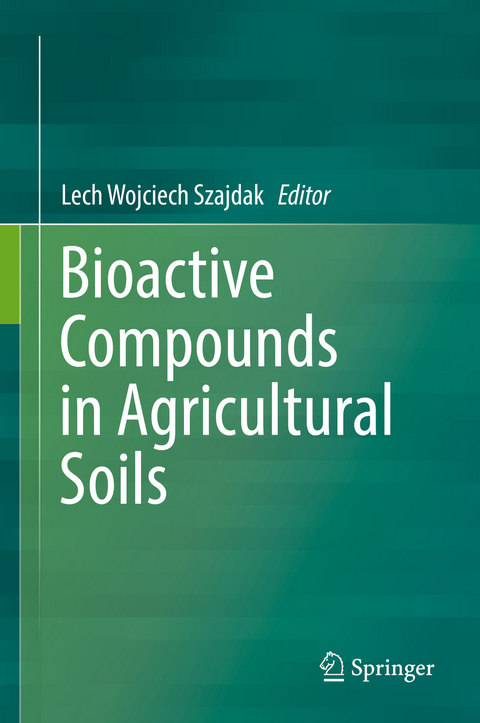
Bioactive Compounds in Agricultural Soils (eBook)
VI, 312 Seiten
Springer International Publishing (Verlag)
978-3-319-43107-9 (ISBN)
This volume looks at the impact that different cropping systems and tillage have on soil's biologically active substances. It considers how phytotoxins accumulate and can inhibit the development of cultivated plants. Coverage explores the continuous cropping of rye, crop rotation, no tillage, and conventional tillage. It offers a comprehensive, comparative approach to allelopathic plant-soil interactions.
The authors focus on free and bounded biologically active substances such as amino acids, auxins, humic and fulvic acids, transient radicals, and enzymes in light sand soils fertilized with different mineral and organic fertilizers.
The chapters address fundamental questions relevant to the environmental challenges we face today and will deal with in the future. The results involve asking basic questions motivated by soil's chemical and biochemical processes. The answers will lead to the improvement of the quality of soil's organic matter, which, in turn, can lead to increased crop yields.
Readers will come to understand the relationship between ecological processes and environmental change on individual levels of biocomplexity as well as on systems in their entirety. The title is ideal for students and teachers for laboratory practical classes. Soil scientists, biochemists, chemists, plant ecophysiologists, 'Natural Products' organic chemists, and other environmental scientists and specialists will also find it useful.
Lech Wojciech Szajdak, Professor of Agronomy since 2006, is currently the Director of the Institute for Agricultural and Forest Environment, Polish Academy of Sciences, in Poznań, Poland. He obtained his M.Sc. (Pharmacy) and Ph.D. in 1977 and 1986, respectively, from Poznań University of Medical Sciences. In 2009, he was awarded a Honoris Causa degree from Estonia University of Life Sciences, Tartu.
His professional interests are: a) Free and bounded amino acids, phenolic acids, auxins, humic and fulvic acids, transient radicals, enzymes in soils under crop rotation and the continuous cropping of rye, conventional and no-tillage, fertilized with different mineral and organic fertilizers, b) Soil enzymes involved in nitrogen cycle; c) Chemical and biochemical processes and mechanisms in organic soils (peat, moorsh, sapropel) and peatlands in agriculture and the impact of secondary transformed peat soils on the content and properties of hydrophilic and hydrophobic organic compounds of well-known and unknown structure; d) substrates for growing media.
Professor Szajdak has written more than 500 research papers, 11 books and 84 chapters in Monographs. He was the guest editor of 2 special issues of Agronomy Research and Plant and Soil 'Restoration of Peatlands Soil for Agricultural Use' and 'Processes, Mechanism and Use of Organic Soils'. He has been a primary researcher in 19 scientific projects.Lech Wojciech Szajdak, Professor of Agronomy since 2006, is currently the Director of the Institute for Agricultural and Forest Environment, Polish Academy of Sciences, in Poznań, Poland. He obtained his M.Sc. (Pharmacy) and Ph.D. in 1977 and 1986, respectively, from Poznań University of Medical Sciences. In 2009, he was awarded a Honoris Causa degree from Estonia University of Life Sciences, Tartu. His professional interests are: a) Free and bounded amino acids, phenolic acids, auxins, humic and fulvic acids, transient radicals, enzymes in soils under crop rotation and the continuous cropping of rye, conventional and no-tillage, fertilized with different mineral and organic fertilizers, b) Soil enzymes involved in nitrogen cycle; c) Chemical and biochemical processes and mechanisms in organic soils (peat, moorsh, sapropel) and peatlands in agriculture and the impact of secondary transformed peat soils on the content and properties of hydrophilic and hydrophobic organic compounds of well-known and unknown structure; d) substrates for growing media. Professor Szajdak has written more than 500 research papers, 11 books and 84 chapters in Monographs. He was the guest editor of 2 special issues of Agronomy Research and Plant and Soil “Restoration of Peatlands Soil for Agricultural Use” and “Processes, Mechanism and Use of Organic Soils”. He has been a primary researcher in 19 scientific projects.
Introduction. Biologically Active Substances.- 2. Free, Bounded and Included in Humic Acids Amino Acids from Cropping Systems. Thermal properties of Humic Acids from Cropping systems.- 3. Conversions and Pathways of Organic Carbon and Organic Nitrogen in Soils.- 4. Free Sulfuric Amino Acids and the Activity of Rhodanese in Soils under Continuous Cropping of Rye and Crop Rotation.- 5. Amino Acids, Indole -3-Acetic Acid, Stable and Transient Radicals, and Properties of Humic and Fulvic Acids as Affected by Tillage System.- 6. Leaching Kinetics of Organic and Inorganic Compounds in Tilled and Orchard Soils.- 7. Phytohormone in Peats, Sapropels and Peat Substrates.- 8. Auxin, One Major Plant Hormone, in Soil.- 9. Transformations of Organic Matter in Soils Under Shelterbelts of Different Age in Agricultural Landscape.- 10. Impact of Long-term Agricultural Management and Native Forest Ecosystem on the Chemical and Biochemical Properties of Stagnic Albeluvisols' Organic Matter.- 11. Cranberry - The Plant Growing on Organic Soils with Broad Spectrum of Pharmaceutical and Medical Utilization.- 12. The Importance of Horticultural Growing Media and Biochemical, Chemical and Physical Processes.
| Erscheint lt. Verlag | 2.11.2016 |
|---|---|
| Zusatzinfo | VI, 312 p. 66 illus., 9 illus. in color. |
| Verlagsort | Cham |
| Sprache | englisch |
| Themenwelt | Naturwissenschaften ► Biologie |
| Technik | |
| Weitere Fachgebiete ► Land- / Forstwirtschaft / Fischerei | |
| Schlagworte | Allelopathy • Biologically Active Substances • Humic acids • Organic carbon in soils • Organic nitrogen in soils • Phytohormone • Plant-Plant Interface • Plant-Soil Interface |
| ISBN-10 | 3-319-43107-2 / 3319431072 |
| ISBN-13 | 978-3-319-43107-9 / 9783319431079 |
| Informationen gemäß Produktsicherheitsverordnung (GPSR) | |
| Haben Sie eine Frage zum Produkt? |
 PDF (Wasserzeichen)
DRM: Digitales Wasserzeichen
Dieses eBook enthält ein digitales Wasserzeichen und ist damit für Sie personalisiert. Bei einer missbräuchlichen Weitergabe des eBooks an Dritte ist eine Rückverfolgung an die Quelle möglich.
Dateiformat: PDF (Portable Document Format)
Mit einem festen Seitenlayout eignet sich die PDF besonders für Fachbücher mit Spalten, Tabellen und Abbildungen. Eine PDF kann auf fast allen Geräten angezeigt werden, ist aber für kleine Displays (Smartphone, eReader) nur eingeschränkt geeignet.
Systemvoraussetzungen:
PC/Mac: Mit einem PC oder Mac können Sie dieses eBook lesen. Sie benötigen dafür einen PDF-Viewer - z.B. den Adobe Reader oder Adobe Digital Editions.
eReader: Dieses eBook kann mit (fast) allen eBook-Readern gelesen werden. Mit dem amazon-Kindle ist es aber nicht kompatibel.
Smartphone/Tablet: Egal ob Apple oder Android, dieses eBook können Sie lesen. Sie benötigen dafür einen PDF-Viewer - z.B. die kostenlose Adobe Digital Editions-App.
Buying eBooks from abroad
For tax law reasons we can sell eBooks just within Germany and Switzerland. Regrettably we cannot fulfill eBook-orders from other countries.
aus dem Bereich