Flavour (eBook)
424 Seiten
Wiley-Blackwell (Verlag)
978-1-118-92939-1 (ISBN)
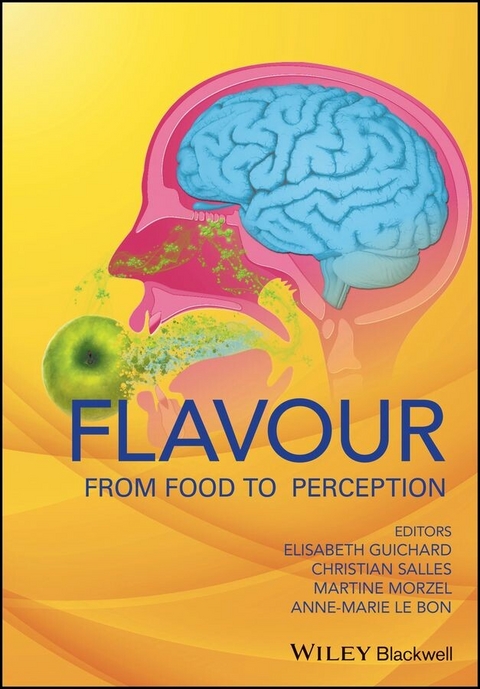
The book presents the bases of anatomy of sensory perception. It will provide the requisite basic knowledge on the molecules responsible for flavour perception, on their release from the food matrix during the eating process in order to reach the chemosensory receptors, and on their retention and release from and transformation by bodily fluids of the oral and nasal cavities. It will also bring current knowledge on the multimodal interactions.
This book will also cover the recent evolution in flavour science: characterisation of molecules, interaction with food matrix and more recently, physic-chemical and physiological and events during oral processing increasingly considered.
Elisabeth Guichard, Christian Salles, Martine Morzel and Anne-Marie Le Bon, Centre des Sciences du Goût et de l'Alimentation, CNRS, INRA, Université de Bourgogne Franche-Comté, Dijon, France
Elisabeth Guichard, Christian Salles, Martine Morzel and Anne-Marie Le Bon, Centre des Sciences du Goût et de l'Alimentation, CNRS, INRA, Université de Bourgogne Franche-Comté, Dijon, France
Lists of Contributors vii
Preface xi
List of Abbreviations xiii
1 Olfactory system in mammals: structural and functional anatomy 1
Anne-Marie Le Bon, Frédérique Datiche, Jean Gascuel & Xavier Grosmaitre
2 Odorant metabolizing enzymes in the peripheral olfactory process 34
Jean-Marie Heydel, Hassan-Ismail Hanser, Philippe Faure & Fabrice Neiers
3 The vertebrate gustatory system 57
Maik Behrens & Wolfgang Meyerhof
4 Bioadhesion and oral fluids--perireceptor modulators of taste perception? 79
Christian Hannig, Matthias Hannig & Martine Morzel
5 Basic physiology of the intranasal trigeminal system 109
Florence Gingras-Lessard & Johannes Frasnelli
6 Characterization of aroma compounds: structure, physico-chemical and sensory properties 126
Henryk Jelen & Anna Gracka
7 Characterization of taste compounds: chemical structures and sensory properties 154
Anni Laffitte, Fabrice Neiers & Loïc Briand
8 Sensory characterization of compounds with a trigeminal effect for taste modulation purposes 192
Isabelle Cayeux & Christian Starkenmann
9 Interactions between aroma compounds and food matrix 208
Laurianne Paravisini & Elisabeth Guichard
10 Aroma release during in-mouth process 235
Andrea Romano
11 Release of tastants during in-mouth processing 266
Christian Salles
12 Interactions between saliva and flavour compounds 284
Francis Canon & Eric Neyraud
13 Orthonasal and retronasal perception 310
Thomas Hummel & Han-Seok Seo
14 Perception of mixtures of odorants and tastants: sensory and analytical points of view 319
Thierry Thomas-Danguin, Carmen Barba, Christian Salles & Elisabeth Guichard
15 Odour mixture coding from the neuronal point of view 341
Patricia Duchamp-Viret
16 Multisensory flavour perception 373
Charles Spence
Index 395
List of Abbreviations
- 3D
- 3 dimensions
- γι
- activity coefficient
- ABT
- 1-aminobenzotriazole
- Aco
- anterior cortical nucleus of amygdala
- ADH
- alcohol dehydrogenase
- AEDA
- aroma extract dilution analysis
- AI
- agranular insular cortex
- AL
- antennal lobe
- AMP
- adenosine-5'-monophosphate
- AOB
- accessory olfactory bulb
- AON
- anterior olfactory nucleus
- AOS
- allene oxide synthase
- APCI-MS
- atmospheric pressure chemical ionization-mass spectrometry
- aPCx
- anterior piriform cortex
- aPRP
- acidic proline-rich protein
- ATP
- adenosine triphosphate
- AUC
- area under the curve
- BLA
- basolateral nucleus
- BNPP
- bis-p-nitro-phenylphosphate
- BOLD
- blood-oxygen-level dependent
- bPRP
- basic proline-rich protein
- Ca
- calcium
- cAMP
- cyclic adenosine monophosphate
- CaSR
- calcium sensing receptor
- CAVI
- carbonic anhydrase VI
- CD
- cyclodextrin
- CG
- concentration of the volatile in the headspace
- cGMP
- cyclic guanosine monophosphate
- CHARM
- combined hedonic aroma response measurement
- CIT
- citral
- CM
- concentration of the volatile compound in the matrix
- CNGC
- cyclic nucleotide gated channels
- CNV
- cranial nerve 5
- CYP
- cytochrome P450 enzyme
- Da
- dalton
- DE
- dextrose equivalent
- DF
- detection frequency
- DIMS
- direct injection-mass spectrometry
- dliq
- liquid density (kg L−1)
- DOSY
- diffusion ordered spectroscopy investigation
- DP
- deep pyramidal cell
- EEG
- electro-encephalogram
- EgCG
- epigallocatechin gallate
- EGF
- epidermal growth factor
- ENaC
- epithelial sodium channel
- EOG
- electro-olfactogram
- EPL
- external plexiform layer
- ER
- endoplasmic reticulum
- ERP
- event-related potentials
- ESP
- exocrine-gland-secreting peptide
- FB
- feedback interneuron
- FDA
- food and drug administration
- FF
- feed forward interneuron
- FFT
- furfurylthiol
- FID
- flame ionisation detection
- fMRI
- functional magnetic resonance imaging
- FPR
- formyl peptide-like receptor
- FSCM
- finger span cross modality
- GBC
- globose basal cell
- GC-GOOD
- gas chromatography-global olfactometry omission detection
- GC-MS
- gas chromatography-mass spectrometry
- GC-O
- gas chromatography-olfactometry
- GC-PO
- gas chromatography-pedestal olfactometry
- GC-R
- gas chromatography recomposition-olfactometry
- GDP
- guanosine diphosphate
- GG
- Grueneberg ganglion
- GL
- glomerular layer
- GMP
- guanosine 5'-monophosphate
- GPCR
- G protein-coupled receptor
- gPRP
- glycosylated proline-rich protein
- Gr
- granule cells
- GRAS
- generally regarded as safe
- GrL
- granular cell layer
- GSH
- glutathione
- GST
- glutathione-S-transferase
- HEK
- human embryonic kidney cell
- HPL
- hydroperoxide lyase
- HPLC
- high performance liquid chromatography
- Hst
- histatin
- IAA
- isoamyl acetate
- IBMX
- 3-isobutyl-1-methylxanthine
- IDP
- intrinsically disordered protein
- IL
- infralimbic cortex
- IMAC
- in-mouth air cavity
- Imax
- maximum intensity of the release profiles
- IMP
- inosine-5'-monophosphate
- IPL
- internal plexiform layer
- ISO
- International Standards Organization
- K
- gas matrix partition coefficient
- Kd
- dissociation constant
- ki
- molar concentration
- Ki
- molar fraction
- km
- mass fraction
- L
- liter
- LCN1
- lipocalin-1
- LEC
- lateral entorhinal cortex
- LH
- lateral hypothalamus
- LISS
- ligand-induced selective signaling
- LN
- local interneurons
- LOT
- lateral olfactory tract
- Ma
- molar mass of air (28.8 g mol−1)
- MC
- mitral cell
- MCL
- mitral cell layer
- MDR
- multidrug resistance
- mGluR
- metabotropic glutamate receptor
- Mliq
- molar mass of liquid (g mol−1)
- MMP-3
- matrix metalloproteinase 3
- MOE
- main olfactory epithelium
- Mp
- multipolar cell
- MRI
- magnetic resonance imaging
- MRP
- multidrug resistance-associated protein
- MSG
- monosodium glutamate
- MUC
- mucin
- MUC1
- mucin 1
- MUC5B
- mucin 5B
- MUC7
- mucin 7
- NaCl
- sodium chloride
- NHDC
- neohesperidin dihydrochalcone
- NIF
- nasal impact frequency
- NLOT
- nucleus of the lateral olfactory tract
- NMP
- negative mucosal potential
- NMR
- nuclear magnetic resonance
- NPY
- neuropeptide Y
- NTS
- nucleus tractus solitarius
- OASIS
- original aroma simultaneously input to the sniffing port method
- OAV
- odour activity value
- OB
- olfactory bulb
- OBP
- odorant-binding protein
- OC
- olfactory cortex
- OCT
- octanol/al
- OE
- olfactory epithelium
- OEC
- olfactory ensheathing cell
- OFC
- orbito-frontal cortex
- OM
- olfactory mucosa
- OME
- odorant metabolizing enzyme
- ONL
- olfactory nerve layer
- OR
- olfactory receptor
- ORN
- olfactory receptor neuron
- OSN
- olfactory sensory neuron
- OT
- odour threshold
- OT
- olfactory tubercle
- P
- pressure (Pa)
- saturated vapour pressure of compound i (Pa)
- PCx
- piriform cortex
- PEEK
- poly-ether-ether-ketone
- PET
- positron emission tomography
- pgC
- periglomerular cells
- Pgp
- P-glycoprotein
- PI3
- phosphoinositide-3
- PI3K
- phosphoinositide-3-kinase
- PIP3
- phosphatidylinositol-(3, 4, 5)-trisphosphate
- PLC
- phospholipase C
- PLco
- posterolateralcortical nucleus of amygdala
- PN
- projection neuron
- pPCx
- posterior piriform cortex
- PPI
- polyproline I
- PPII
- polyproline II
- PRH2 protein
- proline-rich protein HaeIII subfamily 2
- PROP
- 6-n-propylthiouracil
- PRP
- proline-rich protein
- PRV
- phase ratio variation
- PTC
- phenylthiocarbamide
- PTFE
- polytetrafluoroethylene
- PTR-MS
- proton transfer reaction mass spectrometry
- QSAR
- quantitative structure activity relationships
- QSPR
- quantitative structure property relationships
- R
- gas constant (8.314 J mol−1 K−1)
- RAS
- retronasal aroma simulator
- RI
- retention index
- RMS
- rostral migratory stream
- RNA
- ribonucleic acid
- RNAi
- RNA interference
- SCM
- single chain monellin
- SCOPe
- structural classification of proteins
- sIgA
- secretory immunoglobulin A
- SL
- semilunar cell
- SNIF
- surface of nasal impact frequency
- SNP
- single nucleotide polymorphism
- SO
- septal organ
- SON
- supraoptic nucleus
- SP
- superficial pyramidal cell
- SPLUNC2
- short palate, lung and nasal epithelium clone 2
- SPME
- solid phase micro-extraction
- ST
- sulfotransferase
- SVP
- saturated vapour pressure
- T
- temperature (K)
- T1R1
- taste receptor type 1, member 1
- T1R2
- taste receptor type 1, member 2
- T1R3
- taste receptor type 1, member 3
- TAS1R
- taste 1 receptor
- TAS2R
- taste 2 receptor
- TDS
- temporal dominance of sensations
- TGF-α
- transforming growth factor-alpha
- TI
- time-intensity
- TM
- trans-membrane
- Tmax
- time to reach maximum intensity
- ToF
- time-of-flight
- TRP
- transient receptor potential
- Trp
- tryptophan
- TT
- tenia tecta
- UGT
- UDP-glucuronosyltransferase
- V1
- first branch of the trigeminal nerve
- V2
- second branch of the trigeminal nerve
- V3
- third branch of the trigeminal nerve
- VEG
- von Ebner's glands
- VEGP
- von Ebner's...
| Erscheint lt. Verlag | 26.10.2016 |
|---|---|
| Sprache | englisch |
| Themenwelt | Naturwissenschaften ► Biologie |
| Naturwissenschaften ► Chemie | |
| Technik ► Lebensmitteltechnologie | |
| Weitere Fachgebiete ► Land- / Forstwirtschaft / Fischerei | |
| Schlagworte | aroma • Aromastoffe, Riechstoffe, Kosmetika • characterisation of molecules • Chemie • Chemistry • composition of food • evolution in flavour science • Flavor, Perfume & Cosmetic Science • flavour perception • Food Science & Technology • Food Science & Technology Special Topics • Lebensmittelforschung u. -technologie • Lebensmittelsensorik • multimodal interactions • physic-chemical • sensory perception • Sensory Science • Spezialthemen Lebensmittelforschung u. -technologie • Taste • trigeminal nerve |
| ISBN-10 | 1-118-92939-X / 111892939X |
| ISBN-13 | 978-1-118-92939-1 / 9781118929391 |
| Informationen gemäß Produktsicherheitsverordnung (GPSR) | |
| Haben Sie eine Frage zum Produkt? |
 EPUB (Adobe DRM)
Kopierschutz: Adobe-DRM
Adobe-DRM ist ein Kopierschutz, der das eBook vor Mißbrauch schützen soll. Dabei wird das eBook bereits beim Download auf Ihre persönliche Adobe-ID autorisiert. Lesen können Sie das eBook dann nur auf den Geräten, welche ebenfalls auf Ihre Adobe-ID registriert sind.
Details zum Adobe-DRM
Dateiformat: EPUB (Electronic Publication)
EPUB ist ein offener Standard für eBooks und eignet sich besonders zur Darstellung von Belletristik und Sachbüchern. Der Fließtext wird dynamisch an die Display- und Schriftgröße angepasst. Auch für mobile Lesegeräte ist EPUB daher gut geeignet.
Systemvoraussetzungen:
PC/Mac: Mit einem PC oder Mac können Sie dieses eBook lesen. Sie benötigen eine
eReader: Dieses eBook kann mit (fast) allen eBook-Readern gelesen werden. Mit dem amazon-Kindle ist es aber nicht kompatibel.
Smartphone/Tablet: Egal ob Apple oder Android, dieses eBook können Sie lesen. Sie benötigen eine
Geräteliste und zusätzliche Hinweise
Buying eBooks from abroad
For tax law reasons we can sell eBooks just within Germany and Switzerland. Regrettably we cannot fulfill eBook-orders from other countries.
aus dem Bereich