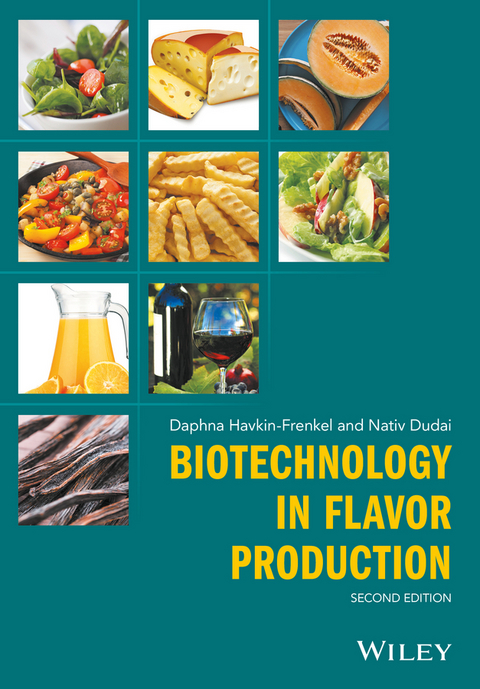
Biotechnology in Flavor Production (eBook)
John Wiley & Sons (Verlag)
978-1-118-35403-2 (ISBN)
Throughout history, human beings have sought ways to enhance the flavor of the foods they eat. In the 21st century, biotechnology plays an important role in the flavor improvement of many types of foods. This book covers many of the biotechnological approaches currently being applied to flavor enhancement. The contribution of microbial metabolism to flavor development in fermented beverages and dairy products has been exploited for thousands of years, but the recent availability of whole genome sequences of the yeasts and bacteria involved in these processes is stimulating targeted approaches to flavor enhancement.
Chapters discuss recent developments in the flavor modification of wine, beer, and dairy products through the manipulation of the microbial species involved. Biotechnological approaches to the production of specific flavor molecules in microbes and plant tissue cultures, and the challenges that have been encountered, are also covered, along with the metabolic engineering of food crops for flavor enhancement - also a current area of research. Biotechnology is also being applied to crop breeding through marker-assisted selection for important traits, including flavor, and the book looks at the application of the biotechnological approach to breeding for enhanced flavor in rice, apple, and basil. These techniques are subject to governmental regulation, and this is addressed in a dedicated chapter.
This updated second edition features five brand new chapters, and the topics covered in the book will be of interest to those in the flavor and food industries as well as to academic researchers interested in flavors.
Dr Daphna Havkin-Frenkel, Department of Plant Pathology and Biology, Rutgers University, New Brunswick, New Jersey and Director of Research and Development, Bakto Flavors LLC, New Jersey. Dr Nativ Dudai, Researcher, Newe Ya'ar Research Center, The Agricultural Research Organization of Israel, Ramat Yishay, Israel.
Chapter 1
The flavor of citrus fruit
Ron Porat, Sophie Deterre, Pierre Giampaoli and Anne Plotto
Introduction
Citrus is the most important cultivated fruit tree crop in terms of area and production values. It is grown commercially in more than 140 countries in tropical and subtropical regions of the world, with total annual production of over 100 million tons and providing a contribution of US$6–8 billion to the world economy (Ladaniya 2008; USDA 2012).
The genus Citrus belongs to the Rutaceae family, subfamily Aurantioidae, and originates from Southeast Asia, nearby North India, Myanmar, and China (Swingle and Reece 1967; Scora 1975). According to the classification by Swingle, the most commercially important citrus species are sweet orange (C. sinensis), sour orange (C. aurantium), mandarin (C. reticulata), grapefruit (C. paradisi), pummelo (C. grandis), lemon (C. limon), citron (C. medica), and lime (C. aurantifolia). Furthermore, phylogenetic and taxonomic studies of the genus Citrus revealed that there are only three basic “true” citrus ancestors, which are citron (C. medica), mandarin (C. reticulata) and pummelo (C. grandis), and all other Citrus species were actually evolved from crosses between these true original citrus species or other relatives (Scora 1975; Barrett and Rhodes 1976). For example, sweet orange was derived from a cross between mandarin and pummelo; grapefruit was derived from a cross between pummelo and sweet orange; and lemon was derived from a cross between citron and sour orange (Barkley et al. 2006; Li et al. 2010).
From a botanical perspective, citrus fruit is a hesperidium, i.e., a special type of berry with a leathery rind internally divided into segments (Grierson 2006a). The fruit is anatomically divided into three separate layers: the outer colored portion of the rind called the flavedo or exocarp, which includes the cuticle, the colored epidermis cells containing chlorophyll or carotenoid pigments and the hypodermis cells consisting of the oil glands; the inner white portion of the peel called the albedo or mesocarp, which is comprised of spongy parenchymous cells; and the internal part of the fruit called flesh or endocarp, which represents the edible portion of the fruit including the juice sacs, segment membranes, and seeds (Schneider 1968; Grierson 2006a) (Fig. 1.1). From the nutritional aspect, citrus fruit provide an important beneficial source to the human diet for consumption of ascorbic acid (vitamin C) and folic acid (vitamin B9), pectin and soluble fibers, different minerals, carotenoids, and specific flavonoids and limonoids, all phytonutrients playing a role in preventing degenerative diseases such as heart diseases and various types of cancers (Patil et al. 2006).
Fig. 1.1 Morphological structure of citrus fruit. (a) Cross-sectional view of an orange fruit. (b) Cross-section of the flavedo layer with oil glands beneath; magnification ×8. Source: Ron Porat.
Citrus fruit are either grown for fresh consumption or for juice and/or peel oil manufacturing. With respect to fresh consumption, the main producing countries are China, Brazil, Spain, Mexico and the United States, while with respect to juice manufacturing, the main producing countries are Brazil and the United States (Florida), with sweet oranges being the main product followed by grapefruit and lemons (Ladaniya 2008; USDA 2012). It is worth noting that during the last few years, consumption of fresh oranges, grapefruit, lemons and limes remained constant, whereas easy-to-peel mandarins and tangerines have seen a steady and significant increase (Ladaniya 2008; USDA 2012).
Above all, citrus fruit are appreciated and consumed by billions of people around the globe because of their unique delicate and attractive flavor evolved from a blend of fruity and freshness and earthy notes. In fact, what we perceive as flavor of citrus fruit is actually the combination of basic taste, aroma, and mouth-feel sensations that are perceived simultaneously by the brain during the eating of foods (Goff and Klee 2006). The sensation of taste providing sweet, sour, bitter, salty, and umami attributes is perceived by receptors present on the tongue and in the mouth that bind soluble components in the food matrix, whereas sensation of aroma is perceived via receptors present in the olfactory bulb in the nose cavity that specifically bind thousands of different volatiles providing various kinds of floral, fruity, minty, woody, mushroom, and other odors (Schwab et al. 2008). In this chapter, we discuss the sensory quality and biochemical constituents involved in creating the unique flavor of different citrus fruit species, including oranges, mandarins, grapefruit, and lemons. The chapter focuses on describing the flavor attributes of fresh citrus fruit and essential oils, but not of processed juices. For further information regarding the effects of juice manufacturing processes, such as extraction methods, pulp separation, thermal processing, and concentration and reconstitution methods on orange volatiles, readers are referred to the excellent review by Perez-Cacho and Rouseff (2008b).
Taste components of citrus fruit
The taste of citrus fruit is principally governed by the levels of sugars and acids in the juice sacs and the relative ratio among them; the latter relationship is also termed the total soluble solids to titratable acidity ratio (TSS : TA), or fruit ripening ratio, and is widely used by growers as an indicator of fruit maturity. During fruit ripening, juice TSS levels gradually increase whereas acidity levels gradually decrease, resulting in a continuous rise in the relative ripening ratio of the fruit (Ramana et al. 1981; Grierson 2006b). For example, the ripening ratios of navel oranges in California increase from a low level of 6 in September to above 20 in January (Obenland et al. 2009), and the ripening ratios of “Or” mandarins in Israel increase from 9 in January to 18 in March (R. Porat, unpublished data).
Because of these dynamic changes in TSS and TA levels during citrus fruit maturation (continuous increase in TSS and decrease in acidity), the overall taste of the fruit will vary with the ripening stage; within each cultivar, early-season fruit are more sour than late-season fruit. Therefore, to make sure that the fruit will not be harvested too early when they may be too sour for the market, maturity and grade standards were developed in each country and enforced by local plant protection and inspection services (Grierson 2006b). For example, in Florida, it is permitted to harvest tangerines only when their TSS levels are above 9% and TSS : TA is greater than 7.5, whereas in Israel, export of early-season Satsuma mandarins is allowed only when TSS levels are above 12% and juice acidity levels are below 1.3%, resulting in TSS : TA greater than 7.0 (Tietel et al. 2010a). In California, the minimum allowed TSS : TA for harvesting and marketing of Navel oranges is 8, even though it was shown that consumer acceptability was higher at a ripening ratio of 10 (Obenland et al. 2009). Obviously, harvesting non-mature sour fruit is not recommended because it might deter consumers from buying more fruit later in the season. However, it is also not recommended to harvest over-mature fruit, which will have a too high ripening ratio, since those fruit will suffer from low flavor preference scores (Grierson 1995). Therefore, each citrus species should be harvested at its optimal and preferred maturity index (between 8 and 12 for oranges), and either too high or too low ripening ratios are not desirable. Furthermore, it was proposed that a good tasty fruit should have high levels of sugars and moderate levels of acids rather than any other combination which may result in a similar ripening ratio (Kader 2008).
In addition to the conventional measurements of TSS : TA ratios to monitor the degree of fruit maturation, Jordan et al. (2001) suggested a new formula to evaluate the sweetness to sourness ratios termed BrimA, which takes into account the fact that receptors on the tongue have a different response to sugars and acids, and that small changes in acids are much more easily perceived than small changes in sugars. The BrimA index is derived by subtracting a multiple of TA from TSS, so that BrimA = TSS – k(TA), with constant k being characteristic of a fruit product. In the case of Navel oranges, a better correlation was found between flavor hedonic scores and sugar and acid concentrations using the BrimA index (with k = 3) rather than using the standard TSS : TA ratio, and that was true especially for low acid-containing fruit (Obenland et al. 2009). A better correlation between sweetness intensity determined by a trained panel and BrimA (r2 = 0.92) as compared with using the TSS : TA ratio (r2 = 0.76) or TSS alone (r2 = 0.74) was also found by Plotto and co-workers (unpublished data).
In the following sections, we describe the biochemical components involved in creating the sweet, sour, and bitter tastes in citrus fruit.
Sugars
In most citrus species (apart from lemons that contain high amounts of acids and low amounts of sugars), sugars provide about 80% of the juice TSS content, and therefore TSS measurements provide a useful and simple indicator to evaluate total sugar levels (Erickson 1968). Table 1.1 provides data regarding...
| Erscheint lt. Verlag | 2.8.2016 |
|---|---|
| Sprache | englisch |
| Themenwelt | Naturwissenschaften ► Biologie |
| Naturwissenschaften ► Chemie | |
| Technik ► Lebensmitteltechnologie | |
| Technik ► Umwelttechnik / Biotechnologie | |
| Weitere Fachgebiete ► Land- / Forstwirtschaft / Fischerei | |
| Schlagworte | Aroma • Biotechnologie i. d. Chemie • Biotechnology • Breeding • Chemie • Chemistry • Citrus • Flavor • Food additive • food biotechnology • Food chemistry • Food Quality • Food Science & Technology • Lebensmittel / Biotechnologie • Lebensmittelchemie • Lebensmittelforschung u. -technologie • Lebensmitteltechnik • Melon • Vanilla • Vanillin |
| ISBN-10 | 1-118-35403-6 / 1118354036 |
| ISBN-13 | 978-1-118-35403-2 / 9781118354032 |
| Informationen gemäß Produktsicherheitsverordnung (GPSR) | |
| Haben Sie eine Frage zum Produkt? |
 EPUB (Adobe DRM)
Kopierschutz: Adobe-DRM
Adobe-DRM ist ein Kopierschutz, der das eBook vor Mißbrauch schützen soll. Dabei wird das eBook bereits beim Download auf Ihre persönliche Adobe-ID autorisiert. Lesen können Sie das eBook dann nur auf den Geräten, welche ebenfalls auf Ihre Adobe-ID registriert sind.
Details zum Adobe-DRM
Dateiformat: EPUB (Electronic Publication)
EPUB ist ein offener Standard für eBooks und eignet sich besonders zur Darstellung von Belletristik und Sachbüchern. Der Fließtext wird dynamisch an die Display- und Schriftgröße angepasst. Auch für mobile Lesegeräte ist EPUB daher gut geeignet.
Systemvoraussetzungen:
PC/Mac: Mit einem PC oder Mac können Sie dieses eBook lesen. Sie benötigen eine
eReader: Dieses eBook kann mit (fast) allen eBook-Readern gelesen werden. Mit dem amazon-Kindle ist es aber nicht kompatibel.
Smartphone/Tablet: Egal ob Apple oder Android, dieses eBook können Sie lesen. Sie benötigen eine
Geräteliste und zusätzliche Hinweise
Buying eBooks from abroad
For tax law reasons we can sell eBooks just within Germany and Switzerland. Regrettably we cannot fulfill eBook-orders from other countries.
aus dem Bereich