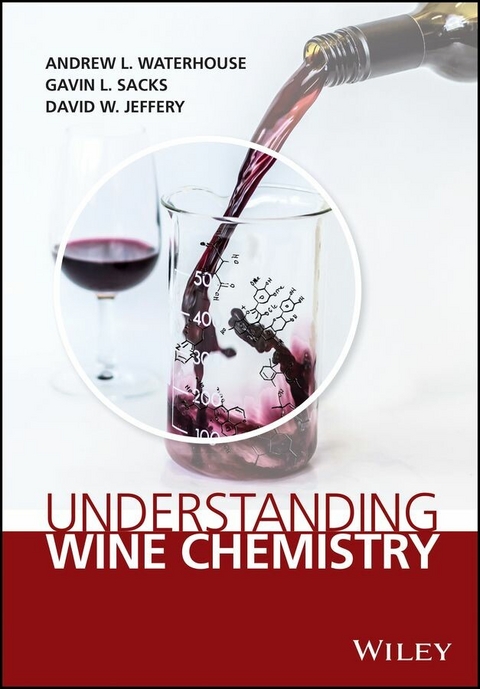
Understanding Wine Chemistry (eBook)
John Wiley & Sons (Verlag)
978-1-118-73070-6 (ISBN)
Wine chemistry inspires and challenges with its complexity, and while this is intriguing, it can also be a barrier to further understanding. The topic is demystified in Understanding Wine Chemistry, which explains the important chemistry of wine at the level of university education, and provides an accessible reference text for scientists and scientifically trained winemakers alike.
Understanding Wine Chemistry:
- Summarizes the compounds found in wine, their basic chemical properties and their contribution to wine stability and sensory properties
- Focuses on chemical and biochemical reaction mechanisms that are critical to wine production processes such as fermentation, aging, physiochemical separations and additions
- Includes case studies showing how chemistry can be harnessed to enhance wine color, aroma, flavor, balance, stability and quality.
This descriptive text provides an overview of wine components and explains the key chemical reactions they undergo, such as those controlling the transformation of grape components, those that arise during fermentation, and the evolution of wine flavor and color. The book aims to guide the reader, who perhaps only has a basic knowledge of chemistry, to rationally explain or predict the outcomes of chemical reactions that contribute to the diversity observed among wines. This will help students, winemakers and other interested individuals to anticipate the effects of wine treatments and processes, or interpret experimental results based on an understanding of the major chemical reactions that can occur in wine.
Professor Andrew L. Waterhouse, Department of Viticulture & Enology, University of California, Davis, USA.
Andrew Waterhouse received his PhD in organic chemistry from UC Berkeley, and has been a wine chemist at the University of California, Davis since 1991. He teaches wine analysis, graduate level wine chemistry, and an online introductory wine course, and is Chair of the Viticulture and Enology graduate studies program. Former graduate students and postdocs are academics, industry scientists and winemakers. His research lab has reported key wine oxidation reactions and has developed new methods to analyse wine components including those using LC-MS with isotope filtering, as well as NMR techniques. The research has focused on wine phenolics, oak compounds and oxidation products. In addition his lab has also been addressing the metabolic products of phenolics. He publishes in numerous international journals in the fields of chemistry and agriculture, and serves as a chief editor at the Journal of the Science of Food and Agriculture. See: waterhouse.ucdavis.edu.
Dr Gavin Sacks, Department of Food Science, Cornell University, USA.
Gavin Sacks received his PhD in analytical chemistry from Cornell University, and following post-doctoral studies in nutritional sciences and biogeochemistry he began as a faculty in food science at Cornell in 2007. He has served as Director of Undergraduate Studies for Cornell's interdepartmental Viticulture and Enology undergraduate major, in which he also teaches courses in wine analysis and in wine flavor chemistry. His research interests include the development of both low-cost and state-of-the-art approaches to analysis of odorants and other organoleptically important compounds; and applying these tools to understanding the role of plant genetics, cultural practices, and post-harvest processing on sensory attributes of foods and beverages, particularly of wine.
Dr David Jeffery, School of Agriculture, Food and Wine, University of Adelaide, USA.
David Jeffery received his PhD in synthetic organic chemistry from Flinders University, and has been involved with wine chemistry for over a decade, initially as a researcher at The Australian Wine Research Institute before transitioning to The University of Adelaide in 2010. He teaches wine chemistry to undergraduate and Master level students, delivering topics associated with stabilization, clarification, distillation, wine aroma, polyphenols, and analytical methods. He also helped to develop and deliver a free online wine education course called Wine 101x, offered on the EdX platform. David's research areas extend to on many aspects of wine chemistry, with special interests in polyphenols and aroma compounds and their precursors. He utilizes his expertise in synthetic organic chemistry and natural product isolation, purification and characterization, along with experience in developing and applying analytical methods, to improve understanding of grape and wine chemistry, particularly in relation to chemical composition and quality.
Wine chemistry inspires and challenges with its complexity, and while this is intriguing, it can also be a barrier to further understanding. The topic is demystified in Understanding Wine Chemistry, Special Mention awardee in the 2018 OIV awards, which explains the important chemistry of wine at the level of university education, and provides an accessible reference text for scientists and scientifically trained winemakers alike. Understanding Wine Chemistry: Summarizes the compounds found in wine, their basic chemical properties and their contribution to wine stability and sensory properties Focuses on chemical and biochemical reaction mechanisms that are critical to wine production processes such as fermentation, aging, physiochemical separations and additions Includes case studies showing how chemistry can be harnessed to enhance wine color, aroma, flavor, balance, stability and quality. This descriptive text provides an overview of wine components and explains the key chemical reactions they undergo, such as those controlling the transformation of grape components, those that arise during fermentation, and the evolution of wine flavor and color. The book aims to guide the reader, who perhaps only has a basic knowledge of chemistry, to rationally explain or predict the outcomes of chemical reactions that contribute to the diversity observed among wines. This will help students, winemakers and other interested individuals to anticipate the effects of wine treatments and processes, or interpret experimental results based on an understanding of the major chemical reactions that can occur in wine.
Professor Andrew L. Waterhouse, Department of Viticulture & Enology, University of California, Davis, USA. Andrew Waterhouse received his PhD in organic chemistry from UC Berkeley, and has been a wine chemist at the University of California, Davis since 1991. He teaches wine analysis, graduate level wine chemistry, and an online introductory wine course, and is Chair of the Viticulture and Enology graduate studies program. Former graduate students and postdocs are academics, industry scientists and winemakers. His research lab has reported key wine oxidation reactions and has developed new methods to analyse wine components including those using LC-MS with isotope filtering, as well as NMR techniques. The research has focused on wine phenolics, oak compounds and oxidation products. In addition his lab has also been addressing the metabolic products of phenolics. He publishes in numerous international journals in the fields of chemistry and agriculture, and serves as a chief editor at the Journal of the Science of Food and Agriculture. See: waterhouse.ucdavis.edu. Dr Gavin Sacks, Department of Food Science, Cornell University, USA. Gavin Sacks received his PhD in analytical chemistry from Cornell University, and following post-doctoral studies in nutritional sciences and biogeochemistry he began as a faculty in food science at Cornell in 2007. He has served as Director of Undergraduate Studies for Cornell's interdepartmental Viticulture and Enology undergraduate major, in which he also teaches courses in wine analysis and in wine flavor chemistry. His research interests include the development of both low-cost and state-of-the-art approaches to analysis of odorants and other organoleptically important compounds; and applying these tools to understanding the role of plant genetics, cultural practices, and post-harvest processing on sensory attributes of foods and beverages, particularly of wine. Dr David Jeffery, School of Agriculture, Food and Wine, University of Adelaide, Australia. David Jeffery received his PhD in synthetic organic chemistry from Flinders University, and has been involved with wine chemistry for over a decade, initially as a researcher at The Australian Wine Research Institute before transitioning to The University of Adelaide in 2010. He teaches wine chemistry to undergraduate and Master level students, delivering topics associated with stabilization, clarification, distillation, wine aroma, polyphenols, and analytical methods. He also helped to develop and deliver a free online wine education course called Wine 101x, offered on the EdX platform. David's research areas extend to on many aspects of wine chemistry, with special interests in polyphenols and aroma compounds and their precursors. He utilizes his expertise in synthetic organic chemistry and natural product isolation, purification and characterization, along with experience in developing and applying analytical methods, to improve understanding of grape and wine chemistry, particularly in relation to chemical composition and quality.
"The book brings some new approaches of chemistry knowledge concerning wine composition, control and production. Each chemical family that can be find in grapes and wines have been studied with updates of the last knowledge in the field including structures and levels in grapes and wines with flavour and taste thresholds. Wine components and their reactions, as well as their role and sensory potential effects are included in a synthetic way. Off-flavours, taints and winemaking itinerary are also listed and updated. Biochemistry deals with major (bio) chemical reactions that occur during alcoholic fermentation and their role in forming secondary odorants and other important compounds in wine. Wine ageing including oak use is well described as well as the most relevant aspects of wine stabilization and fining, additives and processing aids. The book gives updated and accessible reference text for scientists, oenologists and scientifically trained winemakers. The book will be useful for students in the vines and wines field and will attract, researchers and consumers" Professor Pierre-Louis Teissedre, Université de Bordeaux- Institut des Sciences de la Vigne et du Vin, April 2017
Introduction
The chemical diversity of wine
How many choices does a consumer have when they buy a wine? In the United States, all wines sold must have a Certificate of Label Approval (COLA) from the Alcohol and Tobacco Tax and Trade Bureau (TTB), and in 2013 the TTB approved over 93 000 COLA requests.1 Because many wines are vintage products, that is, a new label will be produced for each harvest year, the true number of wines available in wine stores throughout the United States may be closer to 250 000.2 In contrast to commodity products where producers strive for homogeneity (e.g., soybeans, milk), variation in specialty products like wine is not only tolerated – it is appreciated and celebrated. Consumers expect that wines with different labels should smell different, taste different, and look different; from a chemist’s perspective, consumers expect wines to have different chemical compositions. The study of wine chemistry is the study of these differences – explaining how there can be hundreds of thousands, if not millions, of different wine compositions, and contributing to a winemaker’s understanding of how the myriad of choices they are faced with can lead to these differences.
What is wine?
To a first‐order approximation, a dry table wine is a mildly acidic (pH 3–4) hydroalcoholic solution. The two major wine components are water and ethanol, typically accounting for about 97% on a weight‐for‐weight (w/w) basis. The remaining compounds – responsible for most of the flavor and color of wine – are typically present at < 10 g/L (Figure I.1), and many key odorants are found at part‐per‐trillion (ng/L) concentrations! Notably, none of these compounds appear to be unique to wine – compounds present in wine can also be found in coffee, beer, bread, spices, vegetables, cheese, and other foodstuffs.3 What distinguishes different wines from other products (and each other) is differences in the relative concentrations of compounds, rather than the presence of unique components.
Figure I.1 Composition of a representative dry red table wine (a) on a % w/w basis and (b) typical concentrations (mg/L) of major wine components excluding water and ethanol, that is, the main contributors to “Everything Else.” Key trace components (0.1 ng/L–10 mg/L) would not be visible and are therefore not included
Wine is produced by the alcoholic fermentation of grape juice or must (juice and solids), which results in the complete or partial transformation of grape sugars to ethanol and CO2. However, winemaking and wine storage result in many chemical changes beyond simply the consumption of sugars and formation of alcohol. This is readily exemplified by the volatile composition of a wine, which is far more complex than that of grape juice (Figure I.2). These volatile components can contribute to the aroma of wine and such odorants are often classified based on when they are formed; that is, in the grape (primary), during fermentation (secondary), or during storage (tertiary) (Table I.1).
Figure I.2 Comparison of GC‐MS chromatograms for (a) a grape juice and (b) a wine produced from that grape juice. Every peak in the chromatograms represents at least one unique volatile compound
Table I.1 Primary, secondary, and tertiary classifications of wine odorants
| Compound classification | Description | Examples (Part and Chapter) |
| Primary | Compounds present in the grape that persist unchanged into wine | Methoxypyrazines (A.5), rotundone (A.8) |
| Secondary | Compounds formed as a result of alcoholic or malolactic fermentation due to either
|
|
| Tertiary | Compounds formed during wine storage, for example, as a result of
|
|
The number of compounds identified in wine follows advances in analytical technology. A survey from 1969 reported that wine and other alcoholic beverages contained 400 volatiles, while a later book from 1983 reported over 1300 volatiles [1]. A more recent analysis of wines using a state‐of‐the‐art mass spectrometry system (FT‐ICR‐MS) was able to detect tens of thousands of unique chemical signals across a set of wines, and assign chemical formulae to almost 9000 components [2]. However, the advanced instrumentation in this last report would not distinguish structural isomers – for which there may be billions for a condensed tannin consisting of 30 monomers (Chapter 15). Thus, the number of chemical compounds in wine, like most natural products, is essentially uncountable.
With this in mind, the goal of a wine chemist is not to enumerate every compound, but rather to identify compounds, or in many cases classes of compounds, that will directly or indirectly control key quality aspects of the wine such as organoleptic properties (aroma, flavor, appearance), safety, and stability. Alternatively, compounds may be of interest because they can be used to detect the presence of fraud. These categories, and examples, are summarized in Table I.2.
Table I.2 Summary of major functional classes of interest to wine chemists. Note that compounds may fit into more than one category
| Compound functions | Description | Examples (Part and Chapter) |
| Organoleptic | Compounds that contribute to the taste, odor, or tactile sensations of a wine Compounds that affect wine color or cause a visible haze Compounds that act as precursors of organoleptically active compounds | Acids (A.3), monoterpenes (A.8), tannins (A.14) Anthocyanins (A.16), proteins (B.26.2) Glycosides (B.23.1), S‐conjugates (B.23.2) |
| Stability | Compounds that inhibit or promote microbial or abiotic changes during storage | Organic acids (A.3), sulfur dioxide (A.17) |
| Bioactive | Compounds that may positively or negatively affect human health | Phenolic compounds (A.11), biogenic amines (A.5), ethyl carbamate (A.5) |
| Matrix | Compounds that affect the speciation or activity of other compounds, usually through non‐covalent interactions | Water and ethanol (A.1) |
| Authenticity | Markers that help distinguish authentic products from fraudulent products | Artificial colors (C.28) |
Chemical reactions in wine
The complexity of its composition would suggest that the range of chemical reactions in wine is limitless. However, as noted above, wine is ~97% ethanol and water, which precludes the large number of reactions in introductory organic chemistry texts that require the absence of protic solvents (e.g., no Grignard reactions). Similarly, the mildly acidic conditions of wines (typically, pH ~3.5) mean that base‐catalyzed reactions are usually of low importance (e.g., aldol condensations are unlikely).
As with all chemistry, the key to predicting reactions is to define the components of wine that can react with each other. Many of these reactions will be familiar to students of organic chemistry, and include:
- Reactions between nucleophiles and electrophiles, for example, bisulfite and carbonyls
- Hydrolytic reactions, usually acid‐catalyzed, for example, of esters, interflavan bonds, and glycosides
- Addition and elimination reactions, again usually acid‐catalyzed.
These reactions and many more are the very essence of this book, and are presented in detail throughout the following chapters. One uniquely challenging aspect of wine chemistry as compared to the organic chemistry lab (and most other foodstuffs) is that reactions are allowed to take place for months, years, or even decades, often at ambient temperatures and in a reductive environment. These conditions can lead to unexpected reaction products – this is especially important since a part‐per‐trillion of certain compounds may be enough to affect flavor.
Chemistry as a historical record
Many chapters of this text, particularly in Part A, contain tables of “typical concentrations” of various wine components, usually from peer‐reviewed reports published since 2000.4 However, grapegrowing and winemaking practices are not static [3], and typical values may change dramatically with changes in fashion or technology – not to mention climate [4]. In some cases, the analysis of aged wine reveals changes in typical wine composition and lends insight to changes in production practices. For...
| Erscheint lt. Verlag | 7.6.2016 |
|---|---|
| Reihe/Serie | SCI (Society of Chemical Industry) | SCI (Society of Chemical Industry) |
| Sprache | englisch |
| Themenwelt | Naturwissenschaften ► Biologie |
| Naturwissenschaften ► Chemie ► Analytische Chemie | |
| Naturwissenschaften ► Chemie ► Technische Chemie | |
| Technik ► Lebensmitteltechnologie | |
| Weitere Fachgebiete ► Land- / Forstwirtschaft / Fischerei | |
| Schlagworte | Additives • aging • Analytical Chemistry • Analytische Chemie • Aroma volatiles • biochemistry • chemical reactions • Chemie • Chemistry • Distillation • Fermentation • Fermented Foods & Beverages • Fermentierte Nahrungsmittel u. Getränke • Fermentierte Nahrungsmittel u. Getränke • Food Science & Technology • Lebensmittelchemie • Lebensmittelforschung u. -technologie • Natural Products • Polyphenols • Processing • Wein |
| ISBN-10 | 1-118-73070-4 / 1118730704 |
| ISBN-13 | 978-1-118-73070-6 / 9781118730706 |
| Informationen gemäß Produktsicherheitsverordnung (GPSR) | |
| Haben Sie eine Frage zum Produkt? |
 EPUB (Adobe DRM)
Kopierschutz: Adobe-DRM
Adobe-DRM ist ein Kopierschutz, der das eBook vor Mißbrauch schützen soll. Dabei wird das eBook bereits beim Download auf Ihre persönliche Adobe-ID autorisiert. Lesen können Sie das eBook dann nur auf den Geräten, welche ebenfalls auf Ihre Adobe-ID registriert sind.
Details zum Adobe-DRM
Dateiformat: EPUB (Electronic Publication)
EPUB ist ein offener Standard für eBooks und eignet sich besonders zur Darstellung von Belletristik und Sachbüchern. Der Fließtext wird dynamisch an die Display- und Schriftgröße angepasst. Auch für mobile Lesegeräte ist EPUB daher gut geeignet.
Systemvoraussetzungen:
PC/Mac: Mit einem PC oder Mac können Sie dieses eBook lesen. Sie benötigen eine
eReader: Dieses eBook kann mit (fast) allen eBook-Readern gelesen werden. Mit dem amazon-Kindle ist es aber nicht kompatibel.
Smartphone/Tablet: Egal ob Apple oder Android, dieses eBook können Sie lesen. Sie benötigen eine
Geräteliste und zusätzliche Hinweise
Buying eBooks from abroad
For tax law reasons we can sell eBooks just within Germany and Switzerland. Regrettably we cannot fulfill eBook-orders from other countries.
aus dem Bereich