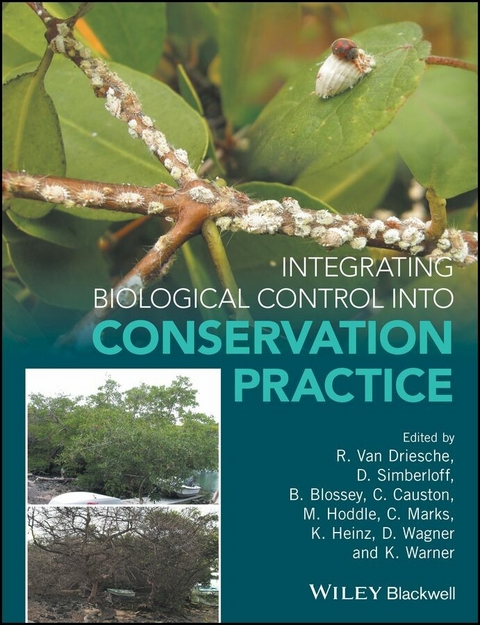
Integrating Biological Control into Conservation Practice (eBook)
356 Seiten
John Wiley & Sons (Verlag)
978-1-118-39257-7 (ISBN)
Invasive species have a critical and growing effect upon natural areas. They can modify, degrade, or destroy wildland ecosystem structure and function, and reduce native biodiversity. Landscape-level solutions are needed to address these problems. Conservation biologists seek to limit such damage and restore ecosystems using a variety of approaches. One such approach is biological control: the deliberate importation and establishment of specialized natural enemies, which can address invasive species problems and which should be considered as a possible component of restoration. Biological control can be an effective tool against many invasive insects and plants but it has rarely been successfully employed against other groups. Safety is of paramount concern and requires that the natural enemies used be specialized and that targeted pests be drivers of ecological degradation. While modern approaches allow species to be selected with a high level of security, some risks do remain. However, as in all species introductions, these should be viewed in the context of the risk of failing to reduce the impact of the invasive species.
This unique book identifies the balance among these factors to show how biological control can be integrated into ecosystem restoration as practiced by conservation biologists. Jointly developed by conservation biologists and biological control scientists, it contains chapters on matching tools to management goals; tools in action; measuring and evaluating ecological outcomes of biological control introductions; managing conflict over biological control; and includes case studies as well as an ethical framework for integrating biological control and conservation practice.
Integrating Biological Control into Conservation Practice is suitable for graduate courses in invasive species management and biological control, as well as for research scientists in government and non-profit conservation organizations.
Roy G. Van Driesche, Department of Environmental Conservation, University of Massachusetts, USA.
Daniel Simberloff, Department of Ecology & Evolutionary Biology, University of Tennessee, USA.
Bernd Blossey, Department of Natural Resources, Cornell University, USA.
Chrlotte Causton, Charles Darwin Foundation, Galapagos Islands.
Mark S. Hoddle, Department of Entomology, University of California, Riverside, USA.
Christian O. Marks, The Nature Conservancy, Connecticut River Program, USA.
Kevin M. Heinz, Department of Entomology, Texas A & M University, USA.
David Wagner, Department of Ecology & Evolutionary Biology, University of Connecticut, USA.
Keith Warner, Center for Science, Technology and Society, Santa Clara University, USA.
Invasive species have a critical and growing effect upon natural areas. They can modify, degrade, or destroy wildland ecosystem structure and function, and reduce native biodiversity. Landscape-level solutions are needed to address these problems. Conservation biologists seek to limit such damage and restore ecosystems using a variety of approaches. One such approach is biological control: the deliberate importation and establishment of specialized natural enemies, which can address invasive species problems and which should be considered as a possible component of restoration. Biological control can be an effective tool against many invasive insects and plants but it has rarely been successfully employed against other groups. Safety is of paramount concern and requires that the natural enemies used be specialized and that targeted pests be drivers of ecological degradation. While modern approaches allow species to be selected with a high level of security, some risks do remain. However, as in all species introductions, these should be viewed in the context of the risk of failing to reduce the impact of the invasive species. This unique book identifies the balance among these factors to show how biological control can be integrated into ecosystem restoration as practiced by conservation biologists. Jointly developed by conservation biologists and biological control scientists, it contains chapters on matching tools to management goals; tools in action; measuring and evaluating ecological outcomes of biological control introductions; managing conflict over biological control; and includes case studies as well as an ethical framework for integrating biological control and conservation practice. Integrating Biological Control into Conservation Practice is suitable for graduate courses in invasive species management and biological control, as well as for research scientists in government and non-profit conservation organizations.
Roy G. Van Driesche, Department of Environmental Conservation, University of Massachusetts, USA. Daniel Simberloff, Department of Ecology & Evolutionary Biology, University of Tennessee, USA. Bernd Blossey, Department of Natural Resources, Cornell University, USA. Chrlotte Causton, Charles Darwin Foundation, Galapagos Islands. Mark S. Hoddle, Department of Entomology, University of California, Riverside, USA. Christian O. Marks, The Nature Conservancy, Connecticut River Program, USA. Kevin M. Heinz, Department of Entomology, Texas A & M University, USA. David Wagner, Department of Ecology & Evolutionary Biology, University of Connecticut, USA. Keith Warner, Center for Science, Technology and Society, Santa Clara University, USA.
List of contributors, vi
Preface, viii
1 Integrating biological control into a conservation context: why is it necessary?, 1
Kevin M. Heinz, Roy G. Van Driesche, and Daniel Simberloff
2 Designing restoration programs based on understanding the drivers of ecological change, 4
Christian O. Marks and Roy G. Van Driesche
3 Matching tools to management goals, 22
Charlotte Causton and Roy G. Van Driesche
4 Tools in action: understanding tradeoffs through case histories, 54
Roy G. Van Driesche, Bernd Blossey, and Daniel Simberloff
5 Benefit-risk assessment of biological control in wildlands, 80
Roy G. Van Driesche and Daniel Simberloff
6 Systematics and biological control, 105
Jeremy C. Andersen and David L. Wagner
7 Forecasting unintended effects of natural enemies used for classical biological control of invasive species, 130
Mark S. Hoddle
8 Measuring and evaluating ecological outcomes of biological control introductions, 161
Bernd Blossey
9 Methods for evaluation of natural enemy impacts on invasive pests of wildlands, 189
Roy G. Van Driesche
10 Cases of biological control restoring natural systems, 208
Roy G. Van Driesche, Paul D. Pratt, Ted D. Center, Min B. Rayamajhi, Phil W. Tipping, Mary Purcell, Simon Fowler, Charlotte Causton, Mark S. Hoddle, Leyla Kaufman, Russell H. Messing, Michael E. Montgomery, Rieks van Klinken, Jian J. Duan, and Jean?-Yves Meyer
11 Societal values expressed through policy and regulations concerning biological control releases, 247
Andy W. Sheppard and Keith D. Warner
12 Managing conflict over biological control: the case of strawberry guava in Hawaii, 264
M. Tracy Johnson
13 An ethical framework for integrating biological control into conservation practice, 277
Keith D. Warner
14 Economics of biological control for species invading wildlands, 294
Roy G. Van Driesche and Kevin M. Heinz
15 The future of biological control: a proposal for fundamental reform, 314
Bernd Blossey
Concluding thoughts on future actions, 329
Roy G. Van Driesche, Daniel Simberloff, and David L. Wagner
Index, 330
| Erscheint lt. Verlag | 17.5.2016 |
|---|---|
| Sprache | englisch |
| Themenwelt | Naturwissenschaften ► Biologie ► Ökologie / Naturschutz |
| Naturwissenschaften ► Geowissenschaften ► Geologie | |
| Technik | |
| Weitere Fachgebiete ► Land- / Forstwirtschaft / Fischerei | |
| Schlagworte | Agriculture • Biological Control • Biowissenschaften • Conservation Science • Entomologie • Entomology • Integration into Conservation • Invasive species • Landwirtschaft • Life Sciences • natural ecosystems • Natural enemies • Naturschutzbiologie • Non-target risk • Pests, Diseases & Weeds • Pests of Wildlands • Reform • restoration • Schädlinge, Krankheiten u. Unkräuter • Schädlinge, Krankheiten u. Unkräuter |
| ISBN-10 | 1-118-39257-4 / 1118392574 |
| ISBN-13 | 978-1-118-39257-7 / 9781118392577 |
| Informationen gemäß Produktsicherheitsverordnung (GPSR) | |
| Haben Sie eine Frage zum Produkt? |
 PDF (Adobe DRM)
Kopierschutz: Adobe-DRM
Adobe-DRM ist ein Kopierschutz, der das eBook vor Mißbrauch schützen soll. Dabei wird das eBook bereits beim Download auf Ihre persönliche Adobe-ID autorisiert. Lesen können Sie das eBook dann nur auf den Geräten, welche ebenfalls auf Ihre Adobe-ID registriert sind.
Details zum Adobe-DRM
Dateiformat: PDF (Portable Document Format)
Mit einem festen Seitenlayout eignet sich die PDF besonders für Fachbücher mit Spalten, Tabellen und Abbildungen. Eine PDF kann auf fast allen Geräten angezeigt werden, ist aber für kleine Displays (Smartphone, eReader) nur eingeschränkt geeignet.
Systemvoraussetzungen:
PC/Mac: Mit einem PC oder Mac können Sie dieses eBook lesen. Sie benötigen eine
eReader: Dieses eBook kann mit (fast) allen eBook-Readern gelesen werden. Mit dem amazon-Kindle ist es aber nicht kompatibel.
Smartphone/Tablet: Egal ob Apple oder Android, dieses eBook können Sie lesen. Sie benötigen eine
Geräteliste und zusätzliche Hinweise
Buying eBooks from abroad
For tax law reasons we can sell eBooks just within Germany and Switzerland. Regrettably we cannot fulfill eBook-orders from other countries.
aus dem Bereich