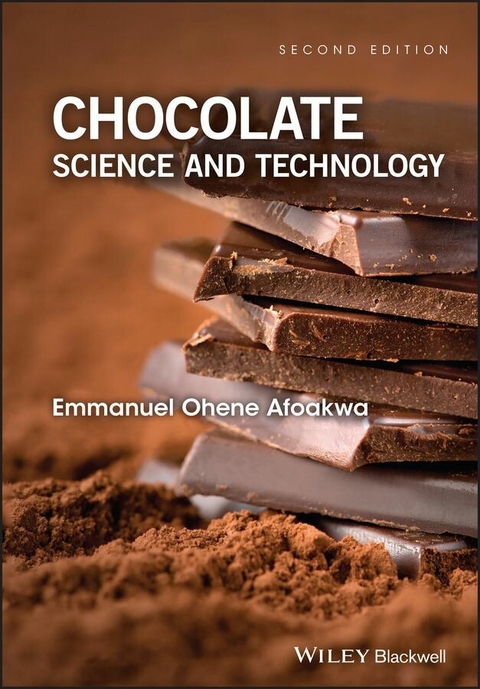
Chocolate Science and Technology (eBook)
John Wiley & Sons (Verlag)
978-1-118-91377-2 (ISBN)
This second edition provides information on recent advances in the science and technology of chocolate manufacture and the entire international cocoa industry. It provides detailed review on a wide range of topics including cocoa production, cocoa and chocolate manufacturing operations, sensory perception of chocolate quality, flavour release and perception, sugar replacement and alternative sweetening solutions in chocolate production, industrial manufacture of sugar-free chocolates as well as the nutrition and health benefits of cocoa and chocolate consumption.
The topics cover modern cocoa cultivation and production practices with special attention on cocoa bean composition, genotypic variations in the bean, post-harvest pre-treatments, fermentation and drying processes, and the biochemical basis of these operations. The scientific principles behind industrial chocolate manufacture are outlined with detailed explanations of the various stages of chocolate manufacturing including mixing, refining, conching and tempering. Other topics covered include the chemistry of flavour formation and development during cocoa processing and chocolate manufacture; volatile flavour compounds and their characteristics and identification; sensory descriptions and character; and flavour release and perception in chocolate. The nutritional and health benefits of cocoa and chocolate consumption as well as the application of HACCP and other food safety management systems such as ISO 22,000 in the chocolate processing industry are also addressed. Additionally, detailed research on the influence of different raw materials and processing operations on the flavour and other quality characteristics of chocolates have been provided with scope for process optimization and improvement.
The book is intended to be a desk reference for all those engaged in the business of making and using chocolate worldwide; confectionery and chocolate scientists in industry and academia; students and practising food scientists and technologists; nutritionists and other health professionals; and libraries of institutions where agriculture, food science and nutrition is studied and researched.
Emmanuel Ohene Afoakwa, Department of Nutrition and Food Science, University of Ghana, Ghana.
Formerly of Nestlé Product Technology Centre, York, UK.
CHOCOLATE SCIENCE AND TECHNOLOGY This second edition provides information on recent advances in the science and technology of chocolate manufacture and the entire international cocoa industry. It provides detailed reviews of a wide range of topics, including cocoa production, cocoa and chocolate manufacturing operations, sensory perception of chocolate quality, flavour release and perception, sugar replacement and alternative sweetening solutions in chocolate production, industrial manufacture of sugar-free chocolates and the nutrition and health benefits of cocoa and chocolate consumption. The topics cover modern cocoa cultivation and production practices with special attention to cocoa bean composition, genotypic variations in the bean, post-harvest pretreatments, fermentation and drying processes and the biochemical basis of these operations. The scientific principles behind industrial chocolate manufacture are outlined, with detailed explanations of the various stages of chocolate manufacturing, including mixing, refining, conching and tempering. Other topics covered include the chemistry of flavour formation and development during cocoa processing and chocolate manufacture; volatile flavour compounds and their characteristics and identification; sensory descriptions and character; and flavour release and perception in chocolate. The nutritional and health benefits of cocoa and chocolate consumption and the application of HACCP and other food safety management systems such as ISO 22000 in the chocolate processing industry are also addressed. Additionally, detailed research on the influence of different raw materials and processing operations on the flavour and other quality characteristics of chocolates have been provided, with scope for process optimization and improvement. The book is intended to be a desk reference for all those engaged in the business of making and using chocolate worldwide; confectionery and chocolate scientists in industry and academia; students and practising food scientists and technologists; nutritionists and other health professionals; and libraries of institutions where agriculture, food science and nutrition are studied and researched.
The Author Emmanuel Ohene Afoakwa, Department of Nutrition and Food Science, University of Ghana, Ghana Formerly of Nestlé Product Technology Centre, York, UK
Chapter 1
History, origin and taxonomy of cocoa
1.1 Introduction
Chocolate is derived from the cocoa bean, which is obtained from the fruit of the cocoa tree, Theobroma cacao (Linnaeus). The term ‘Cocoa’ is a corruption of the word ‘Cacao’ that is taken directly from Mayan and Aztec languages. It is indigenous to Central and South America and believed to have originated from the Amazon and Orinoco valleys. Cocoa (Theobroma cacao L.) is one of the most important agricultural export commodities in the world and forms the backbone of the economies of some countries in West Africa, South America and South-East Asia. It is the leading foreign exchange earner and a great source of income for many families in most of the world's developing countries. In Ghana, cocoa is the second highest foreign exchange earner and an estimated 1 million farmers and their families depend on it for their livelihood (Afoakwa, 2014).
Currently, in 2016, cocoa is cultivated on an estimated land size of 8 million hectares in the tropics and secures the livelihoods of about 50 million people globally. More than 8 million of them are mainly smallholder farmers with an average farm size of just 3–4 hectares and an average family size of eight. Of these, some 1.5 million are within West Africa, the most important cocoa-growing region. Such families frequently live exclusively on cocoa farming and processing and are thus dependent mainly on cocoa for their livelihoods. Hence the economic importance of cocoa cannot be over-emphasized and the current global market value of annual cocoa crop is over $8.1 billion (World Cocoa Foundation, 2014).
Cocoa continues to be an important source of export earnings for many producing countries, particularly in Africa, Latin America and South-East Asia. Africa's heavy dependence on cocoa and also on other primary commodities as a source of export earnings has been vulnerable to market developments, in particular price volatility and weather conditions. However, in some circumstances, real exchange rates, domestic marketing arrangements and government intervention have acted to buffer price movements for cocoa producers. Cocoa was the second source of export earnings in Ghana in 2014, after gold, generating US$2.0 billion.
The African region accounts for approximately 72.3% of net world exports of cocoa and is by far the largest supplier of cocoa to world markets, followed by the Americas (16.7%) and then Asia and Oceania (11.0%), and the cocoa market remains highly concentrated, with the top five countries accounting for 87% of world net exports, and over 98% originated from the top 10 countries during the 5-year period 2010–2015. Côte d'Ivoire (Ivory Coast) is the world's leading exporter of cocoa, representing 40.6% of global net exports, followed by Ghana (19.2%) and Indonesia (8.9%) (ICCO, 2015a). Interestingly, there has been continuing repositioning of some countries, which in recent years have shown tremendous interest in advancing their cocoa production. In 2014, Ecuador exported ∼230 000 tonnes of cocoa, which positioned it as the fifth largest producer of cocoa in the world, displacing Cameroon and Brazil to sixth and seventh positions, respectively, and surpassed only by Nigeria, Indonesia, Ghana and Côte d'Ivoire. This means that Ecuador has advanced its position in the global market for the second consecutive year, having overtaken Brazil, one of the leading producers in Latin America, in 2013 (Ricky and Moncayo, 2015). With increased processing at origin, cocoa products now represent a slightly higher proportion of total cocoa exports in most cocoa-producing countries (ICCO, 2015a).
1.2 History of cocoa
Cocoa (Theobroma cacao L.) is a native species of tropical humid forests on the lower eastern equatorial slopes of the Andes in South America. Allen (1987) reported the centre of genetic diversity of T. cacao to be the Amazon Basin region of South America and all 37 collecting expeditions listed by End et al. (1990) seeking germplasm of wild cacao were to the Amazon Basin region. The word cacao is derived from the Olmec and the subsequent Mayan languages (Kakaw) and the chocolate-related term cacahuatl is Nahuatl (Aztec language) derived from Olmec/Mayan etymology (Dillinger et al., 2000). Cocoa was considered divine in origin and, in 1737, the Swedish botanist Carolus Linnaeus (Carl von Linné) named the cocoa tree Theobroma cacao, now its official botanical name, from the Greek word ‘ambrosia’, which refers to the mythical background of the tree, literally meaning ‘cocoa, food of the gods’ (Alvim, 1984; Barry Callebaut, 2008). Based on archaeological information, Purdy and Schmidt (1996) reported that the Mayans cultivated cocoa 2000–4000 years before Spanish contact. It is recorded that cocoa was domesticated and consumed for the first time by the Maya and Aztecs. The Maya, Olmec, Toltec and Aztecs used the beans of cocoa both as currency and as the base for a bitter drink (Purdy and Schmidt, 1996; Nair, 2010; ICE Futures U.S., 2011).
The name ‘cocoa’ is a corruption of the word cacao, which originated from the Amazons in South America. Its cultivation and value spread in ancient times throughout central and eastern Amazonia and northwards to Central America (Afoakwa, 2010). Cocoa was first cultivated by the Aztecs in Mexico, South America, and spread throughout the Caribbean islands. Later, in the 1520s, Hernandos Cortés, a Spaniard, took cocoa to Spain as a beverage and to Spanish Guinea as a crop. The Spanish not only took cocoa to Europe, but also introduced the crop into Fernando Po in the seventeenth century and thus laid the foundation of the future economies of many West African countries. Currently, West Africa produces ∼73% of world cocoa (ICCO, 2015).
The use of cocoa beans dates back at least 1400 years (Rössner, 1997), when Aztecs and Incas used the beans as currency for trading or to produce the so-called chocolatl, a drink made by roasting and grinding cocoa nibs, mashing with water, often adding other ingredients such as vanilla, spices or honey. In the 1520s, the drink was introduced to Spain (Minifie, 1989), although Coe and Coe (1996) emphasized that the Europeans arrivals in the New World, including Christopher Columbus and Herman Cortes, were unimpressed with the Mayan beverage, sweetening it with honey. Nevertheless, conquistadors familiarized the chocolate beverage throughout Europe and, being expensive, it was initially reserved for consumption by the highest social classes, and only in the seventeenth century did consumption of chocolate spread through Europe. After the conquest of Central America in 1521, Hernan Cortez and his conquistadors took a small cargo of cocoa beans to Spain in 1528, together with utensils for making the chocolate drink. By 1580 the drink had been popularized in the country and consignments of cocoa were regularly shipped to Spain. The popularity of chocolate as a drink spread quickly throughout Europe, reaching Italy in 1606, France in 1615, Germany in 1641 and Great Britain in 1657 (Fowler, 2009; Afoakwa, 2010).
Large-scale cultivation of cocoa was started by the Spanish in the sixteenth century in Central America. It spread to the British, French and Dutch West Indies (Jamaica, Martinique and Surinarn) in the seventeenth century and to Brazil in the eighteenth century. From Brazil it was taken to Sao Tome and Fernando Po (now part of Equatorial Guinea) in 1840; and from there to other parts of West Africa, notably the Gold Coast (now Ghana), Nigeria and Côte d'Ivoire. The cultivation of cocoa later spread to the Caribbean islands, Asia and Africa. It is currently grown in a number of Pacific islands, including Papua New Guinea, Fiji, Solomon Islands, Samoa and Hawaii (Hebbar et al., 2011). In Ghana, available records indicate that the Dutch missionaries planted cocoa in the coastal areas of the then Gold Coast as early as 1815, and in 1857 Basel missionaries also planted cocoa at Aburi (Jonfia-Essien, 2004). However, these did not result in the spread of cocoa cultivation until Tetteh Quarshie, a native of Osu, Accra, who had travelled to Fernando Po and worked there as a blacksmith, returned in 1879 with Amelonado cocoa pods and established a farm at Akwapim Mampong in the Eastern Region. Farmers bought pods from his farm to plant and cultivation spread from the Akwapim area to other parts of the Eastern Region (Jonfia-Essien, 2004). In 1886, Sir William Bradford Griffith, the Governor, also arranged for cocoa pods to be brought in from Sao Tome, from which seedlings were raised at Aburi Botanical Gardens and distributed to farmers. In recognition of the contribution of cocoa to the development of Ghana, the government in 1947 established the Ghana Cocoa Board (COCOBOD) as the main government agency responsible for the development of the industry. Currently, there are six cocoa-growing regions in Ghana, namely the Ashanti, Brong Ahafo, Eastern, Volta, Central and Western regions. Ghana is the world's second largest producer of cocoa beans, producing approximately 17% of the world's cocoa (ICCO, 2015).
As the consumption of chocolate became more and more widespread during the eighteenth century, the Spanish monopoly on the production of cocoa became untenable and plantations were soon established by the Italians, Dutch and Portuguese. At this point, chocolate was still consumed in liquid form and was mainly sold as pressed blocks of a grainy mass to be dissolved in water or milk to form a foamy chocolate drink. The...
| Erscheint lt. Verlag | 5.5.2016 |
|---|---|
| Sprache | englisch |
| Themenwelt | Naturwissenschaften ► Biologie |
| Technik ► Lebensmitteltechnologie | |
| Weitere Fachgebiete ► Land- / Forstwirtschaft / Fischerei | |
| Schlagworte | Agriculture • Biotechnologie i. d. Chemie • Biotechnology • Chemie • Chemistry • Chocolate • CoCoA • Confectionery • Food Processing, Production & Manufacture • food science • Food Science & Technology • Functional Foods • HACCP • Health • Herstellung u. Verarbeitung von Lebensmitteln • ingredients • Lebensmittelforschung u. -technologie • Nutrition • sugar-free • Zusatzstoffe |
| ISBN-10 | 1-118-91377-9 / 1118913779 |
| ISBN-13 | 978-1-118-91377-2 / 9781118913772 |
| Informationen gemäß Produktsicherheitsverordnung (GPSR) | |
| Haben Sie eine Frage zum Produkt? |
 EPUB (Adobe DRM)
Kopierschutz: Adobe-DRM
Adobe-DRM ist ein Kopierschutz, der das eBook vor Mißbrauch schützen soll. Dabei wird das eBook bereits beim Download auf Ihre persönliche Adobe-ID autorisiert. Lesen können Sie das eBook dann nur auf den Geräten, welche ebenfalls auf Ihre Adobe-ID registriert sind.
Details zum Adobe-DRM
Dateiformat: EPUB (Electronic Publication)
EPUB ist ein offener Standard für eBooks und eignet sich besonders zur Darstellung von Belletristik und Sachbüchern. Der Fließtext wird dynamisch an die Display- und Schriftgröße angepasst. Auch für mobile Lesegeräte ist EPUB daher gut geeignet.
Systemvoraussetzungen:
PC/Mac: Mit einem PC oder Mac können Sie dieses eBook lesen. Sie benötigen eine
eReader: Dieses eBook kann mit (fast) allen eBook-Readern gelesen werden. Mit dem amazon-Kindle ist es aber nicht kompatibel.
Smartphone/Tablet: Egal ob Apple oder Android, dieses eBook können Sie lesen. Sie benötigen eine
Geräteliste und zusätzliche Hinweise
Buying eBooks from abroad
For tax law reasons we can sell eBooks just within Germany and Switzerland. Regrettably we cannot fulfill eBook-orders from other countries.
aus dem Bereich