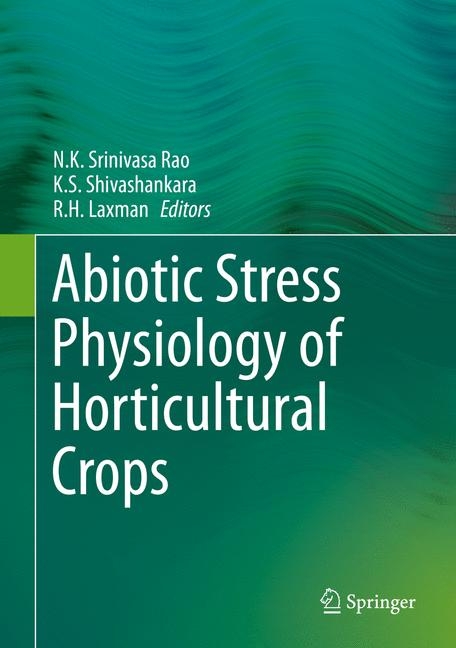
Abiotic Stress Physiology of Horticultural Crops (eBook)
XIV, 368 Seiten
Springer-Verlag
978-81-322-2725-0 (ISBN)
Dr. N. K. Srinivasa Rao, Principal Scientist (Plant Physiology-Retd.) and Ex Emeritus Scientist, Indian Institute of Horticultural Research, Bangalore, was born on 31.01.1950 at Bangalore. He belongs to the first batch of Agricultural Research Service. He has passed ARS examination with first rank and the joined ICAR service on 29.11.1976 at IIHR, Bangalore in the discipline of Plant Physiology. He has contributed significantly to the understanding of mechanism of abiotic stress tolerance in horticultural crops. Some of his publications are:1.Srinivasa Rao, N.K. and Bhatt, R.M. (1990) Response of photosynthesis to Water stress in two eggplant Cultivars (Solanum melongena L.) Photosynthetica, 24: 2. Srinivasa Rao, N.K. and Bhatt,R.M.(1990). Effect of two temperature regimes on photosynthesis and growth in two cultivars of tomato (Lycopersicon esculentum Mill.). Photosynthetica 26: 625-63 Dr. Kodthalu Seetharamaiah Shivashankara is currently working as principal scientist in Indian Institute of Horticultural Research, Bangalore. Some of his publications are: 1) Sheshshayee, M.S., Shivashankara, K.S., Ramaswamy, G.S., Davendra, R., Shankar, A.G., Prasad, T.G., Udaya Kumar, M.,1991. A new method to generate different CO2 concentrations to develop CO2 response curves. Curr. Sci., 62: 538‑540. 2) Shivashankara, K.S., Mithila,J and Maiti, S., 2000. A new method for vegetative multiplication of betelvine. J. Plantation Crops. 28(2): 94-98 Dr. Laxman Ramanna Hunashikatti is currently working as principal scientist in ICAR-Indian Institute of Horticultural Research, Bengaluru.
Part 1. Mechanisms of Abiotic Stress Tolerance Responses.- 1. Physiological and Morphological Responses of Horticultural Crops to Abiotic Stresses.- 2.Role of Plant Hormones in Abiotic Stress Tolerance Responses.- 3. Role of Antioxidants in Abiotic Stress Tolerance Responses.- 4. Molecular Mechanisms of Thermotolerance.- 5. Mechanisms of Heavy Metal Toxicity in Plants.- 6. Seed Priming for Abiotic Stress Tolerance: An Overview.- Part 2. Abiotic Stress Tolerance in Horticultural Crops: Vegetables.- 7. Tomato.- 8. Onion.- 9. Capsicum (Hot Pepper and Bell Pepper).- Part 3. Abiotic Stress tolerance in Horticultural Crops: Fruit Crops.- 10. Mango.- 11. Grapes.- 12. Banana.- 13. Arid Zone Fruit Crops.- 14. Litchi.- Part 4. Abiotic Stress Tolerance in Horticultural Crops: Plantation and Tuber crops.- 15. Coconut and Arecanut.- 16. Cashew and Cocoa.- 17. Water Stress Induced Changes in Black Pepper.- 18. Oil Palm.- 19. Tuber Crops.
| Erscheint lt. Verlag | 8.4.2016 |
|---|---|
| Zusatzinfo | XIV, 368 p. 65 illus., 41 illus. in color. |
| Verlagsort | New Delhi |
| Sprache | englisch |
| Themenwelt | Naturwissenschaften ► Biologie ► Botanik |
| Naturwissenschaften ► Biologie ► Ökologie / Naturschutz | |
| Technik | |
| Weitere Fachgebiete ► Land- / Forstwirtschaft / Fischerei | |
| Schlagworte | Abiotic stress tolerance • Climate change impacts • heavy metal pollution • Horticultural Crops • Tolerance Mechanism and Stress Physiology • Water Policy • Water Use Efficiency and Thermotolerance |
| ISBN-10 | 81-322-2725-5 / 8132227255 |
| ISBN-13 | 978-81-322-2725-0 / 9788132227250 |
| Informationen gemäß Produktsicherheitsverordnung (GPSR) | |
| Haben Sie eine Frage zum Produkt? |
 PDF (Wasserzeichen)
Größe: 8,9 MB
DRM: Digitales Wasserzeichen
Dieses eBook enthält ein digitales Wasserzeichen und ist damit für Sie personalisiert. Bei einer missbräuchlichen Weitergabe des eBooks an Dritte ist eine Rückverfolgung an die Quelle möglich.
Dateiformat: PDF (Portable Document Format)
Mit einem festen Seitenlayout eignet sich die PDF besonders für Fachbücher mit Spalten, Tabellen und Abbildungen. Eine PDF kann auf fast allen Geräten angezeigt werden, ist aber für kleine Displays (Smartphone, eReader) nur eingeschränkt geeignet.
Systemvoraussetzungen:
PC/Mac: Mit einem PC oder Mac können Sie dieses eBook lesen. Sie benötigen dafür einen PDF-Viewer - z.B. den Adobe Reader oder Adobe Digital Editions.
eReader: Dieses eBook kann mit (fast) allen eBook-Readern gelesen werden. Mit dem amazon-Kindle ist es aber nicht kompatibel.
Smartphone/Tablet: Egal ob Apple oder Android, dieses eBook können Sie lesen. Sie benötigen dafür einen PDF-Viewer - z.B. die kostenlose Adobe Digital Editions-App.
Zusätzliches Feature: Online Lesen
Dieses eBook können Sie zusätzlich zum Download auch online im Webbrowser lesen.
Buying eBooks from abroad
For tax law reasons we can sell eBooks just within Germany and Switzerland. Regrettably we cannot fulfill eBook-orders from other countries.
aus dem Bereich