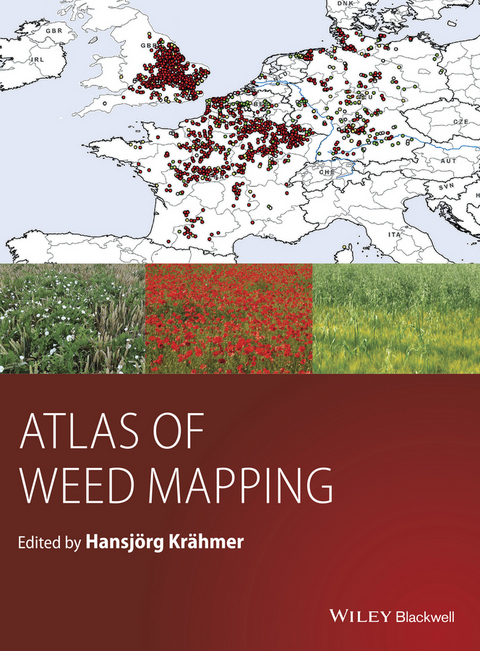
Atlas of Weed Mapping (eBook)
John Wiley & Sons (Verlag)
978-1-118-72072-1 (ISBN)
Weeds are variously defined as plants growing where they are not wanted, plants that interfere with human activity. Weeds affect everyone in the world by reducing crop yield and quality, delaying or interfering with harvesting, interfering with animal feeding, reducing animal health, preventing water flow, as plant parasites, etc. It is estimated that those problems cause $ billions worth of crop losses annually and the global cost of controlling weeds also runs into many $ billions every year.
Atlas of Weed Mapping presents an introductory overview on the occurrence of the most common weeds of the world. The book notably includes:
- Description of cropping practices and explanations for the global distribution of weeds
- Invasive plant mapping
- Aquatics and wetland plants with histological plant details
- Theoretical and practical aspects of weed mapping
- Aspects on the documentation of herbicide resistance
- Biodiversity, rare weeds and the dominance of the most common weeds
Fully illustrated with more than 800 coloured figures and a number of tables, this new characterisation of anthropogenic vegetation will be interesting for readers of a great number of disciplines such as agriculture, botany, ecology, geobotany and plant community research. More than a hundred experts have contributed data to this unique compilation.
Weeds are variously defined as plants growing where they are not wanted, plants that interfere with human activity. Weeds affect everyone in the world by reducing crop yield and quality, delaying or interfering with harvesting, interfering with animal feeding, reducing animal health, preventing water flow, as plant parasites, etc. It is estimated that those problems cause $ billions worth of crop losses annually and the global cost of controlling weeds also runs into many $ billions every year. Atlas of Weed Mapping presents an introductory overview on the occurrence of the most common weeds of the world. The book notably includes: Description of cropping practices and explanations for the global distribution of weeds Invasive plant mapping Aquatics and wetland plants with histological plant details Theoretical and practical aspects of weed mapping Aspects on the documentation of herbicide resistance Biodiversity, rare weeds and the dominance of the most common weeds Fully illustrated with more than 800 coloured figures and a number of tables, this new characterisation of anthropogenic vegetation will be interesting for readers of a great number of disciplines such as agriculture, botany, ecology, geobotany and plant community research. More than a hundred experts have contributed data to this unique compilation.
Hansjoerg Kraehmer, now retired, was President of the European Weed Research Society between 2010 and 2012. He was also Head of Herbicide Profiling and Support, at Bayer Crop Science in Frankfurt, Germany.
Introduction
Hansjörg Krähmer
Bayer CropScience, AG, Frankfurt, Germany
What would the world be, once bereft Of wet and of wildness? Let them be left, O let them be left, wildness and wet, Long live the weeds and the wilderness yet.Gerald Manley Hopkins, Inversnaid, 1883
Weeds are plants interfering with man's interest (Krähmer and Baur, 2013). On arable fields, they compete with crops and reduce yields, some of them are toxic, some cause problems for harvesting, others have a negative impact on crop quality. Weed control is therefore a considerable economic factor in modern agriculture. Almost $US17 billion were spent in 2010 on herbicides worldwide (Markets and Markets, Dallas, Sept. 26, 2011; Wallstreet Online). At the same time, weeds are indicators of ecological changes and of changes in farming practices. Global trade is leading to a worldwide distribution of species which adapt to a wide range of environmental conditions. The Atlas of Weed Mapping provides an overview of the most common weeds affecting the major crops in the world. Holm et al. (1977) entitle their book, The World's Worst Weeds: An Inventory of the Principal Weeds of the World's Major Crops. It shows the worldwide distribution of many weeds in different habitats. In Holzner and Numata's Biology and Ecology of Weeds (1982), various authors describe the occurrence of frequent weeds in selected parts of the world. Also, the factors are analysed that contribute to the competition of weeds and crops in this compilation. Agriculture has changed considerably in many parts of the world in the past 30 years and so has the weed flora. Genetically modified crops are now grown on more than 100 million hectares worldwide (Krähmer & Stübler 2012). A considerable acreage is used for the production of energy crops, especially for fuel. In some countries, however, the weed spectrum of arable fields has remained almost constant despite changed weed control measures. We will try to explain here why changes have happened in some countries and why the weed spectrum has remained almost constant in others. This is nothing new; others have explained changes in weed infestation before (e.g. Hanf 1999). Our weed mapping atlas, however, adopts a context approach, that has not been attempted previously.
I was encouraged to prepare such an atlas several years ago by Karl Hurle from the University of Hohenheim, by Helmut Walter, BASF, and by Martin Schulte, Syngenta, before I became President of the EWRS (European Weed Research Society). I could not believe that it would be possible to compile the enormous amount of data required for such an enterprise. Very soon, however, I found out that many countries of the world have a long tradition of weed surveys, such as Canada (e.g. Leeson et al. 2005), Hungary (e.g. Novák et al. 2009) or Finland (e.g. Salonen & Hyvönen 2011). Soon a few colleagues interested in weed mapping issues had started to exchange their ideas.
Together with around 30 scientists, the EWRS Weed Mapping Working Group was founded in 2009. One of the tasks of this working group is the preparation of European and global weed maps. More than a hundred colleagues from all over the world have joined the group in the meantime. Regional coordinators ensure that data can be collected for different crops. Presentations and abstracts of meeting contributions can be found at http://www.ewrs.org/weedmapping/default.asp. Our first results have been summarized in Krähmer and Barberi (2016).
The approach to our objective is new insofar as we do not rely on species distribution ranges in the first instance. To make it clear from the beginning, we will not be able to achieve anything that is comparable or comes even close to some of the outstanding maps produced by several teams of ecologists in the last century, for example, by Meusel et al. (1965, 1978; Meusel & Jäger 1992) . We have a different aim as we do not want to produce new distribution maps. We want to rank weeds according to frequency and we want to show where the most frequent weeds occur in major crops. This is an approach which has been criticized by phytocoenologists, for instance, by Whittaker (1962). He made it clear that a view driven by dominant species cannot be used for the creation of a system that describes plant communities. Our atlas, however, is not devoted to phytosociological aspects in the first instance. We want to demonstrate where dominant plant species are preventing biodiversity and where farmers or landscape managers are being forced to invest in tools to safeguard food production or ecosystems. Unfortunately, weed survey data are not available for all European countries for the same years. The first EWRS maps are the result of data for a time span of about 20 years, i.e. from 1990 to 2010. Some literature used for the European maps can be found at: www.ewrs.org/weedmapping/docs/EWRS_Weed_Mapping_Report-1.pdf and www.ewrs.org/weedmapping/weed-mapping_references.asp#.
The ways of ranking weeds according to frequency vary considerably. The most common weed is not necessarily related to weed density, i.e. the number of weeds per m2. Often it has to do with the constant appearance of weeds in surveyed plots. Greig-Smith (1984) discusses the relationship between frequency and density and makes it clear that weed patterns are important when describing this relationship. Chapter 42 in our atlas will discuss assessment methodology and terms such as frequency and density in more detail. Most weed surveys are restricted to some countries or states. The compilation of data from different national or regional surveys often results in artificial maps that create the impression that weeds respect national borders. It is much more appropriate to use ecological zones instead of political borders for the visualization of environmental factors influencing the occurrence of weeds. This approach was chosen by Leeson et al. (2005) for the Canadian Prairies. Most data available outside Canada are, however, the result of national surveys. Also, more detailed or precise overviews of the real situation are dependent on the degree of fine mapping. The information in the maps presented here resembles the political situation in a country. Many countries are run by representatives of one or two major parties but the voting situation in single counties or provinces may, however, vary considerably. This means, we show here only the large-scale trends and hope that future surveys and methods will allow us to get ever improving maps with more and more local details. One valuable source confirming our results here and on the above-mentioned EWRS website is http://grassworld.myspecies.info/content/distribution-0.
A number of distribution maps for invasive species can be found on the internet as described by Krähmer and Barberi (2016). The quality of information that led to our own maps varies considerably. We could rely on elaborate documentation in many cases. A great amount of data is, however, restricted to distinct areas within a state, province or district. Some publications just make qualitative statements about the frequency of weeds. The extrapolation to a whole region remains risky from a scientific point of view. The application of kriging tools should make such extrapolations sounder in the future. Often, we even came to our conclusions based on the opinion of local experts only. Therefore, many maps shown here will have to be improved by detailed studies in future. They present a first approach towards an update of the maps produced by Holm et al. in 1977.
As described above, it is obvious that weed spectra have changed greatly since the publication of The World's Worst Weeds (Holm et al. 1977). Blackgrass or Alopecurus myosuroides and silky bentgrass or Apera spica-venti, for example, are mentioned as being ‘a principal weed of wheat in one or more countries of northern Europe’ in 1977. Holm et al. in World Weeds: Natural Histories and Distribution (1997) already list Alopecurus myosuroides as ‘one of the most serious grass weeds in cereal fields of western Europe’. Today, both weed species are dominating large areas of several arable crops. The continuous application of herbicides with the same mode of action has led to resistant biotypes which have replaced other species in many parts of the world.
Some plant protection experts are trying to map pests or diseases (e.g. Savary et al. 2012) in order to make epidemiological predictions in the same way we do here. Grassland weeds and aquatic weeds differ to some extent from weeds in arable crops. Therefore, separate chapters handle these habitats separately.
The book Weed Anatomy by Krähmer and Baur (2013) is devoted almost only to terrestrial weeds. This is why the anatomy of aquatics deserves special attention in Part X on aquatic weeds here.
Biodiversity is a central issue in agricultural policy today. Landscape aesthetics (Fig. I.1) and conservation have become important factors for recreation areas and tourism centres. Production efficiency is no longer the only factor contributing to the profit of farmers globally. Subsidies are essential income sources for farmers around the world. They are usually connected to sustainability, biodiversity and cross-compliance measures. We will stress the role of aesthetics in agriculture, of rare weed species and of biodiversity in several chapters. One may ask if all the structural features in plants are the result of a meaningful evolution from our perspective, and if natural selection without human interference...
| Erscheint lt. Verlag | 31.3.2016 |
|---|---|
| Sprache | englisch |
| Themenwelt | Naturwissenschaften ► Biologie ► Botanik |
| Technik | |
| Weitere Fachgebiete ► Land- / Forstwirtschaft / Fischerei | |
| Schlagworte | Agriculture • Ãkologie • Ãkologie / Pflanzen • Aquatic Weeds • biodiversity • Biowissenschaften • Botanik • Botanik / Physiologie • crop management • Invasive plants • Landwirtschaft • Life Sciences • Ökologie • Ökologie / Pflanzen • Pests, Diseases & Weeds • Plant associations • plant ecology • Plant Physiology • Rare weeds • Schädlinge, Krankheiten u. Unkräuter • Schädlinge, Krankheiten u. Unkräuter • Unkraut • Vegetation Mapping • Weed dominance • Weed habitat • weeds |
| ISBN-10 | 1-118-72072-5 / 1118720725 |
| ISBN-13 | 978-1-118-72072-1 / 9781118720721 |
| Informationen gemäß Produktsicherheitsverordnung (GPSR) | |
| Haben Sie eine Frage zum Produkt? |
 EPUB (Adobe DRM)
Kopierschutz: Adobe-DRM
Adobe-DRM ist ein Kopierschutz, der das eBook vor Mißbrauch schützen soll. Dabei wird das eBook bereits beim Download auf Ihre persönliche Adobe-ID autorisiert. Lesen können Sie das eBook dann nur auf den Geräten, welche ebenfalls auf Ihre Adobe-ID registriert sind.
Details zum Adobe-DRM
Dateiformat: EPUB (Electronic Publication)
EPUB ist ein offener Standard für eBooks und eignet sich besonders zur Darstellung von Belletristik und Sachbüchern. Der Fließtext wird dynamisch an die Display- und Schriftgröße angepasst. Auch für mobile Lesegeräte ist EPUB daher gut geeignet.
Systemvoraussetzungen:
PC/Mac: Mit einem PC oder Mac können Sie dieses eBook lesen. Sie benötigen eine
eReader: Dieses eBook kann mit (fast) allen eBook-Readern gelesen werden. Mit dem amazon-Kindle ist es aber nicht kompatibel.
Smartphone/Tablet: Egal ob Apple oder Android, dieses eBook können Sie lesen. Sie benötigen eine
Geräteliste und zusätzliche Hinweise
Buying eBooks from abroad
For tax law reasons we can sell eBooks just within Germany and Switzerland. Regrettably we cannot fulfill eBook-orders from other countries.
aus dem Bereich