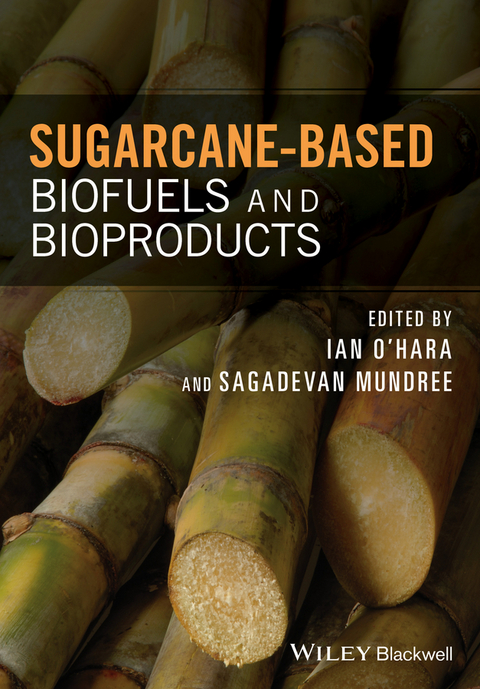
Sugarcane-based Biofuels and Bioproducts (eBook)
John Wiley & Sons (Verlag)
978-1-118-71992-3 (ISBN)
Sugarcane has garnered much interest for its potential as a viable renewable energy crop. While the use of sugar juice for ethanol production has been in practice for years, a new focus on using the fibrous co-product known as bagasse for producing renewable fuels and bio-based chemicals is growing in interest. The success of these efforts, and the development of new varieties of energy canes, could greatly increase the use of sugarcane and sugarcane biomass for fuels while enhancing industry sustainability and competitiveness.
Sugarcane-Based Biofuels and Bioproducts examines the development of a suite of established and developing biofuels and other renewable products derived from sugarcane and sugarcane-based co-products, such as bagasse. Chapters provide broad-ranging coverage of sugarcane biology, biotechnological advances, and breakthroughs in production and processing techniques.
This text brings together essential information regarding the development and utilization of new fuels and bioproducts derived from sugarcane. Authored by experts in the field, Sugarcane-Based Biofuels and Bioproducts is an invaluable resource for researchers studying biofuels, sugarcane, and plant biotechnology as well as sugar and biofuels industry personnel.Sugarcane has garnered much interest for its potential as a viable renewable energy crop. While the use of sugar juice for ethanol production has been in practice for years, a new focus on using the fibrous co-product known as bagasse for producing renewable fuels and bio-based chemicals is growing in interest. The success of these efforts, and the development of new varieties of energy canes, could greatly increase the use of sugarcane and sugarcane biomass for fuels while enhancing industry sustainability and competitiveness. Sugarcane-Based Biofuels and Bioproducts examines the development of a suite of established and developing biofuels and other renewable products derived from sugarcane and sugarcane-based co-products, such as bagasse. Chapters provide broad-ranging coverage of sugarcane biology, biotechnological advances, and breakthroughs in production and processing techniques. This text brings together essential information regarding the development and utilization of new fuels and bioproducts derived from sugarcane. Authored by experts in the field, Sugarcane-Based Biofuels and Bioproducts is an invaluable resource for researchers studying biofuels, sugarcane, and plant biotechnology as well as sugar and biofuels industry personnel.
Ian O'Hara is Associate Professor of Process Engineering with the Centre for Tropical Crops and Biocommodities at Queensland University of Technology in Brisbane, Australia Sagadevan Mundree is Professor and Director of the Centre for Tropical Crops and Biocommodities at Queensland University of Technology in Brisbane, Australia
Chapter 1
The sugarcane industry, biofuel, and bioproduct perspectives
Ian M. O'Hara
Centre for Tropical Crops and Biocommodities, Queensland University of Technology (QUT), Brisbane, Australia
1.1 Sugarcane – a global bioindustrial crop
Sugar (or more specifically sucrose) is one of the major food carbohydrate energy sources in the world. It is used as a sweetener, preservative, and colorant in baked and processed foods and beverages and is one of lowest cost energy sources for human metabolism.
On an industrial scale, sucrose is produced from two major crops – sugarcane, grown in tropical and subtropical regions of the world, and sugar beet, grown in more temperate climates. Sugarcane, however, accounts for the vast majority of global sugar production.
For much of the history of sugarcane production, sugar was a scarce and highly valued commodity. Sugarcane processing focused on extracting sucrose as efficiently as possible for the lucrative markets in the United Kingdom and Europe. The potential for the production of alternative products from sugarcane, however, has long been recognized. The key process by-products including bagasse, molasses, mud, and ash have all been investigated as a basis for the production of alternative products (Rao 1997, Taupier and Bugallo 2000).
Sugarcane is believed to have originated in southern Asia, and migrated in several waves following trade routes through the Pacific to Oceania and Hawaii and through India into Europe. Sugarcane was introduced and spread through the Americas following the expansion by British, Spanish, and Portuguese colonies in the 15th and 16th centuries (Barnes 1964).
While various methods of juice extraction and sugar production have been used over centuries to produce sugar, substantial innovations in sugar chemistry and processing technologies throughout the 18th and 19th centuries have formed the basis of modern sugar production methods (Bruhns et al. 1998). Dramatic improvements in processing efficiency, sugar quality, and automation and control characterized sugar processing throughout the 20th century.
While the production of alcoholic liquors from sugarcane juice and molasses has been known since ancient times, the production of rum has been associated with industrial sugar production since the introduction of sugarcane to the Caribbean in the 17th century. More recently, further coproducts started being produced including paper products, cardboard, compressed fiber board, and furfural from bagasse; ethanol, butanol, acetone, and acetates from molasses; and cane wax extracted from filter mud (Barnes 1964).
Perhaps the most significant development in sugarcane coproducts, however, occurred in 1975 when the Brazilian Government established the National Alcohol Program (the ProÁlcool program) in response to high oil prices and increasing costs of oil imports to Brazil. This program established a large domestic demand for ethanol, which resulted in the rapid expansion of the sugarcane industry in Brazil, enhancing technical capability, increasing the scale of factories, and lowering production costs of sugar and ethanol (Bajay et al. 2002).
The impact on global sugar and ethanol markets of ProÁlcool was profound, and this impact is still being felt today with Brazil being the undisputed global powerhouse of sugarcane production. The ProÁlcool program demonstrated the viability of sugarcane as a truly industrial crop, not just for food markets but also as a large-scale feedstock for the coproduction of energy products in integrated factories.
The period of the 1980s and 1990s saw sustained periods of low world sugar prices, in part the result of lower crude oil prices and increased Brazilian sugar exports, and increasing electricity prices in many countries. These factors focused the attention of the sugar industry on diversification opportunities and, in particular, the utilization of the surplus energy from bagasse to produce electricity for export into electrical distribution networks.
The past two decades have seen the emergence into the public consciousness of global challenges of climate change and increasing crude oil prices. Both these factors have enhanced human desires to find more renewable feedstocks for fuels, chemicals, and other products currently manufactured from fossil-based resources leading to direct consumer demand for more sustainable consumer products.
At the same time, human achievements and growth in our understanding of biotechnology have resulted in a suite of new tools that allow us to more readily convert renewable feedstocks into everyday products.
Sugarcane is widely acknowledged to be one of the best feedstocks for early-stage and large-scale commercialization of biomass into biofuels and bioproducts. As such, the sugarcane industry, with its abundant agricultural resource, is poised to benefit as a key participant in the growth of biofuel and bioproduct industries throughout the 21st century.
1.2 The global sugarcane industry
In 2013, more than 1.9 billion tons of sugarcane was grown globally at an average yield of 70.9 t/ha dominated by production in Brazil and India. Sugar beet production in 2013 was 247 million tons at an average yield of 56.4 t/ha (FAO 2015). The leading sugarcane-producing countries are shown in Figure 1.1.
Figure 1.1 Leading sugarcane-producing countries (FAO 2015).
Sugarcane is the largest agricultural crop by volume globally and the fifth largest by value with a production value in 2012 of US$103.5 billion (FAO 2015).
The principal use of sugarcane throughout the world is for crystal sugar production for human consumption. In several countries, including Brazil, a sizable portion of the crop is also used for ethanol production from both sugarcane juice and molasses. Many other countries produce lesser quantities of ethanol from sugarcane juice or molasses.
Over the past decade, global sugarcane production has increased by 35%, driven by a doubling in sugarcane production in Brazil (FAO 2015). This increased sugarcane production has resulted in both increased crystal sugar production and increased ethanol production, and has had a significant impact on the world price of raw sugar. Land-use change enabling this global expansion of sugarcane production has both direct and indirect sustainability implications, and the factors relating to these implications are diverse and complex (Martinelli and Filoso 2008, Sparovek et al. 2009, Martinelli et al. 2010).
1.2.1 Sugarcane
Sugarcane is a C4 monocotyledonous perennial grass grown in tropical and subtropical regions of the world. Modern sugarcane varieties are complex hybrids derived through intensive selective breeding between the species Saccharum officinarum and Saccharum spontaneum (Cox et al. 2000).
Globally, the 1.9 billion tons of sugarcane produced annually is grown on about 26.9 million hectares (FAO 2015) in tropical and subtropical regions. Modern sugarcane varieties are capable of producing more than 55 t/ha/y of biomass (dry weight). The development of high biomass sugarcane (often referred to as energy cane) has the potential to significantly increase the amount of biomass available.
1.2.2 Sugarcane harvesting and transport
Sugarcane harvesting and transport practices vary around the world, principally depending upon the degree of mechanization of the process. Sugarcane may be burnt before harvesting or cut in a green state without burning. The burning of sugarcane is becoming less prevalent with the introduction and enforcement of environmental air quality guidelines and this is increasing the amount of sugarcane leaf material available for coproducts.
In some countries, hand cutting of sugarcane is still widely practiced, although this has been completely replaced by mechanical harvesting in many countries. The transition to mechanized harvesting has often been driven by the difficulty in attracting labor to the very physically demanding work of hand cutting. This transition has not been without significant challenges in ensuring the delivery of both the optimum sugarcane weight and a quality product low in dirt, leaves, and low-sucrose sugarcane tops, which are collectively referred to as extraneous matter.
Traditional sugarcane-harvesting processes cut the stalk around ground level and discard tops and leaf materials. Only the clean stalk (either as a whole stalk or cut into billets) is transported into the factory for the extraction of the juice and production of sugar. Tops and leaf material separated in harvesting (trash) are generally left in the field to decompose, acting as mulch and providing organic matter and nutrient for the soil, or raked and burnt depending upon farming practices.
Some proportion of this leaf material is of value in the agricultural system, improving the soil condition. The remainder of this extraneous matter is potentially available as a feedstock for biomass value-adding processes such as bioethanol production. The impacts of harvesting and transporting extraneous matter on the sugar milling process, and the economics of the industry, are complex and integrated modeling approaches have been developed to analyze these effects (Thorburn et al. 2006).
Transport of sugarcane to the factory in a timely manner is important to ensure that little sucrose is lost through degradation processes. Not only is this a requirement to ensure maximum recovery of the sugar product, but a significant presence of one of the key...
| Erscheint lt. Verlag | 18.3.2016 |
|---|---|
| Sprache | englisch |
| Themenwelt | Naturwissenschaften ► Biologie ► Botanik |
| Naturwissenschaften ► Biologie ► Ökologie / Naturschutz | |
| Naturwissenschaften ► Geowissenschaften | |
| Technik ► Elektrotechnik / Energietechnik | |
| Weitere Fachgebiete ► Land- / Forstwirtschaft / Fischerei | |
| Schlagworte | Agriculture • Bagasse • Bio-based chemicals • Biokraftstoff • Biorenewable Resources • Biotechnological Advances • Biotechnology • Biowissenschaften • Botanik • Botanik / Biotechnologie • crops • energy canes • Ethanol • Ethanol production • Feldfrüchte • Feldfrüchte • Landwirtschaft • Life Sciences • Nachwachsende Rohstoffe • Plant Biotechnology • renewable energy • renewable energy crops • Renewable Fuels • Sugarcane • sugarcane biology • sugarcane biomass • sugar juice • sustainability • Zuckerrohr |
| ISBN-10 | 1-118-71992-1 / 1118719921 |
| ISBN-13 | 978-1-118-71992-3 / 9781118719923 |
| Informationen gemäß Produktsicherheitsverordnung (GPSR) | |
| Haben Sie eine Frage zum Produkt? |
 EPUB (Adobe DRM)
Kopierschutz: Adobe-DRM
Adobe-DRM ist ein Kopierschutz, der das eBook vor Mißbrauch schützen soll. Dabei wird das eBook bereits beim Download auf Ihre persönliche Adobe-ID autorisiert. Lesen können Sie das eBook dann nur auf den Geräten, welche ebenfalls auf Ihre Adobe-ID registriert sind.
Details zum Adobe-DRM
Dateiformat: EPUB (Electronic Publication)
EPUB ist ein offener Standard für eBooks und eignet sich besonders zur Darstellung von Belletristik und Sachbüchern. Der Fließtext wird dynamisch an die Display- und Schriftgröße angepasst. Auch für mobile Lesegeräte ist EPUB daher gut geeignet.
Systemvoraussetzungen:
PC/Mac: Mit einem PC oder Mac können Sie dieses eBook lesen. Sie benötigen eine
eReader: Dieses eBook kann mit (fast) allen eBook-Readern gelesen werden. Mit dem amazon-Kindle ist es aber nicht kompatibel.
Smartphone/Tablet: Egal ob Apple oder Android, dieses eBook können Sie lesen. Sie benötigen eine
Geräteliste und zusätzliche Hinweise
Buying eBooks from abroad
For tax law reasons we can sell eBooks just within Germany and Switzerland. Regrettably we cannot fulfill eBook-orders from other countries.
aus dem Bereich