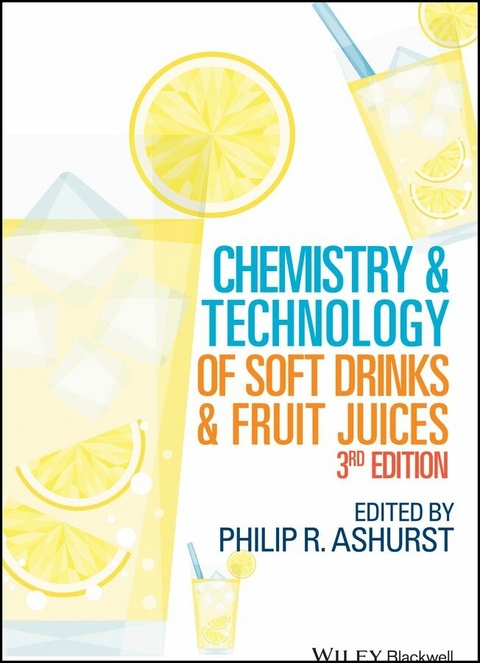
Chemistry and Technology of Soft Drinks and Fruit Juices (eBook)
John Wiley & Sons (Verlag)
978-1-118-63497-4 (ISBN)
Soft drinks and fruit juices are produced in almost every country in the world and their availability is remarkable. From the largest cities to some of the remotest villages, soft drinks are available in a variety of flavours and packaging. Over the last decade, soft drinks and fruit juices have been the subject of criticism by the health community and there is considerable pressure on beverage manufacturers to reduce, or even remove, the sugar content of these products.
Chemistry and Technology of Soft Drinks and Fruit Juices, Third Edition provides an overview of the chemistry and technology of soft drinks and fruit juices, covering ingredients, processing, microbiology, traceability and packaging as well as global market trends. This fully revised edition now includes chapters on topics that have become prominent in the industry since publication of the previous edition namely: water use and treatment, and microbiology technologies. The book is directed at graduates in food science, chemistry or microbiology entering production, quality control, new product development or marketing in the beverage industry or in companies supplying ingredients or packaging materials to the beverage industry.
Dr Philip R. Ashurst, Ashurst and Associates, Consulting Chemists to the Food Industry, Ludlow, UK.
Soft drinks and fruit juices are produced in almost every country in the world and their availability is remarkable. From the largest cities to some of the remotest villages, soft drinks are available in a variety of flavours and packaging. Over the last decade, soft drinks and fruit juices have been the subject of criticism by the health community and there is considerable pressure on beverage manufacturers to reduce, or even remove, the sugar content of these products. Chemistry and Technology of Soft Drinks and Fruit Juices, Third Edition provides an overview of the chemistry and technology of soft drinks and fruit juices, covering ingredients, processing, microbiology, traceability and packaging as well as global market trends. This fully revised edition now includes chapters on topics that have become prominent in the industry since publication of the previous edition namely: water use and treatment, and microbiology technologies. The book is directed at graduates in food science, chemistry or microbiology entering production, quality control, new product development or marketing in the beverage industry or in companies supplying ingredients or packaging materials to the beverage industry.
Dr Philip R. Ashurst, Ashurst and Associates, Consulting Chemists to the Food Industry, Ludlow, UK.
CHAPTER 1
Introduction
Philip R. Ashurst
Dr. P R Ashurst and Associates, Ludlow, UK
1.1 Overview
Fruit juices and soft drinks are available in essentially the same form almost anywhere in the world. From polar bases to the tropics, and from the largest developed nations to small and less developed countries, soft drinks and fruit juices are available in bottles, cans, laminated paper packs, pouches, cups and almost every other form of packaging known.
This chapter outlines what soft drinks are, describes the various types of products available and sets the scene for later chapters, which deal with the more specialised aspects of the chemistry and technology of these products.
1.2 Soft drinks
What are soft drinks? There is no single definition available, but it is generally accepted that they are sweetened, water-based beverages, usually with a balancing acidity. They are flavoured by the use of natural or artificial materials, are frequently coloured, and often contain an amount of fruit juice, fruit pulp or other natural ingredients. The predominant ingredient is water – often ignored and frequently maligned – and it should be considered that the primary function of soft drinks is hydration. The sweetness and other characteristics enhance the enjoyment of consumption and make the products more appealing to consumers. They are, in some respects, secondary, and yet have importance in the provision of energy and some of the minor essential nutrients needed to meet daily requirements.
It is generally accepted that the description of soft drinks excludes tea, coffee, dairy-based beverages and, until recently, alcohol. However, in many countries, the production of ‘soft’ drinks containing alcohol is growing. Many see this as an undesirable trend because, traditionally, the taste of alcoholic beverages has been associated with adulthood. The blurring of the edges between the markets and tastes for alcoholic drinks and soft drinks appears to facilitate an easy transition for children and young people to the consumption of alcohol. It should be noted that, in many soft drinks, small amounts of alcohol (less than 0.5% alcohol by volume (ABV)) may be present as a consequence of alcohol being used as a solvent for many flavourings. Small amounts of alcohol may also be present in fruit juices.
There are two basic types of soft drinks: the so-called ready-to-drink (RTD) products that dominate the world market and the concentrated, or dilute-to-taste, products that are still important in some markets. These include syrups and so-called squashes and cordials.
Whether RTD or dilutable, soft drinks characteristically contain water, a sweetener (usually a carbohydrate, although artificial sweeteners are increasingly important), an acid (citric or malic and phosphoric in colas are the most common), flavouring, colouring and preservatives. There is a large range of additional ingredients that can be used for various effects.
1.2.1 Ready-to-drink products
This sector accounts for the largest volume of soft drinks production, and is divided into products that are carbonated – that is, they contain carbon dioxide – and those that are not. Carbonated RTD soft drinks dominate the world market, and detailed consumption trends are discussed in Chapter 2 of this volume.
The market for carbonated soft drinks is dominated by two giant brands of cola drinks that, together with their associated brand names, account for just over half the world’s consumption of such products.
Non-carbonated RTD beverages have shown some considerable growth in recent years, mainly because of the availability of aseptic packaging forms. Non-carbonated drinks that rely on chemical preservation, or hot-pack/in-pack pasteurisation, often suffer from a number of potential problems, including rapid deterioration of flavour and colour.
1.2.2 Concentrated soft drinks
Concentrated soft drinks became very important during the Second World War, and in the early years following that conflict. Many were based on concentrated orange juice, which was widely available as a nutritional supplement in the United Kingdom, packed in flat-walled medicine bottles.
The main markets for concentrated soft drinks developed mainly in the United Kingdom and its former empire. The products became universally known as ‘squashes’ or ‘cordials’, and became enshrined as such in UK food legislation in the 1960s.
Another very important development was the production of citrus comminutes. These were produced by mixing together, in appropriate proportions, the juice, peel components and essential oils of citrus fruits, and comminuting the mixture in a suitable mill. The resulting product delivered a more intense flavour and cloud than could be obtained from juice alone, and allowed the creation of ‘whole fruit drinks’, which have dominated the concentrates market in the United Kingdom over the past 40–50 years.
1.2.3 Legislation
It is not the intention of this chapter to cover legislation affecting soft drinks in any detail – not least, because it varies from country to country, and there is often a continuous variation of legislation within countries.
Legislation is, however, important from an historical perspective. For example, in the United Kingdom, the Soft Drinks Regulations 1964 (as amended) codified the products according to the way in which the industry was then organised, and set into law definitions not only of ‘soft drinks’, but also of many different product types, such as crushes, squashes and cordials. These names subsequently became generic household names in the United Kingdom and in many parts of the English-speaking world.
The above regulations were probably among the most proscriptive compositional statutes that existed for any food products in the United Kingdom, and for beverages anywhere in the world. As well as defining soft drinks, they laid down the requirement for minimum levels of sugars in certain product types, the maximum levels of saccharin (the only artificial sweetener then permitted) and the minimum levels of comminuted fruit and fruit juices that defined the best-known product categories. These regulations were eventually revoked in 1995.
The current trend is to move away from compositional legislation, to a much freer approach in which carbohydrates and other nutritional components can be used at will, and additives are taken from ‘positive’ lists of functional components. Other ingredients are frequently controlled by negative usage (i.e. they must not be present, or must not exceed closely defined limits).
This move to remove controls on formulations is now backed by informed labelling that contains increasing amounts of information for the consumer. This approach is now used widely throughout the world, with only relatively minor variations from country to country.
At the time of writing, the relevant European Union regulations (EU 1169/2011) require that a food which includes fruit juices and soft drinks must be labelled, and that labels must contain the following information:
- the name of the food;
- the list of ingredients;
- any ingredient or processing aid listed in Annex II (of the regulations), or derived from a substance or product listed in Annex II causing allergies or intolerances that is used in the manufacture or preparation of the food and is still present in the finished product, even if in an altered form;
- the quantity of certain ingredients or categories of ingredients (see below);
- the net quantity of the food;
- the date of minimum durability or the use-by date;
- any special storage conditions and or conditions of use;
- the name or business name and address of the food business referred to in Article 8(1);
- the country of origin or place of provenance, where provided for in Article 26;
- instructions for use where it would be difficult to make use of the food without such information;
- In beverages containing more than 1.2% of alcohol by volume of alcohol, the actual alcoholic strength by volume;
- a nutritional declaration.
It will be apparent that not all of the above will apply to fruit juices and soft drinks, but the declaration of the quantity of key ingredients (fruit or fruit juice in soft drinks) became law through earlier quantitative ingredient declaration regulations in Europe. Where artificial sweeteners and carbohydrates are used together, an appropriate statement is necessary. A warning about the product being a source of phenylalanine must be incorporated when aspartame is used as a sweetener.
Other additional regulations may also apply, and the above information should only be considered as a general guide. There is a wealth of additional information on this topic available on the internet. Readers requiring more specific information should consult appropriate authorities.
Because, in most countries, legislation is a rapidly changing sphere, it is essential for those formulating, producing and marketing soft drinks to update themselves regularly as regards the legislation of consumer countries, and to ensure label compliance.
1.2.4 Product types
1.2.4.1 Ready-to-drink products
Historically, soft drinks were refreshing beverages that copied or extended fruit juices. Fruit juices...
| Erscheint lt. Verlag | 25.1.2016 |
|---|---|
| Sprache | englisch |
| Themenwelt | Sachbuch/Ratgeber ► Essen / Trinken |
| Naturwissenschaften ► Biologie | |
| Naturwissenschaften ► Chemie | |
| Technik ► Lebensmitteltechnologie | |
| Weitere Fachgebiete ► Land- / Forstwirtschaft / Fischerei | |
| Schlagworte | Aromastoffe • Aromastoffe, Riechstoffe, Kosmetika • Chemie • Chemistry • Erfrischungsgetränk • Erfrischungsgetränk • Fermented Foods & Beverages • Fermentierte Nahrungsmittel u. Getränke • Fermentierte Nahrungsmittel u. Getränke • Flavor, Perfume & Cosmetic Science • Food Processing, Production & Manufacture • Food Science & Technology • Food Technology • Fruchtsaft • fruit juices • Herstellung u. Verarbeitung von Lebensmitteln • Lebensmittelforschung u. -technologie • Microbiology • Obstsaft • Softdrink • Soft Drinks • Water |
| ISBN-10 | 1-118-63497-7 / 1118634977 |
| ISBN-13 | 978-1-118-63497-4 / 9781118634974 |
| Informationen gemäß Produktsicherheitsverordnung (GPSR) | |
| Haben Sie eine Frage zum Produkt? |
 EPUB (Adobe DRM)
Kopierschutz: Adobe-DRM
Adobe-DRM ist ein Kopierschutz, der das eBook vor Mißbrauch schützen soll. Dabei wird das eBook bereits beim Download auf Ihre persönliche Adobe-ID autorisiert. Lesen können Sie das eBook dann nur auf den Geräten, welche ebenfalls auf Ihre Adobe-ID registriert sind.
Details zum Adobe-DRM
Dateiformat: EPUB (Electronic Publication)
EPUB ist ein offener Standard für eBooks und eignet sich besonders zur Darstellung von Belletristik und Sachbüchern. Der Fließtext wird dynamisch an die Display- und Schriftgröße angepasst. Auch für mobile Lesegeräte ist EPUB daher gut geeignet.
Systemvoraussetzungen:
PC/Mac: Mit einem PC oder Mac können Sie dieses eBook lesen. Sie benötigen eine
eReader: Dieses eBook kann mit (fast) allen eBook-Readern gelesen werden. Mit dem amazon-Kindle ist es aber nicht kompatibel.
Smartphone/Tablet: Egal ob Apple oder Android, dieses eBook können Sie lesen. Sie benötigen eine
Geräteliste und zusätzliche Hinweise
Buying eBooks from abroad
For tax law reasons we can sell eBooks just within Germany and Switzerland. Regrettably we cannot fulfill eBook-orders from other countries.
aus dem Bereich