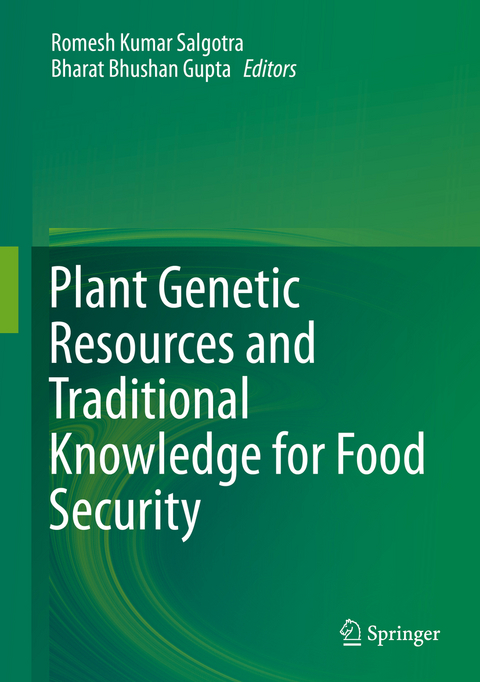
Plant Genetic Resources and Traditional Knowledge for Food Security (eBook)
266 Seiten
Springer Singapore (Verlag)
978-981-10-0060-7 (ISBN)
With exponentially increasing population across the globe and shrinking resources, the concern of food security is looming large over the world community. To catch up with the fierce pace of growth in all the sectors of development, ensuring uninhibited availability of food resources is a prime agenda. The growing global demand for food, feed, fiber and bio-based renewable materials, such as bio-fuels, is changing the conditions for genetic resources development and bio-resource production worldwide.
The crucial role in ensuring food security is played by the agro-based industries and enterprises. Advances in plant genetic resources coupled with traditional knowledge of the local tribes and native practices facilitate achievement of food security.
With exponentially increasing population across the globe and shrinking resources, the concern of food security is looming large over the world community. To catch up with the fierce pace of growth in all the sectors of development, ensuring uninhibited availability of food resources is a prime agenda. The growing global demand for food, feed, fiber and bio-based renewable materials, such as bio-fuels, is changing the conditions for genetic resources development and bio-resource production worldwide. The crucial role in ensuring food security is played by the agro-based industries and enterprises. Advances in plant genetic resources coupled with traditional knowledge of the local tribes and native practices facilitate achievement of food security.
Dr. Romesh Kumar Salgotra is currently working as associate professor cum coordinator in School of Biotechnology, Sher-e-Kashmir University of Agricultural Sciences & Technology of Jammu, India. Few of his important selective publications are: 1. Salgotra, R. K., Gupta, B. B. and Stewart, C. N. (2014). From genomics to functional markers in the era of next-generation sequencing. Biotechnology Letter 36(3): 417–426. 2. Mehraj-Ud-Din, Salgotra, R.K. and Gupta, B. B. (2013). Interaction of Restorer Genes in ‘WA’-type Cytoplasmic Male Sterility System in Rice (Oryza sativa L.). Natl. Acad. Sci. Lett. 36(3):259–264. 3. Salgotra, R. K., Gupta, B. B. and Ahmed, M. I. (2012). Characterization of thermo-sensitive genic male sterility (TGMS) rice genotypes (Oryza sativa L.) at different altitudes. Australian Journal of Crop Science 6(6):957-962. Dr. Bharat Bhushan Gupta is currently working as professor and registrar at Sher-e-Kashmir University of Agricultural Sciences & Technology of Jammu, India. His research publications are: 1. Bijral, J.S., Singh, B., Kanwal, K.S, Gupta, B.B. and Sharma, T.R. (1990). A new hybrid between Aegilops and Secale. Current Science. 59: 520. 2. Bijral, J.S., Gupta, B.B., Singh, B., Sharma, T. R., Kanwal, K.S. and Gupta, S.C. (1990). Hybrid necrosis in wheat. Indian J. Genet. 5: 189-191. 4. Bijral, J. S., Kanwal, K.S., Gupta, B.B., Singh, Bikram. and Sharma, T. R. (1990). Effect of gibberellic acid (GA3) on cytoplasmic male steriles and their maintainer/restorer lines in rice. Acta Agronomica Hugarica. 39: 327-329.
| Erscheint lt. Verlag | 22.1.2016 |
|---|---|
| Zusatzinfo | XXI, 266 p. 18 illus., 10 illus. in color. |
| Verlagsort | Singapore |
| Sprache | englisch |
| Themenwelt | Naturwissenschaften ► Biologie ► Botanik |
| Naturwissenschaften ► Biologie ► Genetik / Molekularbiologie | |
| Naturwissenschaften ► Biologie ► Ökologie / Naturschutz | |
| Technik ► Umwelttechnik / Biotechnologie | |
| Weitere Fachgebiete ► Land- / Forstwirtschaft / Fischerei | |
| Schlagworte | benefit-sharing • food security • Indian Traditional Knowledge • Intellectual Property India • plant genetic resources |
| ISBN-10 | 981-10-0060-3 / 9811000603 |
| ISBN-13 | 978-981-10-0060-7 / 9789811000607 |
| Informationen gemäß Produktsicherheitsverordnung (GPSR) | |
| Haben Sie eine Frage zum Produkt? |
 PDF (Wasserzeichen)
DRM: Digitales Wasserzeichen
Dieses eBook enthält ein digitales Wasserzeichen und ist damit für Sie personalisiert. Bei einer missbräuchlichen Weitergabe des eBooks an Dritte ist eine Rückverfolgung an die Quelle möglich.
Dateiformat: PDF (Portable Document Format)
Mit einem festen Seitenlayout eignet sich die PDF besonders für Fachbücher mit Spalten, Tabellen und Abbildungen. Eine PDF kann auf fast allen Geräten angezeigt werden, ist aber für kleine Displays (Smartphone, eReader) nur eingeschränkt geeignet.
Systemvoraussetzungen:
PC/Mac: Mit einem PC oder Mac können Sie dieses eBook lesen. Sie benötigen dafür einen PDF-Viewer - z.B. den Adobe Reader oder Adobe Digital Editions.
eReader: Dieses eBook kann mit (fast) allen eBook-Readern gelesen werden. Mit dem amazon-Kindle ist es aber nicht kompatibel.
Smartphone/Tablet: Egal ob Apple oder Android, dieses eBook können Sie lesen. Sie benötigen dafür einen PDF-Viewer - z.B. die kostenlose Adobe Digital Editions-App.
Buying eBooks from abroad
For tax law reasons we can sell eBooks just within Germany and Switzerland. Regrettably we cannot fulfill eBook-orders from other countries.
aus dem Bereich