


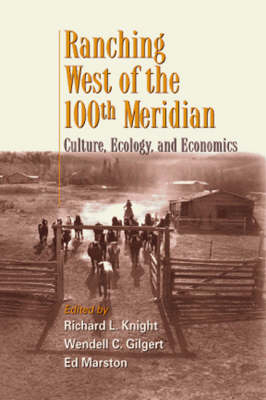
Ranching West of the 100th Meridian
Culture, Ecology, and Economics
Seiten
2002
Island Press (Verlag)
978-1-55963-827-2 (ISBN)
Island Press (Verlag)
978-1-55963-827-2 (ISBN)
A look at ranching and its role in the changing West. A series of narratives on ranchers' ecological commitments to the land, their cultural commitments to American society and the economic role ranching plays in sustainable food production and the protection of biodiversity.
Ranching West of the 100th Meridian offers a literary and thought-provoking look at ranching and its role in the changing West. The book's lyrical and deeply felt narratives, combined with fresh information and analysis, offer a poignant and enlightening consideration of ranchers' ecological commitments to the land, their cultural commitments to American society, and the economic role ranching plays in sustainable food production and the protection of biodiversity. The book begins with writings that bring to life the culture of ranching, including the fading reality of families living and working together on their land generation after generation. The middle section offers an understanding of the ecology of ranching, from issues of overgrazing and watershed damage to the concept that grazing animals can actually help restore degraded land. The final section addresses the economics of ranching in the face of declining commodity prices and rising land values brought by the increasing suburbanization of the West. Among the contributors are Paul Starrs, Linda Hasselstrom, Bob Budd, Drummond Hadley, Mark Brunson, Wayne Elmore, Allan Savory, Luther Propst, and Bill Weeks.
Livestock ranching in the West has been attacked from all sides - by environmentalists who see cattle as a scourge upon the land, by fiscal conservatives who consider the leasing of grazing rights to be a massive federal handout program, and by developers who covet intact ranches for subdivisions and shopping centers. The authors acknowledge that, if done wrong, ranching clearly has the capacity to hurt the land. But if done right, it has the power to restore ecological integrity to Western lands that have been too-long neglected. Ranching West of the 100th Meridian makes a unique and impassioned contribution to the ongoing debate on the future of the New West.
Ranching West of the 100th Meridian offers a literary and thought-provoking look at ranching and its role in the changing West. The book's lyrical and deeply felt narratives, combined with fresh information and analysis, offer a poignant and enlightening consideration of ranchers' ecological commitments to the land, their cultural commitments to American society, and the economic role ranching plays in sustainable food production and the protection of biodiversity. The book begins with writings that bring to life the culture of ranching, including the fading reality of families living and working together on their land generation after generation. The middle section offers an understanding of the ecology of ranching, from issues of overgrazing and watershed damage to the concept that grazing animals can actually help restore degraded land. The final section addresses the economics of ranching in the face of declining commodity prices and rising land values brought by the increasing suburbanization of the West. Among the contributors are Paul Starrs, Linda Hasselstrom, Bob Budd, Drummond Hadley, Mark Brunson, Wayne Elmore, Allan Savory, Luther Propst, and Bill Weeks.
Livestock ranching in the West has been attacked from all sides - by environmentalists who see cattle as a scourge upon the land, by fiscal conservatives who consider the leasing of grazing rights to be a massive federal handout program, and by developers who covet intact ranches for subdivisions and shopping centers. The authors acknowledge that, if done wrong, ranching clearly has the capacity to hurt the land. But if done right, it has the power to restore ecological integrity to Western lands that have been too-long neglected. Ranching West of the 100th Meridian makes a unique and impassioned contribution to the ongoing debate on the future of the New West.
Richard L. Knight is professor of wildlife conservation at Colorado State University, and coeditor of Stewardship Across Boundaries (Island Press, 1998) and A New Century for Natural Resources Management (Island Press, 1995). Wendell C. Gilgert is wildlife biologist with the Natural Resources Conservation Service in the Wildlife Habitat Manage-ment Institute in the Department of Fishery and Wildlife Biology at Colorado State University. Ed Marston is publisher of High Country News.
| Erscheint lt. Verlag | 1.1.2002 |
|---|---|
| Verlagsort | Washington |
| Sprache | englisch |
| Maße | 153 x 229 mm |
| Themenwelt | Naturwissenschaften ► Biologie ► Ökologie / Naturschutz |
| Weitere Fachgebiete ► Land- / Forstwirtschaft / Fischerei | |
| ISBN-10 | 1-55963-827-3 / 1559638273 |
| ISBN-13 | 978-1-55963-827-2 / 9781559638272 |
| Zustand | Neuware |
| Informationen gemäß Produktsicherheitsverordnung (GPSR) | |
| Haben Sie eine Frage zum Produkt? |
Mehr entdecken
aus dem Bereich


aus dem Bereich
Methoden – Lösungen – Anwendungen
Buch | Hardcover (2025)
Hanser (Verlag)
CHF 69,95


