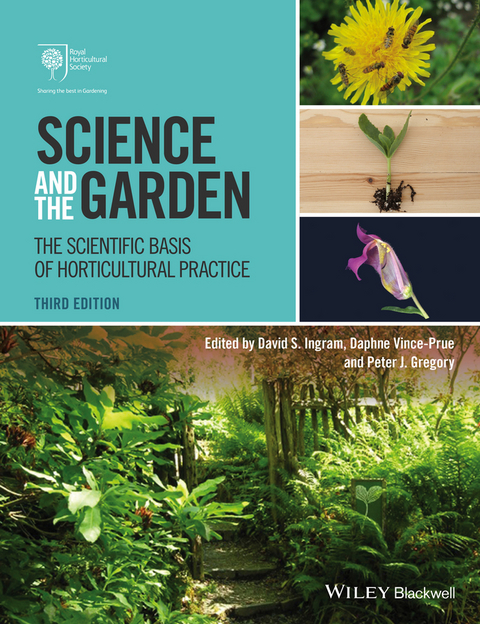
Science and the Garden (eBook)
John Wiley & Sons (Verlag)
978-1-118-77840-1 (ISBN)
Most conventional gardening books concentrate on how and when to carry out horticultural tasks such as pruning, seed sowing and taking cuttings. Science and the Garden, Third Edition is unique in explaining in straightforward terms some of the science that underlies these practices. It is principally a book of 'Why' - Why are plants green? Why do some plants only flower in the autumn? Why do lateral buds begin to grow when the terminal bud is removed by pruning? Why are some plants successful as weeds? Why does climate variability and change mean change for gardeners? But it also goes on to deal with the 'How', providing rationale behind the practical advice.
The coverage is wide-ranging and comprehensive and includes: the diversity, structure, functioning and reproduction of garden plants; nomenclature and classification; genetics and plant breeding; soil properties and soil management; environmental factors affecting growth and development; methods of propagation; size and form; colour, scent and sound; climate; environmental change; protected cultivation; pest, disease and weed diversity and control; post-harvest management and storage; garden ecology and conservation; sustainable horticulture; gardens and human health and wellbeing; and gardens for science.
This expanded and fully updated Third Edition of Science and the Garden includes two completely new chapters on important topics:
- Climate and Other Environmental Changes
- Health, Wellbeing and Socio-cultural Benefits
Many of the other chapters have been completely re-written or extensively revised and expanded, often with new authors and/or illustrators, and the remainder have all been carefully updated and re-edited. Published in collaboration with the Royal Horticultural Society, reproduced in full colour throughout, carefully edited and beautifully produced, this new edition remains a key text for students of horticulture and will also appeal to amateur and professional gardeners wishing to know more about the fascinating science behind the plants and practices that are the everyday currency of gardening.
Professor David Ingram, Formerly Regius Keeper, the Royal Botanic Garden, Edinburgh, RHS Professor of Horticulture and Master, St Catharine's College, Cambridge; now Honorary Professor in the Universities of Edinburgh (Science, Technology & Innovation Studies) and Lancaster (Environment Centre), UK.
Dr Daphne Vince-Prue, Formerly Reader in Botany, University of Reading, Scientific Advisor to the Agricultural Research Council and Head, Physiology and Chemistry Department, Glasshouse Crops Research Institute, UK.
Professor Peter Gregory, Formerly Director and Chief Executive, Scottish Crop Research Institute, Dundee and Chief Executive, East Malling Research; now Professor of Global Food Security, University of Reading, UK.
Most conventional gardening books concentrate on how and when to carry out horticultural tasks such as pruning, seed sowing and taking cuttings. Science and the Garden, Third Edition is unique in explaining in straightforward terms some of the science that underlies these practices. It is principally a book of 'Why' Why are plants green? Why do some plants only flower in the autumn? Why do lateral buds begin to grow when the terminal bud is removed by pruning? Why are some plants successful as weeds? Why does climate variability and change mean change for gardeners? But it also goes on to deal with the 'How', providing rationale behind the practical advice. The coverage is wide-ranging and comprehensive and includes: the diversity, structure, functioning and reproduction of garden plants; nomenclature and classification; genetics and plant breeding; soil properties and soil management; environmental factors affecting growth and development; methods of propagation; size and form; colour, scent and sound; climate; environmental change; protected cultivation; pest, disease and weed diversity and control; post-harvest management and storage; garden ecology and conservation; sustainable horticulture; gardens and human health and wellbeing; and gardens for science. This expanded and fully updated Third Edition of Science and the Garden includes two completely new chapters on important topics: Climate and Other Environmental Changes Health, Wellbeing and Socio-cultural Benefits Many of the other chapters have been completely re-written or extensively revised and expanded, often with new authors and/or illustrators, and the remainder have all been carefully updated and re-edited. Published in collaboration with the Royal Horticultural Society, reproduced in full colour throughout, carefully edited and beautifully produced, this new edition remains a key text for students of horticulture and will also appeal to amateur and professional gardeners wishing to know more about the fascinating science behind the plants and practices that are the everyday currency of gardening.
Professor David Ingram, Formerly Regius Keeper, the Royal Botanic Garden, Edinburgh, RHS Professor of Horticulture and Master, St Catharine's College, Cambridge; now Honorary Professor in the Universities of Edinburgh (Science, Technology & Innovation Studies) and Lancaster (Environment Centre), UK. Dr Daphne Vince-Prue, Formerly Reader in Botany, University of Reading, Scientific Advisor to the Agricultural Research Council and Head, Physiology and Chemistry Department, Glasshouse Crops Research Institute, UK. Professor Peter Gregory, Formerly Director and Chief Executive, Scottish Crop Research Institute, Dundee and Chief Executive, East Malling Research; now Professor of Global Food Security, University of Reading, UK.
Preface to third edition xiii
Preface to second edition xiv
Preface to first edition xv
1 Diversity in the plant world 1
2 The plant body: structure and function 14
3 Reproduction: Securing the future 37
4 Naming plants 45
5 Selecting and breeding plants 55
6 Summary 75
7 Soil cultivation and fertility 86
8 The plant environment: Light and water 102
9 Plants and seasons 120
10 Growing plants from seed 139
11 Vegetative propagation 149
12 Size and form 166
13 Colour, scent and sound in the garden 175
14 Climate and weather 191
15 Climate and other environmental changes 206
16 Protected cultivation 214
17 The diversity of the undesirables 234
18 Controlling the undesirables 248
19 Maturation, ripening and storage 262
20 Garden ecology 278
21 Garden wildlife and conservation 292
22 Low-input and low-impact gardening 299
23 Health, well-being and socio-cultural benefits 307
24 Gardens for science 320
Conclusion 328
Further reading 328
Authors and affiliations 328
Glossary 329
Index 355
| Erscheint lt. Verlag | 9.10.2015 |
|---|---|
| Sprache | englisch |
| Themenwelt | Naturwissenschaften ► Biologie |
| Technik | |
| Weitere Fachgebiete ► Land- / Forstwirtschaft / Fischerei | |
| Schlagworte | Agriculture • Biowissenschaften • Botanik • climate change • Environment • garden ecology • Gardening • Garden plants • Gartenbau • horticulture • Landwirtschaft • Life Sciences • Organic Gardening • plant science • RHS examinations • Royal Horticultural Society • sustainability |
| ISBN-10 | 1-118-77840-5 / 1118778405 |
| ISBN-13 | 978-1-118-77840-1 / 9781118778401 |
| Informationen gemäß Produktsicherheitsverordnung (GPSR) | |
| Haben Sie eine Frage zum Produkt? |
 PDF (Adobe DRM)
Kopierschutz: Adobe-DRM
Adobe-DRM ist ein Kopierschutz, der das eBook vor Mißbrauch schützen soll. Dabei wird das eBook bereits beim Download auf Ihre persönliche Adobe-ID autorisiert. Lesen können Sie das eBook dann nur auf den Geräten, welche ebenfalls auf Ihre Adobe-ID registriert sind.
Details zum Adobe-DRM
Dateiformat: PDF (Portable Document Format)
Mit einem festen Seitenlayout eignet sich die PDF besonders für Fachbücher mit Spalten, Tabellen und Abbildungen. Eine PDF kann auf fast allen Geräten angezeigt werden, ist aber für kleine Displays (Smartphone, eReader) nur eingeschränkt geeignet.
Systemvoraussetzungen:
PC/Mac: Mit einem PC oder Mac können Sie dieses eBook lesen. Sie benötigen eine
eReader: Dieses eBook kann mit (fast) allen eBook-Readern gelesen werden. Mit dem amazon-Kindle ist es aber nicht kompatibel.
Smartphone/Tablet: Egal ob Apple oder Android, dieses eBook können Sie lesen. Sie benötigen eine
Geräteliste und zusätzliche Hinweise
Buying eBooks from abroad
For tax law reasons we can sell eBooks just within Germany and Switzerland. Regrettably we cannot fulfill eBook-orders from other countries.
aus dem Bereich