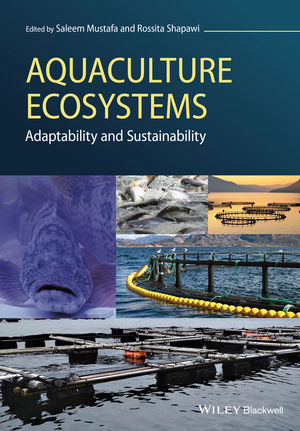
Aquaculture Ecosystems (eBook)
John Wiley & Sons (Verlag)
978-1-118-77851-7 (ISBN)
Aquaculture Ecosystems contains a thorough and exciting synthesis of current information on aquaculture practices and substantial discussion of the way forward in transforming the aquaculture industry by improving its sustainability. This important book includes discussion of all the current major issues relating to aquaculture practices in relation to the ecology of their situations, environmental concerns, and details of how sustainability can be improved. Efforts have been made to include chapters that go beyond the stage of debate on old topics, providing conclusions to provide leads for action plans and practices addressing modern challenges such as global climate change.
Commencing with a chapter covering concerns and solutions centred around seafood security, the following chapters cover the biology and behavior of aquatic animals and their selection for use in aquaculture systems, integrated multi-trophic aquaculture, nutrient inputs and pollution, biofouling, blue carbon stocks in coastal aquaculture, climate change adaptations and knowledge management in aquaculture.
Written by internationally-recognized experts in aquaculture and ecology, and edited by Saleem Mustafa, well known for his work in aquatic sciences, the book provides a great deal of use and interest to all those involved in aquaculture planning and development, environmental sciences and aquatic ecology. All libraries in universities and research establishments where biological sciences and aquaculture are studied and taught should have copies of this vital reference on their shelves.
Aquaculture Ecosystems contains a thorough and exciting synthesis of current information on aquaculture practices and substantial discussion of the way forward in transforming the aquaculture industry by improving its sustainability. This important book includes discussion of all the current major issues relating to aquaculture practices in relation to the ecology of their situations, environmental concerns, and details of how sustainability can be improved. Efforts have been made to include chapters that go beyond the stage of debate on old topics, providing conclusions to provide leads for action plans and practices addressing modern challenges such as global climate change. Commencing with a chapter covering concerns and solutions centred around seafood security, the following chapters cover the biology and behavior of aquatic animals and their selection for use in aquaculture systems, integrated multi-trophic aquaculture, nutrient inputs and pollution, biofouling, blue carbon stocks in coastal aquaculture, climate change adaptations and knowledge management in aquaculture. Written by internationally-recognized experts in aquaculture and ecology, and edited by Saleem Mustafa, well known for his work in aquatic sciences, the book provides a great deal of use and interest to all those involved in aquaculture planning and development, environmental sciences and aquatic ecology. All libraries in universities and research establishments where biological sciences and aquaculture are studied and taught should have copies of this vital reference on their shelves.
About the Editors Saleem Mustafa and Rossita Shapawi are based at the Borneo Marine Research Institute, Universiti Malaysia Sabah, Sabah, Malaysia.
CHAPTER 1
Sustainability of seafood production – challenges and the way forward
Saleem Mustafa
Borneo Marine Research Institute, Universiti Malaysia Sabah, Sabah, Malaysia
Abstract
Sustainability of seafood supplies is a matter of growing concern at a time when demand is increasing and some of the factors constraining the development of aquaculture are challenging the efforts towards increasing production. Stabilization of harvest from fisheries has generated a great deal of interest in aquaculture. Besides directly enhancing production, aquaculture can reduce pressure on wild stocks and biodiversity, and contribute to enhancing depleted stocks. Aquaculture systems are diverse, requiring a comprehensive understanding of the different issues and knowledge-based solutions, and an enabling environment that favours application of innovative ideas to support development of this sector. Diversity in aquaculture often requires adopting more balanced and informed approaches that take into consideration the environmental, social and economic conditions. The future of aquaculture depends on management of key issues and application of appropriate strategies. This chapter discusses the trends that characterize the emergence of aquaculture as a major provider of high quality protein, the challenges it faces in a changing climate, the impact of adaptation measures on sustainability, the possible role of some forms of biotechnology, introducing ecosystem perspectives and the potential of forging synergies of this sector with other means of producing seafood.
Keywords: Seafood security; aquaculture; climate change; adaptation strategies; ecosystem approaches;
1.1 Sustainability issues and concerns
The long-held world view of oceans as a limitless source of fish was a mistaken notion. In less than two centuries, during the age of industrialization, human impacts have pushed the oceans to the brink. We have not taken seriously signs of resource exhaustion, out of ignorance of the consequences or for convenience, and we still continue to do so for lack of cheap options.
Until a few decades ago we did not believe that the cost of inaction could be far greater than the cost of remedial action. Catching fish from the sea is, of course, cheaper than farming it but the situation in the twenty-first century tells us what used to be a free bounty has a cost. Oceans have been taken for granted for too long. We need to invest not just in saving what is left in the oceans but also in growing in farms what we used to harvest from the sea.
Most of the marine fish stocks are under great pressure: almost 30% are overexploited, 57% are fully exploited (at or close to their maximum sustainable production) and only about 13% are not fully exploited (FAO, 2012).
For a long time, we did not care about the environmental impacts of fish farming. We could have learned lessons from the green revolution but we chose not to. The green revolution increased agricultural production from land-based crops and saved a vast population from hunger and malnutrition. However, it created environmental problems. The blue revolution was launched with the aim of increasing animal protein supply. This was achieved but also at the cost of the environment.
When the green revolution was launched and progressed, oceans were still viewed as a major frontier for food production. However, this frontier is facing serious challenges that are pushing it to the tipping points. Oceans being the last frontier on Earth for food supply, we have nowhere else to go to produce food. The consequences of factors as powerful as ocean acidification, warming and oxygen deficit on capture fisheries are already becoming visible and are strong enough to undermine the seafood supply.
Sustainably managing what is left in the oceans and rapidly developing sustainable aquaculture are the very basis of seafood security.
The world’s human population has exceeded seven billion and is projected to reach 9.3 billion by 2050 (UN, 2010). The maximum potential fish production from current marine fisheries is estimated to be about 80 million tonnes per year (FAO, 2010). If it declines while human population grows, aquaculture would be expected to meet the world demand. How much marine fisheries and aquaculture will be able to supply fish in the future will depend to a great extent on ecosystem productivity (Brander, 2007; Cheung et al., 2009a, 2009b), the efficiency of fisheries management (Rice and Garcia, 2011) and on the capacity to expand environment-friendly aquaculture (Naylor et al., 2009). The human welfare dimension of fisheries and aquaculture is more than just direct consumption of seafood. These sectors also provide means of livelihood and income.
In the course of this chapter, certain terms will be used and to avoid any confusion their technical definitions provided by the United Nations Food and Agriculture Organization (FAO) are explained here. Let us start with aquaculture and fisheries. Aquaculture denotes farming of aquatic organisms including fish, molluscs, crustaceans and aquatic plants, which implies some form of intervention in the rearing process to enhance production, such as regular stocking, feeding and protection from predators. Farming also implies individual or corporate ownership of the stock being cultivated. The aquatic organisms that are harvested by an individual or a corporate body that has owned them throughout their rearing period contribute to aquaculture, while aquatic organisms which are exploitable by the public as a common property resource, with or without appropriate licences, are the harvest of capture fisheries. Capture fisheries comprise the range of all activities related to harvesting fish and may refer to the location, the target resource, the technology used, the social characteristics (artisanal, industrial), the purpose (subsistence, commercial, recreational) as well as the season.
The primary sector of fish production engaged 55 million people in 2010 (FAO, 2012). Interestingly, due to stagnation in capture fisheries, the number of people engaged in fishing increased by only 0.8% per year compared to 5.5% in fish farming based on the pattern in the last five years (FAO, 2012). The FAO report further stated that, in addition to the primary production sector, numerous jobs are also provided by ancillary activities, such as: post-harvest processing; packaging; marketing; distribution; manufacture of fish-processing equipment, nets and gears; ice factories; feed mills; boat construction; maintenance of facilities; transport of product; administration; and research and professional services.
Overfishing should be viewed from the point of view of its adverse impact on fish production and its socioeconomic consequences. To increase the contribution of marine fisheries and aquaculture to food security, economies and human welfare, a thoroughly integrated and effective management of seafood production along the lines suggested above is absolutely necessary and time is not on our side. Our options are reducing and the cost of the remaining options is increasing. There are pathways explained in the FAO’s Code of Conduct for Responsible Fisheries, Guidelines for Inland Fisheries and Aquaculture, Sustainable Livelihoods Approach, Ecosystem Approach to Fisheries Management, UN Fish Stocks Agreement and Manual of Good Aquaculture Practices. Provisions under these frameworks can be implemented according to local conditions. The UN Conference on Sustainable Development held in 2012, known as Rio+20, dealt with the governance of fisheries and aquaculture and countered the notion that sustainability and growth are mutually exclusive. At a time when pressures on land-based farming systems are increasing, the focus on the world’s oceans is a logical development. In this context, the importance of improved management and sustainable growth in minimizing the use of natural resources and increasing food security cannot be overemphasized.
World supply of fish from capture fisheries and aquaculture reached 154 million tonnes (mt) in 2011. Capture fisheries contributed 90.4 mt and aquaculture 63.6 mt to this total fish production (Table 1.1). This figure suggests an increasing trend in production, which was demand driven.
Table 1.1 World fisheries and aquaculture production and use (FAO, 2012).
| 2006 | 2007 | 2008 | 2009 | 2010 | 2011 |
| PRODUCTION (Million tonnes) |
| Capture |
| Inland | 9.8 | 10.0 | 10.2 | 10.4 | 11.2 | 11.5 |
| Marine | 80.2 | 80.4 | 79.5 | 79.2 | 77.4 | 78.9 |
| Total capture | 90.0 | 90.3 | 89.7 | 89.6 | 88.6 | 90.4 |
| Aquaculture |
| Inland | 31.3 | 33.4 | 36.0 | 38.1 | 41.7 | 44.3 |
| Marine | 16.0 | 16.6 | 16.9 | 17.6 | 18.1 | 19.3 |
| Total... |
| Erscheint lt. Verlag | 24.8.2015 |
|---|---|
| Sprache | englisch |
| Themenwelt | Naturwissenschaften ► Biologie ► Ökologie / Naturschutz |
| Technik | |
| Weitere Fachgebiete ► Land- / Forstwirtschaft / Fischerei | |
| Schlagworte | Ãkologie / Aquatische Lebensräume • Aquaculture • Aquaculture, aquaculture sustainability, aquaculture adaptations, blue carbon stocks and aquaculture, seafood security, good aquaculture practices, knowledge management in aquaculture, low carbon aquaculture, ecological aquaculture, aquaculture innovations • Aquaculture, Fisheries & Fish Science • Aquakultur • Aquakultur, Fischereiwesen u. Fischforschung • aquatic ecology • Bauingenieur- u. Bauwesen • Biowissenschaften • Civil Engineering & Construction • Environmental impact • Life Sciences • Ökologie / Aquatische Lebensräume • Umweltbelastung |
| ISBN-10 | 1-118-77851-0 / 1118778510 |
| ISBN-13 | 978-1-118-77851-7 / 9781118778517 |
| Informationen gemäß Produktsicherheitsverordnung (GPSR) | |
| Haben Sie eine Frage zum Produkt? |
 EPUB (Adobe DRM)
Kopierschutz: Adobe-DRM
Adobe-DRM ist ein Kopierschutz, der das eBook vor Mißbrauch schützen soll. Dabei wird das eBook bereits beim Download auf Ihre persönliche Adobe-ID autorisiert. Lesen können Sie das eBook dann nur auf den Geräten, welche ebenfalls auf Ihre Adobe-ID registriert sind.
Details zum Adobe-DRM
Dateiformat: EPUB (Electronic Publication)
EPUB ist ein offener Standard für eBooks und eignet sich besonders zur Darstellung von Belletristik und Sachbüchern. Der Fließtext wird dynamisch an die Display- und Schriftgröße angepasst. Auch für mobile Lesegeräte ist EPUB daher gut geeignet.
Systemvoraussetzungen:
PC/Mac: Mit einem PC oder Mac können Sie dieses eBook lesen. Sie benötigen eine
eReader: Dieses eBook kann mit (fast) allen eBook-Readern gelesen werden. Mit dem amazon-Kindle ist es aber nicht kompatibel.
Smartphone/Tablet: Egal ob Apple oder Android, dieses eBook können Sie lesen. Sie benötigen eine
Geräteliste und zusätzliche Hinweise
Buying eBooks from abroad
For tax law reasons we can sell eBooks just within Germany and Switzerland. Regrettably we cannot fulfill eBook-orders from other countries.
aus dem Bereich