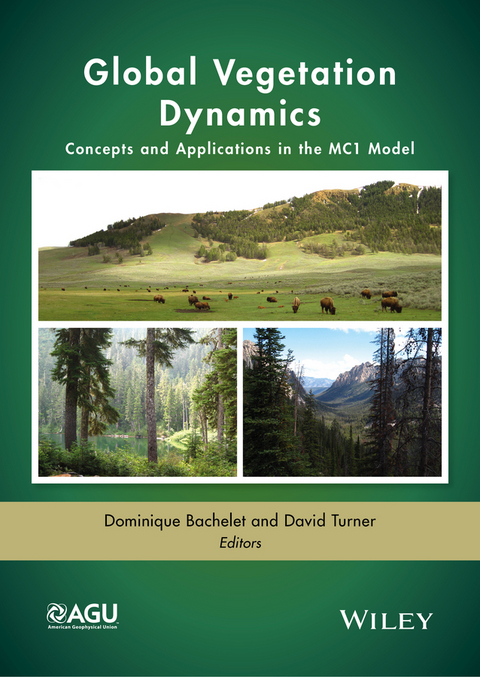
Global Vegetation Dynamics (eBook)
John Wiley & Sons (Verlag)
978-1-119-01173-6 (ISBN)
Global Vegetation Dynamics: Concepts and Applications in MC1 model describes the creation in the mid 1990s, architecture, uses, and limitations of the MC1 dynamic global vegetation model (DGVM) that is being used by an increasing number of research groups around the world, The scientific foundation of most models is often poorly documented and difficult to access, and a centralized source of information for MC1, including the complete list of over eighty papers and reports with MC1 results will be useful to scientists and users who want to better understand the model and the output it generates,
Global Vegetation Dynamics: Concepts and Applications in MC1 model will be a valuable resource for students and researchers in the fields of climate change science, conservation science, biogeochemistry and ecology, as well as for land managers looking for a better understanding of the projections of climate change impacts and of the tools that have been developed to produce them,
Dominique Bachelet is a Senior Scientist at the Conservation Biology Institute in Corvallis and Data Basin Climate Center in Oregon, She is the Associate Professor in the Department of Biological and Ecological Engineering at Oregon State University, She was the former director of the Climate Change Science Team for the Nature Conservancy, She completed her Ph,D, in 1983 from Colorado State University working on biogeochemical cycles in the shortgrass prairie, She has authored several research articles including the Journal of Geophysical Research and a few book chapters, She is a member of the American Geophysical Union, Ecological Society of America and the American Association for the Advancement of Science, Her research expertise is on plant ecology, biogeochemistry and biogeography with special focus on climate change impacts,
Global Vegetation Dynamics: Concepts and Applications in MC1 model describes the creation in the mid 1990s, architecture, uses, and limitations of the MC1 dynamic global vegetation model (DGVM) that is being used by an increasing number of research groups around the world. The scientific foundation of most models is often poorly documented and difficult to access, and a centralized source of information for MC1, including the complete list of over eighty papers and reports with MC1 results will be useful to scientists and users who want to better understand the model and the output it generates. Global Vegetation Dynamics: Concepts and Applications in MC1 model will be a valuable resource for students and researchers in the fields of climate change science, conservation science, biogeochemistry and ecology, as well as for land managers looking for a better understanding of the projections of climate change impacts and of the tools that have been developed to produce them.
Dominique Bachelet is a Senior Scientist at the Conservation Biology Institute in Corvallis and Data Basin Climate Center in Oregon. She is the Associate Professor in the Department of Biological and Ecological Engineering at Oregon State University. She was the former director of the Climate Change Science Team for the Nature Conservancy. She completed her Ph.D. in 1983 from Colorado State University working on biogeochemical cycles in the shortgrass prairie. She has authored several research articles including the Journal of Geophysical Research and a few book chapters. She is a member of the American Geophysical Union, Ecological Society of America and the American Association for the Advancement of Science. Her research expertise is on plant ecology, biogeochemistry and biogeography with special focus on climate change impacts.
Contributors vii
Preface ix
Acknowledgments xi
Part I: General Description of the Model MC1
1 History and General Description of the Dynamic Global Vegetation Model MC1
Dominique Bachelet 3
2 Historical Climate and Suppression Effects on Simulated Fire and Carbon Dynamics in the Conterminous United States
James M Lenihan and Dominique Bachelet 17
3 Challenges and Limitations of Using a DGVM for Local to Regional Applications
Dominique Bachelet, Brendan M Rogers, and David R Conklin 31
4 The Making of a Dynamic General Vegetation Model, MC1
Ronald P Neilson 41
Part II: Examples of Projects Using MC1 at Various Spatial Scales
5 A Brief Description of the VINCERA Project; Vulnerability and Impacts of North American Forests to Climate Change: Ecosystem Responses and Adaptation
David T Price, Daniel Scott, Mark R Lomas, Daniel W McKenney, Dominique Bachelet, Raymond J Drapek, James M Lenihan, Ronald P Neilson, F I Woodward, and Jonathan A Foley 61
6 Continent?]wide Simulations of a Dynamic Global Vegetation Model over the United States and Canada under Nine AR4 Future Scenarios
Raymond J Drapek, John B Kim, and Ronald P Neilson 73
7 Drivers of Future Ecosystem Change in the US Pacific Northwest: The Role of Climate, Fire, and Nitrogen
Brendan M Rogers, Dominique Bachelet, Raymond J Drapek, Beverly E Law, Ronald P Neilson, and John R Wells 91
8 Application of MC1 to Wind Cave National Park: Lessons from a Small?]Scale Study
David A King, Dominique Bachelet, and Amy J Symstad 115
9 Simulating Effects of Climate and Vegetation Change on Distributions of Martens and Fishers in the Sierra Nevada, California, Using Maxent and MC1
Wayne D Spencer, Heather Rustigian?]Romsos, Ken Ferschweiler, and Dominique Bachelet 135
Part III: Packaging MC1 Results to Increase Its Usability by Managers
10 Using a Dynamic Global Vegetation Model to Help Inform Management Decisions
Joshua S Halofsky, Jessica E Halofsky, David R Conklin, Dominique Bachelet, Miles A Hemstrom, Becky K Kerns, and Anita T Morzillo 153
11 Bringing MC1 Model Results to Data Basin to Facilitate Access, Distribution, and Interpretation
Dominique Bachelet and the CBI Data Basin team 171
Appendix: Publications and Reports Featuring MC1 177
Glossary 183
Index 185
1
History and General Description of the Dynamic Global Vegetation Model MC1
Dominique Bachelet
Conservation Biology Institute, Corvallis, Oregon, USA
ABSTRACT
The model MC1 was designed during the second phase of the Vegetation Ecosystem Modeling and Analysis Project (VEMAP), a collaborative multiagency project designed to simulate and understand ecosystem dynamics for the continental United States [VEMAP members, 1995]. The goal was to focus on transient vegetation dynamics and to link biogeography and biogeochemistry models so that the trajectory of ecosystems between historical and future time periods could be simulated. The model was designed to simulate the potential vegetation that would occur without direct intervention by industrialized societies. Since then, applications of MC1 have included effects of humans on vegetation through cattle grazing and fire suppression as well as direct (CO2) and indirect (climate) effects of increasing greenhouse gas concentrations. The MC1 model has been used in many projects, at various spatial scales (50 m−50 km) and for different spatial domains (national parks to global) as illustrated by over 80 reports and publications using its projections of vegetation response to climate change. This chapter briefly describes its history and its design.
1.1. MODEL HISTORY
To prepare for the effects of climate change on terrestrial ecosystems, it is essential to understand how climate has driven vegetation distribution and the carbon cycle in the past and how it may affect them in the future. It is well recognized that land use may have transformed some landscapes more than climate, but future land use changes will depend on social and political decisions that are impossible to forecast while climate models can provide robust projections of climate futures. Moreover, anthropogenic influences do not affect all ecosystems equally. Many ecosystems still strongly reflect direct climatic influences, and their response to climate change is likely to influence the ecosystem services they provide. While farmers have access to management alternatives (irrigation, fertilizers, pesticides, genetically modified annual crops) that can alleviate some of the more negative effects of weather, foresters and pastoralists have adapted their management practices to account for climatic influences and will continue to do so, benefiting from projections of natural vegetation responses to change. Therefore many climate change research projects have focused on understanding the effects of future climate on natural vegetation.
The Vegetation Ecosystem Modeling and Analysis Project (VEMAP) was a collaborative multiagency project designed to simulate and understand ecosystem dynamics in the conterminous United States [VEMAP members, 1995]. During the first phase of VEMAP, potential vegetation maps for historical and for future conditions were generated by the static biogeography models MAPSS (Mapped Atmosphere Plant Soil System) [Neilson, 1995], BIOME2 [Prentice et al., 1992], and DOLY (Dynamic glObaL phytogeographY) [Woodward et al., 1995] using 30-year average observed as well as projected climate data, providing instantaneous snapshots of what was (historical starting point) and what might become (future endpoint) the vegetation distribution over the country without describing the path it might follow to get there. The gridded vegetation maps produced by the static models were then provided to three biogeochemistry models, CENTURY [Parton et al., 1987, 1988, 1993], BIOME-BGC (Biome BioGeochemical Cycle) [Hunt and Running, 1992; Running and Hunt, 1993], and TEM (Terrestrial Ecosystem Model) [McGuire et al., 1992; Melillo et al., 1993; Tian et al., 2000], to calculate the carbon stocks that matched the simulated vegetation type for these two time periods. Phenology and fire disturbance were prescribed in all cases. The underlying assumption was that chronic change was happening and that ecosystem trajectories between 2000 and 2100 were linear. However, scientists believed this assumption might be wrong and wanted to create a model that could explore transient ecosystem dynamics during the 21st century. One of the hypotheses was that land could first “greenup” with warmer temperatures but instead of increasing its productivity continuously until 2100 could be affected by the exceedence of a particular climatic threshold causing a “browndown” driven by increasing evaporative demand and drought stress associated with vegetation shifts, declines in productivity, and carbon losses.
During the second phase of VEMAP, instead of focusing on instantaneous snapshots of what might happen in terms of vegetation type change and concurrent shifts in the location of carbon sources and sinks, the goal was to focus on year-to-year variations and link biogeography and biogeochemistry models so that the trajectory of the ecosystems between historical and future time periods was simulated. At the time there were only a couple of research groups addressing this issue. A team composed of Oregon State University scientists including Chris Daly, Jim Lenihan, and Dominique Bachelet, under the leadership of USFS Ron Neilson and with financial support from the USDA Forest Service, started to link the biogeography rules adapted from the MAPSS biogeography model [Neilson, 1995] to a modified version of the CENTURY biogeochemistry model [Metherell et al., 1993] in order to create what was to become the model MC1 [Bachelet et al., 2001a, 2003]. Two other VEMAP-related projects emerged to link biogeochemistry models and biography models, MAPSS with BIOME-BGC (the BIOMAP model, originally started by Ron Neilson, now retired, remains under construction by John Kim, USFS), MAPSS with TEM (project lead by Jeff Borchers terminated before the new model was finished). Neither of the two latter projects provided usable DGVMs to this date. Other combinations of models were never explored by other group members despite the original project objectives.
For MC1, climate-based rules were extracted from the MAPSS biogeography model while the species-specific set of parameters in the CENTURY biogeochemistry model were replaced by globally relevant lifeform parameters. These parameters were defined so as to vary continuously with the fraction of each lifeform under different climate conditions. On the basis of climate zones and a few climatic indices (growing season precipitation, mean monthly minimum temperature), lifeform combinations were used to specify general vegetation types (e.g. maritime evergreen needleleaf forest) defined further by biomass thresholds [unlike the MAPSS model approach of using leaf area index (LAI)–based on an optimized hydrological budget–and ignoring the carbon budget]. The CENTURY code was modified, and only the “savanna” mode was implemented whereby grasses and trees competed for resources at all time. 1 Moreover, deep water was made accessible only to tree roots and surface nitrogen was preferentially accessible to grasses. The first area where the model was tested (at 50-m resolution) and competition between trees and grasses simulated at an existing ecotone, was Wind Cave National Park in South Dakota [Daly et al., 2000; Bachelet et al., 2000].
Since then, the MC1 model has been used in many projects, at various spatial scales and for different domains. After Lenihan et al. [2003] started producing results for the state of California, Galbraith et al. [2006] considered MC1 projections as “an essential first step” for an integrated assessment of the potential overall effects of climate change on the status and distribution of California’s major vegetation communities. Gucinski [2005] was one of the first to use it for natural resource management purposes. It was later used at the Nature Conservancy to anticipate and plan for potential biome shifts under warming climates [Aldous et al., 2007] and to design sustainable strategies for prairie chicken conservation [McLachlan et al., 2011]. Projections of changes in fire regimes [Bachelet et al., 2008] have been used for regional climate change assessments [e.g., Kueppers et al., 2009; Halofsky et al., 2014]. They and other model results were included in climate change adaptation reports [e.g., Doppelt et al., 2008, 2009; Halofsky et al., 2011] and used in various workshops [e.g., Barr et al., 2010, 2011; Koopman et al., 2010, 2011] where stakeholders had an opportunity to learn to interpret model results and discuss implications. An up-to-date list of publications that have included MC1 results as an important part of the work published is available in Appendix 1.
To expand the visibility and use of the model, the MC1 code has been made available under version control and is currently provided through an Oregon State University website (https://sites.google.com/site/mc1dgvmusers/home/mc1-source-repository-at-the-osu-biological-ecological-engineering-dept). A webpage was designed specifically for MC1 users interested in learning about the latest code revisions (https://sites.google.com/site/mc1dgvmusers/). In 2010, a users’ network was created to share MC1 code updates and simulation-related issues between users (http://groups.google.com/group/mc1-dgvm-users). An MC1...
| Erscheint lt. Verlag | 30.10.2015 |
|---|---|
| Reihe/Serie | Geophysical Monograph Series |
| Geophysical Monograph Series | Geophysical Monograph Series |
| Sprache | englisch |
| Themenwelt | Sachbuch/Ratgeber |
| Naturwissenschaften ► Biologie | |
| Naturwissenschaften ► Geowissenschaften ► Geologie | |
| Technik | |
| Weitere Fachgebiete ► Land- / Forstwirtschaft / Fischerei | |
| Schlagworte | Agriculture • Ãkologie / Pflanzen • Biowissenschaften • earth sciences • Environmental Geoscience • Gartenbau • Geowissenschaften • horticulture • Landwirtschaft • Life Sciences • Ökologie / Pflanzen • plant ecology • Umweltgeowissenschaften • vegetation science, landscape degredation, landscape modeling, soil erosion, soil science, environmental science, environmental change, agriculture, climate change, vegetation modeling, conservation science, biogeochemistry, geobiology, ecology, land management, fire science, climatology, ecosystem change, data analysis |
| ISBN-10 | 1-119-01173-6 / 1119011736 |
| ISBN-13 | 978-1-119-01173-6 / 9781119011736 |
| Informationen gemäß Produktsicherheitsverordnung (GPSR) | |
| Haben Sie eine Frage zum Produkt? |
 EPUB (Adobe DRM)
Kopierschutz: Adobe-DRM
Adobe-DRM ist ein Kopierschutz, der das eBook vor Mißbrauch schützen soll. Dabei wird das eBook bereits beim Download auf Ihre persönliche Adobe-ID autorisiert. Lesen können Sie das eBook dann nur auf den Geräten, welche ebenfalls auf Ihre Adobe-ID registriert sind.
Details zum Adobe-DRM
Dateiformat: EPUB (Electronic Publication)
EPUB ist ein offener Standard für eBooks und eignet sich besonders zur Darstellung von Belletristik und Sachbüchern. Der Fließtext wird dynamisch an die Display- und Schriftgröße angepasst. Auch für mobile Lesegeräte ist EPUB daher gut geeignet.
Systemvoraussetzungen:
PC/Mac: Mit einem PC oder Mac können Sie dieses eBook lesen. Sie benötigen eine
eReader: Dieses eBook kann mit (fast) allen eBook-Readern gelesen werden. Mit dem amazon-Kindle ist es aber nicht kompatibel.
Smartphone/Tablet: Egal ob Apple oder Android, dieses eBook können Sie lesen. Sie benötigen eine
Geräteliste und zusätzliche Hinweise
Buying eBooks from abroad
For tax law reasons we can sell eBooks just within Germany and Switzerland. Regrettably we cannot fulfill eBook-orders from other countries.
aus dem Bereich