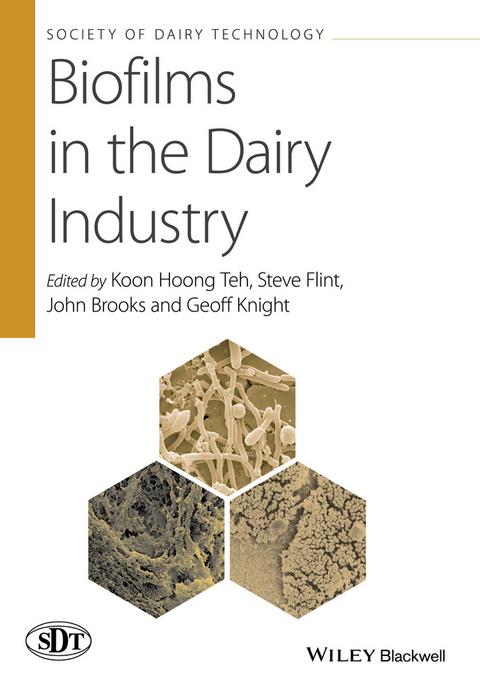
Biofilms in the Dairy Industry (eBook)
John Wiley & Sons (Verlag)
978-1-118-87623-7 (ISBN)
In recent years, the formation and impacts of biofilms on dairy manufacturing have been studied extensively, from the effects of microbial enzymes produced during transportation of raw milk to the mechanisms of biofilm formation by thermophilic spore-forming bacteria. The dairy industry now has a better understanding of biofilms and of approaches that may be adopted to reduce the impacts that biofilms have on manufacturing efficiencies and the quality of dairy products. Biofilms in the Dairy Industry provides a comprehensive overview of biofilm-related issues facing the dairy sector. The book is a cornerstone for a better understanding of the current science and of ways to reduce the occurrence of biofilms associated with dairy manufacturing. The introductory section covers the definition and basic concepts of biofilm formation and development, and provides an overview of problems caused by the occurrence of biofilms along the dairy manufacturing chain. The second section of the book focuses on specific biofilm-related issues, including the quality of raw milk influenced by biofilms, biofilm formation by thermoduric streptococci and thermophilic spore-forming bacteria in dairy manufacturing plants, the presence of pathogens in biofilms, and biofilms associated with dairy waste effluent. The final section of the book looks at the application of modelling approaches to control biofilms. Potential solutions for reducing contamination throughout the dairy manufacturing chain are also presented. Essential to professionals in the global dairy sector, Biofilms in the Dairy Industry will be of great interest to anyone in the food and beverage, academic and government sectors. This text is specifically targeted at dairy professionals who aim to improve the quality and consistency of dairy products and improve the efficiency of dairy product manufacture through optimizing the use of dairy manufacturing plant and reducing operating costs.
Dr Koon Hoong Teh graduated from Massey University, Palmerston North, New Zealand, majoring in food technology. Steve Flint is Professor of Food Safety and Microbiology and director of the Food Division of the School of Food and Nutrition at Massey University, Palmerston North, New Zealand. John Brooks is Adjunct Professor of Food Microbiology at Auckland University of Technology, Auckland, New Zealand, and microbiology consultant at microTech Services Limited, Ashhurst, New Zealand. Geoff Knight is a food microbiologist, principal consultant for Food Process Hygiene Solutions, Melbourne, Victoria, Australia.
1
Introduction to Biofilms: Definition and Basic Concepts
Phil Bremer1, Steve Flint2, John Brooks3 and Jon Palmer2
1Department of Food Science, University of Otago, Dunedin, New Zealand
2Institute of Food, Nutrition and Human Health, Massey University, Palmerston North, New Zealand
3School of Applied Sciences, Faculty of Health and Environmental Sciences, Auckland University of Technology, Auckland, New Zealand
1.1 Definition of biofilms
In 2012, the term ‘biofilm’ was defined by the International Union of Pure and Applied Chemistry (IUPAC), Polymer Division as an ‘Aggregate of micro-organisms in which cells that are frequently embedded within a self-produced matrix of extracellular polymeric substances (EPS) adhere to each other and/or to a surface’. IUPAC included the following notes after the definition:
- Note 1: A biofilm is a fixed system that can be adapted internally to environmental conditions by its inhabitants.
- Note 2: The self-produced matrix of EPS, which is also referred to as slime, is a polymeric conglomeration generally composed of extracellular biopolymers in various structural forms.
The idea behind the development of this definition was to provide a terminology usable, without any confusion, in the various domains dealing with biorelated polymers, namely, medicine, surgery, pharmacology, agriculture, packaging, biotechnology and polymer waste management (Vert et al., 2012).
Bearing this definition in mind, in this book we use the term ‘biofilm’ to refer to ‘microorganisms attached to and growing, or capable of growing, on a surface’. This definition is broader than the IUPAC definition, as it includes cells or spores that are attached to a surface but have yet to produce a biofilm matrix. We have included attached cells not within a matrix in order to acknowledge that in many instances the act of attaching induces phenotypic changes to a cell. We have included the phrase ‘growing or capable of growing’ to reinforce the point that many of the unique features associated with biofilms arise as a result of the growth and replication of microorganisms on a surface, such as the production of EPS and the development of a complex three-dimensional structure.
In this chapter, we briefly discuss the importance of biofilms to the dairy industry, before introducing their general features, including their development, composition and structure, the advantages they confer to microorganisms living in them and how they may be controlled. This chapter serves as an introduction to the other chapters in the book, and includes cross-references to more detailed information on dairy-specific features in other chapters.
1.2 Importance of biofilms in the dairy industry
On a global basis, the dairy industry produces a wide range of perishable (milk and cream) and semiperishable foods (cheese, butter and yoghurt) and food ingredients (milk powders, whey protein concentrates and caseinates). Microbial contamination of dairy products is of great concern to the dairy industry. Strict adherence to microbiological guidelines is essential to maintain product quality, functionality and safety (see Chapter 4) and to allow companies to remain competitive in the international market.
Those microorganisms associated with bovine raw milk and dairy manufacturing plants that are of particular interest to the dairy industry can be divided into three major categories, namely, spoilage, pathogenic and beneficial microorganisms. Spoilage microorganisms can have an impact on the quality and sensory properties of milk and other dairy products, through the production of metabolic byproducts and/or extracellular enzymes. Pathogenic microorganisms (see Chapter 9) have the potential to cause human illness and to have significant economic repercussions. Beneficial microorganisms generally belong to a diverse group loosely termed ‘lactic acid-producing bacteria’ (LAB) and are used as starter cultures for the manufacture of cheese, yoghurt and other fermented dairy products. A subgroup of LAB that is becoming more commonly used in fermented dairy products, such as yoghurt, is the probiotic bacteria, which include strains of Lactobacillus and Bifidobacterium (Jamaly et al., 2011; Quigley et al., 2013).
Biofilms have become a major issue within the dairy industry and are now recognised as sources, or potential sources, of contamination by spoilage or pathogenic microorganisms, which can decrease product safety, stability, quality and value. Many manufacturing processes provide unique niches, within processing equipment, where bacteria are able to grow and survive. Examples are thermoresistant streptococci in pasteurisation equipment (see Chapter 6) and thermophilic spore-forming bacteria in milk powder production equipment (see Chapter 7). Within the last 2–3 decades the importance of biofilms in the processing environment has also been recognised, particularly around drains and other locations that are difficult to reach and where cleaning and sanitation applications may be inadequate to eliminate bacteria present within biofilms.
In dairy manufacturing plants, biofilms can be divided into two categories: process biofilms, which are unique to processing plants and form on surfaces in direct contact with flowing product; and environmental biofilms, which form in the processing environment, such as in niches where cleaning and sanitation is poor and around drains. Process biofilms differ from environmental biofilms in two key ways. First, in a process biofilm, one or a few species may dominate, as the unit operation employed (e.g. pasteurisation equipment) may select for particular groups of bacteria (e.g. thermoduric). Second, process biofilms are frequently characterised by rapid growth rates. An example of this is the increase in numbers from ‘not detectable’ to 106 bacteria per cm2 within 12 hours of operation that occurs in the regeneration section of a pasteurisation plant (Bouman et al., 1892). In contrast, environmental biofilms can take several days or weeks to develop (Zottola & Sasahara, 1994).
1.3 Biofilm formation
The development of a biofilm on a surface follows a logical series of steps, in which the first step is the initial contact of the free-living microorganism with the surface. The initial interaction of cells with a surface is influenced by a wide range of chemical, physical and biological cues, as outlined in detail in Chapter 2. In general, the initial interactions are influenced by: (i) the surface topography, chemistry (functional groups, surface charge, presence of antibacterial compounds) and free energy (hydrophobicity); (ii) environmental conditions, including temperature, pH, nutrients and the presence of other microorganisms, which can either inhibit or enhance contact; (iii) processing factors such as fluid velocity and shear force; and (iv) the various mechanisms employed by the cell (quorum sensing, nutrient sensing, production of EPS) and the cell surface structures (such as pili, flagella, fimbriae, adhesins) to interact with the surface (Figure 1.1).
Figure 1.1 Steps involved in biofilm formation over time (arrow) in a dairy processing plant under conditions of flow. (1) Cells and/or spores come into contact with a surface that may be fouled with protein, fat and salts. (2) Cells and spores attach to the fouled surface. (3) Spores germinate and cells grow, beginning to produce EPS. (4) Cells replicate, forming microcolonies enclosed in EPS. (5) Microcolonies increase in size and coalesce, forming complex three-dimensional aggregates of cells and EPS that may contain a variety of niches. (6) Dispersal of cells and spores from the biofilm occurs.
Once on or near a surface, a bacterium has to commit to adopting either an attached or a planktonic lifestyle based on a series of signals or cues it receives (Karatan & Watnick, 2009). An obvious cue for settlement is nutrient concentration, with high or low concentrations of nutrients promoting biofilm formation for different bacterial species. Bacteria, such as Salmonella spp., are more likely to join a multilayer biofilm in response to nutrient limitation (Gerstel & Romling, 2001), while for Vibrio cholera, the presence of glucose and other sugars induces production of a biofilm matrix and multilayer biofilm formation (Kierek & Watnick, 2003).
The second step in biofilm formation requires the cell to form at least a semipermanent association with the surface. This step is frequently referred to as the ‘attachment phase’. Many authors have broken this down into a reversible and an irreversible phase, but with increasing knowledge on cell dispersal, the term ‘irreversible attachment’ is proving to be overstated. In dairy processing plants, there is a wide range of different materials to which bacteria can attach, including 304 and 316 stainless steel, plastic, elastomer (rubber) materials, polyester/polyurethane (conveyor belt materials), epoxy surface coatings and tiles. Bacteria will attach at different rates and strengths to these materials. The ability of bacteria to attach to a surface and the rate at which they attach will, however, change as material (proteins, carbohydrates) from the processing environment comes into contact with the surface and modifies its characteristics. Such...
| Erscheint lt. Verlag | 29.6.2015 |
|---|---|
| Reihe/Serie | Society of Dairy Technology |
| Society of Dairy Technology Series | Society of Dairy Technology Series |
| Sprache | englisch |
| Themenwelt | Naturwissenschaften ► Biologie |
| Technik ► Lebensmitteltechnologie | |
| Weitere Fachgebiete ► Land- / Forstwirtschaft / Fischerei | |
| Schlagworte | Biofilm • Biofilms • Contamination • Dairy Food • dairy manufacturing • Evaporators • Food Science & Technology • Lactic Bacteria • Lebensmittelforschung u. -technologie • Medical Science • Medizin • Microbiology • Microbiology, Food Safety & Security • Mikrobiologie • Mikrobiologie u. Nahrungsmittelsicherheit • Mikrobiologie u. Virologie • Milchhygiene • Milchprodukte • pasteurisers • Pathogens • quality • raw milk • streptococci • thermophilic spore-forming bacteria |
| ISBN-10 | 1-118-87623-7 / 1118876237 |
| ISBN-13 | 978-1-118-87623-7 / 9781118876237 |
| Informationen gemäß Produktsicherheitsverordnung (GPSR) | |
| Haben Sie eine Frage zum Produkt? |
 EPUB (Adobe DRM)
Kopierschutz: Adobe-DRM
Adobe-DRM ist ein Kopierschutz, der das eBook vor Mißbrauch schützen soll. Dabei wird das eBook bereits beim Download auf Ihre persönliche Adobe-ID autorisiert. Lesen können Sie das eBook dann nur auf den Geräten, welche ebenfalls auf Ihre Adobe-ID registriert sind.
Details zum Adobe-DRM
Dateiformat: EPUB (Electronic Publication)
EPUB ist ein offener Standard für eBooks und eignet sich besonders zur Darstellung von Belletristik und Sachbüchern. Der Fließtext wird dynamisch an die Display- und Schriftgröße angepasst. Auch für mobile Lesegeräte ist EPUB daher gut geeignet.
Systemvoraussetzungen:
PC/Mac: Mit einem PC oder Mac können Sie dieses eBook lesen. Sie benötigen eine
eReader: Dieses eBook kann mit (fast) allen eBook-Readern gelesen werden. Mit dem amazon-Kindle ist es aber nicht kompatibel.
Smartphone/Tablet: Egal ob Apple oder Android, dieses eBook können Sie lesen. Sie benötigen eine
Geräteliste und zusätzliche Hinweise
Buying eBooks from abroad
For tax law reasons we can sell eBooks just within Germany and Switzerland. Regrettably we cannot fulfill eBook-orders from other countries.
aus dem Bereich