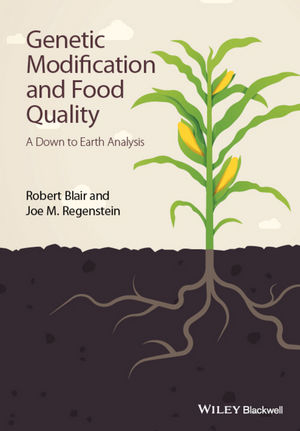
Genetic Modification and Food Quality (eBook)
John Wiley & Sons (Verlag)
978-1-118-82361-3 (ISBN)
The development of recombinant DNA methods has changed the face of the food industry over the last 50 years. Crops which have been genetically modified are being cultivated in more and more countries and this process is likely to accelerate as desirable traits are identified and transferred to appropriate organisms, and they are cleared by the regulatory authorities. However, the technique has its critics who claim that modification of the genome of the plant (or animal) in this way may pose unknown and unacceptable risks to the human consumer. Genetic Modification and Food Quality: A Down to Earth Analysis is the first comprehensive text on how GM production methods influence the quality of foods and feeds, based on a complete and unbiased assessment of the scientific findings. It presents a balanced analysis of the benefits and drawbacks of gene-modified food sources in the human diet. Chapters approach the topic with regard to different food types such as cereal grains, oilseed crops, vegetables, fish and animal products. Assessing the nutritive value as well as the health and safety of GMO foods, this book is a reference for anyone working in the food production industry and will also be of an interest to NGOs, trade associations and consumers who are looking for an objective, balanced study of this contentious issue.
Robert Blair, DSc, is Professor Emeritus in the Faculty of Land and Food Systems at the University of British Columbia, Vancouver, Canada. Joe M. Regenstein, PhD, is Professor Emeritus in the Department of Food Science at Cornell University, Ithaca, New York, USA.
1 Introduction 1
2 International regulations 4
3 Microorganisms 20
4 Cereals 35
5 Oilseed crops 81
6 Fruits and vegetables 141
7 Fish and other animals 174
8 Animal products 181
9 Overall assessment of the safety of GM foods and feeds 200
10 Overall assessment of the nutritional value of GM foods and feeds 211
11 Addressing consumer issues 250
12 Overall conclusions 262
Index 271
"Genetic Modification and Food
Quality: A Down to Earth Analysis
is the first comprehensive text
on how GM production methods
influence the quality of foods
and feeds, based on a complete
and unbiased assessment of the
scientific findings. It presents a
balanced analysis of the benefits
and drawbacks of gene-modified
food sources
in the human
diet." (South African Food Science and Technology July 2017)
CHAPTER 2
International regulations
Developed countries have government agencies to ensure that the food we buy is safe. All foods, often a specific legal category that excludes other materials such as food additives, are subject to the same regulations, regardless of source and country of origin of the food. The regulations in most such countries include provisions relating to GM foods and also for feed for food-producing animals.
An important feature of the regulatory process relating to the approval of GM foods such as cereal grains is that the approved product is patented and licensed to the companies that developed them. They can then be produced either by the company owning the patent or under license by any other company approved by the patent holder.
The approval process for the assessment of GM products for use in food and feed in most (if not all) jurisdictions involves the submission of extensive supporting documentation by the applicant company to the relevant regulatory agency. Approval follows the assessment and acceptance of the submitted documentation. In many cases, the regulatory agencies will ask for additional information if the material submitted is incomplete. Some commentators dislike this process in that the supporting documentation is not made public. However, it is similar to the approval process for other patented products such as pharmaceuticals. Since the supporting documentation has to be comprehensive, it often requires disclosure of proprietary information that the government agency is required to protect. Thus, companies are confident that information provided to the government will not find its way into the hands of competitors.
Leaders in developing the appropriate regulations for GM foods and feeds are those countries in North America, the European Community (EC) and Australasia. It is clear that not all decisions on food and related issues are reached on the basis of the scientific evidence alone. These other influences can arise both in the legislative process that defines the framework for how a topic might be handled, and during the regulatory process when the broad scope of the legislation is turned into regulatory language that will be enforced by the appropriate executive branch department or ministry. And sometimes they will even arise thereafter in how the department or ministry actually enforces its own regulations.
Decisions by regulatory authorities and their advisory committees can be swayed by interpretation of safety thresholds, trade benefits and political considerations, which can be influenced by lobbying – the advocacy by different groups for positions that favour their particular interests. Organisations, including religious, charitable, sociable or consumer group, are likely to be involved in lobbying, either formally or informally.
Attempts have been made to develop harmonised international regulations with relevance to GM foods, the goal being to allow goods to move freely between all countries operating with the same rules.
For instance, the Cartagena Protocol on Biosafety to the Convention on Biological Diversity is an international agreement involving 168 parties, including 166 United Nations member states, Niue, and the European Union, which aims to ensure the safe handling, transport and use of living modified organisms (LMO) resulting from modern biotechnology that may have adverse effects on biological diversity, also taking into account any risks to human health. It was adopted in 2000 and entered into force in 2003. Lebanon became the 165th signatory in 2013. Australia, the USA and Canada have yet to become signatories. The Protocol appears to be directed more towards ecological and environmental issues related to genetically modified organisms (GMOs) rather than the quality and safety of GM foods. Additionally, it appears that countries with advanced legislation on food quality and safety are not willing to delegate responsibility for this issue to an international body.
In the following pages, the authors will review some of the key legislation in various countries that specifically relates to GM foods.
North America
USA
Legislation applying to most food products, that is, everything other than meat, poultry and liquid eggs, is governed by the Federal Food, Drug, and Cosmetic Act (FFDCA), and the regulations issued under its authority by the US Food and Drug Administration (FDA). The FFDCA defines food as ‘articles used for food or drink for man or other animals’. The FDA Center for Food Safety and Applied Nutrition (CFSAN) is responsible for the regulation of human food products. The FDA Center for Veterinary Medicine (CVM) is responsible for the regulation of animal food (feed) products.
The FDA conducts a rigorous science-based assessment of the safety and quality of GM foods and feeds prior to their entry into the marketplace, unless the food(s) in question have GRAS (Generally Recognised As Safe) status. In addition food manufacturers must ensure the safety and quality of products that contain ingredients derived using GM technology.
The federal government in 1986 developed a Coordinated Framework for the Regulation of Biotechnology to provide for the regulatory oversight of organisms derived through genetic modification. The three principal agencies involved are the US Department of Agriculture (USDA) Animal and Plant Health Inspection Service (APHIS), the Environmental Protection Agency (EPA) and the FDA. The approach taken by the Coordinated Framework is based on the judgement of the National Academy of Sciences, a non-governmental agency set up to provide advice to the government, that the potential risks associated with these organisms fall into the same general categories as those risks created by using traditionally bred organisms. Products are regulated according to their intended use, with some products being regulated by more than one agency depending on use. All the government regulatory agencies involved have a responsibility to ensure that the implementation of regulatory decisions, including approval of field tests of any GM crops and eventual deregulation of approved biotech crops, does not adversely impact human health or the environment. In 1992, the FDA provided a general outline for the safety assessment of GM technology derived food products based on a risk analysis related to the characteristics of the products.
The FDA carries out its responsibility for the regulation of animal feed in cooperation with state and local partners. For instance, FDA cooperates with the Association of American Feed Control Officials (AAFCO) and the states to allow for the implementation of uniform policies in all US jurisdictions for regulating the use of animal feed products. Although FDA has the responsibility for regulating the use of animal feed products, the ultimate responsibility for the production of safe and effective animal feed products lies with the manufacturers and distributors of the products.
The Federal, Food, Drug and Cosmetic Act (FFDCA) requires that any substance that is added to or is expected to become a component of animal feed, either directly or indirectly, must be used in accordance with a food additive regulation unless it is GRAS. Typical feed ingredients – such as forages, grains, and most minerals and vitamins – are GRAS as sources of nutrients.
The FDA regards traditional food and feed products as safe, based on a long history of use. Therefore in assessing the acceptability of a GM food or feed, it uses the concept of substantial equivalence. If it can be demonstrated that the GM product is as safe and nutritious as its conventional equivalent, then the GM product is deemed acceptable. Otherwise the GM product is not approved for food or feed use.
Other agencies outside of the USA also accept the substantial equivalence approach. The Food and Agriculture Organization (FAO) and World Health Organization (WHO) of the United Nations in 2000 stated that the substantial equivalence approach ‘is considered the most appropriate strategy for the safety and nutritional assessment of genetically modified foods’. And while substantial equivalence is not a safety assessment in itself, in that it does not characterise any hazards, ‘it is used to structure the safety assessment of a genetically modified food relative to a conventional counterpart’. Similarly, the Organization for Economic Cooperation and Development (OECD) in 2000 concluded: ‘Safety assessment based on substantial equivalence is the most practical approach to address the safety of food and food components derived through modern biotechnology.’
Canada
Health Canada is the federal agency responsible for provisions related to public health, food safety and nutrition, under the Food and Drugs Act and the agency’s subsequent regulations. This agency conducts pre-market evaluations to assess the safety and nutritional adequacy of foods proposed for sale in Canada as well as health risk assessments related to chemical, physical and microbiological contaminants, toxicants and allergens. GM foods are considered to be a class of ‘novel foods’, regulated by the same agency. Manufacturers and importers who wish to sell or advertise a GM food in Canada must submit data to Health Canada for a pre-market safety assessment, which involves a rigorous scientific evaluation by Health Canada evaluators with expertise in molecular biology, toxicology, chemistry, immunology, nutritional sciences and microbiology. This safety assessment provides assurance that the food, if acceptable, is safe when...
| Erscheint lt. Verlag | 26.6.2015 |
|---|---|
| Sprache | englisch |
| Themenwelt | Naturwissenschaften ► Biologie |
| Technik ► Lebensmitteltechnologie | |
| Weitere Fachgebiete ► Land- / Forstwirtschaft / Fischerei | |
| Schlagworte | Agriculture • Biowissenschaften • cereal grains • crops • Environment • ethics • Feldfrüchte • Feldfrüchte • Food Quality • Food Science & Technology • Genetic modifications • Genetics • Genetik • GMO • Health • Landwirtschaft • Lebensmittelforschung u. -technologie • Life Sciences • Microbiology, Food Safety & Security • Mikrobiologie • Mikrobiologie u. Nahrungsmittelsicherheit • Nutrition • oilseed • Pesticides • Safety |
| ISBN-10 | 1-118-82361-3 / 1118823613 |
| ISBN-13 | 978-1-118-82361-3 / 9781118823613 |
| Informationen gemäß Produktsicherheitsverordnung (GPSR) | |
| Haben Sie eine Frage zum Produkt? |
 EPUB (Adobe DRM)
Kopierschutz: Adobe-DRM
Adobe-DRM ist ein Kopierschutz, der das eBook vor Mißbrauch schützen soll. Dabei wird das eBook bereits beim Download auf Ihre persönliche Adobe-ID autorisiert. Lesen können Sie das eBook dann nur auf den Geräten, welche ebenfalls auf Ihre Adobe-ID registriert sind.
Details zum Adobe-DRM
Dateiformat: EPUB (Electronic Publication)
EPUB ist ein offener Standard für eBooks und eignet sich besonders zur Darstellung von Belletristik und Sachbüchern. Der Fließtext wird dynamisch an die Display- und Schriftgröße angepasst. Auch für mobile Lesegeräte ist EPUB daher gut geeignet.
Systemvoraussetzungen:
PC/Mac: Mit einem PC oder Mac können Sie dieses eBook lesen. Sie benötigen eine
eReader: Dieses eBook kann mit (fast) allen eBook-Readern gelesen werden. Mit dem amazon-Kindle ist es aber nicht kompatibel.
Smartphone/Tablet: Egal ob Apple oder Android, dieses eBook können Sie lesen. Sie benötigen eine
Geräteliste und zusätzliche Hinweise
Buying eBooks from abroad
For tax law reasons we can sell eBooks just within Germany and Switzerland. Regrettably we cannot fulfill eBook-orders from other countries.
aus dem Bereich