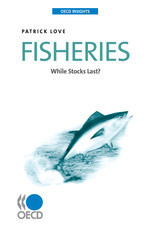
OECD Insights Fisheries While Stocks Last? (eBook)
152 Seiten
OECD Publishing (Verlag)
978-92-64-10717-5 (ISBN)
The fish on your plate may have been caught by a high-tech trawler, trapped by a lone fisher, farmed along with tons of others, or even stolen by pirates. It may have been captured in the South Atlantic, landed in Europe, and processed in China. Globalisation, North-South relations, changing attitudes and lifestyles, and the way we manage natural resources all influence fisheries.
This book uses the expertise of the OECD to assess these issues, and describes the challenges facing those who work in the industry. Apart from the fishers themselves and their families, it also draws on the points of view of NGOs, government specialists, scientists and independent experts.
This book includes StatLinks, URLs under graphs and tables linking to Excel® spreadsheets showing the underlying data
"We at International Aquafeed would recommend this to anyone involved in marine fishing and even to those in aquaculture to and aqua policy development as a foundation document for future decision-making. Well done Patrick Love."
-The Aquaculturists Blog
The fish on your plate may have been caught by a high-tech trawler, trapped by a lone fisher, farmed along with tons of others, or even stolen by pirates. It may have been captured in the South Atlantic, landed in Europe, and processed in China. Globalisation, North-South relations, changing attitudes and lifestyles, andthe waywe manage natural resources all influence fisheries. This book uses the expertise of the OECD to assess these issues, and describes the challenges facing those who work in the industry. Apart from the fishers themselves and their families, it also draws on the points of view of NGOs, government specialists, scientists and independent experts. This book includes StatLinks, URLs under graphs and tables linking to Excel spreadsheets showing the underlying data "e;We at International Aquafeed would recommend this to anyone involved in marine fishing and even to those in aquaculture to and aqua policy development as a foundation document for future decision-making. Well done Patrick Love."e; -The Aquaculturists Blog
1. Fishing: Difficult, Dangerous and Doomed?
| We eat more fish than ever, and the use of oils and other fish products is growing, yet the most commercially important stocks are being fished at or near their ecologically sustainable limits and there are fears that the industry may collapse in some regions. Addressing the problems means tackling a number of interlinked economic, social, environmental and legal issues, and will require a far higher degree of co-operation and agreement than has been the case so far. |
By way of introduction …
What's bigger, faster and costlier than a sports car, and is edible too? Answer: a bluefin tuna. An adult measures 2 metres long for 250 kg, but can grow to over 4 metres and 650 kg. Bluefin usually swim at around 3 to 7 km/hour, but can suddenly accelerate to 70 to 100 km/hour when closing in on prey.
At the first auction of 2010 in Tokyo's Tsujiki market, a single bluefin tuna sold for 16.3 million yen ($177 777). The record is 20.2 million yen ($220 000) paid for another tuna in 2001, and at those prices you can easily understand why fishers want to catch as many as they can.
They may do so using “long lines” and also by “ranching”. Long lines are rows of hooks over 80 km in length, while ranching consists of taking the fish alive and fattening them in pens. Capture techniques are so efficient, and stocks have been hit so hard in some fisheries, that there have been calls to put the species on the UN's Convention on International Trade in Endangered Species (CITES) list.
The bluefin is only one example of the fisheries industry making the news because of reports of fish stocks or species in danger of extinction, or because of actions by fishers to protest plans to restructure the industry. Fisheries are popular with other parts of the media, too. In the UK, the BBC attracted huge audiences with a documentary series on trawlers from Northeast Scotland, while in the US, Discovery Channel did the same with crab fishers in the Bering Sea.
Part of the attraction is the fascination of dangerous, difficult work in spectacular surroundings. There's also the feeling in more nostalgic presentations that fishing like this can't go on, and that it's a dying occupation. Yet by some measures, fishing is a thriving industry. Demand for fisheries products is growing, thanks in part to the general increase in demand for food products worldwide, and also because of the healthy image of fish and fish oils, rich in omega-3. At the same time, as the media reports show, crises are frequent, even chronic.
Practically everybody involved in fishing recognises the problems of too many boats chasing too few fish, but, quite understandably, few, if any, are prepared to sacrifice their own livelihood in the greater interest of all. The result is often “a race to fish”, sometimes encouraged by government policies such as subsidies, or by lack of effective management of fisheries.
The key challenges concern how to manage the world's oceans and how to devise policies that are fair to all concerned. In other words, how to manage a common resource where each person's consumption reduces availability of the resource to others – the central theme in the work of Elinor Ostrom, who won the 2009 Nobel Prize for economics. Success in building a sector that is economically and environmentally sustainable hinges on a major shift in thinking on how to manage a shared, relatively unpredictable, resource.
There are a number of other challenges too. The technology used for fishing is becoming ever more sophisticated and ever more efficient. In other industries, this would be seen as entirely good news, allowing production to grow and reducing the costs and time needed to make things. In fishing though, technological progress can have negative effects, destroying the sector's resource base and obliging boats to stay at sea longer to maintain catches.
Technology can also replace people, and employment in the industry is affected by the need for fewer crew members on the boats and greater automation in fish processing factories.
What this book is about
Fishing provides vivid examples of many of the preoccupations of citizens and governments today. Biodiversity is perhaps the most obvious one – the threat to fish stocks is well documented.
But fishing also illustrates a number of other issues in a concrete way. At the time of writing this book, the crisis in financial markets and the recession it precipitated are worrying people everywhere. Fishing has been affected too, both directly by the drop in scales of “luxury” products and indirectly.
Around 40 per cent of fish from capture fisheries and aquaculture are traded internationally and fisheries products are the single most traded food commodity in the world, ahead of tea, coffee, bananas or cocoa. Like other businesses, this relies on credit, but loans are becoming harder to obtain as banks tighten requirements particularly for high risk enterprises such as fishing. Moreover, the early victims of the financial crisis included big Icelandic banks that were important in financing the fishing industry.
Unlike previous crises such as sudden fuel price hikes, the credit crunch affects aquaculture too. Some species take a couple of years to grow to a marketable size. During this time, fish farmers may need loans to buy feed and keep the business going until the fish are harvested. Moreover, restaurants, a big part of the fish trade, are among the first sectors to be hit as consumers start cutting back on non-essential items.
Fishing also illustrates long-term social and economic trends. Take the issue of population ageing and its impact on the workforce. An OECD workshop on the social aspects of changes to the fishing industry was told about the implications of ageing for the Japanese industry. The statistics themselves are impressive enough. The percentage of male fishery workers over 60 years old went up from 14% in 1971 to 47% in 2004. In 2004, only 13% of them were aged between 25 and 39, and only 3% between 15 and 24 years old.
What does that actually mean on a fishing boat? Small coastal trawlers are operated by 2-3 man crews. They have to hoist the net completely on board to gather the catch and release the untargeted species (bycatch). However, as crews become older, their physical strength wanes and they are unable to pull the net up as frequently. As a result, the net may stay underwater for hours. The fish become compressed and their commercial value decreases. The survival rates of bycatch and that of undersized fish fall, because they're not released in time.
Change in the labour force is only one topic we'll be looking at in the following chapters. We'll start by describing the state of the various subsectors that make up the industry – industrial fishing, artisanal fishing, subsistence fishing, recreational fishing and aquaculture.
As we said, biodiversity is a major concern, and we'll examine the physical environment in which fishing takes place, not just biodiversity, but climate change, pollution, urbanisation and other factors interacting with fishing.
Descriptions of Dutch fishers operating out of English ports or Basque fleets ranging up to Newfoundland hundreds of years ago remind us that fisheries have been globalised for centuries, even if not on the scale seen today. We'll look at how the different parts of the chain link together to produce, process and distribute the fish we eat and use for other purposes.
The historical outline focusses on European fishers and northern fisheries, since they created the modern industry. But it's not possible to understand fully what is happening today without looking at the role other countries are playing, and how they are transforming fishing production and markets.
The natural reaction to much of what is going on is to wonder why nobody is doing anything about it. In fact many people are trying to do something – the fishers themselves, the industry more generally, governments, NGOs, and shoppers who buy one kind of fish rather than another, or something else instead of fish. All these groups may agree on a few basic goals, but how to achieve them is another matter. We'll therefore look at the controversies and contradictions behind bland jargon such as “structural adjustment” or “policy coherence”.
Finally, we'll try to bring all these strands together to summarise the challenges the industry is facing and examine the responses. The aim is not to present a consensus. This book will not achieve what years of discussion and dispute have failed to bring about. Our hope is that you the reader will come away with a better understanding of the issues, even if you don't agree with all our analyses.
Chapter 2 describes the history of fishing and what has and hasn't changed over the thousand centuries people have been catching fish.
Chapter 3 summarises the state of the industry today, looking at capture fisheries and aquaculture, as well as recreational fishing.
Chapter 4 examines the interactions between fishing and the environment, both how the environment influences fishing, and how fishing influences the environment.
Chapter 5 studies pirate fishing and why it is so hard to stop it.
Chapter 6 outlines the impacts of social and economic...
| Erscheint lt. Verlag | 17.6.2011 |
|---|---|
| Sprache | englisch |
| Themenwelt | Technik |
| Weitere Fachgebiete ► Land- / Forstwirtschaft / Fischerei | |
| ISBN-10 | 92-64-10717-7 / 9264107177 |
| ISBN-13 | 978-92-64-10717-5 / 9789264107175 |
| Informationen gemäß Produktsicherheitsverordnung (GPSR) | |
| Haben Sie eine Frage zum Produkt? |
 EPUB (Adobe DRM)
Kopierschutz: Adobe-DRM
Adobe-DRM ist ein Kopierschutz, der das eBook vor Mißbrauch schützen soll. Dabei wird das eBook bereits beim Download auf Ihre persönliche Adobe-ID autorisiert. Lesen können Sie das eBook dann nur auf den Geräten, welche ebenfalls auf Ihre Adobe-ID registriert sind.
Details zum Adobe-DRM
Dateiformat: EPUB (Electronic Publication)
EPUB ist ein offener Standard für eBooks und eignet sich besonders zur Darstellung von Belletristik und Sachbüchern. Der Fließtext wird dynamisch an die Display- und Schriftgröße angepasst. Auch für mobile Lesegeräte ist EPUB daher gut geeignet.
Systemvoraussetzungen:
PC/Mac: Mit einem PC oder Mac können Sie dieses eBook lesen. Sie benötigen eine
eReader: Dieses eBook kann mit (fast) allen eBook-Readern gelesen werden. Mit dem amazon-Kindle ist es aber nicht kompatibel.
Smartphone/Tablet: Egal ob Apple oder Android, dieses eBook können Sie lesen. Sie benötigen eine
Geräteliste und zusätzliche Hinweise
Buying eBooks from abroad
For tax law reasons we can sell eBooks just within Germany and Switzerland. Regrettably we cannot fulfill eBook-orders from other countries.
aus dem Bereich