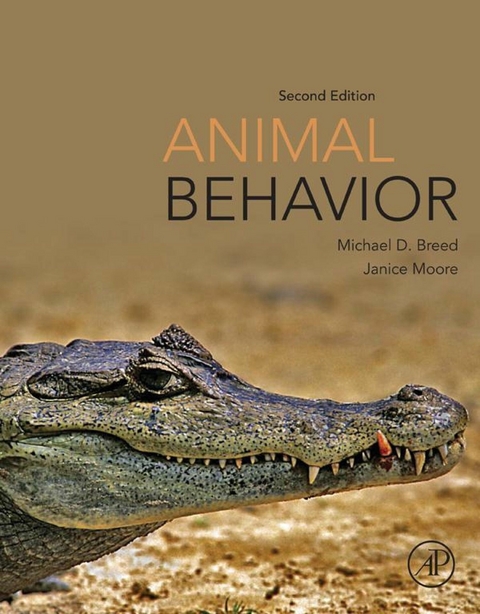
Animal Behavior (eBook)
552 Seiten
Elsevier Science (Verlag)
978-0-12-801683-1 (ISBN)
After receiving his PhD from the University of Kansas in 1977, Dr. Breed began work as a faculty member at the University of Colorado, Boulder and taught as a Professor in the Department of Ecology and Evolutionary Biology until his retirement in 2019. He taught courses in general biology, animal behavior, insect biology, and tropical biology. His research program focused on the behavior and ecology of social insects, and he worked on ants, bees, and wasps. He studied many aspects of social behavior, including nestmate recognition, division of labor, the genetics of colony defense, the behavior of defensive bees, and communication during colony defense. Dr. Breed was the Executive Editor of the scientific journals Animal Behaviour from 2006-2009 and Insectes Sociaux from 2014-2018.
Animal Behavior, Second Edition, covers the broad sweep of animal behavior from its neurological underpinnings to the importance of behavior in conservation. The authors, Michael Breed and Janice Moore, bring almost 60 years of combined experience as university professors to this textbook, much of that teaching animal behavior. An entire chapter is devoted to the vibrant new field of behavior and conservation, including topics such as social behavior and the relationship between parasites, pathogens, and behavior. Thoughtful coverage has also been given to foraging behavior, mating and parenting behavior, anti-predator behavior, and learning. This text addresses the physiological foundations of behavior in a way that is both accessible and inviting, with each chapter beginning with learning objectives and ending with thought-provoking questions. Additionally, special terms and definitions are highlighted throughout. Animal Behavior provides a rich resource for students (and professors) from a wide range of life science disciplines. - Provides a rich resource for students and professors from a wide range of life science disciplines- Updated and revised chapters, with at least 50% new case studies and the addition of contemporary in-text examples- Expanded and updated coverage of animal welfare topics- Includes behavior and homeostatic mechanisms, behavior and conservation, and behavioral aspects of disease- Available lab manual with fully developed and tested laboratory exercises- Companion website includes newly developed slide sets/templates (PowerPoints) coordinated with the book
Preface
Michael D. Breed and Janice Moore
The world of animal behavior changes rapidly, and in this second edition of Animal Behavior we reflect some of that change. We have remained true to the overall organization of the first edition; it works for us in our classrooms, and as we have heard from colleagues, it also works well for them. Throughout that organizational structure, we have added new material and deleted some material as well, updating references along the way. We have modified over 40 figures and added several new case studies. In particular, Chapter 2 (Neurobiology and Endocrinology for Animal Behaviorists) has been thoroughly updated. In Chapter 3 (Behavioral Genetics), the “toolbox” approach has given way to a more linear presentation after considerable rewriting. Behavioral syndromes and related material can now be found in Chapter 4 (Homeostasis and Time Budgets), and magnetoreception is addressed in greater detail (Chapters 2 and 8). We have enhanced coverage of parasite-induced behavioral changes, be they manipulative (Chapter 9) or defensive (Chapter 10). Throughout the book, we have increased examples demonstrating that small squishy and crunchy animals exhibit behaviors that are every bit as intriguing as the actions of the so-called charismatic megafauna. In almost every chapter, we have modified and added to our coverage of “Bringing Animal Behavior Home,” topics that invariably capture student interest. In short, our aim has been that of every good revision—improve and update, keeping the best elements of the book and adding to them.
In so doing, we continue to offer students an accessible approach to the major principles, mechanisms and controversies in the study of animal behavior. Throughout the book, we use Tinbergen’s four questions—causation, survival value, ontogeny, and evolution—to frame animal behavior and to lend coherence to a diverse and highly integrative field of scientific inquiry. We see that same inquiry at the heart of the discipline, so we emphasize how to test hypotheses about animal behavior, and we encourage students to think critically about experimental evidence.
We take stands on controversial issues in this book and have clearly expressed our points of view in scientific interpretations. We do not expect faculty members who teach animal behavior courses to agree with all of our interpretations. (Indeed, the two of us have had some lively discussions about some of these topics as the work has progressed!) Instead, we see areas of disagreement as pedagogical tools to help students understand that not all scientific issues are settled. In fact, we have highlighted those unsettled areas, because a textbook is not a compendium of absolute knowledge; it is a snapshot of current scientific understanding. We encourage faculty and students who use this textbook to approach our statements critically, and to ask how further hypothesis testing will improve knowledge and understanding.
Every field has a history, but the history of animal behavior is particularly informative because it teaches us so much about how scientists sort through controversy and learn, collectively, how to think critically. It also tells us why we are only now asking questions that might have been off-limits to earlier workers. We therefore begin this book with a brief overview of that history. Then, because evolution is, famously, that thing without which nothing in biology makes sense, we follow history with a refresher on evolution. In our experience as teachers, we have realized that such a refresher is often desirable.
After this introductory chapter, our approach flows from the physiological and genetic underpinnings of behavior (Chapters 2 and 3) through behavioral concerns of individual animals to the complexities of social behavior (Chapters 13 and 14). Chapters 2 and 3 provide ample foundation for mechanisms-oriented animal behavior courses and offer background for students in courses that do not emphasize mechanisms. Building on mechanisms, we consider behavioral homeostasis (Chapter 4). Learning (Chapter 5) and cognition (Chapter 6) are aspects of animal behavior that link neural processes with the behavior of the animal itself. An understanding of communication (Chapter 7) involves not only the underlying mechanisms, but the behavior of at least two participants. Midway through the book a study of orientation and migration (Chapter 8) builds a bridge from mechanisms to behavioral ecology. Behavioral ecologists will find contemporary coverage of the key elements of behavioral ecology in chapters on foraging (Chapter 9), self-defense (Chapter 10), mating systems (Chapter 11), parenting (Chapter 12), and social behavior (Chapters 13 and 14). Chapter 15 introduces the exciting—and essential—field of conservation behavior.
In our coverage, we recognize two emerging topics in animal behavior, cognition (Chapter 6) and conservation (Chapter 15), with full chapters. Cognition presents engaging and difficult hypotheses that will challenge our students, perhaps more than any other topic in animal behavior. Given societal debates over our relationships with animals and the ethics of maintaining animals in farms, zoos, and human households, our chapter on cognition provides a timely overview of the scientific evidence in that field. Cognition is one of the Next Big Topics in animal behavior and reveals some dimly lit areas of the discipline; we invite students to step onto the ground floor of an area of study that in the future will likely revolutionize our concept of and relationship with animals.
As for conservation, there is no denying that many species are in peril. Effective animal conservation programs can exist only with a thorough understanding of the behavior of the species that the programs seek to save. In our experience, community, ecosystems, and landscape-level ecologists often give short shrift to the importance of animal behavior in making conservation choices, and in so doing, they run the risk of failure. Effective conservation programs require knowledge of foraging behavior, mating systems, dispersal, and migration. Successful release of captive-reared animals—an increasingly important strategy in saving endangered species—requires substantial knowledge of animal learning, ranging from imprinting to learned aspects of foraging and antipredator behavior. We offer the last chapter of this text as a platform for integrating behavior and conservation, and hope to inspire a generation of students to use behavior as a conservation tool.
The majority of animal behavior students will not go on to careers in animal behavior, but most of them will enjoy the companionship of animals. We have highlighted the behavior of companion animals in special features called “Bringing Animal Behavior Home.” This dimension of animal behavior is often important to students but may be overlooked in textbooks intended for animal behavior courses. Teachers of animal behavior courses may opt to cover companion animals, but even if a lecturer does not mention dogs or cats, including them in the text is one more reason for a student to read this book. This material also appeals to preveterinary students, who often enroll in animal behavior courses as preparation for their careers.
Because of our emphasis on evolution, we have not strictly excluded humans from our textbook, but neither is human behavior emphasized. Instead, when we do refer to human behavior, it is often in the context of questioning the traditional distinction between nonhuman animals and humans—a distinction that may be artificial in places, lacking sufficient scientific scrutiny. We explicitly reject an overly simplistic “my-genes-made-me-do-it” approach to behavior in general and human behavior in particular. In asking students to consider the continuum of all living things, we aim to promote critical thinking and a new consideration of traits that we may share with other species as a result of descent from common ancestors.
The laboratory manual that accompanies this text (Field and Laboratory Exercises in Animal Behavior) contains proven exercises. We encourage instructors who have not incorporated a laboratory in their course to consider doing so. A successful laboratory experience in animal behavior need not be expensive to present. The laboratory manual puts a strong focus on inquiry-based student participation, developing student strengths in hypothesis testing, and on giving the students hands-on experiences with topics covered in animal behavior courses. The exercises in the manual include a mix of field studies and laboratory studies. The targeted species of the field studies are widespread, and if the species mentioned in the manual does not occur locally, substitutions should be easy. The laboratory studies rely on easily obtained study animals. The focus is slightly biased to experiments with invertebrate animals; this reduces the burden of obtaining IACUC approval for some of the laboratories. However, the most popular laboratory for our students is a multi-week exploration of Betta (Siamese fighting fish) behavior.
This book is an outgrowth of our decades of teaching animal behavior—what we have learned, what we have wished for, where we have found great joy. As we have worked through this immense undertaking, we have been impressed with the wide-ranging curiosity of our colleagues, friends, and students, and with their willingness to help in so many ways,...
| Erscheint lt. Verlag | 16.5.2015 |
|---|---|
| Sprache | englisch |
| Themenwelt | Naturwissenschaften ► Biologie ► Zoologie |
| Sozialwissenschaften ► Soziologie | |
| Technik | |
| Weitere Fachgebiete ► Land- / Forstwirtschaft / Fischerei | |
| ISBN-10 | 0-12-801683-3 / 0128016833 |
| ISBN-13 | 978-0-12-801683-1 / 9780128016831 |
| Informationen gemäß Produktsicherheitsverordnung (GPSR) | |
| Haben Sie eine Frage zum Produkt? |
 EPUB (Adobe DRM)
Kopierschutz: Adobe-DRM
Adobe-DRM ist ein Kopierschutz, der das eBook vor Mißbrauch schützen soll. Dabei wird das eBook bereits beim Download auf Ihre persönliche Adobe-ID autorisiert. Lesen können Sie das eBook dann nur auf den Geräten, welche ebenfalls auf Ihre Adobe-ID registriert sind.
Details zum Adobe-DRM
Dateiformat: EPUB (Electronic Publication)
EPUB ist ein offener Standard für eBooks und eignet sich besonders zur Darstellung von Belletristik und Sachbüchern. Der Fließtext wird dynamisch an die Display- und Schriftgröße angepasst. Auch für mobile Lesegeräte ist EPUB daher gut geeignet.
Systemvoraussetzungen:
PC/Mac: Mit einem PC oder Mac können Sie dieses eBook lesen. Sie benötigen eine
eReader: Dieses eBook kann mit (fast) allen eBook-Readern gelesen werden. Mit dem amazon-Kindle ist es aber nicht kompatibel.
Smartphone/Tablet: Egal ob Apple oder Android, dieses eBook können Sie lesen. Sie benötigen eine
Geräteliste und zusätzliche Hinweise
Buying eBooks from abroad
For tax law reasons we can sell eBooks just within Germany and Switzerland. Regrettably we cannot fulfill eBook-orders from other countries.
aus dem Bereich