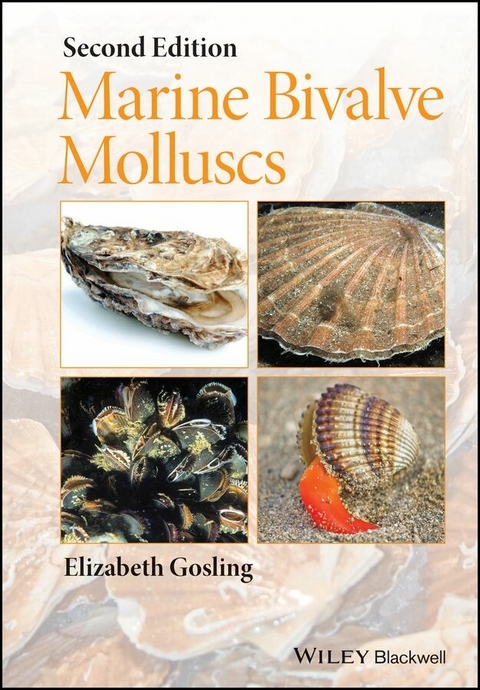
Marine Bivalve Molluscs (eBook)
536 Seiten
Wiley-Blackwell (Verlag)
978-1-119-04523-6 (ISBN)
Marine Bivalve Molluscs is a comprehensive and thoroughly updated second edition of Bivalve Molluscs, covering all major aspects of this important class of invertebrates. As well as being an important class biologically and ecologically, many of the bivalves are fished and cultured commercially (e.g. mussels, oysters, scallops and clams) in a multi-billion dollar worldwide industry.
Elizabeth Gosling has written a landmark book that will stand for many years as the standard work on the subject. Chapters in Marine Bivalve Molluscs cover morphology, ecology, feeding, reproduction, settlement and recruitment, growth, physiology, fisheries, aquaculture, genetics, diseases and parasites, and public health issues. A full understanding of many of these aspects is vital for all those working in bivalve fisheries and culture.
An essential purchase for anyone concerned with this important class of animals, copies of Marine Bivalve Molluscs should be on the shelves of biologists, ecologists, environmental scientists, fisheries scientists and personnel within the aquaculture industry. Copies of the book should be available in all libraries and research establishments where these subjects are studied or taught.
Reviews of the First Edition
• An admirable achievement... a valuable addition to marine sciences libraries everywhere. The back cover of this book says that it is a landmark text that will stand for many years as the standard work on this subject. I can only agree with this sentiment. Aquaculture
• A welcome addition to the literature and provides the reader with a comprehensive overview of biological and environmental factors that affect and control both natural populations of marine bivalves and culture operations. Aquaculture International
• The author has done an admirable job in compiling a wealth of information into a readable text. Transactions of the American Fisheries Society
• Will serve well as a description of much of both the experimental biology and the aquaculture of bivalves. Journal of Experimental Marine Biology and Ecology
• Provides excellent reviews of all major aspects...an extremely important reference for anyone engaged in bivalve research, fisheries management, and aquaculture. Quarterly Review of Biology
• The book is very readable, in an easy style. It is well illustrated and there is a wealth of data and statistics presented. Bulletin of The Malacological Society of London
Elizabeth Gosling PhD, DSc, based at the Galway-Mayo Institute of Technology, Ireland, is an author of international repute with a huge wealth of research, teaching and hands-on experience of working with bivalves.
ABOUT THE AUTHOR Elizabeth Gosling, PhD, DSc, based at the Galway-Mayo Institute of Technology, Ireland, is an author of international repute with a huge wealth of research, teaching and hands-on experience of working with bivalves.
1
Phylogeny and evolution of bivalve molluscs
The phylum Mollusca is one of the largest, most diverse and important groups in the animal kingdom, with at least 50 000 described species and probably as many as 200 000 living species, most of which are marine. The phylum has a remarkable fossil record going back to the Early Cambrian some 540 million years ago (Ponder & Lindberg 2008). Molluscs are soft-bodied animals but most have a hard protective shell. Inside the shell is a heavy fold of tissue called the mantle. The mantle encloses the internal organs of the animal. Another feature of the phylum is a large muscular foot that is generally used for locomotion.
Although most molluscs share this basic body plan the group is characterised by a great diversity of form and habit. As Morton (1967) aptly puts it:
Molluscs range from limpets clinging to rocks, to snails which crawl or dig or swim, to bivalves which anchor or burrow or bore, to cephalopods which torpedo through the water or lurk watchfully on the bottom. They penetrate all habitats: the abysses of the sea, coral reefs, mudflats, deserts, and forests, rivers, lakes and under ground. They may become hidden as parasites in the interior of other animals. They feed on every possible food and vary in size from giant squids and clams to little snails a millimetre long.
Phylogeny of the Mollusca
Eight classes of molluscs are recognized (Figure 1.1), mostly based on cladistic1 (phylogenetic) analysis of morphological characters in extant and fossil taxa (Haszprunar et al. 2008). Aplacophora contains two classes: Solenogastres (~250 species) and Caudofoveata (~150 species). These are worm-shaped, deep-water animals lacking a shell but covered by a cuticle and aragonite spicules. Polyplacophora (~100 species), often referred to as chitons, inhabit hard substrates on rocky shores, and are characterized by eight dorsal shell plates. Aplacophora and Polyplacophora are grouped in Aculifera, which is regarded as monophyletic, that is all taxa in this group share a common ancestor (Sigwart & Sutton 2007). There are only 30 or so species in the class Monoplacophora (not shown in Figure 1.1) and all live in deep waters, and are small and limpet-like with a single cap-like shell. Scaphopoda (~600 species), commonly known as tusk shells because of their conical and slightly curved shell, live in marine mud and sediments. The class Gastropoda is the largest (>100 000 species) and most diverse, containing spirally coiled snails, flat-shelled limpets, shell-less sea slugs and terrestrial snails and slugs. The class Bivalvia with about 9200 species (Huber 2010) includes laterally compressed animals enclosed in two shell valves, such as mussels, oysters, scallops and clams. Octopus, squid and cuttlefish are in the class Cephalopoda. There are about 1000 species in this class and they represent the largest, most organised and specialised of all the molluscs. These four shelled classes are grouped as Conchifera, which is regarded as a monophyletic group. The Monoplacophora are generally accepted as the earliest extant offshoot of the Conchifera.
Figure 1.1 Molluscan phylogenetic tree based on transcriptome and genome data from all major lineages, except the Monoplacophora. Black circles represent nodes with bootstrap support (bs) = 100 and posterior probabilities (pp) = 1.00. Grey circles represent nodes with bs = 100 and pp ≥ 0.98. Bootstrapping is used to assess the stability of taxon groupings in a phylogenetic tree; posterior probability measures the likelihood that an event will occur given that a related event has already occurred. Photos of the major lineages are not to scale. Neomeniomorpha = Solenogastres; Chaetodermomorpha = Caudofoveata.
From Kocot et al. (2011). Reproduced with permission of Nature Publishing Group.
The hypothetical ancestral mollusc (HAM) is believed to have been either an advanced flatworm or a reduced annelid. It is envisioned as a small (1–3 mm) shelled animal that lived in shallow, pre-Cambrian seas, and crept over the substrate on a large foot, scraping algae off the rocks with its specialised mouthparts. At the posterior of the animal was a pair of ciliated filamentous ctenidia (gills), which functioned solely as respiratory organs (see Haszprunar et al. (2008) and references therein). Whether such a creature really existed is a moot point. Lindberg and Ghiselin (2003) regard it as ‘a pest preserved in a textbook refugium’ and made a strong case for its ‘extinction’, on the basis that it has hindered rather than helped evolutionary biologists and palaeontologists in solving problems.
Until relatively recently morphological data were the only source used to deduce phylogenetic relationships within the Mollusca. In the 1980s the application of molecular methods was seen as a potentially important advance towards elucidating relationships of this major taxon. Most analyses have focused on single nuclear genes, for example small 18S ribosomal subunit (SSU) and large 28S ribosomal subunit (LSU). However, fundamental questions in mollusc evolution remain largely unanswered by the morphological and molecular data, which often give non-congruent results. Examples of such questions are whether the worm-like Aplacophora diverged before the Conchifera or lost their shells secondarily; whether the Polyplacpophora is a sister group to Conchifera, or Monoplacophora; and what are the interrelationships of conchiferan groups (Smith et al. 2011). Recently, researchers have adopted a multigene approach in an attempt to answer these questions. This approach uses sequences derived from genome and transcriptome data (Chapter 10) that allow numerous orthologous2 protein-coding genes to be identified and employed in phylogeny reconstruction. Kocot et al. (2011) identified more than 300 orthologous genes, which they used in a phylogenetic study on 42 taxa from all major lineages within the Mollusca, except the Monoplacophera (Figure 1.1). Their results strongly supported two major clades3: Aculifera, which included a monophyletic Aplacophora sister to Polyplacophora, and Conchifera, which supported a sister–taxon relationship between Gastropoda and Bivalvia. They proposed the name Pleistomollusca for this grouping, which contains greater than 95% of all molluscan species (Figure 1.1). Scaphopoda was sister to Pleistomollusca, albeit with only moderate support, and Cephalopoda was found to be the sister taxon of all other Conchifera. Smith et al. (2011), using a similar approach but this time including Monoplacophra, also found strong support for the same two major clades, but within the Conchifera, Monoplacophora was not the sister group to all other Conchifera, as has been suggested by most authors, but was instead the sister group to Cephalopoda. They also found support for a clade comprising Bivalvia, Scaphopoda and Gastropoda, with the last two as sister groups. Just to highlight the complexity of deducing molluscan phylogeny, Vinther et al. (2012), using seven nuclear genes, found support for Cephalopoda as a sister group to Aculifera.
Because this book is concerned with bivalve molluscs, attention will now be fully focused on the class Bivalvia.
Phylogeny and evolution of Bivalvia
Classification and phylogeny
Bivalves are the second largest class within the Mollusca. Over evolutionary time they have become flattened side to side. Two mantle lobes cover the body organs and secrete the two shell valves that are hinged dorsally (Figure 1.2 and Chapter 2). Extant bivalves are an important component of marine and freshwater ecosystems, with more than 80% of species living in ocean habitats, and exhibiting varied ecologies. Sessile epifaunal bivalves, such as oysters and mussels, attach themselves to hard surfaces using cement or byssal threads, while infaunal burrowers bury themselves to different depths in sand or sediment on the seafloor or in riverbeds. Other sessile forms bore into hard sediments, coral or wood. Some species such as scallops are free-living and can move through the water by clapping the two shell valves together, or can dig into the sediment using their muscular foot. Although some bivalves are deposit feeders, the majority use greatly enlarged gill surfaces to filter food particles from the surrounding water (Chapter 4). Some species obtain all or part of their food through symbiosis with bacteria or zooxanthellae. Because bivalves are rich in protein they form the basis of valuable fisheries and aquaculture industries worldwide (Chapters 8 and 9). However, because of their mode of feeding they pump large volumes of water and thus have the potential to accumulate contaminants, bacteria, viruses and toxins, frequently posing significant public health risks (Chapter 12).
Figure 1.2 (a) Transverse section through a bivalve illustrating lateral compression and the position of the mantle, foot and gills. (b) Longitudinal section showing the major organs; gill omitted for clarity.
Adapted from Barnes et al. (1993). Reproduced with permission of John Wiley & Sons.
Despite the fact that bivalves, because of their strong shells, provide one of the most complete fossil record of any animal group, their...
| Erscheint lt. Verlag | 27.4.2015 |
|---|---|
| Sprache | englisch |
| Themenwelt | Naturwissenschaften ► Biologie ► Zoologie |
| Technik | |
| Weitere Fachgebiete ► Land- / Forstwirtschaft / Fischerei | |
| Schlagworte | Aquaculture, Fisheries & Fish Science • Aquakultur, Fischereiwesen u. Fischforschung • Crustaceans & Mollusks • Krusten- u. Weichtiere • Mollusks, Molluscs, Bivalves, Invertebrate zoology, Marine biology, Marine ecology, Shellfish, Fisheries, Aquaculture, Environmental science, Water quality • Muscheln |
| ISBN-10 | 1-119-04523-1 / 1119045231 |
| ISBN-13 | 978-1-119-04523-6 / 9781119045236 |
| Informationen gemäß Produktsicherheitsverordnung (GPSR) | |
| Haben Sie eine Frage zum Produkt? |
 EPUB (Adobe DRM)
Kopierschutz: Adobe-DRM
Adobe-DRM ist ein Kopierschutz, der das eBook vor Mißbrauch schützen soll. Dabei wird das eBook bereits beim Download auf Ihre persönliche Adobe-ID autorisiert. Lesen können Sie das eBook dann nur auf den Geräten, welche ebenfalls auf Ihre Adobe-ID registriert sind.
Details zum Adobe-DRM
Dateiformat: EPUB (Electronic Publication)
EPUB ist ein offener Standard für eBooks und eignet sich besonders zur Darstellung von Belletristik und Sachbüchern. Der Fließtext wird dynamisch an die Display- und Schriftgröße angepasst. Auch für mobile Lesegeräte ist EPUB daher gut geeignet.
Systemvoraussetzungen:
PC/Mac: Mit einem PC oder Mac können Sie dieses eBook lesen. Sie benötigen eine
eReader: Dieses eBook kann mit (fast) allen eBook-Readern gelesen werden. Mit dem amazon-Kindle ist es aber nicht kompatibel.
Smartphone/Tablet: Egal ob Apple oder Android, dieses eBook können Sie lesen. Sie benötigen eine
Geräteliste und zusätzliche Hinweise
Buying eBooks from abroad
For tax law reasons we can sell eBooks just within Germany and Switzerland. Regrettably we cannot fulfill eBook-orders from other countries.
aus dem Bereich