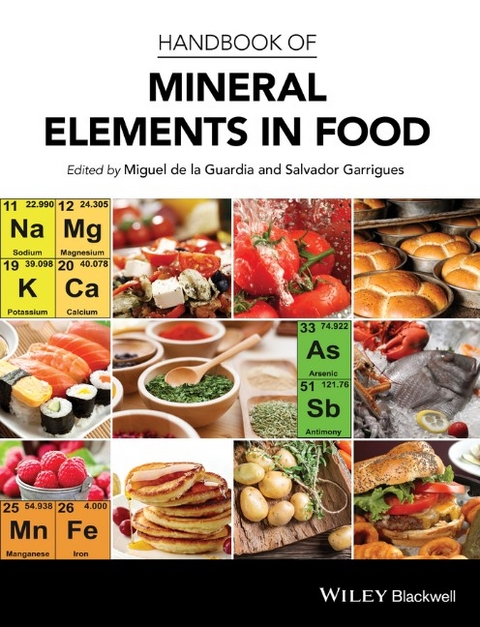
Handbook of Mineral Elements in Food (eBook)
John Wiley & Sons (Verlag)
978-1-118-65434-7 (ISBN)
Mineral elements are found in foods and drink of all different types, from drinking water through to mothers' milk. The search for mineral elements has shown that many trace and ultratrace-level elements presented in food are required for a healthy life. By identifying and analysing these elements, it is possible to evaluate them for their specific health-giving properties, and conversely, to isolate their less desirable properties with a view to reducing or removing them altogether from some foods. The analysis of mineral elements requires a number of different techniques - some methods may be suitable for one food type yet completely unsuited to another.
The Handbook of Mineral Elements in Food is the first book to bring together the analytical techniques, the regulatory and legislative framework, and the widest possible range of food types into one comprehensive handbook for food scientists and technologists. Much of the book is based on the authors' own data, most of which is previously unpublished, making the Handbook of Mineral Elements in Food a vital and up-to-the-minute reference for food scientists in industry and academia alike. Analytical chemists, nutritionists and food policy makers will also find it an invaluable resource.
Showcasing contributions from international researchers, and constituting a major resource for our future understanding of the topic, the Handbook of Mineral Elements in Food is an essential reference and should be found wherever food science and technology are researched and taught.
Miguel de la Guardia is, since 1991, Professor of Analytical Chemistry at the University of Valencia (Spain), having published numerous papers in the area of Analytical Chemistry related to sample preparation, automation, atomic and molecular spectroscopy and chromatography.
Salvador Garrigues, is Professor of Analytical Chemistry at the University of Valencia (Spain) since 2006, being developed his research about sample preparation and, mainly, in the field of vibrational spectroscopy applied to the quantitative analysis, combined with automation and the use of chemometrics.
Their research group has contributed to the development of Green Analytical Chemistry and participated in different research projects focused on food characterization and food safety, also for authentication of Protected Designation of Origin (PDO) foods.
Mineral elements are found in foods and drink of all different types, from drinking water through to mothers milk. The search for mineral elements has shown that many trace and ultratrace-level elements presented in food are required for a healthy life. By identifying and analysing these elements, it is possible to evaluate them for their specific health-giving properties, and conversely, to isolate their less desirable properties with a view to reducing or removing them altogether from some foods. The analysis of mineral elements requires a number of different techniques some methods may be suitable for one food type yet completely unsuited to another. The Handbook of Mineral Elements in Food is the first book to bring together the analytical techniques, the regulatory and legislative framework, and the widest possible range of food types into one comprehensive handbook for food scientists and technologists. Much of the book is based on the authors own data, most of which is previously unpublished, making the Handbook of Mineral Elements in Food a vital and up-to-the-minute reference for food scientists in industry and academia alike. Analytical chemists, nutritionists and food policy makers will also find it an invaluable resource. Showcasing contributions from international researchers, and constituting a major resource for our future understanding of the topic, the Handbook of Mineral Elements in Food is an essential reference and should be found wherever food science and technology are researched and taught.
Miguel de la Guardia is, since 1991, Professor of Analytical Chemistry at the University of Valencia (Spain), having published numerous papers in the area of Analytical Chemistry related to sample preparation, automation, atomic and molecular spectroscopy and chromatography. Salvador Garrigues, is Professor of Analytical Chemistry at the University of Valencia (Spain) since 2006, being developed his research about sample preparation and, mainly, in the field of vibrational spectroscopy applied to the quantitative analysis, combined with automation and the use of chemometrics. Their research group has contributed to the development of Green Analytical Chemistry and participated in different research projects focused on food characterization and food safety, also for authentication of Protected Designation of Origin (PDO) foods.
List of Contributors
Preface
Chapter 1 The importance of minerals in the human diet
Chapter 2 Dietary Intake of minerals
Chapter 3 Bioavailability of minerals in foods
Chapter 4 Human risk
Chapter 5 The oligoelements
Chapter 6 The toxic elements
Chapter 7 Geographical variation of land mineral composition
Chapter 8 Variation of food mineral content during industrial
and culinary processing
Chapter 9 Speciation
Chapter 10 Atomic Absorption Spectrometry
Chapter 11 Elemental composition analysis of food by FAES and
ICP-OES
Chapter 12 ICP-MS
Chapter 13 Application of electrochemical techniques
Chapter 14 X-ray
Chapter 15 Vibrational spectroscopy
Chapter 16 Ion chromatography
Chapter 17 Neutron Activation Analysis
Chapter 18 Speciation
Chapter 19 Drinking water
Chapter 20 Elemental composition in grapes and wine role
Chapter 21 Vegetables and fruits
Chapter 22 Cereals and pulses
Chapter 23 Bread and bakery products
Chapter 24 Edible fats and oils
Chapter 25 Elemental Composition of Sugar and Honey
Chapter 26 Meat
Chapter 27 Fish and seafood
Chapter 28 Milk and dairy products
Chapter 29 Mineral content of eggs
Chapter 30 Mineral content of seasonings, salt and vinegar
Chapter 31 Other foods of plant origin
Chapter 32 Baby foods
Chapter 33 Human milk
Index
| Erscheint lt. Verlag | 20.4.2015 |
|---|---|
| Sprache | englisch |
| Themenwelt | Medizin / Pharmazie ► Gesundheitsfachberufe ► Diätassistenz / Ernährungsberatung |
| Naturwissenschaften ► Biologie | |
| Naturwissenschaften ► Chemie | |
| Technik ► Lebensmitteltechnologie | |
| Weitere Fachgebiete ► Land- / Forstwirtschaft / Fischerei | |
| Schlagworte | Absorption • biochemistry • Ernährung • Ernährung • Food chemistry • food engineering • Food Processing • Food Science & Technology • Human health • Lebensmittelchemie • Lebensmittelforschung u. -technologie • Lebensmitteltechnik • Mineral elements • Nutrition |
| ISBN-10 | 1-118-65434-X / 111865434X |
| ISBN-13 | 978-1-118-65434-7 / 9781118654347 |
| Informationen gemäß Produktsicherheitsverordnung (GPSR) | |
| Haben Sie eine Frage zum Produkt? |
 PDF (Adobe DRM)
Kopierschutz: Adobe-DRM
Adobe-DRM ist ein Kopierschutz, der das eBook vor Mißbrauch schützen soll. Dabei wird das eBook bereits beim Download auf Ihre persönliche Adobe-ID autorisiert. Lesen können Sie das eBook dann nur auf den Geräten, welche ebenfalls auf Ihre Adobe-ID registriert sind.
Details zum Adobe-DRM
Dateiformat: PDF (Portable Document Format)
Mit einem festen Seitenlayout eignet sich die PDF besonders für Fachbücher mit Spalten, Tabellen und Abbildungen. Eine PDF kann auf fast allen Geräten angezeigt werden, ist aber für kleine Displays (Smartphone, eReader) nur eingeschränkt geeignet.
Systemvoraussetzungen:
PC/Mac: Mit einem PC oder Mac können Sie dieses eBook lesen. Sie benötigen eine
eReader: Dieses eBook kann mit (fast) allen eBook-Readern gelesen werden. Mit dem amazon-Kindle ist es aber nicht kompatibel.
Smartphone/Tablet: Egal ob Apple oder Android, dieses eBook können Sie lesen. Sie benötigen eine
Geräteliste und zusätzliche Hinweise
Buying eBooks from abroad
For tax law reasons we can sell eBooks just within Germany and Switzerland. Regrettably we cannot fulfill eBook-orders from other countries.
aus dem Bereich