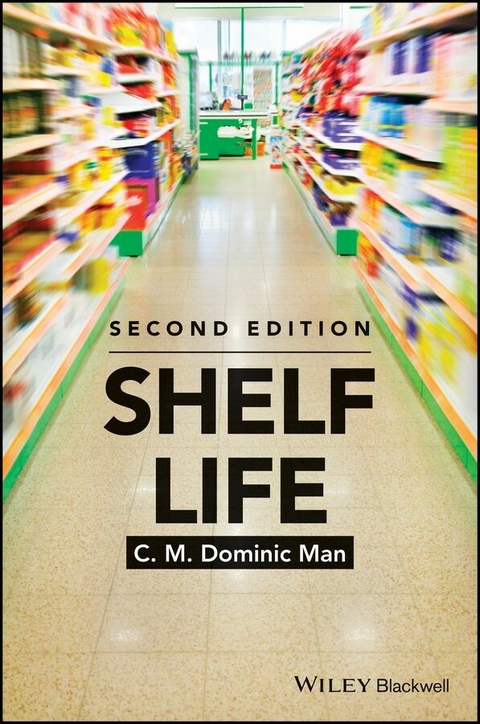
Shelf Life (eBook)
John Wiley & Sons (Verlag)
978-1-118-34625-9 (ISBN)
Shelf life, a term recognised in EU/UK food legislation, may be defined as the period of time for which a food product will remain safe and fit for use, provided that it is kept in defined storage conditions. During this period, the product should retain its desired sensory, chemical, physical, functional and microbiological characteristics, as well as accurately comply with any nutritional information printed on the label. ?Shelf life? therefore refers to a number of different aspects; each food product has a microbiological shelf life, a chemical shelf life, and a sensory (or organoleptic) shelf life. These categories reflect the different ways in which a food product will deteriorate over time. Ultimately the shelf life of a food product is intended to reflect the overall effect of these different aspects.
Shelf life has always been an important facet of industrial food preparation and production, as food and drink are often produced in one area and then distributed to other areas for retailing and consumption. Globalised distribution and supply chains make it imperative that food should survive the transit between producer and consumer ? as a perishable commodity, food carries a high risk of spoilage. As such, a realistic, workable and reproducible shelf life has to be determined every time a new food product is developed and marketed; shelf life determination of food has become an integral part of food safety, quality assurance, product development, marketing, and consumer behaviour.
Dominic Man?s Shelf Life, now in a revised and updated second edition, encompasses the core considerations about shelf life. Section 1 introduces shelf life, describes its relationship to food safety, and provides answers to the frequently asked questions around shelf life determination and testing which are a manager?s chief concerns. Section 2 covers the science of the various ways in which food deteriorates and spoils, including the physical, chemical and microbiological changes. Section 3 looks at shelf life in practice, using case studies of different products to illustrate how shelf life may be determined in real life settings. This book will be invaluable to both practitioners and students in need of a succinct and comprehensive overview of shelf life concerns and topics.
Dominic Man is a food scientist with 40 years' experience in technical development and food safety and quality management in the UK food industry. He has worked for a number of food companies covering product categories of frozen foods, chilled ready meals and ambient cakes, pastries and biscuits. He has conducted academic research in HACCP, sensory evaluation, stability of water-soluble vitamins, and currently, long-term storage properties of green teas. He has successfully managed government-industry funded KTP projects, and carried out consultancy work for the industry. He is a part-time lecturer at London South Bank University and a consultant of its London Food Centre.
Shelf life, a term recognised in EU/UK food legislation, may be defined as the period of time for which a food product will remain safe and fit for use, provided that it is kept in defined storage conditions. During this period, the product should retain its desired sensory, chemical, physical, functional and microbiological characteristics, as well as accurately comply with any nutritional information printed on the label. 'Shelf life' therefore refers to a number of different aspects; each food product has a microbiological shelf life, a chemical shelf life, and a sensory (or organoleptic) shelf life. These categories reflect the different ways in which a food product will deteriorate over time. Ultimately the shelf life of a food product is intended to reflect the overall effect of these different aspects. Shelf life has always been an important facet of industrial food preparation and production, as food and drink are often produced in one area and then distributed to other areas for retailing and consumption. Globalised distribution and supply chains make it imperative that food should survive the transit between producer and consumer as a perishable commodity, food carries a high risk of spoilage. As such, a realistic, workable and reproducible shelf life has to be determined every time a new food product is developed and marketed; shelf life determination of food has become an integral part of food safety, quality assurance, product development, marketing, and consumer behaviour. Dominic Man's Shelf Life, now in a revised and updated second edition, encompasses the core considerations about shelf life. Section 1 introduces shelf life, describes its relationship to food safety, and provides answers to the frequently asked questions around shelf life determination and testing which are a manager's chief concerns. Section 2 covers the science of the various ways in which food deteriorates and spoils, including the physical, chemical and microbiological changes. Section 3 looks at shelf life in practice, using case studies of different products to illustrate how shelf life may be determined in real life settings. This book will be invaluable to both practitioners and students in need of a succinct and comprehensive overview of shelf life concerns and topics.
Dominic Man is a food scientist with 40 years' experience in technical development and food safety and quality management in the UK food industry. He has worked for a number of food companies covering product categories of frozen foods, chilled ready meals and ambient cakes, pastries and biscuits. He has conducted academic research in HACCP, sensory evaluation, stability of water-soluble vitamins, and currently, long-term storage properties of green teas. He has successfully managed government-industry funded KTP projects, and carried out consultancy work for the industry. He is a part-time lecturer at London South Bank University and a consultant of its London Food Centre.
Preface to the Second Edition ix
Preface to the First Edition xi
Section 1 Introduction to shelf life of foods - Frequently asked questions 1
1.1 What is shelf life? 1
1.2 Why are food safety and shelf life related? 2
1.3 Who should be interested in shelf life of foods? 5
1.4 Who is responsible for determining shelf life? 6
1.5 Is it illegal to give a wrong shelf life to a food product? 7
1.6 How long a shelf life should my product have? 10
1.7 What is accelerated shelf life testing? 12
1.8 What are the resources required for determining shelf life? 15
1.9 How is the end of shelf life normally decided? 16
1.10 How do we ensure that the shelf lives established for our products are accurate and reproducible? 17
1.11 Can mathematical/computer models help in shelf life determinations? 20
1.12 What is challenge testing? 30
1.13 Can the shelf life of my product be extended? 31
1.14 How are storage tests and trials set up for determining shelf life? 36
1.14.1 Objective of the storage trial 36
1.14.2 Storage conditions 36
1.14.3 Samples for storage trials 37
1.14.4 Sampling schedule 38
1.14.5 Shelf life tests 38
1.15 Food waste and shelf life: What is the problem? 39
1.16 Summary 40
Section 2 The ways food deteriorates and spoils 41
2.1 Mechanisms of food deterioration and spoilage 41
2.1.1 Physical changes and mechanisms 41
2.1.2 Chemical and/or biochemical changes 46
2.1.3 Light-induced changes 57
2.1.4 Microbiological changes 58
2.2 Factors influencing the shelf life of foods 62
2.2.1 Intrinsic factors 62
2.2.2 Extrinsic factors 71
2.2.3 Interaction between intrinsic and extrinsic factors 76
2.2.4 Consumer handling and use 76
2.2.5 Commercial considerations 77
2.3 Summary 77
Section 3 Determining shelf life in practice 79
3.1 Case study 1 - chilled recipe dish 79
3.1.1 The product 79
3.1.2 The process 79
3.1.3 Food safety 80
3.1.4 Mechanism(s) of shelf life deterioration 81
3.1.5 Shelf life determination - storage trials 81
3.1.6 Predicting shelf life 82
3.1.7 Assurance of assigned shelf life - the HACCP approach 82
3.2 Case study 2 - savoury potato snack 83
3.2.1 The product 83
3.2.2 The process 83
3.2.3 Food safety 83
3.2.4 Mechanism(s) of shelf life deterioration 84
3.2.5 Shelf life determination - storage trials 85
3.2.6 Assurance of assigned shelf life - the HACCP approach 86
3.3 Case study 3 - carbonated soft drink 86
3.3.1 The product 86
3.3.2 The process 87
3.3.3 Food safety 88
3.3.4 Mechanism(s) of shelf life determination 88
3.3.5 Shelf life determination - storage trials 88
3.3.6 Assurance of assigned shelf life - the HACCP approach 89
3.4 Case study 4 - condiment sauce 91
3.4.1 The product 91
3.4.2 The process 91
3.4.3 Food safety 91
3.4.4 Mechanism(s) of shelf life deterioration 91
3.4.5 Shelf life determination - storage trials 93
3.4.6 Assurance of assigned shelf life - the HACCP approach 94
3.5 Case study 5 - frozen baked cake 95
3.5.1 The product 95
3.5.2 The process 95
3.5.3 Food safety 95
3.5.4 Mechanisms(s) of shelf life deterioration 95
3.5.5 Shelf life determination - storage trials 96
3.5.6 Assurance of assigned shelf life - the HACCP approach 97
3.6 Summary 98
Epilogue 101
Appendix A: The Arrhenius model 109
Appendix B: The CIMSCEE formulae for microbiological safety and stability 111
References 115
Index 131
Section 1
Introduction to shelf life of foods – frequently asked questions
1.1 What is shelf life?
Shelf life has been a frequently used term that can be understood and interpreted differently. A consumer is generally concerned with the length of time a food product can be kept in the home before it can no longer be used. A retailer is particularly interested in the length of time a product can stay on its shelf in order to maximise sales potential. Shelf life is now a legal term within the European Union (EU). Regulation (EC) No. 852/2004 of the European Parliament and of the Council on the hygiene of foodstuffs (EC, 2004a), enforced in England by the Food Safety and Hygiene (England) Regulations 2013 (TSO, 2013), requires food business operators to adopt as appropriate a number of specific hygiene measures (Article 4(3)) including ‘compliance with microbiological criteria’ as laid down in Commission Regulation (EC) No. 2073/2005 as amended on microbiological criteria for foodstuffs (EC, 2005). This latter regulation defines ‘shelf life’ (or ‘shelf-life’ (Article 2(f))) as ‘either the period corresponding to the period preceding the “use by” or the minimum durability date, as defined respectively in Articles 9 and 10 of Directive 2000/13/EC’, which itself has been repealed by Regulation (EU) No. 1169/2011 on the provision of food information to consumers (EC, 2011a), implemented in the United Kingdom as the Food Information Regulations 2014 (TSO, 2014). A much more helpful and informative definition of shelf life of food has been available for some time (IFST, 1993): It is the period of time under defined conditions of storage, after manufacture or packing, for which a food product will remain safe and be fit for use. In other words, during this period, it should retain its desired sensory, chemical, physical, functional or microbiological characteristics and, where appropriate, comply with any label declaration of nutrition information when stored according to the recommended conditions. It is obvious therefore that shelf life is a very important and multifaceted requirement of all manufactured and processed food products. Every food product has in principle, and should be recognised as having, a microbiological shelf life, a chemical shelf life, a functional shelf life and an organoleptic shelf life because all foods deteriorate, often in different ways and at different rates. Ultimately, the shelf life of a food product is intended to reflect the overall effect of these different aspects, ideally under a set of specified storage conditions. Because of this, the study of shelf life of food can often only rightfully be dealt with by the employment of multidisciplinary resources.
1.2 Why are food safety and shelf life related?
Within the EU, of which the United Kingdom is a member, the safety of food is both a fundamental and a legal requirement. Article 14 (Food safety requirements) of the European Regulation (EC) No. 178/2002 (EC, 2002), laying down the general principles and requirements of food law, clearly states the following:
- Food shall not be placed on the market if it is unsafe.
- Food shall be deemed to be unsafe if it is considered to be
- Injurious to health
- Unfit for human consumption
It follows that all food products offered for sale must be safe although they do not necessarily have to be of the highest quality. In the United Kingdom, the Food Safety Act 1990 (as amended) (FSA, 2009) prohibits the sale of food that
- Has been rendered injurious to health
- Is unfit
- Is so contaminated it would be unreasonable to expect it to be eaten
- Is not of the nature or substance or quality demanded
- Is falsely or misleadingly labelled
Table 1.1 gives examples of past food product withdrawals and recalls in the United Kingdom between 2010 and 2014 available on the UK Food Standards Agency (FSA) website. The list should give some insight into the kinds of hazards that can cause food to be unsafe and/or unacceptable to the public; recall and/or withdrawal of the affected food is a legal requirement within the EU (Article 19 of Regulation (EC) No. 178/2002). In effect, a food product, the safety of which has been called into question, be it of microbial, chemical or physical nature has no useful shelf life; its declared shelf life has become meaningless and irrelevant. Food safety and product shelf life are therefore inextricably linked; there can be no quality without food safety. Without exception, the question ‘Is this product safe to eat?’ must be a first question to be asked in every shelf life study for the simple fact that food safety is a legal requirement. Also, as every product or product concept has to be taste tested at some stage, it is only right and proper for ethical reasons to resolve this question about food safety at the earliest opportunity. Furthermore, the controlling factors for safety and spoilage, particularly those that are related to microbial growth, are often identical; the separate consideration of food safety and shelf life, although convenient in practice, is artificial. Today, the most effective way to ensure the safety of food is to use the internationally recognised hazard analysis critical control point (HACCP) system. Current EU food legislation mandates that, in order to ensure a high level of consumer protection with regard to food safety, food business operators are required to put in place, implement and maintain a permanent food safety management procedure or procedures based on the HACCP principles (EC, 2004a). In England, this legal requirement is contained in the Food Safety and Hygiene (England) Regulations 2013. An in-depth and up-to-date reference on the development, implementation and maintenance of an effective HACCP-based food safety management system as required by EU legislation is available (Mortimore & Wallace, 2013).
Table 1.1 Examples of food and drink product withdrawals and recalls in the United Kingdom between 2010 and 2014a
| Year | Product | Published reason for the recall |
| 2014 | Spring still natural mineral water | Contamination with small black particles |
| Supermarket own-brand pitted black olives | Contamination with small pieces of glass |
| Fresh sandwiches, baguettes and wraps | Production not complying with food hygiene requirements |
| Smoked salmon 70-g packs | High levels of Listeria monocytogenes |
| Bread and butter pudding | Under-processing and food spoilage |
| Vacuum-packed organic tofu | Potential risk of botulism |
| Organic sultanas | Presence of Salmonella |
| Unpasteurised cheese | High levels of Listeria monocytogenes |
| 2013 | Supermarket own-brand curried chicken snack pack with a ‘use by’ date | Listeria monocytogenes was detected in the product |
| Coleslaw | Presence of Listeria monocytogenes |
| Milk and cream products | Possible cross-contamination of milk and insufficient heat processing |
| Peach and apricot yoghurt drink | Possible yeast fermentation |
| Deli pork and egg slices | A labelling error giving the product an extra 4 months of ‘use by’ date |
| Supermarket own-brand corned beef | Very low levels of the veterinary medicine phenylbutazone (‘bute’) found in some batches |
| Multi-bag crisps | Possible contamination with small pieces of plastic |
| Supermarket own-brand frozen beef lasagne and frozen spaghetti bolognese | Some samples found to contain between 30 and 100% horse meat |
| 2012 | Salted peanuts | One batch found to contain aflatoxins at levels higher than the regulatory limits |
| Smoked prawns | A processing error resulting in inadequate controlling factors to prevent growth of Clostridium botulinum |
| Mild Cheddar and red Leicester cheeses | Possible presence of small pieces of metal |
| Iced rich fruit cake | Signs of mould spoilage in some products |
| Peanut butter and peanut-based products | Following a Salmonella outbreak in United States |
| A jar of olives | Tested positive for Clostridium botulinum |
| A variety of (24) RTE meat products | Inadequate disinfection of food contact surfaces resulting in potential cross-contamination of the products with pathogenic bacteria |
| Various sliced salami chorizo/serrano ham products | High levels of Listeria monocytogenes found |
| 2011 | Scottish smoked salmon | Listeria detected in a... |
| Erscheint lt. Verlag | 23.3.2015 |
|---|---|
| Sprache | englisch |
| Themenwelt | Naturwissenschaften ► Biologie |
| Technik ► Lebensmitteltechnologie | |
| Weitere Fachgebiete ► Handwerk | |
| Weitere Fachgebiete ► Land- / Forstwirtschaft / Fischerei | |
| Schlagworte | food deterioration • food distribution • Food Legislation • Food Packaging • Food Processing • Food Quality • Food Science & Technology • Lebensmittel • Lebensmittelforschung u. -technologie • Lebensmittel-Gesetzgebung • Lebensmittelsicherheit • Lebensmittel / Verpackung • Microbiology • Microbiology, Food Safety & Security • Mikrobiologie • Mikrobiologie u. Nahrungsmittelsicherheit • Safety • Sensory Science • Shelf Life |
| ISBN-10 | 1-118-34625-4 / 1118346254 |
| ISBN-13 | 978-1-118-34625-9 / 9781118346259 |
| Informationen gemäß Produktsicherheitsverordnung (GPSR) | |
| Haben Sie eine Frage zum Produkt? |
 EPUB (Adobe DRM)
Kopierschutz: Adobe-DRM
Adobe-DRM ist ein Kopierschutz, der das eBook vor Mißbrauch schützen soll. Dabei wird das eBook bereits beim Download auf Ihre persönliche Adobe-ID autorisiert. Lesen können Sie das eBook dann nur auf den Geräten, welche ebenfalls auf Ihre Adobe-ID registriert sind.
Details zum Adobe-DRM
Dateiformat: EPUB (Electronic Publication)
EPUB ist ein offener Standard für eBooks und eignet sich besonders zur Darstellung von Belletristik und Sachbüchern. Der Fließtext wird dynamisch an die Display- und Schriftgröße angepasst. Auch für mobile Lesegeräte ist EPUB daher gut geeignet.
Systemvoraussetzungen:
PC/Mac: Mit einem PC oder Mac können Sie dieses eBook lesen. Sie benötigen eine
eReader: Dieses eBook kann mit (fast) allen eBook-Readern gelesen werden. Mit dem amazon-Kindle ist es aber nicht kompatibel.
Smartphone/Tablet: Egal ob Apple oder Android, dieses eBook können Sie lesen. Sie benötigen eine
Geräteliste und zusätzliche Hinweise
Buying eBooks from abroad
For tax law reasons we can sell eBooks just within Germany and Switzerland. Regrettably we cannot fulfill eBook-orders from other countries.
aus dem Bereich