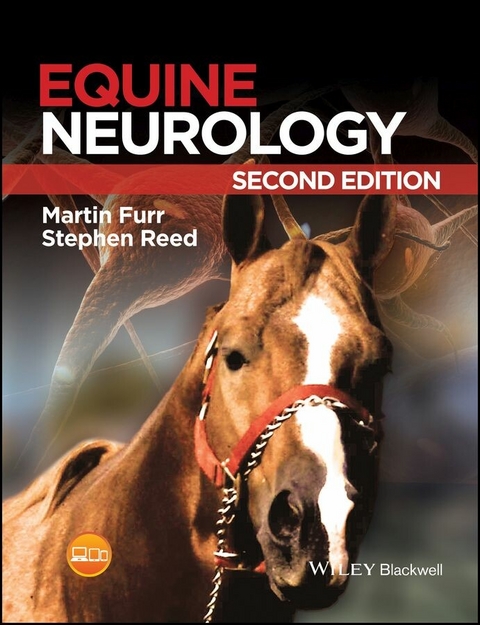
Equine Neurology (eBook)
John Wiley & Sons (Verlag)
978-1-118-50157-3 (ISBN)
- Offers a complete clinical reference to neurologic conditions in equine patients
- Takes a problem-based approach to present a clinically oriented perspective
- Presents new chapters on imaging the nervous system, neuronal physiology, sleep disorders, head shaking, differential diagnosis of muscle trembling and weakness, and cervical articular process joint disease
- Covers the basic principles of neurology, clinical topics such as the initial exam, differentials, and neuropathology, and specific conditions and disorders
- Includes access to a companion website offering video clips demonstrating presenting signs
Martin Furr, DVM, PhD, Diplomate ACVIM, is Adelaide Riggs Chair of Internal Medicine, Chief of Medicine, and Professor of Medicine at the Marion duPont Scott Equine Medicine Center, Virginia-Maryland Regional College of Veterinary Medicine, Blacksburg, Virginia, USA.
Stephen Reed, DVM, Diplomate ACVIM, is former Professor and Head of Equine Medicine and Surgery at the Ohio State University College of Veterinary Medicine, USA and is currently affiliated with Rood and Riddle Equine Hospital, Lexington, Kentucky, USA.
Equine Neurology, Second Edition provides a fully updated new edition of the only equine-specific neurology book, with comprehensive, clinically oriented information. Offers a complete clinical reference to neurologic conditions in equine patients Takes a problem-based approach to present a clinically oriented perspective Presents new chapters on imaging the nervous system, neuronal physiology, sleep disorders, head shaking, differential diagnosis of muscle trembling and weakness, and cervical articular process joint disease Covers the basic principles of neurology, clinical topics such as the initial exam, differentials, and neuropathology, and specific conditions and disorders Includes access to a companion website offering video clips demonstrating presenting signs
Martin Furr, DVM, PhD, Diplomate ACVIM, is Adelaide Riggs Chair of Internal Medicine, Chief of Medicine, and Professor of Medicine at the Marion duPont Scott Equine Medicine Center, Virginia-Maryland Regional College of Veterinary Medicine, Blacksburg, Virginia, USA. Stephen Reed, DVM, Diplomate ACVIM, is former Professor and Head of Equine Medicine and Surgery at the Ohio State University College of Veterinary Medicine, USA and is currently affiliated with Rood and Riddle Equine Hospital, Lexington, Kentucky, USA.
Contributors List vii
Preface ix
Video Clips Demonstrating Clinical Signs x
Section 1: Foundations of Clinical Neurology
1 Overview of Neuroanatomy 3
Caroline Hahn and Jerry Masty
2 Cerebrospinal Fluid and the Blood-Brain Barrier 21
Martin Furr
3 Immunology of the Central Nervous System 36
Martin Furr
4 Pharmaceutical Considerations for Treatment of Central Nervous System Disease 46
Véronique A. Lacombe and Martin Furr
5 Fundamental Neurophysiology 58
Craig Johnson and Caroline Hahn
Section 2: Clinical Equine Neurology
6 Examination of the Nervous System 67
Martin Furr and Stephen Reed
7 Differential Diagnosis and Management of Horses with Seizures or Alterations in Consciousness 79
Véronique A. Lacombe and Martin Furr
8 Differential Diagnosis of Equine Spinal Ataxia 93
Martin Furr
9 Differential Diagnosis and Management of Cranial Nerve Abnormalities 99
Robert J. MacKay
10 Sleep and Sleep Disorders in Horses 123
Joseph J. Bertone
11 Headshaking 130
Monica Aleman and Kirstie Pickles
12 Differential Diagnosis of Urinary Incontinence and Cauda Equina Syndrome 139
Melissa Hines
13 Differential Diagnosis of Muscle Tremor and Paresis 149
Amy L. Johnson
14 Electrodiagnostic Evaluation of the Nervous System 157
George M. Strain, Frank Andrews and Veronique A. Lacombe
15 Anesthetic Considerations for Horses with Neurologic Disorders 184
Adriana G. Silva
16 The Basics of Equine Neuropathology 191
Fabio Del Piero and John L. Robertson
17 Diagnostic Imaging of the Equine Nervous System 215
Katherine Garrett
Section 3: Specific Disease Syndromes
18 Equid Herpesvirus-Associated Myeloencephalopathy 225
Lutz S. Goehring
19 Mosquito-Borne Infections Affecting the Central Nervous System 233
Maureen T. Long
20 Contagious Neurological Diseases 262
Maureen T. Long
21 Bacterial Infections of the Central Nervous System 273
Martin Furr
22 Equine Protozoal Myeloencephalitis 285
Martin Furr and Daniel K. Howe
23 Parasitic Infections of the Central Nervous System 306
Martin Furr
24 Miscellaneous Infections of the Central Nervous System 314
Martin Furr
25 Disorders Associated with Clostridial Neurotoxins: Botulism and Tetanus 319
Martin Furr
26 Neurodegenerative Disorders 328
Robert J. MacKay
27 Equine Hepatic Encephalopathy 343
Tom Divers
28 Cervical Vertebral Stenotic Myelopathy 349
Amy L. Johnson and Stephen Reed
29 Electrolyte Abnormalities and Neurologic Dysfunction in Horses 368
Ramiro E. Toribio
30 Cervical Articular Process Disease Fractures and Other Axial Skeletal Disorders 386
Richard Hepburn
31 Congenital Malformation of the Nervous System 401
Martin Furr
32 Central Nervous System Trauma 406
Yvette S. Nout-Lomas
33 Disorders of the Peripheral Nervous System 429
Martin Furr
34 Equine Neurotoxic Agents and Conditions 437
Martin Furr
35 Neonatal Encephalopathy and Related Conditions 455
Martin Furr
36 Miscellaneous Movement Disorders 465
Caroline Hahn
37 Stereotypic and Behavior Disorders 472
Carissa L. Wickens and Katherine A. Houpt
38 Miscellaneous Conditions 484
Martin Furr
Index 488
"I thoroughly recommend it and would not be without it now." (Veterinary Record, 14 November 2015)
"The second edition of Equine Neurologyedited by Martin Furr and Stephen Reed is a valuable reference for veterinary students, general practitioners, and specialists." (Journal of the American Veterinary Medical Association, 15 September 2015)
1
Overview of Neuroanatomy
Caroline Hahn1 and Jerry Masty2
1 Royal (Dick) School of Veterinary Studies, The University of Edinburgh, Midlothian, UK
2 College of Veterinary Medicine, The Ohio State University, Columbus, USA
In order to evaluate a patient with a neurologic disorder, a basic understanding of the structure and function of the nervous system is necessary. The goal of this chapter is not to expose the reader to intricate and perhaps daunting detail but rather to present a basic overview of neuroanatomy, highlighting some of the peculiarities of equine neuroanatomy. A basic understanding of the nervous system from an anatomic and functional perspective is an absolute prerequisite to interpreting the neurological examination and to assess if there is indeed a lesion in the nervous system and, if so, where the lesion is located (the “anatomic diagnosis”).
Organization of the nervous system
The nervous system is organized into central and peripheral divisions. The central nervous system (CNS) is composed of the brain and spinal cord and is located within the skull and vertebral column. The peripheral nervous system (PNS) is formed by neuronal cell processes that extend from the central axis to the periphery. There are also collections of neuronal cell bodies in the periphery (“ganglia”) that contribute to the components of the peripheral system. Functionally, the nervous system is divided into the somatic nervous system, a system under voluntary control that innervates skeletal muscle and whose sensory branch reaches consciousness, and the autonomic nervous system, which is concerned with subconsciously regulating visceral smooth muscle structures. Both the somatic and nervous system and CNS have central and peripheral motor and sensory components.
Development
The nervous system begins as a thickening of the embryonic layer identified as ectoderm. The initial growth of the neural ectoderm forms a thickened layer of cells identified as the neural plate. The neural groove is evident as a depression in the neural plate. As continued growth of the developing system occurs, neural folds develop at the margins of the neural plate caused by migration of the cells in a dorsal direction. Eventually, the neural folds meet and fuse at the dorsal midline thereby forming a cylindrical structure identified as the neural tube. This simplified explanation of the formation of the neural tube is shown in Figure 1.1.
Figure 1.1 Stages of neural tube formation. (a) Thickening of cells to form neural plate (1) (b) Indentation formed by the neural groove (2) (c) Closure of the neural tube produced by neural folds (3) (d) Neural tube (4) closure completed with formation of neural crest cells (5) Circle in (b–d) represents the notochord.
As the neural tube is forming, cells in the region of the neural folds pinch off and migrate throughout the developing body. These are the neural crest cells that differentiate to become various structures in the adult: spinal ganglia, sensory ganglia associated with some of the cranial nerves, autonomic ganglia associated with various body systems, cells of the adrenal medulla and, interestingly, melanocytes.
Closure of the neural tube begins in the midsection of the developing embryo and progresses in a cranial and caudal direction. The opening at each end of the tube is identified as the neural pore. If complete closure of either neural pore is arrested during development, congenital malformations may be evident after birth such as anencephaly, which results in decreased formation of the cerebral hemispheres. In extreme conditions, the hemispheres may be completely absent. Failure of closure of the caudal neuropore results in spina bifida. This condition presents as varying degrees of lack of closure and fusion of the neural tissue and the bony tissue of the vertebral canal that would normally enclose the caudal portion of the spinal cord.
To understand the basic generalized arrangement of the adult nervous system, certain facets of development should be kept in mind. As the neural tube completes its closure, it becomes a fluid-filled cylindrical structure that serves as the template for further development of the adult structures. Segments of the neural tube undergo differential growth to become the adult divisions and structures of the nervous system. As the process of differential growth occurs, the fluid-filled center of the embryonic neural tube follows this pattern of differential growth to become the ventricular system of the nervous system.
Embryonic vesicles
The adult brain is divided into five regions that have their beginnings localized to specific areas of the developing neural tube. As the embryonic brain is developing, it is characterized by vesicle formation (swellings) that begins to divide the developing brain topographically into separate regions. There is a primary stage of development where three vesicles are observed. This is followed by a secondary stage where five vesicles subsequently form from the initial three. Upon further differentiation and growth, these five vesicles give rise to the five topographic regions of the adult brain.
From rostral to caudal, the vesicles of the primary stage are identified as the prosencephalon (forebrain), mesencephalon (midbrain), and rhombencephalon (hindbrain). With continued differential growth at the rostral end of the neural tube, the prosencephalon develops into the telencephalon (cerebrum) and diencephalon (thalamus). At the caudal end of the tube, the rhombencephalon gives rise to the metencephalon (pons and cerebellum) and the more caudally positioned myelencephalon (medulla oblongata) (Figure 1.2).
Figure 1.2 Embryonic brain vesicles. (a) Primary vesicle stage; (b) secondary vesicle stage. 1, Prosencephalon; 2, mesencephalon; 3, rhombencephalon; 4, telencephalon; 5, diencephalon; 6, metencephalon; 7, myelencephalon.
Ventricular system
The fluid-filled cavity of the developing neural tube follows the differential growth pattern of the neural tissue through the vesicle stages into the formation of the adult brain. Therefore, a portion of the ventricular system is found at all levels of the adult brain as shown in Figure 1.3.
Figure 1.3 Dorsal view of ventricular system. 1, Lateral ventricles; 2, interventricular foramen; 3, third ventricle; 4, mesencephalic aqueduct; 5, fourth ventricle; 6, lateral aperture; 7, extension of ventricular system into central canal of spinal cord.
The right and left lateral ventricles follow the growth of the cerebral hemispheres of the cerebrum as they expand dorsally and caudally over the developing brainstem. The interventricular foramen interconnects each lateral ventricle with the third ventricle. The third ventricle, located in the thalamus, is shaped somewhat like an upright tire, encircling the interthalamic adhesion (the connection of the left and right halves of the thalamus across the midline of the brainstem). In the midbrain, the ventricular system is present as the narrow, tubular mesencephalic aqueduct. Cerebrospinal fluid (CSF), principally produced by the choroid plexus in the lateral and third ventricles, flows through the mesencephalic aqueduct to enter the relatively large fourth ventricle. The fourth ventricle is a somewhat diamond-shaped depression of the dorsal medulla oblongata, mostly hidden by the overlying cerebellum. CSF leaves the fourth ventricle through lateral apertures at the junction between the midbrain and the medulla oblongata and enters the subarachnoid space that surrounds the brain and spinal cord. CSF can also enter the central canal of the spinal cord through the median aperture of the caudal extent of the fourth ventricle; there is therefor bulk flow of CSF from a cranial to caudal direction with some modification of the fluid content during this passage. Hence, CSF collected at the lumbosacral junction has slightly different reference values compared with CSF collected at the atlantooccipital site (see Table 1.1).
Table 1.1 Functional classification of the cranial nerves.
| Cranial nerve | Number | Function |
| Sensory |
| Olfactory | CN I | Olfaction |
| Optic | CN II | Vision |
| Vestibulocochlear | CN VIII | Balance and hearing |
| Motor |
| Oculomotor | CN III | Extraocular eye muscles Parasympathetic to eye |
| Trochlear | CN IV | Extraocular eye muscles |
| Abducens | CN VI | Extraocular eye muscles |
| Accessory | CN XI | Pharyngeal and laryngeal muscles; cervical muscles |
| Hypoglossal | CN XII | Lingual muscles |
| Mixed |
| Trigeminal | CN V | General sensation to face; motor to muscles of mastication |
| Facial | CN VII | Taste sensation; motor to muscles of facial expression; parasympathetic for salivation and... |
| Erscheint lt. Verlag | 9.4.2015 |
|---|---|
| Sprache | englisch |
| Themenwelt | Medizin / Pharmazie |
| Veterinärmedizin ► Klinische Fächer ► Mikrobiologie / Immunologie | |
| Veterinärmedizin ► Klinische Fächer ► Neurologie / Verhalten | |
| Veterinärmedizin ► Pferd ► Neurologie / Verhalten / Haltung | |
| Weitere Fachgebiete ► Land- / Forstwirtschaft / Fischerei | |
| Schlagworte | Equine • equine disease • equine movement disorders • equine neuroanatomy • equine neurologic • equine neuropathology • equine neurophysiology • equine seizure • horse • horse central nervous system • horse disease • horse neurology • horse seizure • large animal vet • Pferd • Veterinärmedizin • Veterinärmedizin f. Pferde • Veterinärmedizin / Innere Medizin • Veterinärmedizin • Veterinärmedizin f. Pferde • Veterinärmedizin / Innere Medizin • Veterinary Internal Medicine • Veterinary Medicine • Veterinary Medicine - Equine |
| ISBN-10 | 1-118-50157-8 / 1118501578 |
| ISBN-13 | 978-1-118-50157-3 / 9781118501573 |
| Informationen gemäß Produktsicherheitsverordnung (GPSR) | |
| Haben Sie eine Frage zum Produkt? |
 EPUB (Adobe DRM)
Kopierschutz: Adobe-DRM
Adobe-DRM ist ein Kopierschutz, der das eBook vor Mißbrauch schützen soll. Dabei wird das eBook bereits beim Download auf Ihre persönliche Adobe-ID autorisiert. Lesen können Sie das eBook dann nur auf den Geräten, welche ebenfalls auf Ihre Adobe-ID registriert sind.
Details zum Adobe-DRM
Dateiformat: EPUB (Electronic Publication)
EPUB ist ein offener Standard für eBooks und eignet sich besonders zur Darstellung von Belletristik und Sachbüchern. Der Fließtext wird dynamisch an die Display- und Schriftgröße angepasst. Auch für mobile Lesegeräte ist EPUB daher gut geeignet.
Systemvoraussetzungen:
PC/Mac: Mit einem PC oder Mac können Sie dieses eBook lesen. Sie benötigen eine
eReader: Dieses eBook kann mit (fast) allen eBook-Readern gelesen werden. Mit dem amazon-Kindle ist es aber nicht kompatibel.
Smartphone/Tablet: Egal ob Apple oder Android, dieses eBook können Sie lesen. Sie benötigen eine
Geräteliste und zusätzliche Hinweise
Buying eBooks from abroad
For tax law reasons we can sell eBooks just within Germany and Switzerland. Regrettably we cannot fulfill eBook-orders from other countries.
aus dem Bereich