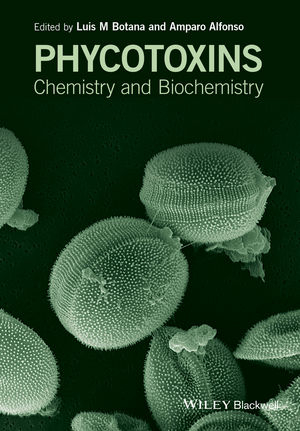
Phycotoxins (eBook)
John Wiley & Sons (Verlag)
978-1-118-50033-0 (ISBN)
Dr Luis M Botana is Director of the Community Reference Laboratory for Marine Toxins and Head of the Department of Pharmacology, University of Santiago de Compostela, Spain.
Dr Amparo Alfonso is Professor of Pharmacology, University of Santiago de Compostela, Spain.
Phycotoxins are a diverse group of poisonous substances produced by certain seaweed and algae in marine and fresh waters and are important to the scientific community for many reasons, the most obvious being that they pose food safety issues which requires a large investment to regularly monitor the presence of these compounds in foods. Phycotoxins: Chemistry and Biochemistry, second edition presents the most updated information available on phycotoxins. Major emphases are given to chemistry and biochemistry, while origins, mechanism of action, toxicology, and analytical methodology are also covered. Since the publication of the first edition, there have been major advances in the science of marine and aquatic toxins, as well as advances in toxicology, analytical chemistry and pharmacology. This fully revised and updated edition includes several new chapters, including those on ciguatoxins, pinnatoxin, ichthyotoxins, as well as new chapters on food safety control of marine toxins, climate change and water toxins, and microalgae as a source of nutraceuticals. The book will be of interest to toxicologists, marine, food, and plant scientists, as well as researchers and academics in the areas of food science, medicine, public health, toxicology, pharmacology and marine biology.
Dr Luis M Botana is Director of the Community Reference Laboratory for Marine Toxins and Head of the Department of Pharmacology, University of Santiago de Compostela, Spain. Dr Amparo Alfonso is Professor of Pharmacology, University of Santiago de Compostela, Spain.
List of contributors vii
Preface xiii
1 Analysis of marine toxins: gaps on food safety control of marine toxins 1
Paz Otero and Carmen Alfonso
2 Pharmacology of ciguatoxins 23
Carmen Vale, Álvaro Antelo and Víctor Martín
3 Chemistry of pinnatoxins 49
Phillip Mabe and Armen Zakarian
4 Chemistry and analysis of PSP toxins 69
Ana Botana and Verónica Rey López
5 Chemistry of palytoxin and its analogues 85
Patrizia Ciminiello, Carmela Dell'Aversano and Martino Forino
6 Pharmacology of palytoxins and ostreocins 113
M. Carmen Louzao, María Fraga and Natalia Vilarin~ o
7 Recent insights into anatoxin-a chemical synthesis, biomolecular targets, mechanisms of action and LC-MS detection 137
Custódia Fonseca, Manuel Aureliano, Feras Abbas and Ambrose Furey
8 Therapeutics of marine toxins 181
Eva Alonso and Juan A. Rubiolo
9 Marine toxins as modulators of apoptosis 203
Amparo Alfonso, Andrea Fernández-Araujo and Mercedes R. Vieytes
10 Cyanobacterial toxins 225
Vitor Vasconcelos, Pedro Leão and Alexandre Campos
11 Marine toxins and climate change: the case of PSP from cyanobacteria in coastal lagoons 239
Antonella Lugliè, Silvia Pulina, Milena Bruno, Bachisio Mario Padedda, Cecilia Teodora Satta, and Nicola Sechi
12 Microalgae as a source of nutraceuticals 255
Sushanta Kumar Saha, Edward McHugh, Patrick Murray and Daniel J. Walsh
13 The marine origin of drugs 293
André Horta, Celso Alves, Susete Pinteus and Rui Pedrosa
14 Pharmacology of cylindrospermopsin 317
Juan A. Rubiolo, Diego Alberto Fernández, Henar López and M. Carmen Louzao
15 Pharmacology of the cyclic imines 343
Natalia Vilarinõ, Sara F. Ferreiro, Andrés Crespo and José Gil
16 Diversity of organic structures of marine microbial origin with drug potential 361
Marcel Jaspars, Rainer Ebel and Hai Deng
17 Polyketides as a source of chemical diversity 381
Tanya Beletskaya, Catherine Collins and Patrick Murray
18 Ichthyotoxins 407
John W. La Claire II and Schonna R. Manning
19 Pathological clues of phycotoxin ingestion 463
Manuel Cifuentes, Andrés Crespo and Roberto Bermúdez
Index 513
List of contributors
- Feras Abbas
Mass Spectrometry Research Centre (MSRC) and PRTOEOBIO Research groups, Department of Chemistry, Cork Institute of Technology (CIT), Bishopstown, Cork, Ireland.
- Amparo Alfonso
Department Pharmacology, Veterinary School, Campus de Lugo, University of Santiago de Compostela, 27002 Lugo, Spain.
- Carmen Alfonso
Cifga Laboratory, Campus Universitario, Pl. Santo Domingo, 20, 5a, 27001 Lugo, Spain.
- Eva Alonso
Department of Pharmacology, Veterinary School, Campus de Lugo, University of Santiago de Compostela, 27002 Lugo, Spain.
- Celso Alves
Grupo de Investigação em Recursos Marinhos, Escola Superior de Turismo e Tecnologia do Mar, Instituto Politécnico de Leiria, Campus 4 – Santuário N.a Sra. dos Remédios, 2520–641 Peniche, Portugal.
- Álvaro Antenlo
Cifga Laboratory, Campus Universitario, Pl. Santo Domingo, 20, 5a, 27001 Lugo, Spain.
- Manuel Aureliano
Department of Biological Sciences and Bioengineering, Marine Science Center, Faculty of Science and Technology, Algarve University, Faro 8005–139 Portugal.
- Tanya Beletskaya
Shannon Applied Biotechnology Centre, Limerick Institute of Technology, Moylish Park, Limerick, Ireland.
- Roberto Bermúdez
Department of Anatomy and Animal Production, University of Santiago de Compostela, Lugo 27002, Spain.
- Ana M. Botana López
Department of Analytical Chemistry, Faculty of Sciences, University of Santiago de Compostela. C/ Alfonso X s/n, 27002 Lugo, Spain.
- Milena Bruno
Istituto Superiore di Sanità, Department of Environment and Primary Prevention, V.le Regina Elena 299, 00161 Rome, Italy.
- Alexandre Campos
Interdisciplinary Center of Marine and Environmental Research, CIIMAR, and Faculty of Sciences, University of Porto, Porto, Portugal.
- Manuel Cifuentes
Department of Anatomy and Animal Production, University of Santiago de Compostela, Lugo 27002, Spain.
- Patrizia Ciminiello
Department of Pharmacy, University of Napoli Federico II, Via Domenico Montesano 49, Napoli 80131, Italy.
- John W. La Claire II
University of Texas at Austin, Department of Molecular Biosciences, 205 W. 24th St., Austin, TX 78712-1240, USA.
- Catherine Collins
Shannon Applied Biotechnology Centre, Limerick Institute of Technology, Moylish Park, Limerick, Ireland.
- Andrés Crespo Vieira
Department of Pharmacology, Veterinary School, University of Santiago de Compostela, 27002 Lugo, Spain.
- Sara F. Ferreiro
Department of Pharmacology, Veterinary School, University of Santiago de Compostela, 27002 Lugo, Spain.
- Rainer Ebel
Marine Biodiscovery Centre, Department of Chemistry, University of Aberdeen, Old Aberdeen, AB24 3UE, Scotland, UK.
- Hai Deng
Marine Biodiscovery Centre, Department of Chemistry, University of Aberdeen, Old Aberdeen, AB24 3UE, Scotland, UK.
- Carmela Dell'Aversano
Department of Pharmacy, University of Napoli Federico II, Via Domenico Montesano 49, Napoli 80131, Italy.
- Diego Alberto Fernández
Department of Pharmacology, Veterinary School, Campus de Lugo, University of Santiago de Compostela 27002 Lugo, Spain.
- Andrea Fernández-Araujo
Department of Pharmacology, Veterinary School, Campus de Lugo, University of Santiago de Compostela, 27002 Lugo, Spain.
- Custódia Fonseca
Department of Chemistry and Pharmacy, Marine Science Center, Faculty of Science and Technology, Algarve University, Faro 8005–139 Portugal.
- Martino Forino
Department of Pharmacy, University of Napoli Federico II, Via Domenico Montesano 49, Napoli 80131, Italy.
- María Fraga
Department of Pharmacology, University of Santiago de Compostela, Spain.
- Ambrose Furey
Mass Spectrometry Research Centre (MSRC) and PRTOEOBIO Research groups, Department of Chemistry, Cork Institute of Technology (CIT), Bishopstown, Cork, Ireland.
- José Gil
Department of Pharmacology, School of Pharmacy, University of Santiago de Compostela, Campus Sur, Praza Seminario de Estudos Galegos, s/n., 1782 Santiago de Compostela, Spain.
- André Horta
Grupo de Investigação em Recursos Marinhos, Escola Superior de Turismo e Tecnologia do Mar, Instituto Politécnico de Leiria, Campus 4 - Santuário N.a Sra. dos Remédios, 2520 – 641 Peniche, Portugal.
- Marcel Jaspars
Marine Biodiscovery Centre, Department of Chemistry, University of Aberdeen, Old Aberdeen, AB24 3UE, Scotland, UK.
- Sushanta Kumar Saha
Shannon Applied Biotechnology Centre, Limerick Institute of Technology, Moylish Park, Limerick, Ireland (ROI).
- Pedro Leão
Interdisciplinary Center of Marine and Environmental Research, CIIMAR, University of Porto, Porto, Portugal.
- Henar López Alonso
Department of Pharmacology, Veterinary School, Campus de Lugo, University of Santiago de Compostela, 27002 Lugo, Spain.
- M Carmen Louzao
Department of Pharmacology, Veterinary School, Campus de Lugo, University of Santiago de Compostela, 27002 Lugo, Spain.
- Antonella Lugliè
University of Sassari, Department of Sciences for Nature and Environmental Resources, Via Piandanna 4, 07100 Sassari, Italy.
- Phillip Mabe
Department of Chemistry and Biochemistry, University of California, Santa Barbara, CA 93106, USA.
- Schonna R. Manning
University of Texas at Austin, Department of Molecular Biosciences, 205 W. 24th St., Austin, TX 78712-1240, USA.
- Víctor Martín
Department of Pharmacology, Veterinary School, University of Santiago de Compostela, Campus Universitario, 27002 Lugo, Spain.
- Edward McHugh
Algae Health Ltd., Rooaunmore Lodge, Rooaunmore, Claregalway, Galway, Ireland (ROI).
- Patrick Murray
Shannon Applied Biotechnology Centre, Limerick Institute of Technology, Moylish Park, Limerick, Ireland (ROI).
- Alexei Novikov
Department of Chemistry, University of North Dakota, Grand Forks, ND 58201.
- Paz Otero
Department of Pharmacology, Veterinary School, University of Santiago de Compostela, 27002 Lugo, Spain.
- Susete Pinteus
Grupo de Investigação em Recursos Marinhos, Escola Superior de Turismo e Tecnologia do Mar, Instituto Politécnico de Leiria, Campus 4 - Santuário N.a Sra. dos Remédios, 2520 – 641 Peniche, Portugal.
- Bachisio Mario Padedda
University of Sassari, Department of Sciences for Nature and Environmental Resources, Via Piandanna 4, 07100 Sassari, Italy.
- Rui Pedrosa
Grupo de Investigação em Recursos Marinhos, Escola Superior de Turismo e Tecnologia do Mar, Instituto Politécnico de Leiria, Campus 4 - Santuário N.a Sra. dos Remédios, 2520 – 641 Peniche, Portugal.
- Silvia Pulina
University of Sassari, Department of Sciences for Nature and Environmental Resources, Via Piandanna 4, 07100 Sassari, Italy.
- Cecilia Teodora Satta
University of Sassari, Department of Sciences for Nature and Environmental Resources, Via Piandanna 4, 07100 Sassari, Italy.
- Verónica Rey López
Department of Analytical Chemistry, Faculty of Sciences, University of Santiago de Compostela. C/ Alfonso X s/n, 27002 Lugo, Spain.
- Juan A. Rubiolo
Department of Pharmacology, Veterinary School, Campus de Lugo, University of Santiago de Compostela, 27002 Lugo, Spain.
- Nicola Sechi
University of Sassari, Department of Sciences for Nature and Environmental Resources, Via Piandanna 4, 07100 Sassari,...
| Erscheint lt. Verlag | 30.3.2015 |
|---|---|
| Sprache | englisch |
| Themenwelt | Medizin / Pharmazie ► Gesundheitsfachberufe |
| Studium ► 2. Studienabschnitt (Klinik) ► Pharmakologie / Toxikologie | |
| Naturwissenschaften ► Biologie ► Biochemie | |
| Naturwissenschaften ► Biologie ► Mikrobiologie / Immunologie | |
| Naturwissenschaften ► Chemie | |
| Technik ► Lebensmitteltechnologie | |
| Weitere Fachgebiete ► Land- / Forstwirtschaft / Fischerei | |
| Schlagworte | Aquaculture • Aquaculture, Fisheries & Fish Science • Aquakultur • Aquakultur, Fischereiwesen u. Fischforschung • Food chemistry • Food Science & Technology • Lebensmittelchemie • Lebensmittelforschung u. -technologie • Microbiology, Food Safety & Security • Mikrobiologie • Mikrobiologie u. Nahrungsmittelsicherheit • Phycotoxins, Ciguatoxin, Pinnatoxin, Tetrodotoxin, Gambierols, Brevetoxins, food, seafood, fish, seaweed, algae, marine, safety, toxicology • Phytotoxin |
| ISBN-10 | 1-118-50033-4 / 1118500334 |
| ISBN-13 | 978-1-118-50033-0 / 9781118500330 |
| Informationen gemäß Produktsicherheitsverordnung (GPSR) | |
| Haben Sie eine Frage zum Produkt? |
 EPUB (Adobe DRM)
Kopierschutz: Adobe-DRM
Adobe-DRM ist ein Kopierschutz, der das eBook vor Mißbrauch schützen soll. Dabei wird das eBook bereits beim Download auf Ihre persönliche Adobe-ID autorisiert. Lesen können Sie das eBook dann nur auf den Geräten, welche ebenfalls auf Ihre Adobe-ID registriert sind.
Details zum Adobe-DRM
Dateiformat: EPUB (Electronic Publication)
EPUB ist ein offener Standard für eBooks und eignet sich besonders zur Darstellung von Belletristik und Sachbüchern. Der Fließtext wird dynamisch an die Display- und Schriftgröße angepasst. Auch für mobile Lesegeräte ist EPUB daher gut geeignet.
Systemvoraussetzungen:
PC/Mac: Mit einem PC oder Mac können Sie dieses eBook lesen. Sie benötigen eine
eReader: Dieses eBook kann mit (fast) allen eBook-Readern gelesen werden. Mit dem amazon-Kindle ist es aber nicht kompatibel.
Smartphone/Tablet: Egal ob Apple oder Android, dieses eBook können Sie lesen. Sie benötigen eine
Geräteliste und zusätzliche Hinweise
Buying eBooks from abroad
For tax law reasons we can sell eBooks just within Germany and Switzerland. Regrettably we cannot fulfill eBook-orders from other countries.
aus dem Bereich