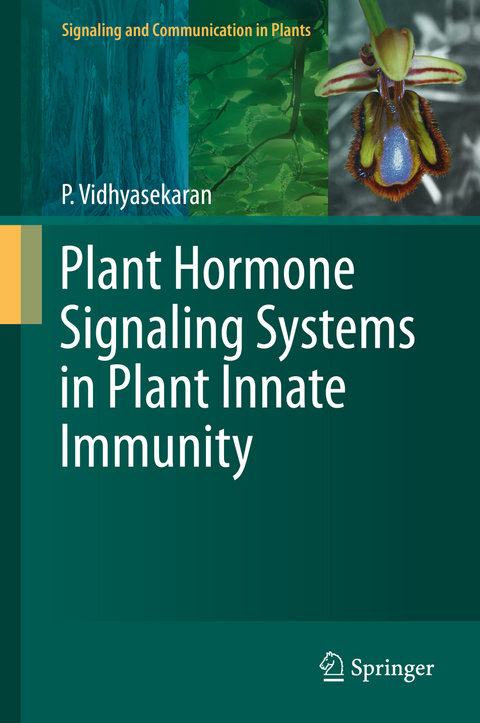
Plant Hormone Signaling Systems in Plant Innate Immunity (eBook)
XVII, 458 Seiten
Springer Netherland (Verlag)
9789401792851 (ISBN)
Professor Dr. P. Vidhyasekaran, Ph.D., F.N.A., is the Former Director, Center for Plant Protection Studies, Tamil Nadu Agricultural University. 'I have published more than 400 research papers in almost all International Journals with high impact factor (to be precise- 32 journals). I have published 12 books so far and my book publishers include CRC Press, Boca Raton, Florida, U.S.A (3 books), Marcel Dekker, New York (1), The Haworth Press, New York (3 books) and Taylor-Francis -CRC Press, USA. My books have received very enthusiastic reviews and second editions, in addition the regional editions and e-Book format of my books have also appeared. My latest book published by CRC Press as second edition is recommended by American Phytopathological Society (APS) and included in the APS Press Store. I have won several national awards and I am a Fellow of National Academy of Agricultural Sciences and in several other scientific societies. I have served as President of Indian Society of Plant Pathologists. I have served in editorial boards of several journals and also served as Visiting Scientist in USA, Philippines and Denmark. ZB: selection of books published: * Handbook of Molecular Technologies in Crop Disease Management (The Haworth Press, 2007) * Concise Encyclopedia of Plant Pathology (The Haworth Press, 2004) * Bacterial Disease Resistance in Plants, Molecular Biology and Biotechnological Applications (The Haworth Press, 2002) * Fungal Pathogenesis in Plants and Crops: Molecular Biology and Host Defence Mechanisms, 1st & 2nd ed. (CRC Press, 2nd ed. 2007).
Plants are endowed with innate immune system, which acts as a surveillance system against possible attack by pathogens. Plant innate immune systems have high potential to fight against viral, bacterial, oomycete and fungal pathogens and protect the crop plants against wide range of diseases. However, the innate immune system is a sleeping system in unstressed healthy plants. Fast and strong activation of the plant immune responses aids the host plants to win the war against the pathogens. Plant hormone signaling systems including salicylate (SA), jasmonate (JA), ethylene (ET), abscisic acid (ABA), auxins, cytokinins, gibberellins and brassinosteroids signaling systems play a key role in activation of the sleeping immune systems. Suppression or induction of specific hormone signaling systems may result in disease development or disease resistance. Specific signaling pathway has to be activated to confer resistance against specific pathogen in a particular host. Two forms of induced resistance, systemic acquired resistance (SAR) and induced systemic resistance (ISR), have been recognized based on the induction of specific hormone signaling systems. Specific hormone signaling system determines the outcome of plant-pathogen interactions, culminating in disease development or disease resistance. Susceptibility or resistance against a particular pathogen is determined by the action of the signaling network. The disease outcome is often determined by complex network of interactions among multiple hormone signaling pathways. Manipulation of the complex hormone signaling systems and fine tuning the hormone signaling events would help in management of various crop diseases. The purpose of the book is to critically examine the potential methods to manipulate the multiple plant hormone signaling systems to aid the host plants to win the battle against pathogens.
Professor Dr. P. Vidhyasekaran, Ph.D., F.N.A., is the Former Director, Center for Plant Protection Studies, Tamil Nadu Agricultural University. "I have published more than 400 research papers in almost all International Journals with high impact factor (to be precise- 32 journals). I have published 12 books so far and my book publishers include CRC Press, Boca Raton, Florida, U.S.A (3 books), Marcel Dekker, New York (1), The Haworth Press, New York (3 books) and Taylor-Francis —CRC Press, USA. My books have received very enthusiastic reviews and second editions, in addition the regional editions and e-Book format of my books have also appeared. My latest book published by CRC Press as second edition is recommended by American Phytopathological Society (APS) and included in the APS Press Store. I have won several national awards and I am a Fellow of National Academy of Agricultural Sciences and in several other scientific societies. I have served as President of Indian Society of Plant Pathologists. I have served in editorial boards of several journals and also served as Visiting Scientist in USA, Philippines and Denmark. ZB: selection of books published: * Handbook of Molecular Technologies in Crop Disease Management (The Haworth Press, 2007) * Concise Encyclopedia of Plant Pathology (The Haworth Press, 2004) * Bacterial Disease Resistance in Plants, Molecular Biology and Biotechnological Applications (The Haworth Press, 2002) * Fungal Pathogenesis in Plants and Crops: Molecular Biology and Host Defence Mechanisms, 1st & 2nd ed. (CRC Press, 2nd ed. 2007).
1 Introduction1.1 Plant Innate Immunity1.2 Salicylic Acid Signaling 1.3 Jasmonate Signaling1.4 Ethylene Signaling 1.5 Abscisic Acid Signaling1.6 Auxin Signaling1.7 Cytokinins 1.8 Gibberellins 1.9 Brassinosteroids1.10 Plant Hormone Signaling Network1.11 Can Molecular Manipulation of Plant Hormone Signaling Network Help the Plant to Win the War Against Pathogens? 2 Salicylic acid Signaling in Plant Innate Immunity2.1 Salicylic Acid as an Endogenous Immune Signal in Plants2.2 Biosynthesis of Salicylic Acid in Plants2.3 Upstream of Salicylic Acid Signaling System2.4 Downstream Events in Salicylic acid Signaling2.5 SA Signaling Induces Increased Expression of Transcription Factors to Activate SA-Responsive Defense-Related Genes2.6 NPR1 Is Master Regulator of SA Signaling2.7 Role of SUMO in SA Signaling System 2.8 SA Induces Transcription of Various Defense Genes2.9 Role of SA Signaling in Stomatal Closure-Related Immune Responses Against Bacterial Pathogens 2.10 SA-Induces Resistance Against Viruses By Modulating AOX-Mediated Alternative Respiratory Pathway2.11 SA Triggers Small RNA-Directed RNA Silencing system2.12 Enhancement of Small RNA-Directed RNA Silencing by Salicylate Signaling System2.13 Interplay Between SA-Induced AOX-Mediated Redox Signaling and SA-Induced Small RNA-Directed RNA Silencing 2.14 Salicylic Acid Signaling is Involved in Induction of Systemic Acquired Resistance 2.15 Mobile Long-distance Signals for Induction of Systemic Acquired Resistance2.16 Role of Mediator Complex in SA-mediated Systemic Acquired Resistance2.17 Salicylic Acid Triggers Priming and Induces Systemic Acquired Resistance2.18 Next Generation Systemic Acquired Resistance2.19 Cross-Talk between Salicylate and Jasmonate Signaling Systems 2.20 Cross-Talk between SA and ET Signaling Systems2.21 Cross-Talk between SA and ABA Signaling Systems2.22 Cross-Talk between SA and Auxin Signaling Systems2.23 Negative Regulation of Salicylate-mediated Immunity by Brassinosteroid Signaling2.24 SA Signaling System May Induce Resistance Against Wide Range of Pathogens2.25 Pathogens May Suppress SA Signaling System to Cause Disease3 Jasmonate Signaling System in Plant Innate Immunity3.1 Jasmonate Signaling System is a Key Component in PAMP-Triggered Innate Immunity3.2 Biosynthesis of Jasmonates3.3 Jasmonate Biosynthesis Intermediate OPDA in Defense Signaling 3.4 JA Metabolites Involved in Defense Signaling3.5 Upstream of JA Biosynthesis3.6 Jasmonate Receptor Complex in JA Signal Perception3.7 JA Signaling Pathway3.8 Mediator Complex Regulates Transcription of JA-Responsive Genes by Interacting With Transcription Factors3.9 MAP Kinases May Regulate the Downstream Events in JA Signaling Pathway3.10 Histone Acetylation May Regulate JA- Mediated Signaling Systems 3.11 JA-Induced Pep1 Peptide Amplifies JA Downstream Signaling to Induce JA- Responsive Genes 3.12 Transcription Factors Acting Downstream of JA in Defense Signaling System3.13 JA Signaling System-Activated Defense Genes3.14 JA-Signaling System Triggers Immune Responses Against Necrotrophic Pathogens 3.15 JA and Ethylene Signaling Pathways May Operate Concomitantly in Plant Innate Immune System 3.16 JA Signaling May Suppress SA signaling System3.17 Suppression of JA Signaling by SA Signaling System3.18 Interplay between JA and Abscisic Acid Signaling Systems in Plant Immune Responses3.19 Crosstalk between JA Signaling and Small RNA Signaling Systems3.20 JA Signaling in Induced Systemic Immunity4 Ethylene Signaling System in Plant Innate Immunity4.1 Ethylene Signaling is an Important Component in Plant Innate Immunity4.2 Ethylene Biosynthesis in Plants4.3 Ethylene Signal Transduction Downstream of Ethylene Biosynthesis 4.4 ERF Transcription Factors Functioning Downstream in Ethylene Signaling System4.5 ROS and NO Signaling Systems Activate Transcription of Ethylene-Responsive Genes 4.6 MAPK Cascade May Regulate Ethylene Signaling System4.7 Ethylene Signaling Triggers Transcription of Plant Pattern Recognition Receptors (PRRs) in PAMP-PRR Signaling System 4.8 Ethylene Triggers Ca2+ Influx in Downstream Ethylene Signaling System4.9 Ethylene and Jasmonate Signaling Interdependency in Triggering Plant Immune Responses4.10 Ethylene Induces Transcription of Defense-Related Genes4.11 Ethylene Signaling System Modulates Plant Immune Sigmaling System Triggering Resistance or Susceptibility Against Different Pathogens5 Absicisic Acid Signaling System in Plant Innate Immunity5.1 Abscisic Acid as a Multifaceted Plant Hormone Signal Triggering or Suppressing Plant Defense Responses5.2 ABA Biosynthesis in Innate Immune Responses5.3 ABA Perception and Signal Transduction5.4 ABA Signaling Events Downstream of PYR/PYL/RCAR-PP2C-SNRK2 Signaling 5.5 Systemic Movement of ABA and Intercellular ABA Signaling Pathway5.6 Interplay Between ABA and JA Signaling Systems5.7 Interplay Between ABA and SA Signaling Systems5.8 Interplay Between ABA and Ethylene Signaling Systems5.9 ABA Signaling System May Trigger Defense Responses Against Pathogens5.10 ABA Signaling System May Confer Susceptibility Against Pathogens5.11 Pathogens May Suppress Host Defense Mechanisms by Activating ABA signaling system to Cause Disease5.12 Pathogens May Hijack ABA Signaling Pathway to Cause Disease5.13 Pathogen Produces Toxins/Effectors and Suppresses ABA-dependent Defenses6 Auxin Signaling System in Plant Innate Immunity6.1 Auxin as a Signaling Molecule 6.2 Auxin Biosynthesis6.3 Auxin Signaling Pathway6.4 Pathogen Infection Elevates Auxin Biosynthesis in Plants6.5 Antagonism between Auxin Signaling and PAMPs/elicitors-Triggered Signaling Systems6.6 Antagonism Between Auxin Signaling and HAMP/Endogenous Elicitor - triggered Signaling Systems6.7 Interplay Between Auxin Signaling and Mitogen-activated Protein Kinase Mediated Signaling Systems6.8 Nitric Oxide Modulates Auxin Signaling6.9 Interaction between Auxin and Salicylic acid (SA) Signaling Systems6.10 Role of Auxin Signaling in Systemic Acquired Resistance (SAR)6.11 Interactions between Auxin and Jasmonate Signaling Systems6.12 Interaction between Auxin and Ethylene Signaling Systems6.13 Interaction between Small RNAs and Auxin Signaling Systems6.14 Auxin Signaling may promote Susceptibility6.15 Auxin Signaling may promote Plant Disease Resistance 7 Cytokinin Signaling System in Plant Immunity7.1 Cytokinin Signaling in Plant Immune System7.2 Cytokinin Biosynthesis7.3 Cytokinin Degradation 7.4 Cytokinin Signal Perception and Transduction 7.5 Cytokinin-Responsive Genes7.6 Cytokinins May be Involved in Triggering Defense responses7.7 Cytokinins May Induce Susceptibility7.8 Interplay Between Cytokinin and SA Signaling Pathways in Plant Immune System7.9 Interaction Between Cytokinin and Abscisic acid Signaling Systems7.10 Interplay Between Cytokinin and Auxin Signaling Systems in Plant Immunity8 Gibberellin Signaling in Plant Innate Immunity8.1 Role of Gibberellins in Plant Immune Responses8.2 Biosynthesis of Gibberellins8.3 GA Signaling Pathway8.4 GA Triggers Susceptibility or Resistance Against Different Pathogens8.5 Interplay of GA Signaling System with SA Signaling System in Modulating Plant Immune System8.6 Interplay of GA and JA signaling Systems in Modulating Plant Immune System 8.7 Interplay Between GA and Brassinosteroids Signaling Systems in Plant Immune Responses 8.8 Interplay Between GA and Auxin Signaling Systems8.9 GA May be Involved in Triggering Systemic Acquired Resistance (SAR)8.10 Pathogen May Suppress GA Signaling Pathway to Cause Disease9 Brassinosteoid Signaling in Plant Immune System9.1 Brassinosteroids Modulate Plant Immune Responses9.2 Biosynthesis of Brassinosteroids9.3 Brassinosteroid Signaling System 9.4 Pathogen Modulates Brassinosteroid Signaling System in Infected Plants 9.5 BR Signaling Triggers Plant Disease Resistance 9.6 BAK1 in the BR Signaling Pathway Triggers Plant Disease Resistance9.7 BR Signaling Machinery Negatively Regulates Plant Immune Responses and Induces Susceptibility9.8 Brassinosteroid Signaling Negatively Regulates Salicylate-mediated Immunity 9.9 BR Signaling Negatively Regulates Gibberellic Acid (GA)-Mediated Plant Immune Responses9.10 Interplay Between BR and PAMP-PRR Signaling Systems9.11 Pathogen Hijacks Brassinosteroid Signaling Machinery to cause Disease9.12 Crosstalk between BR and Other Hormone Signaling Systems
| Erscheint lt. Verlag | 1.10.2014 |
|---|---|
| Reihe/Serie | Signaling and Communication in Plants | Signaling and Communication in Plants |
| Zusatzinfo | XVII, 458 p. 102 illus. |
| Verlagsort | Dordrecht |
| Sprache | englisch |
| Themenwelt | Naturwissenschaften ► Biologie ► Botanik |
| Naturwissenschaften ► Biologie ► Mikrobiologie / Immunologie | |
| Technik ► Umwelttechnik / Biotechnologie | |
| Weitere Fachgebiete ► Land- / Forstwirtschaft / Fischerei | |
| Schlagworte | DELLA proteins • PAMP-PRR-hormone signalling interplay • Pathogen-triggered molecular patterns • Phosphorelay signaling • Priming defense responses |
| ISBN-13 | 9789401792851 / 9789401792851 |
| Informationen gemäß Produktsicherheitsverordnung (GPSR) | |
| Haben Sie eine Frage zum Produkt? |
 PDF (Wasserzeichen)
Größe: 10,9 MB
DRM: Digitales Wasserzeichen
Dieses eBook enthält ein digitales Wasserzeichen und ist damit für Sie personalisiert. Bei einer missbräuchlichen Weitergabe des eBooks an Dritte ist eine Rückverfolgung an die Quelle möglich.
Dateiformat: PDF (Portable Document Format)
Mit einem festen Seitenlayout eignet sich die PDF besonders für Fachbücher mit Spalten, Tabellen und Abbildungen. Eine PDF kann auf fast allen Geräten angezeigt werden, ist aber für kleine Displays (Smartphone, eReader) nur eingeschränkt geeignet.
Systemvoraussetzungen:
PC/Mac: Mit einem PC oder Mac können Sie dieses eBook lesen. Sie benötigen dafür einen PDF-Viewer - z.B. den Adobe Reader oder Adobe Digital Editions.
eReader: Dieses eBook kann mit (fast) allen eBook-Readern gelesen werden. Mit dem amazon-Kindle ist es aber nicht kompatibel.
Smartphone/Tablet: Egal ob Apple oder Android, dieses eBook können Sie lesen. Sie benötigen dafür einen PDF-Viewer - z.B. die kostenlose Adobe Digital Editions-App.
Buying eBooks from abroad
For tax law reasons we can sell eBooks just within Germany and Switzerland. Regrettably we cannot fulfill eBook-orders from other countries.
aus dem Bereich