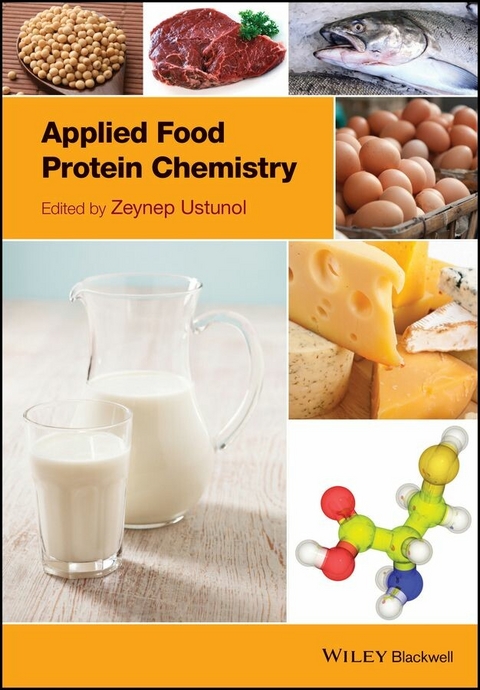
Applied Food Protein Chemistry (eBook)
528 Seiten
Wiley (Verlag)
978-1-118-86061-8 (ISBN)
Food proteins are of great interest, not only because of their nutritional importance and their functionality in foods, but also for their detrimental effects. Although proteins from milk, meats (including fish and poultry), eggs, cereals, legumes, and oilseeds have been the traditional sources of protein in the human diet, potentially any proteins from a biological source could serve as a food protein. The primary role of protein in the diet is to provide the building materials for the synthesis of muscle and other tissues, and they play a critical role in many biological processes. They are also responsible for food texture, color, and flavor. Today, food proteins are extracted, modified, and incorporated into processed foods to impart specific functional properties. They can also have adverse effects in the diet: proteins, such as walnuts, pecans, almonds, and cashews, soybean, wheat, milk, egg, crustacean, and fish proteins can be powerful allergens for some people.
Applied Food Protein Chemistry is an applied reference which reviews the properties of food proteins and provides in-depth information on important plant and animal proteins consumed around the world. The book is grouped into three sections: (1) overview of food proteins, (2) plant proteins, and (3) animal proteins. Each chapter discusses world production, distribution, utilization, physicochemical properties, and the functional properties of each protein, as well as its food applications. The authors for each of the chapters are carefully selected experts in the field. This book will be a valuable reference tool for those who work on food proteins. It will also be an important text on applied food protein chemistry for upper-level students and graduate students of food science programs.
Dr Zeynep Ustunol is Professor of Food Science and Human Nutrition and Director of Graduate Programs at Michigan State University, East Lansing, Michigan, USA
Dr Zeynep Ustunol is Professor of Food Science and Human Nutrition and Director of Graduate Programs at Michigan State University, East Lansing, Michigan, USA
About the Editor vii
List of Contributors ix
Scientific Review Panel xiii
Preface xv
Acknowledgments xvii
Part I Protein Properties
1 Introduction to Food Proteins 3
Zeynep Ustunol
2 Overview of Food Proteins 5
Zeynep Ustunol
3 Amino Acids, Peptides, and Proteins 11
Zeynep Ustunol
4 Physical, Chemical, and Processing-Induced Changes in Proteins 23
Zeynep Ustunol
5 Functional Properties of Food Proteins 47
Eleana Kristo and Milena Corredig
6 Biologically Active Peptides from Foods 75
Fereidoon Shahidi and Quanqaun Li
7 Protein and Peptide-Based Antioxidants 99
Roger Nahas and John Weaver
8 Nutritional Aspects of Proteins 113
Nathalie Trottier and Ryan Walker
Part II Plant Proteins
9 Soy Proteins 141
Luis Mojica, Vermont P. Dia, and Elvira Gonz´alez de Mej´ia
10 Canola/Rapeseed Proteins and Peptides 193
Ayyappan Appukuttan Aachary, Usha Thiyam-Hollander, and Michael N.A. Eskin
11 Wheat Proteins 219
Ang´ela Juh´asz, Frank B´ek´es, and Colin W. Wrigley
12 Rice Proteins 305
Marissa Villafuerte Romero
13 Sorghum and Millet Proteins 323
Scott Bean and Brian P. Ioerger
Part III Animal Proteins
14 Muscle Proteins 363
Iksoon Kang and Pranjal Singh
15 Seafood Proteins and Surimi 393
Jae W. Park and Zachary H. Reed
16 Milk Proteins 427
Nana Y. Farkye and Nagendra Shah
17 Egg Proteins 459
Yoshinori Mine
Index 491
"This book reviews the properties of food proteins and provides in-depth information on important plant and animal proteins consumed around the world." (South African Food Science and Technology, 1 February 2016)
2
Overview of Food Proteins
Zeynep Ustunol
Department of Food Science and Human Nutrition, Michigan State University, East Lansing, MI, USA
2.1 Overview of food proteins
This book, Applied Food Protein Chemistry, is divided into three main sections. The first section reviews amino acid, peptide, and protein chemistry. It covers the properties of proteins important in foods. The second section provides an in-depth review of the chemistry, properties, and application of food proteins derived from plant sources. The third and last section is on the chemistry, properties and application of food proteins from animal sources.
2.1.1 Section I. Protein properties
Food proteins are essential source of amino acids in the diet which are necessary for normal growth and maintenance of the body. Chapter 3 provides a review of amino acid, peptide, and protein chemistry. Many of our food proteins are denatured and/or altered at the time of their consumption. Thus Chapter 4 is dedicated to protein denaturation, chemical modification of proteins, as well as processing-induced changes. The effects of these changes on specific food proteins are further discussed in the specific chapter dedicated to that protein. Protein denaturation may or may not be desirable, and the nutritional value of a particular protein may be dependent on the extent of denaturation; this is addressed in several of the chapters.
Proteins are essential in the human diet, therefore it is critical to accurately define protein quality and the amount of protein required to meet nutritional needs of different populations. Since the optimum balance between the amino acid supply (provided by dietary proteins) and the dietary needs is important for the health and well-being of human populations, dietary applications for proteins are determined by the nutritional value of the protein and the human requirements for protein and amino acids. Chapter 8 provides a critical review of the most relevant method for evaluation of food protein quality, the relevance of the pig as a model for assessment of protein quality, and the most recent development in amino acid requirement estimates for humans.
Food proteins also encode a series of bioactive peptides within their structure. Bioactive peptides, once ingested and absorbed, can play a key biological role as regulators of the immune system, blood pressure, or as signalling molecules. Bioactive peptides derived from food proteins are reviewed in detail in Chapter 6.
In addition to their importance nutritionally, food proteins are used as ingredients in foods because of their functional properties and are important in providing structure to the food matrix. Chapter 4 reviews functional properties of food proteins. However, as the authors indicate, this chapter is not a comprehensive review of food protein functionality, rather it highlights some of the novel aspects and recent advances in the methodologies used to study protein functionality. Understanding protein structure provides insight into different aspects of protein functionality; food texture may be manipulated by manipulating the structure and aggregation of proteins. This may be accomplished through processing, by altering environmental conditions, or the interaction of protein with other components in foods. It is important to emphasize that food matrices are complex. The presence of other food components and phases in food provide for additional complexity to studying these systems. Food proteins' ability to form colloidal structures is also discussed in Chapter 4 as these are important in the processing and nutritional properties of the food matrix they form.
Proteins or peptides derived from food proteins also offer potential as natural antioxidants. They can serve as food preservatives, against lipid oxidation. Lipid oxidation is the primary way lipids and lipid-containing foods deteriorate. Lipid oxidation can lead to loss of nutrients and color, and produce off-flavors and off-aromas. Lipid oxidation can also impact texture and functionality because of its effect on protein structure. Chapter 7 provides an overview of lipid oxidation mechanisms in foods and offers an insight into natural antioxidant options derived from proteins and peptides, among the variety of existing natural antioxidants, to manage lipid oxidation in food and beverage systems. Allergenicity of proteins of course is a concern when using proteins as ingredients/additives. Hydrolyzed pea protein currently looks most promising in food applications. A section in this chapter is dedicated to pea proteins.
2.1.2 Section II. Plant proteins
Proteins from soybeans, canola, corn, wheat, rice, sorghum, and millet are the most significant sources of plant proteins around the world. The nutrient composition of plants and thus proteins are influenced by cultivar, breeding, growth conditions, processing, and refinement.
Soy proteins is one of the most widely consumed oilseed protein in the world. They have been of interest due to their low cost and data accumulating on their health benefits. Soy protein products have experienced significant increase in sales in the United States. Their application in foods range from functional ingredients to biopolymers, biofilms, and nanocomposite. Particularly popular are energy bars, soy beverages, flavored soy nuts texturized meat substitutes. Changes in their physicochemical properties can further extend their applications in food formulations by improving on their functional, sensory, rheological, and nutritional properties. Chapter 9 reviews chemical composition and principal physicochemical modifications of soybean proteins, and their application in foods.
Canola is a variety of rapeseed that was developed in Canada. It is characterized by its low erucic acid and glucosinolate content in the oil and the meal. Canola is a major oilseed crop. Canola proteins are found in the meal that results as a by-product of oil extraction. The nutritional profile and functional properties of canola proteins make them good candidates as ingredients for use in the food and beverage industries. However, a number of antinutritional components such as glucosinolates, phenolics, phytates, tannins, sinapine, and high fiber in the canola meal have limited their food use. These components also contribute to the inferior physicochemical properties of canola proteins, their digestibility, color, and taste. Over the years research has focused on removing or reducing the amount of these undesirable components, which has provided canola proteins with desirable functional properties with potential use in foods. Chapter 10 discusses the characteristics of canola and low erucic acid rapeseed proteins as well as their functional and health-related properties.
Among cereals grains, wheat, rice, and maize make up approximately 87% of the world production. Wheat is one of the oldest cereal grains to be domesticated. Today it is grown in almost all continents. Among cereal grains wheat has the highest protein content. Wheat proteins are storage proteins whose primary application are bakery products. When the grain is milled and mixed with water, the water-insoluble storage proteins form an elastic dough, due to the unique rheological properties of the gluten proteins. This dough has the ability to retain gas bubbles. Wheat flour is well suited for making the many wheat-based food products that are an important part of the diet for millions around the world. These products included bread in many different forms, noodle and pasta products, pastries, and other baked goods. Gluten was one of the first proteins to be purified and identified as contributing to wheat's unique dough-forming properties. Today, great complexity of wheat grain proteins is well known. Chapter 11 provides an in-depth review of wheat proteins. Growing interest and expanding markets for “gluten-free” products are also covered in this chapter.
After wheat, maize (or corn) contains the highest amount of protein among cereal grains. Maize is one of the top three cereal crops in terms of world consumption and economic importance. It is the main source of calories and protein for majority of the population in about 20 of the developing countries in Central and South America, Asia, and Africa. It is also used as a weaning food for babies in these countries. Much research has been conducted on improving the nutritional value of maize. There are several excellent books dedicated to maize and maize proteins, therefore, maize is not covered in this book.
Rice is a cereal grain also consumed as a staple food in parts of the world particularly Asia and parts of Central and South America, and to a lesser extent Africa. Rice is a tropical cereal, typically grown in paddies. Rice has one of the lowest protein contents among cereals. Proteins are present in rice hull, bran, and endosperm but the highest protein content is found in the bran. The best sources of rice proteins are the bran and broken rice because these by-products of rice processing are undervalued and with limited applications. Contrary to other cereal proteins which tend to be deficient in lysine, rice has a good amount of lysine. Recently rice proteins have been of interest due to their hypoallergenicity. The functional properties of protein hydrolysates from rice bran and rice endosperm and their various food applications are described in Chapter 12.
Chapter 13 is dedicated to sorghum and pearl millet which rank fifth and sixth worldwide in production among the cereal grains. They serve...
| Erscheint lt. Verlag | 19.12.2014 |
|---|---|
| Sprache | englisch |
| Themenwelt | Naturwissenschaften ► Biologie |
| Naturwissenschaften ► Chemie ► Technische Chemie | |
| Technik ► Lebensmitteltechnologie | |
| Weitere Fachgebiete ► Land- / Forstwirtschaft / Fischerei | |
| Schlagworte | biological • Building Materials • Critical • diet • Effects • Food • Food chemistry • Foods • Food Science & Technology • Functionality • Great • Human • Lebensmittelchemie • Lebensmittelforschung u. -technologie • meats • milk • Muscle • nutritional • Protein • proteins • Role • source • Sources • synthesis • Traditional |
| ISBN-10 | 1-118-86061-6 / 1118860616 |
| ISBN-13 | 978-1-118-86061-8 / 9781118860618 |
| Informationen gemäß Produktsicherheitsverordnung (GPSR) | |
| Haben Sie eine Frage zum Produkt? |
 EPUB (Adobe DRM)
Kopierschutz: Adobe-DRM
Adobe-DRM ist ein Kopierschutz, der das eBook vor Mißbrauch schützen soll. Dabei wird das eBook bereits beim Download auf Ihre persönliche Adobe-ID autorisiert. Lesen können Sie das eBook dann nur auf den Geräten, welche ebenfalls auf Ihre Adobe-ID registriert sind.
Details zum Adobe-DRM
Dateiformat: EPUB (Electronic Publication)
EPUB ist ein offener Standard für eBooks und eignet sich besonders zur Darstellung von Belletristik und Sachbüchern. Der Fließtext wird dynamisch an die Display- und Schriftgröße angepasst. Auch für mobile Lesegeräte ist EPUB daher gut geeignet.
Systemvoraussetzungen:
PC/Mac: Mit einem PC oder Mac können Sie dieses eBook lesen. Sie benötigen eine
eReader: Dieses eBook kann mit (fast) allen eBook-Readern gelesen werden. Mit dem amazon-Kindle ist es aber nicht kompatibel.
Smartphone/Tablet: Egal ob Apple oder Android, dieses eBook können Sie lesen. Sie benötigen eine
Geräteliste und zusätzliche Hinweise
Buying eBooks from abroad
For tax law reasons we can sell eBooks just within Germany and Switzerland. Regrettably we cannot fulfill eBook-orders from other countries.
aus dem Bereich