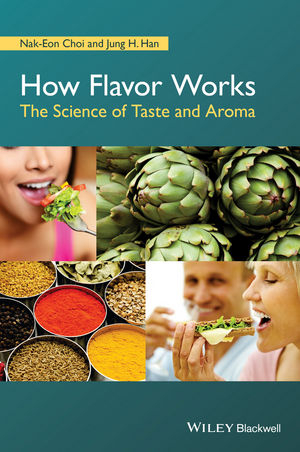
How Flavor Works (eBook)
John Wiley & Sons (Verlag)
978-1-118-86545-3 (ISBN)

Taste is the number one driving force in the decision to purchase a food product and food consumption is the most critical function for living organisms to obtain the energy and resources essential to their vitality. Flavor and aroma are therefore universally important concepts: intrinsic to human well-being and pleasure, and of huge significance for the multi-trillion dollar global food business.
How Flavor Works: the Science of Taste and Aroma offers a fascinating and accessible primer on the concepts of flavor science for all who have an interest in food and related topics. Professionals and students of food science and technology who do not already specialize in flavor science will find it a valuable reference on a topic crucial to how consumers perceive and enjoy food products. In this regard, it will also be of interest to product developers, marketers and food processors. Other readers with a professional (eg culinary and food service) or personal interest in food will also find the book interesting as it provides a user-friendly account of the mechanisms of flavor and aroma which will provide new insights into their craft.
Nak-Eon Choi is Research Director at Sias Co, Ltd, Seoul, South Korea
Jung H. Han, PhD CFS is an Adjunct Associate Professor in the Department of Food Science and Human Nutrition at
the University of Illinois at Urbana/Champaign, USA
Taste is the number one driving force in the decision to purchase a food product and food consumption is the most critical function for living organisms to obtain the energy and resources essential to their vitality. Flavor and aroma are therefore universally important concepts: intrinsic to human well-being and pleasure, and of huge significance for the multi-trillion dollar global food business. How Flavor Works: the Science of Taste and Aroma offers a fascinating and accessible primer on the concepts of flavor science for all who have an interest in food and related topics. Professionals and students of food science and technology who do not already specialize in flavor science will find it a valuable reference on a topic crucial to how consumers perceive and enjoy food products. In this regard, it will also be of interest to product developers, marketers and food processors. Other readers with a professional (eg culinary and food service) or personal interest in food will also find the book interesting as it provides a user-friendly account of the mechanisms of flavor and aroma which will provide new insights into their craft.
Nak-Eon Choi is Research Director at Sias Co, Ltd, Seoul, South Korea. Jung H. Han, PhD CFS is an Adjunct Associate Professor in the Department of Food Science and Human Nutrition at the University of Illinois at Urbana/Champaign, USA.
"Anyone with an interest in foods, flavours or fragrances (dare I say most of us!) will definitely 'sniff out' something of value from this book." (Chemistry in Australia, 1 October 2015)
"Other readers with a professional (e.g. culinary and food service) or personal interest in food will also find the book interesting as it provides a user-friendly account of the mechanisms of flavor and aroma which will provide new insights into their craft." (Biotech, Agro, Soc & Env, 1 September 2015)
Chapter 1
What is Taste?
Le Créateur, en obligeant l'homme à manger pour vivre, l'y invite par l'appétit, et l'en récompense par le plaisir. (The Creator, when he obliges man to eat, invites him to do so by appetite, and rewards him by pleasure.)
Jean Anthelme Brillat-Savarin (Physiologie du goût, 1825)
Taste is the major influence when deciding which food products to purchase. Globally, regardless of geographical and cultural backgrounds, tastier foods will sell better. For example, strawberries can be found in grocery shops whatever the season or location because they are in high demand. Rarely are any bad-tasting foods popular. The food business worldwide is about 4 trillion USD and the huge size of this market reflects how much taste influences the value of this business. In addition to the food manufacturing business, there are many other different types of food industries. Worldwide, many TV stations broadcast food shows featuring the country's native cuisine. Also, most newspapers and magazines publish food review articles. Recently, as well as these conventional journalism sectors, internet web sites have begun to post various stories on delicious foods and restaurants. However, as people obsess more frequently over tasty foods, some serious side effects have also become more common. The most severe side effect is obesity. Since this is caused by excessive eating habits, solving obesity seems very simple: just “eat less.” However, today's obesity issue is worse than ever, regardless of the simple solution. This is because the answer to successful weight control requires a change in lifestyle, and this can be extremely difficult for some people. Another issue is that in today's culture food is not eaten just to eliminate hunger, people also eat when they are not hungry. The indulgent satisfaction that comes from eating overcomes their desire to stop eating or, in the long term, to change their lifestyle in order to ensure healthy weight control. Now you may start to question what is taste and its relation to obesity, and how do you make your food tastier yet healthier?
All life forms have to eat to survive. In order to obtain the essential energy and resources necessary for their vitality, consumption of food is a critical and major activity for all living organisms. If there was no indulgent satisfaction from our eating habits, food consumption would be a most tedious task that was simply necessary for humans to survive. It would become a chore in order to maintain our vitality, as is taking prescribed medicines. For example, remembering to take prescribed antibiotics twice a day for 10 days is always difficult. Without the delight of eating, ingesting essential nutrients and obtaining our daily energy would be very tedious. Furthermore, it would be extremely hard work to motivate someone to secure adequate amounts of food every single day. However, the emotional pleasure of eating compensates for this hard work. This pleasure never subsides, and is experienced whenever we eat. Unlike other stimulants, eating food is an easy way to receive instant, constant and satisfying gratification. However, when we start to think about a definition for taste, this becomes very difficult, even though it is easy to actually sense it. If we define taste only as a gustatory sense through the biochemistry in our mouth, there are five basic taste elements: sweetness, saltiness, sourness, bitterness, and umami. However, can we describe all the characteristic tastes of thousands of cuisines with the combinations of only these five basic tastes? The answer is no. The characteristic tastes of foods consist of various flavors as well as these five elements. These unique tastes are identified by combinations of thousands of volatile odorants transferred to the nasal cavity through a narrow air-passage from the throat when we eat food. Patients suffering from nasal congestion cannot sense the taste of food as well as normal people can. You may have experienced a slightly better taste when you swallow bitter medications whilst closing your nose with your fingers. Even trace amounts of volatile flavors can change the overall taste of a food, and in the food industry these can affect the profit and loss of their business directly.
The total amount of odorants in a food product is at trace levels. For example, lycopene in tomatoes is only 0.004% but it gives the tomato its famous red color. In most cases, the total amount of odorants is less than 0.01% but this is responsible for the characteristic flavors in the food. Most flowers have less than 0.01% of volatile chemicals in their weight. Sometimes we can obtain a total extract, with both volatile and nonvolatile chemicals, which may reach 0.1% of the total flower composition. However, not all of the components of the volatile extract have the characteristic odorants of the flower. It would be difficult to characterize various fruits by their composition analysis data; however, trace amounts of flavors could classify many fruits into their characteristic groups. An infusion of a small amount of a flavor can make bland fruits taste like completely different fruits.
The human brain allocates only 0.1% of its space to the sensory function of smell, while the area for the visual sensory system takes up 25%. From this statistic, the olfactory sense seems very insignificant, sluggish, and undeveloped. However, in many other animals the olfactory sense is the most developed, sensitive, and dominant sensory system. Did the human sensory system for smell really degenerate? I believe the answer is no. As opposed to those of other animals, the human brain, especially the parts in charge of all sensory systems other than smell, is uniquely advanced, resulting in a relatively small portion of the brain being responsible for the function of smell. Most carnivores have a very sensitive olfactory sense, especially to the odor of prey, compared with that of a human. However, the olfactory sense of a human is not inferior to the sense of other animals when we consider various scent recognition abilities and we understand the connection between this sense to memory, emotions, or other brain functions. The olfactory system of a human is much more important than any other sensory system. Knowing this allows us to correctly understand flavors and intuitively utilize the sensory mechanism.
How can we smell an odorant? Obviously we smell through our nose. The actively functioning area for recognizing the odorant is located in the olfactory epithelium, the top of our nasal cavity, which is only the size of a small coin. This area has more than 400 different types of olfactory cells, indicating that there are far more than 400 genes related to these cells. Compare this with only three types of photoreceptor cells responding to light, one type of taste receptor cell for sweetness, and two types of cells for umami. When we compare the number of olfactory cell types to the small number of receptor cell types for other important sensory systems and also the small number of cell types for other essential metabolisms, the relative number of olfactory cell types is notably large. The entire human body has only 23 000 genes. Therefore, it would be a relatively very high number of genes that are required to develop only one sensory system of smell with 400 types of olfactory cells.
G-protein coupled receptors (GPCR) are found in the olfactory cells. In 1994, Alfred Gilman and Martin Rodbell received the Nobel Prize in Physiology for their discovery of G-proteins and the role of these proteins in signal transduction. Richard Axel and Linda Buck received the Nobel Prize in Physiology for their discoveries of odorant receptors (GPCR) and the organization of the olfactory system in 2004. In 2012, Robert Lefkowitz and Brian Kent Kobilka also received the Nobel Prize in Chemistry for their studies of GPCR. It is very surprising that studies on one sensory mechanism can yield three Nobel Prizes. However, the news of Nobel Prizes related to GPCR studies and olfactory sensory mechanisms has not been as widespread as much other news. Thus, the olfactory sense has become a forgotten physiological topic. However, the mechanism of the olfactory system is the first signal process that living organisms respond to in natural environments. Predators identify the location of their prey using their olfactory signals first, and also recognize edible foods from toxic materials after sniffing them. They do this by remembering which smells relate to which experiences. The system of smell can be developed earlier than any other sensory system.
In the same way that a small amount of hormone can differentiate all body metabolisms, a small amount of odorant can completely dictate the flavors and tastes of foods. However, we enjoy eating foods with flavors without recognizing all of the odorants in them. Of course enjoying the flavors of foods is more important than analyzing all the volatile chemicals and we do not need to actually think about the various odorants. Moreover we have all heard about so many cases of incorrect information on foods that has had no validation by experts on the specific subject matter, which ironically influence our lifestyle by making us more anxious than any evidence-based suggestions from food specialists. Therefore, it is necessary and worth understanding more about odorants and the sense of smell.
All tastes can be classified as one of two extreme results: delightful or disgusting. Since most processed foods are made from high quality ingredients and well-established technologies, they are generally delicious and...
| Erscheint lt. Verlag | 3.12.2014 |
|---|---|
| Sprache | englisch |
| Themenwelt | Naturwissenschaften ► Biologie |
| Naturwissenschaften ► Chemie | |
| Technik ► Lebensmitteltechnologie | |
| Weitere Fachgebiete ► Land- / Forstwirtschaft / Fischerei | |
| Schlagworte | Aromastoffe, Riechstoffe, Kosmetika • Chemie • Chemistry • Flavor, Perfume & Cosmetic Science • Food, flavor, flavor, taste, aroma, odor, perception, sweet, salty, bitter, sour, umami, sensory • Food Marketing & Product Development • Food Science & Technology • Lebensmittelforschung u. -technologie • Lebensmittelsensorik • Lebensmittel-Vermarktung u. -Produktentwicklung • Sensory Science |
| ISBN-10 | 1-118-86545-6 / 1118865456 |
| ISBN-13 | 978-1-118-86545-3 / 9781118865453 |
| Informationen gemäß Produktsicherheitsverordnung (GPSR) | |
| Haben Sie eine Frage zum Produkt? |
 EPUB (Adobe DRM)
Kopierschutz: Adobe-DRM
Adobe-DRM ist ein Kopierschutz, der das eBook vor Mißbrauch schützen soll. Dabei wird das eBook bereits beim Download auf Ihre persönliche Adobe-ID autorisiert. Lesen können Sie das eBook dann nur auf den Geräten, welche ebenfalls auf Ihre Adobe-ID registriert sind.
Details zum Adobe-DRM
Dateiformat: EPUB (Electronic Publication)
EPUB ist ein offener Standard für eBooks und eignet sich besonders zur Darstellung von Belletristik und Sachbüchern. Der Fließtext wird dynamisch an die Display- und Schriftgröße angepasst. Auch für mobile Lesegeräte ist EPUB daher gut geeignet.
Systemvoraussetzungen:
PC/Mac: Mit einem PC oder Mac können Sie dieses eBook lesen. Sie benötigen eine
eReader: Dieses eBook kann mit (fast) allen eBook-Readern gelesen werden. Mit dem amazon-Kindle ist es aber nicht kompatibel.
Smartphone/Tablet: Egal ob Apple oder Android, dieses eBook können Sie lesen. Sie benötigen eine
Geräteliste und zusätzliche Hinweise
Buying eBooks from abroad
For tax law reasons we can sell eBooks just within Germany and Switzerland. Regrettably we cannot fulfill eBook-orders from other countries.
aus dem Bereich