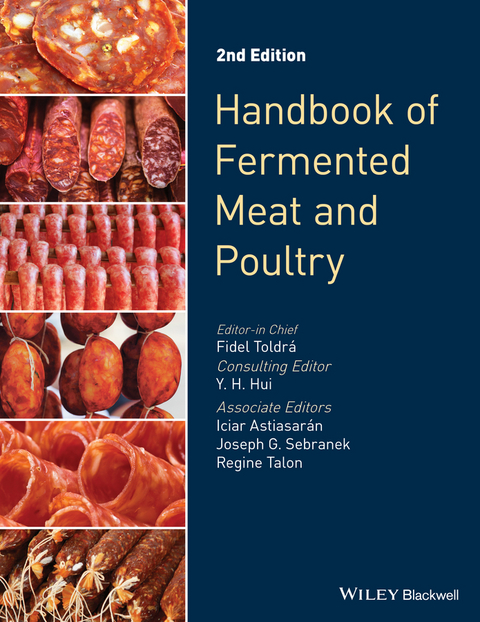
Handbook of Fermented Meat and Poultry (eBook)
John Wiley & Sons (Verlag)
978-1-118-52267-7 (ISBN)
Fermented meat products have been consumed for centuries in many different parts of the world and constitute one of the most important groups of food. Bacterial cultures are used in their manufacture to preserve the meat and confer particular textures and sensory attributes. Examples of fermented meats include salami, chorizo, pepperoni and saucisson.
This fully revised and expanded reference book on meat fermentation presents all the principle fermented meat products and the processing technologies currently used in their manufacture. The 54 chapters of this substantial book are grouped into the following sections:
• Meat fermentation worldwide: overview, production and principles
• Raw materials
• Microbiology and starter cultures for meat fermentation
• Sensory attributes
• Product categories: general considerations
• Semidry-fermented sausages
• Dry-fermented sausages
• Other fermented meats and poultry
• Ripened meat products
• Biological and chemical safety of fermented meat products
• Processing sanitation and quality assurance
There are five new chapters in the second edition that address the following topics: Smoking and new smoke flavourings; Probiotics; Methodologies for the study of the microbial ecology in fermented sausages; Low sodium in meat products; and Asian sausages.
Handbook of Fermented Meat and Poultry, Second Edition provides readers with a full overview of meat fermentation, the role of microorganisms naturally present and/or added as starter cultures, safety aspects and an account of the main chemical, biochemical, physical and microbiological changes that occur in processing and how they affect final quality. Finally, readers will find the main types of worldwide fermented meat products, typically produced in different areas, with the description of their main characteristics.
Dr Fidel Toldrá, Instituto de Agroquímica y Tecnología de Alimentos (CSIC), Valencia, Spain
Dr Y. H. Hui, Science Technology System, West Sacramento, California, USA
Dr Iciar Astiasarán, Department of Food Science, Technology and Toxicology, Faculty of Pharmacy, University of Navarra, Pamplona, Spain
Dr Joseph G. Sebranek, Food Science and Human Nutrition, Iowa State University, Ames, Iowa, USA
Dr Regine Talon, SRV-UR Microbiologie, INRA, Saint Genès Champanelle, France
Fermented meat products have been consumed for centuries in many different parts of the world and constitute one of the most important groups of food. Bacterial cultures are used in their manufacture to preserve the meat and confer particular textures and sensory attributes. Examples of fermented meats include salami, chorizo, pepperoni and saucisson. This fully revised and expanded reference book on meat fermentation presents all the principle fermented meat products and the processing technologies currently used in their manufacture. The 54 chapters of this substantial book are grouped into the following sections: Meat fermentation worldwide: overview, production and principles Raw materials Microbiology and starter cultures for meat fermentation Sensory attributes Product categories: general considerations Semidry-fermented sausages Dry-fermented sausages Other fermented meats and poultry Ripened meat products Biological and chemical safety of fermented meat products Processing sanitation and quality assurance There are five new chapters in the second edition that address the following topics: Smoking and new smoke flavourings; Probiotics; Methodologies for the study of the microbial ecology in fermented sausages; Low sodium in meat products; and Asian sausages. Handbook of Fermented Meat and Poultry, Second Edition provides readers with a full overview of meat fermentation, the role of microorganisms naturally present and/or added as starter cultures, safety aspects and an account of the main chemical, biochemical, physical and microbiological changes that occur in processing and how they affect final quality. Finally, readers will find the main types of worldwide fermented meat products, typically produced in different areas, with the description of their main characteristics.
Editor-in-Chief: Dr Fidel Toldrá, Instituto de Agroquímica y Tecnología de Alimentos (CSIC), Paterna, Valencia, Spain Consulting Editor: Dr Y. H. Hui, Science Technology System, West Sacramento, CA, USA Associate Editors: Dr Iciar Astiasarán, Department of Food Science, Nutrition and Physiology, University of Navarra, Pamplona, Spain Dr Joseph G. Sebranek, Food Science and Human Nutrition, Iowa State University, Ames, IA, USA Dr Régine Talon, INRA, UR454 Microbiologie, Saint-Genès Champanelle, France
List of Contributors
- Dong Uk Ahn
Department of Animal Science Department, Iowa State University, Ames, IA, USA
- Valentina Alessandria
Università di Torino, Dipartimento di Scienze Agrarie, Forestali e Alimentari, Turin, Italy
- J. Anba-Mondoloni
INRA, UMR1319 Micalis, Jouy-en-Josas, France; AgroPArisTech, UMR Micalis, Jouy-en-Josas, France
- Ana Andres
Institute of Food Engineering for Development, Food Science and Technology Department, Universitat Politècnica de València, Valencia, Spain
- Diana Ansorena
Department of Food Science, Nutrition and Physiology, University of Navarra, Pamplona, Spain
- Keizo Arihara
School of Veterinary Medicine, Kitasato University, Towada-shi, Aomori, Japan
- M. Concepción Aristoy
Instituto de Agroquímica y Tecnología de Alimentos (CSIC), Paterna, Valencia, Spain
- E. Arnaud
UMR QUALISUD, CIRAD, France
- Iciar Astiasarán
Department of Food Science, Nutrition and Physiology, University of Navarra, Pamplona, Spain
- Lars Axelsson
Nofima, Ås, Norway
- Teresa Aymerich
Institute for Food and Agricultural Research and Technology (IRTA), Food Safety Program, Monells, Spain
- José M. Barat
Food Science and Technology Department, Universitat Politècnica de València, Valencia, Spain
- Shai Barbut
Food Science Department, University of Guelph, Guelph, ON, Canada
- A.S. Barreto
Faculdade de Medicina Veterinária CIISA, Universidade de Lisboa, Lisbon, Portugal
- Lopa Basu
Ohio State University, Columbus, OH, USA
- Elettra Berni
Department of Microbiology, SSICA, Parma, Italy
- Nicholas L Berry
Department of Animal Science, Iowa State University, Ames, IA, USA
- Sara Bover-Cid
IRTA Food Safety Programme, Institute for Food and Agricultural Research and Technology, Finca Camps i Armet, Monells, Spain
- Elizabeth Boyle
Department of Animal Sciences and Industry, Kansas State University, Manhattan, KS, USA
- Patricia Castellano
Centro de Referencia para Lactobacilos (CERELA), CONICET, Tucumán, Argentina
- Marie-Christine Champomier-Vergès
INRA, UMR1319 Micalis, Jouy-en-Josas, France; AgroPArisTech, UMR Micalis, Jouy-en-Josas, France
- Ming-Ju Chen
Department of Animal Science and Technology, National Taiwan University, Taipei, Taiwan, Republic of China
- Suey Ping Chi
Department of Animal Products Processing, Livestock Research Institute, Council of Agriculture, Hsinhua, Taiwan, Republic of China
- Souad Christieans
ADIV, Clermont-Ferrand Cedex, France
- Pier Sandro Cocconcelli
Istituto di Microbiologia, Centro Ricerche Biotecnologiche, Università Cattolica del Sacro Cuore, Piacenza-Cremona, Italy
- Luca Cocolin
Università di Torino, Dipartimento di Scienze Agrarie, Forestali e Alimentari, Turin, Italy
- A. Collignan
UMR QUALISUD, Institut des Régions Chaudes, Montpellier, France
- Lorenzo de la Hoz
Departamento de Nutrición, Bromatología y Tecnología de los Alimentos, Facultad de Veterinaria, Universidad Complutense de Madrid, Madrid, Spain
- Daniel Demeyer
Laboratory of Animal Production and Animal Product Quality, Department of Animal Production, Ghent University, Melle, Belgium
- L. De Vuyst
Vrije Universiteit Brussel, Research Group of Industrial Microbiology and Food Biotechnology (IMDO), Brussels, Belgium
- Ana M. Diez
Department of Biotechnology and Food Science, University of Burgos, Burgos, Spain
- Paola Dolci
Università di Torino, Dipartimento di Scienze Agrarie, Forestali e Alimentari, Turin, Italy
- E. Dordet-Frisoni
INRA, UR454 Microbiologie, Saint-Genès Champanelle, France
- Mario Estévez
Department of Food Technology, University of Extremadura, Extremadura, Spain
- Silvina Fadda
Centro de Referencia para Lactobacilos (CERELA), CONICET, Tucumán, Argentina
- Chris Fedler
Department of Food Science and Human Nutrition, Iowa State University, Ames, IA, USA
- Manuela Fernández
Departamento de Nutrición, Bromatología y Tecnología de los Alimentos, Facultad de Veterinaria, Universidad Complutense de Madrid, Madrid, Spain
- Mónica Flores
Instituto de Agroquímica y Tecnología de Alimentos (CSIC), Paterna, Valencia, Spain
- Cecilia Fontana
Istituto di Microbiologia, Centro Ricerche Biotecnologiche, Università Cattolica del Sacro Cuore, Piacenza-Cremona, Italy
- M.J. Fraqueza
Faculdade de Medicina Veterinária CIISA, Universidade de Lisboa, Lisbon, Portugal
- Reinhard Fries
Panel Veterinary Public Health, Institute of Meat Hygiene and Technology, Faculty of Veterinary Medicine, Freie Universität Berlin, Berlin, Germany
- M.L. García
Departamento Nutrición, Bromatología y Tecnología de los Alimentos, Facultad Veterinaria, Universidad Complutense, Madrid
- Margarita Garriga
Institute for Food and Agricultural Research and Technology (IRTA), Food Safety Program, Monells, Spain
- T. Goudman
Vrije Universiteit Brussel, Research Group of Industrial Microbiology and Food Biotechnology (IMDO), Brussels, Belgium
- Raúl Grau
Food Science and Technology Department, Universitat Politècnica de València, Valencia, Spain
- Dana J Hanson
Food, Bioprocessing & Nutrition Sciences, North Carolina State University, Raleigh, NC, USA
- Torunn Thauland Håseth
Animalia—the Norwegian Meat Research Centre, Oslo, Norway
- Even Heir
Nofima, Ås, Norway
- Eva Hierro
Departamento de Nutrición, Bromatología y Tecnología de los Alimentos, Facultad de Veterinaria, Universidad Complutense de Madrid, Madrid, Spain
- Askild Holck
Nofima, Ås, Norway
- Karl O. Honikel
Max Rubner-Institute, Federal Research Centre for Nutrition and Food, Kulmbach, Germany
- Y.H. Hui
Science Technology System, West Sacramento, CA, USA
- Melvin C. Hunt
Department of Animal Sciences and Industry, Kansas State University, Manhattan, KS, USA
- Tom C. Johannessen
Nofima, Ås, Norway
- Sisse Jongberg
Food Chemistry, Department of Food Science, University of Copenhagen, Frederiksberg, Denmark
- M. Luz Latorre-Moratalla
Departament de Nutrició i Bromatologia, Campus de l'Alimentació de Torribera, Universitat de Barcelona-INSA-Xarta, Santa Coloma de Gramenet, Spain
- Isabelle Lebert
INRA, UR454 Microbiologie, Saint-Genès Champanelle, France
- F. Leroy
Vrije Universiteit Brussel, Research Group of Industrial Microbiology and Food Biotechnology (IMDO), Brussels, Belgium
- Sabine Leroy
INRA, UR454 Microbiologie, Saint-Genès Champanelle, France
- Friedrich-Karl Lücke
Hochschule Fulda (University of Applied Sciences), Fulda, Germany
- Robert Maddock
Department of Animal & Range Sciences, North Dakota State University, Fargo, ND, USA
- Beatriz Melero
Department of Biotechnology and Food Science, University of Burgos, Burgos, Spain
- W. Benjy Mikel
Department of Food Science, Nutrition, and Health Promotion, Mississippi State University, Mississippi State, MS, USA
- Byungrok Min
Food Science and Technology Program, Department of Agriculture, Food, and Resource Sciences, University of Maryland Eastern Shore, Princess Anne, MD, USA
- Jens K.S. Møller
Chr. Hansen A/S, Natural Colors Division, Hoersholm, Denmark
- David Morcuende
Department of Food Technology, University of Extremadura, Extremadura, Spain
- Asgeir Nilsen
Matforsk A/S, Ås, Norway
- George-John E. Nychas
Laboratory of Microbiology and Biotechnology of Foods, Department of Food Science & Human Nutrition, Agricultural University of Athens, Athens, Greece
- Herbert W. Ockerman
Ohio State University, Columbus, OH, USA
- Alicia Olivares
Instituto de Agroquímica y Tecnología de Alimentos (CSIC), Paterna, Valencia, Spain
- Juan A. Ordóñez
Departamento de Nutrición, Bromatología y Tecnología de los Alimentos, Facultad de Veterinaria, Universidad Complutense de Madrid, Madrid, Spain
- Emin Burçin Özvural
Department of Food Engineering, Faculty of Engineering, Çankırı Karatekin University, Çankırı, Turkey
- Ronald B. Pegg
Department of Food Science & Technology, University of Georgia, Athens,...
| Erscheint lt. Verlag | 27.10.2014 |
|---|---|
| Mitarbeit |
Berater: Y. H. Hui Stellvertretende Herausgeber: Iciar Astiasaran, Joseph Sebranek, Regine Talon |
| Sprache | englisch |
| Themenwelt | Naturwissenschaften ► Biologie |
| Technik ► Lebensmitteltechnologie | |
| Weitere Fachgebiete ► Land- / Forstwirtschaft / Fischerei | |
| Schlagworte | attributes • bacterial • Book • centuries • Chapters • Different • Examples • Fermentation • fermented • Fermented Foods & Beverages • Fermentierte Nahrungsmittel u. Getränke • Fermentierte Nahrungsmittel u. Getränke • Fleisch, Fisch, Geflügel • Fleisch, Fisch, Geflügel • following • Food Processing, Production & Manufacture • Food Science & Technology • Herstellung u. Verarbeitung von Lebensmitteln • Lebensmittelforschung u. -technologie • Lebensmitteltechnik • Manufacture • many • meat • Meat, Fish & Poultry • meats • Overview • Principle • Products • Reference • Salami • sections • World |
| ISBN-10 | 1-118-52267-2 / 1118522672 |
| ISBN-13 | 978-1-118-52267-7 / 9781118522677 |
| Informationen gemäß Produktsicherheitsverordnung (GPSR) | |
| Haben Sie eine Frage zum Produkt? |
 EPUB (Adobe DRM)
Kopierschutz: Adobe-DRM
Adobe-DRM ist ein Kopierschutz, der das eBook vor Mißbrauch schützen soll. Dabei wird das eBook bereits beim Download auf Ihre persönliche Adobe-ID autorisiert. Lesen können Sie das eBook dann nur auf den Geräten, welche ebenfalls auf Ihre Adobe-ID registriert sind.
Details zum Adobe-DRM
Dateiformat: EPUB (Electronic Publication)
EPUB ist ein offener Standard für eBooks und eignet sich besonders zur Darstellung von Belletristik und Sachbüchern. Der Fließtext wird dynamisch an die Display- und Schriftgröße angepasst. Auch für mobile Lesegeräte ist EPUB daher gut geeignet.
Systemvoraussetzungen:
PC/Mac: Mit einem PC oder Mac können Sie dieses eBook lesen. Sie benötigen eine
eReader: Dieses eBook kann mit (fast) allen eBook-Readern gelesen werden. Mit dem amazon-Kindle ist es aber nicht kompatibel.
Smartphone/Tablet: Egal ob Apple oder Android, dieses eBook können Sie lesen. Sie benötigen eine
Geräteliste und zusätzliche Hinweise
Buying eBooks from abroad
For tax law reasons we can sell eBooks just within Germany and Switzerland. Regrettably we cannot fulfill eBook-orders from other countries.
aus dem Bereich