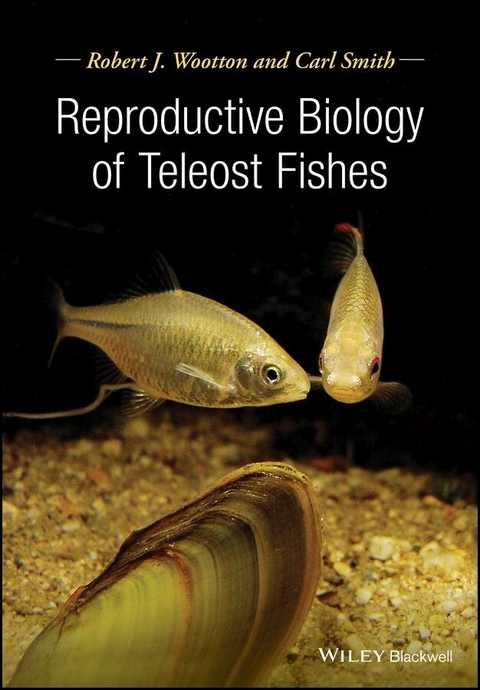
Reproductive Biology of Teleost Fishes (eBook)
John Wiley & Sons (Verlag)
978-1-118-89139-1 (ISBN)
Reproductive Biology of Teleost Fishes is the first integrated review of the reproductive biology of the bony fishes, which are the most species-rich and diversified group of vertebrates. Teleosts display remarkable variation in their modes of reproduction, and this volume is intended to provide a framework for understanding the remarkable reproductive diversity of this group. It describes their reproductive biology using, wherever possible, phylogenetic analyses and life-history theory as a means to interpret the information. The book addresses the genetic, physiological, behavioural, ecological, evolutionary and applied aspects of teleost reproduction in a comparative framework that emphasises the adaptive basis of reproductive diversity.
Reproductive Biology of Teleost Fishes provides a comprehensive synthesis of fish reproduction that will be of great interest to life scientists, particularly ecologists, evolutionary biologists, physiologists and advanced undergraduates, postgraduates and research workers requiring a comprehensive overview of fish reproduction. The book is suitable for courses in fish biology and ecology, reproductive physiology and reproductive genetics. It also addresses applied questions and will be of value for courses on fisheries science and aquaculture. Libraries in all universities and research establishments where biological sciences, fisheries science and aquaculture are studied and taught should have several copies of this important book on their shelves.
Dr Robert 'Bob' Wootton was Reader in Ecology at the Institute of Biological, Environmental and Rural Sciences, Aberystwyth University, UK. Bob's research addressed the ecology, behaviour and evolutionary biology of fishes.
Dr Carl Smith is a Lecturer in the School of Biology at the University of St Andrews, UK and also holds a research position at the Institute of Vertebrate Biology of the Czech Academy of Sciences in Brno, Czech Republic. Carl's research focuses on mating system evolution in fishes.
Dr Robert 'Bob' Wootton was Reader in Ecology at the Institute of Biological, Environmental and Rural Sciences, Aberystwyth University, UK. Bob's research addressed the ecology, behaviour and evolutionary biology of fishes. Dr Carl Smith is a Lecturer in the School of Biology at the University of St Andrews, UK and also holds a research position at the Institute of Vertebrate Biology of the Czech Academy of Sciences in Brno, Czech Republic. Carl's research focuses on mating system evolution in fishes.
"I was very impressed by this book, even if it does not delve deeply into the mathematics of evolutionary theory applied to the topics." (Environ Biol Fish, 1 September 2015)
Abbreviations and acronyms
| 3β-HSD | 3β-hydroxysteroid dehydrogenase |
| 5HT | serotonin |
| 11β-HSD | 11β-hydroxysteroid dehydrogenase |
| 11-KA | 11 ketoandrosetnedione |
| 11-KT | 11 ketotestosterone |
| 15-K-PGF2α | 15-keto-prostaglandin F2α |
| 17α-MT | 17α-methyltestosterone |
| 17α-OHP | 17α-hydroxyprogesterone |
| 17,20β-P | 17,20βP hydroxyprogesterone |
| 17α,20β-P | 17α,20β dihydroxy-4-pregnen-3-one |
| 17α,20β-P-S | 17α,20β-dihydroxy-4-pregnen-3-one 20β-sulphate |
| 17β-HSD | 17β-hydroxysteroid dehydrogenase |
| 20β-HSD | 20β-hydroxysteroid dehydrogenase |
| 17-P | 17-hydroxypregnen-4-ene-3,20-dione |
| 20β-S | 17,20β,21-trihydroxy-4-pregnen-3-one |
| α | age at maturity |
| A | individual production rate |
| AA | arachidonic acid |
| ACTH | adrenocorticotrophic hormone |
| ACT-R | activin receptor |
| AD | androstenedione |
| AGS | accessory gonadal structures |
| AH | adenohypophysis |
| AMH | anti-Müllerian hormone |
| ARs | androgen receptors |
| AVT | arginine vasotocin |
| BB | blue-barred phenotype |
| BBS | bombesin |
| BG | Bateman gradient |
| bp | before present |
| BPG | brain–pituitary–gonad |
| BPI | brain-pituitary inter-renal |
| CA | cortical alveoli |
| cAMP | cyclic-3′,5′-adenosine monophosphate |
| CCK | cholecystokinin |
| CNS | central nervous system |
| CRF | corticotrophin-releasing factor |
| CRH | corticotrophin-releasing hormone |
| Ct | corticotropes |
| D1 | dopamine receptor 1 |
| D2 | dopamine receptor 2 |
| DA | dopamine |
| DDC | diethyldithiocarbamate |
| DES | diethylystilbestrol |
| DHA | docasahexaenoic acid |
| dpf | days post-fertilisation |
| dph | days post-hatching |
| DW | dry mass |
| E | average adult lifespan |
| E1 | oestrone |
| E2 | oestradiol-17β |
| EDC | endocrine-disrupting chemical |
| EE2 | ethinyloestradiol |
| EGF | epidermal growth factor |
| EGF-R | epidermal growth factor receptor |
| EMG | electromyogram |
| ER | oestrogen receptor |
| ERα | oestrogen receptor α |
| ERβ1 | oestrogen receptor β1 |
| ERβ2 | oestrogen receptor β2 |
| ERE | oestrogen response element |
| ERs | oestrogen receptors |
| ESC | evolutionarily stable continuum |
| ESD | environmental sex determination |
| ESS | evolutionarily stable strategy |
| Ex | age-specific reproductive effort |
| EYPP | egg yolk precursor proteins |
| F | total fecundity |
| FAA | free amino acid |
| Fb | breeding season fecundity |
| Fbatch | number of eggs produced in a spawning bout |
| FISH | fluorescent in-situ hybridisation |
| FNV | frozen niche variation |
| Fs | fecundity per spawning |
| FSH | follicle-stimulating hormone |
| FSH-β | follicle stimulating hormone β subunit |
| FSH-R | follicle-stimulating hormone receptor |
| GABA | γ-aminobutyric acid |
| GAL | galanin |
| GAP | GnRH-associated peptide |
| GH | growth hormone |
| GH-R | growth hormone receptor |
| GHRH | growth hormone-releasing hormone |
| GJ | gap junctions |
| GnRH | gonadotrophin-releasing hormone |
| GnRH-1 | gonadotrophin-releasing hormone type 1 |
| GnRH-2 | gonadotrophin-releasing hormone type 2 |
| GnRHa | gonadotrophin-releasing hormone analogue |
| GnRH-ir | immunoreactive gonadotrophin-releasing hormone |
| GnRH-R | gonadotrophin releasing hormone receptor |
| GnRH-R1 | gonadotrophin releasing hormone receptor type 1 |
| GPα | gonadotrophic hormone α subunit |
| GPCR | G protein-coupled receptor |
| GPER | G protein-coupled oestrogen receptor |
| GSD | genetic sex determination |
| GSDF | gonad-soma derived factor |
| GSI | gonadosomatic index |
| Gt | gonadotropes |
| GTH | gonadotrophic hormone |
| GTH-I | gonadotrophic hormone I |
| GTH-II | gonadotrophic hormone II |
| GTH-R | gonadotrophic hormone receptor |
| GV | germinal vesicle |
| GVBD | germinal vesicle breakdown |
| GVM | germinal vesicle maturation |
| gx | age-specific growth rate |
| H | hypothalamus |
| HPG | hypothalamus pituitary gonad |
| HPI | hypothalamus pituitary inter-renal |
| IDH | isocitrate dehydrogenase |
| IGA | internal gamete association |
| IGF | insulin-like growth factor |
| IGF-I | insulin-like growth factor I |
| IGF-II | insulin-like growth factor II |
| IGF-R | insulin like growth factor receptor |
| IP | initial phase |
| JS | Japan Sea clade |
| k | growth coefficient |
| K | threshold stock size above which density dependence limits recruitment |
| KISS | kisspeptin |
| L | length |
| L∞ | asymptotic length |
| Lα | length at maturity |
| LD | lipid droplets |
| L:D | light:dark |
| LDFR | low-density lipoprotein receptors |
| LG | linkage... |
| Erscheint lt. Verlag | 17.10.2014 |
|---|---|
| Sprache | englisch |
| Themenwelt | Naturwissenschaften ► Biologie ► Zoologie |
| Technik | |
| Weitere Fachgebiete ► Land- / Forstwirtschaft / Fischerei | |
| Schlagworte | Aquaculture, Fisheries & Fish Science • Aquakultur, Fischereiwesen u. Fischforschung • Bony • diversified • Diversity • First • Fische / Zucht u. Genetik • Fish Breeding & Genetics • Fishes • Framework • Group • Integrated • lifehistory • modes • remarkable • Reproduction • Reproductive • Review • speciesrich • Teleost • teleosts • Variation • Vertebrates • Volume |
| ISBN-10 | 1-118-89139-2 / 1118891392 |
| ISBN-13 | 978-1-118-89139-1 / 9781118891391 |
| Informationen gemäß Produktsicherheitsverordnung (GPSR) | |
| Haben Sie eine Frage zum Produkt? |
 EPUB (Adobe DRM)
Kopierschutz: Adobe-DRM
Adobe-DRM ist ein Kopierschutz, der das eBook vor Mißbrauch schützen soll. Dabei wird das eBook bereits beim Download auf Ihre persönliche Adobe-ID autorisiert. Lesen können Sie das eBook dann nur auf den Geräten, welche ebenfalls auf Ihre Adobe-ID registriert sind.
Details zum Adobe-DRM
Dateiformat: EPUB (Electronic Publication)
EPUB ist ein offener Standard für eBooks und eignet sich besonders zur Darstellung von Belletristik und Sachbüchern. Der Fließtext wird dynamisch an die Display- und Schriftgröße angepasst. Auch für mobile Lesegeräte ist EPUB daher gut geeignet.
Systemvoraussetzungen:
PC/Mac: Mit einem PC oder Mac können Sie dieses eBook lesen. Sie benötigen eine
eReader: Dieses eBook kann mit (fast) allen eBook-Readern gelesen werden. Mit dem amazon-Kindle ist es aber nicht kompatibel.
Smartphone/Tablet: Egal ob Apple oder Android, dieses eBook können Sie lesen. Sie benötigen eine
Geräteliste und zusätzliche Hinweise
Buying eBooks from abroad
For tax law reasons we can sell eBooks just within Germany and Switzerland. Regrettably we cannot fulfill eBook-orders from other countries.
aus dem Bereich