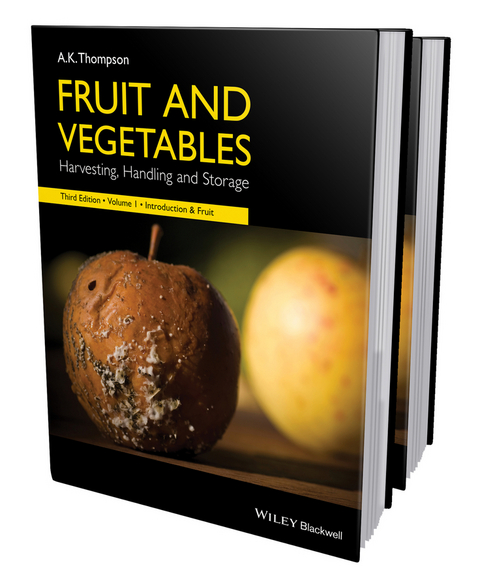
Fruit and Vegetables (eBook)
John Wiley & Sons (Verlag)
978-1-118-65401-9 (ISBN)

The new edition of this definitive work, which contains many full colour photographs, and details of species not covered in the previous editions, provides key practical and commercially-oriented information of great use in helping to ensure that fresh fruit and vegetables reach the retailer in optimum condition, with the minimum of deterioration and spoilage.
With the constantly increasing experimental work throughout the world the book incorporates salient advances in the context of current work, as well as that dating back over a century, to give options to the reader to choose what is most relevant to their situation and needs. This is important because recommendations in the literature are often conflicting; part of the evaluation of the published results and reviews is to guide the reader to make suitable choices through discussion of the reasons for diverse recommendations. Also included is much more on the nutritional values of fruit and vegetables, and how these may vary and change postharvest. There is also additional information on the origin, domestication and taxonomy of fruit and vegetables, putting recommendations in context.
Fruits and Vegetables 3e is essential reading for fruit and vegetable technologists, food scientists and food technologists, agricultural scientists, commercial growers, shippers, packhouse operatives and personnel within packaging companies. Researchers and upper level students in food science, food technology, plant and agricultural sciences will find a great deal of use within this popular book. All libraries in research establishments and universities where these subjects are studied and taught should have copies readily available for users.
Anthony Keith Thompson is Professor of Horticulture at Hamelmalo Agricultural College in Keren, Eritrea. Previously he had been Professor of Postharvest Technology, Cranfield University, UK; Team Leader, EU project at the Windward Islands Banana Development and Exporting Company; Principal Scientific Officer, Tropical Products Institute, London; Team Leader and Expert for the UN Food and Agriculture Organization in the Sudan and Korea; Advisor to the Colombian Government in postharvest technology of fruit and vegetables; Research Fellow in Crop Science, University of the West Indies, Trinidad; Research Assistant, University of Leeds, UK. Also as a consultant and advisor in many countries for many international, government and private organizations.
Completely revised, updated and enlarged, now encompassing two volumes, this third edition of Fruit and Vegetables reviews and evaluates, in comprehensive detail, postharvest aspects of a very wide international range of fresh fruit and vegetables as it applies to their physiology, quality, technology, harvest maturity determination, harvesting methods, packaging, postharvest treatments, controlled atmosphere storage, ripening and transportation. The new edition of this definitive work, which contains many full colour photographs, and details of species not covered in the previous editions, provides key practical and commercially-oriented information of great use in helping to ensure that fresh fruit and vegetables reach the retailer in optimum condition, with the minimum of deterioration and spoilage. With the constantly increasing experimental work throughout the world the book incorporates salient advances in the context of current work, as well as that dating back over a century, to give options to the reader to choose what is most relevant to their situation and needs. This is important because recommendations in the literature are often conflicting; part of the evaluation of the published results and reviews is to guide the reader to make suitable choices through discussion of the reasons for diverse recommendations. Also included is much more on the nutritional values of fruit and vegetables, and how these may vary and change postharvest. There is also additional information on the origin, domestication and taxonomy of fruit and vegetables, putting recommendations in context. Fruits and Vegetables 3e is essential reading for fruit and vegetable technologists, food scientists and food technologists, agricultural scientists, commercial growers, shippers, packhouse operatives and personnel within packaging companies. Researchers and upper level students in food science, food technology, plant and agricultural sciences will find a great deal of use within this popular book. All libraries in research establishments and universities where these subjects are studied and taught should have copies readily available for users.
Anthony Keith Thompson is Professor of Horticulture at Hamelmalo Agricultural College in Keren, Eritrea. Previously he had been Professor of Postharvest Technology, Cranfield University, UK; Team Leader, EU project at the Windward Islands Banana Development and Exporting Company; Principal Scientific Officer, Tropical Products Institute, London; Team Leader and Expert for the UN Food and Agriculture Organization in the Sudan and Korea; Advisor to the Colombian Government in postharvest technology of fruit and vegetables; Research Fellow in Crop Science, University of the West Indies, Trinidad; Research Assistant, University of Leeds, UK. Also as a consultant and advisor in many countries for many international, government and private organizations.
Chapter 1
Preharvest factors on postharvest life
The quality of a crop at harvest can have a major effect on its postharvest life. There are numerous factors involved and these factors frequently interact giving complex interrelationships. In tree crops, fruit produced on the same tree and harvested at the same time may behave differently during marketing or when stored. The issues that influence produce quality include obvious things, such as harvest maturity and cultivar or variety, but also the climate and soil in which it was grown, chemicals which have been applied to the crop, and its water status. Many of these factors can also interact with time such as when fertilizers or irrigation is applied or the weather conditions near to the time of harvest.
An equation was proposed (David Johnson 1994, personal communication) to predict the probability of low temperature breakdown in apples in storage where variance accounted for 56%. This equation was based on preharvest factors such as temperature, rainfall and nutrient level in the leaves and fruit of the trees as follows:
where:
- = mean daily maximum temperature in June
- = difference in mean daily maximum temperature in August and September
- = total rainfall in August and September
- = level of nitrogen in the leaves
- = level of phosphorous in the fruit.
Nutrients
The soil type and its fertility affect the chemical composition of a crop. Excess or deficiency of certain elements from the crop can affect its quality and its postharvest life. Many storage disorders of apples are associated with an imbalance of chemicals within the fruit at harvest (Table 1).
Table 1 Storage disorders and other storage characteristics of Cox's Orange Pippin apples in relation to their mineral content (source: adapted from Rowe 1980)
| Composition in mg 100 g−1 |
| Disorder | N | P | Ca | Mg | K/Ca |
| Bitter pit | — | — | <4.5 | >5 | >30 |
| Breakdown | — | <11 | <5 | — | >30 |
| Lenticel blotch pit | — | — | <3.1 | — | — |
| Loss of firmness | >80 | <11 | <5 | — | — |
| Loss of texture | — | <12 | — | — | — |
The relation between the mineral composition of fruits and their quality and behaviour during storage is not always predictable (Table 2) but in some cases the mineral content of fruits can be used to predict storage quality. For good storage quality of Cox's Orange Pippin apples it was found that they required the following composition (on a dry matter basis): 50–70% N, 11% minimum P, 130–160% K, 5% Mg and 5% Ca for storage until December at 3.5 °C or 4.5% Ca with minimum storage in 2% O2 and <1% CO2 at 4 °C until March (Sharples 1980).
Table 2 Summary of the most consistent significant correlations between mineral composition (fruits and leaves) and storage attributes in a 3-year survey (1967, 1968 and 1969) of Cox's Orange Pippin commercial orchards (source: adapted from Sharples 1980)
| Positive correlation years | Negative correlation years |
| Fruit firmness | Fruit P (68, 69) | — |
| Gloeosporium rot susceptibility | Fruit K/Ca: Mg Ca (67, 68, 69) | Fruit Ca (67, 68, 69) |
| Bitter pit | Fruit K/Ca: Mg Ca (67, 68, 69) | (67, 68, 69) |
| Senescent breakdown | — | Fruit Ca (67, 68, 69) |
| Core flush | Leaf K (67, 69) (August) | Leaf N (68, 69) (July) |
| Low temperature breakdown | Fruitlet | Ca P (67, 68, 69) (July) |
The physiological disorder that results in the production of colourless fruit in strawberries is called albinism. The fruit, which were suffering from this physiological disorder, were also found to be softer. The ratio of potassium : calcium and nitrogen : calcium was found to be greater in fruit suffering from albinism than in red fruit (Lieten and Marcelle 1993). Albinism was associated with the cultivar Elsanta and some American cultivars, and the recommendation for control was either to grow only resistant cultivars or decrease the application of nitrogen and potassium fertilizers (Lieten and Marcelle 1993).
The application of fertilizers to crops has been shown to influence their postharvest respiration rate. This has been reported for a variety of fertilizers on several crops including potassium on tomatoes, nitrogen on oranges and organic fertilizers on mangoes. An example of this is that an imbalance of fertilizers can result in the physiological disorder of watermelon called blossom-end rot (Cirulli and Ciccarese 1981). However, care must be taken in interpreting experimental results since the application of fertilizers may simply be correcting nutrient deficiencies in the soil that may be having detrimental effects of the physiology of the crop.
Nitrogen
Generally crops that contain high levels of nitrogen typically have poorer keeping qualities than those with lower levels. Results on the effects of nitrogen fertilizer on the storage life have been variable. In shallots the highest incidence of sprouting was found in the treatment combination of 150 kg N ha−1, 50% top fall harvest and non-cured bulbs which accounted for 16.73% sprouting, while the least was observed from zero N, 75% top fall harvest and cured bulbs which was 2.37% at the end of 3 months of storage (Woldetsadik and Workneh 2010). Bhalekar et al. (1987) also observed that sprouting of onions was increased with increasing nitrogen levels from 0 to 150 kg N ha−1. Dankhar and Singh (1991) also reported that high dose of nitrogen produced thick-necked onion bulbs that increased sprouting in storage while Ystaas (1980) showed that the application of nitrogen fertilizer to pear trees did not affect the soluble solids content, firmness, ground colour or quality of the fruit. Kodithuwakku and Kirthisinghe (2009) applied different levels of urea fertilizer to growing cauliflowers and found no significant difference in the postharvest quality of cauliflower curds. However, they found that applying 50% of the recommended N fertilizer resulted in an extension in their postharvest life of 6 days longer than other treatments in storage in ambient conditions. Anonymous (2010) reported that limiting nitrogen fertilizer resulted in improved shape, size and storability of swedes (Brassica napus var. napobrassica).
Application of N fertilizer can affect postharvest quality. Link (1980) showed that high rates of N fertilizer to apple trees could adversely affect the flavour of the fruit. Comis (1989) reported that too much soil nitrogen could reduce the vitamin C content of Swiss chard. Rogozinska and Pinska (1991) found that loss of tuber weight during storage increased with increasing fertilizer rate but loss of starch was high only at high N rates (200 kg N ha−1). They also found a negative effect on the organoleptic value of tubers after 200 kg N ha−1, especially after 6 months of storage. Potatoes grown with high levels of N had lower amounts of free sugars at all times (Roe et al. 1990). High N levels delayed tuber formation resulting in more immature tubers when harvested at the same time compared with tubers grown with lower N levels (Bodin 1988). Admiraal (1988) found that tuber density was less within those that had been grown in 150 kg N ha−1 applied 4 weeks after harvest and after 3 months of storage at 10 °C compared with those grown without N fertilizer. Kolbe et al. (1995) found that at harvest, the glucose and fructose contents in tubers were lower for those that had been grown with high rates of N fertilizer compared to low rates or absence of fertilizers, but throughout storage, reducing sugar accumulation increased, sucrose reduction decreased and ascorbic acid content increased. N decreased reducing and non-reducing sugar content after storage for 3 months at 10 or 15.5 °C (Badshah et al. 1990). During storage of potatoes at 4 °C and 90% r.h. there was an increase in water loss of 54% as a result of N fertilization (Kolbe et al. 1995). Woldetsadik and Workneh (2010) found that with a basic dressing of 92 kg ha−1 P2O5 increasing N levels (0, 50, 75 or 100 kg ha−1) showed proportional increase in the shallot bulb pungency levels, but the dry matter, TSS, total sugars and reducing sugars were not significantly affected either at harvest or during storage. However, there were increments in the percentage bulb rotting, sprouting and weight loss with increased N levels. Since nitrogen fertilizer can affect quality it may be summarized that they could affect their susceptibility to handling damage. However, increasing levels of N fertilizer application did not affect the susceptibility of potato tubers to mechanical damage...
| Erscheint lt. Verlag | 3.10.2014 |
|---|---|
| Sprache | englisch |
| Themenwelt | Naturwissenschaften ► Biologie |
| Technik | |
| Weitere Fachgebiete ► Land- / Forstwirtschaft / Fischerei | |
| Schlagworte | Agriculture • applies • Aspects • Colour • commerciallyoriented information • Contains • crops • Definitive Work • Edition • Editions • Encompassing • Feldfrüchte • Feldfrüchte • Food Science & Technology • Food Types • Fruit • Fruit & Vegetable • full • Gemüse • Gemüse • Great • international • Landwirtschaft • Lebensmittel • Lebensmittelforschung u. -technologie • many • New • Obst • Obst u. Gemüse • Obst u. Gemüse • Physiology • postharvest • previous • Range • species • Storage • Third • two • use • wide |
| ISBN-10 | 1-118-65401-3 / 1118654013 |
| ISBN-13 | 978-1-118-65401-9 / 9781118654019 |
| Informationen gemäß Produktsicherheitsverordnung (GPSR) | |
| Haben Sie eine Frage zum Produkt? |
 EPUB (Adobe DRM)
Kopierschutz: Adobe-DRM
Adobe-DRM ist ein Kopierschutz, der das eBook vor Mißbrauch schützen soll. Dabei wird das eBook bereits beim Download auf Ihre persönliche Adobe-ID autorisiert. Lesen können Sie das eBook dann nur auf den Geräten, welche ebenfalls auf Ihre Adobe-ID registriert sind.
Details zum Adobe-DRM
Dateiformat: EPUB (Electronic Publication)
EPUB ist ein offener Standard für eBooks und eignet sich besonders zur Darstellung von Belletristik und Sachbüchern. Der Fließtext wird dynamisch an die Display- und Schriftgröße angepasst. Auch für mobile Lesegeräte ist EPUB daher gut geeignet.
Systemvoraussetzungen:
PC/Mac: Mit einem PC oder Mac können Sie dieses eBook lesen. Sie benötigen eine
eReader: Dieses eBook kann mit (fast) allen eBook-Readern gelesen werden. Mit dem amazon-Kindle ist es aber nicht kompatibel.
Smartphone/Tablet: Egal ob Apple oder Android, dieses eBook können Sie lesen. Sie benötigen eine
Geräteliste und zusätzliche Hinweise
Buying eBooks from abroad
For tax law reasons we can sell eBooks just within Germany and Switzerland. Regrettably we cannot fulfill eBook-orders from other countries.
aus dem Bereich