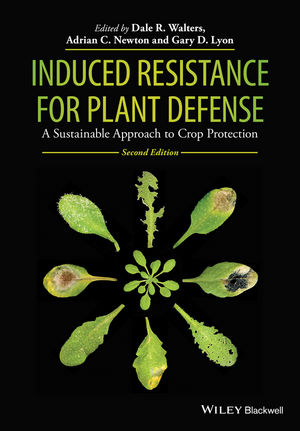
Induced Resistance for Plant Defense (eBook)
John Wiley & Sons (Verlag)
9781118371879 (ISBN)
Induced resistance offers the prospect of broad spectrum, long-lasting and potentially environmentally-benign disease and pest control in plants. Induced Resistance for Plant Defense 2e provides a comprehensive account of the subject, encompassing the underlying science and methodology, as well as research on application of the phenomenon in practice.
The second edition of this important book includes updated coverage of cellular aspects of induced resistance, including signalling and defenses, costs and trade-offs associated with the expression of induced resistance, research aimed at integrating induced resistance into crop protection practice, and induced resistance from a commercial perspective. Current thinking on how beneficial microbes induce resistance in plants has been included in the second edition.
The 14 chapters in this book have been written by internationally-respected researchers and edited by three editors with considerable experience of working on induced resistance. Like its predecessor, the second edition of Induced Resistance for Plant Defense will be of great interest to plant pathologists, plant cell and molecular biologists, agricultural scientists, crop protection specialists, and personnel in the agrochemical industry. All libraries in universities and research establishments where biological, agricultural, horticultural and forest sciences are studied and taught should have copies of this book on their shelves.
Dale Walters is based at the Crop and Soil Systems Research Group, Scotland's Rural College (SRUC), Edinburgh, UK, where he is Professor of Plant Pathology.
Adrian Newton is based at the James Hutton Institute, Invergowrie, Dundee, UK, and is also Visiting Professor of Cereal Pathology at SRUC (Scotland's Rural College, UK).
Until recently, Gary Lyon was based at the James Hutton Institute in Dundee, UK.
Induced resistance offers the prospect of broad spectrum, long-lasting and potentially environmentally-benign disease and pest control in plants. Induced Resistance for Plant Defense 2e provides a comprehensive account of the subject, encompassing the underlying science and methodology, as well as research on application of the phenomenon in practice. The second edition of this important book includes updated coverage of cellular aspects of induced resistance, including signalling and defenses, costs and trade-offs associated with the expression of induced resistance, research aimed at integrating induced resistance into crop protection practice, and induced resistance from a commercial perspective. Current thinking on how beneficial microbes induce resistance in plants has been included in the second edition. The 14 chapters in this book have been written by internationally-respected researchers and edited by three editors with considerable experience of working on induced resistance. Like its predecessor, the second edition of Induced Resistance for Plant Defense will be of great interest to plant pathologists, plant cell and molecular biologists, agricultural scientists, crop protection specialists, and personnel in the agrochemical industry. All libraries in universities and research establishments where biological, agricultural, horticultural and forest sciences are studied and taught should have copies of this book on their shelves.
Dale Walters is based at the Crop and Soil Systems Research Group, Scotland's Rural College (SRUC), Edinburgh, UK, where he is Professor of Plant Pathology. Adrian Newton is based at the James Hutton Institute, Invergowrie, Dundee, UK, and is also Visiting Professor of Cereal Pathology at SRUC (Scotland's Rural College, UK). Until recently, Gary Lyon was based at the James Hutton Institute in Dundee, UK.
Chapter 1
Introduction: Definitions and Some History
Ray Hammerschmidt
Department of Plant, Soil and Microbial Science, Michigan State University, East Lansing, MI, USA
1.1 Induced Resistance: An Established Phenomenon
Certain types of pathogen infection, non-pathogen interaction or other treatments are known to induce localized and systemic disease resistance (e.g. Kuć, 1982; Hammerschmidt and Kuć, 1995; Sticher et al., 1997; Hammerschmidt, 2009; Vallad and Goodman, 1994). The induced plant is believed to resist attack by virulent pathogens and other pests because of an enhanced ability to rapidly express defences upon infection and, in some cases, an increase in defences that are expressed in response to the inducing treatment. Although well established and studied, it is important to consider why induced resistance occurs. How can a plant that is known to be susceptible to a pathogen or even multiple pathogens be physiologically or biochemically changed so that it can now resist those infections?
Two basic assumptions must be considered to explain the overall phenomenon of induced resistance. First of all, plants must have all the genes that are necessary to mount an effective defence. Secondly, the inducing treatment should be capable of activating some of the defences directly and, more importantly, that the inducing treatment primes or sensitizes that plant in such a way that allows rapid expression of a broad set of defences upon infection by a pathogen.
The first assumption is easy to support. It is a well known plant pathology concept that plants resist the vast majority of pathogens which exist in nature, and that this phenomenon (non-host resistance) is associated with the expression of defences (Heath, 2000) and is the basis for innate immunity in plants (van Loon, 2009). Most plants, however, are susceptible to some pathogens or specific isolates or races of those pathogens. This does not mean that the plant lacks the defence needed to fend off the pathogen, but rather that the plant does not have the means to rapidly detect the presence of the pathogen (e.g. a major gene for resistance) and induce the expression of genes needed for defence. The second assumption also has significant support: plants that are induced have enhanced capacity to rapidly express defences after a challenge infection (Conrath et al., 2002).
1.2 Terminology and Types of Induced Resistance
Plant resistance to pathogens and pests can be active and/or passive (Hammerschmidt, and Nicholson, 1999). Passive resistance depends on defences that are constitutively expressed in the plant, while active resistance relies on defences that are induced after infection or attack. Induced resistance is an active process that can describe resistance at two levels. Firstly, active defence to an incompatible race or isolate of a pathogen is a form of induced resistance that is characterized by highly localized expression of defences such as phytoalexins and the hypersensitive response (Hammerschmidt and Nicholson, 1999). Secondly, induced resistance can also describe plants that express resistance to a broad range of compatible pathogens after some initial inducing treatment (Kuć, 1982). It is this latter form of induced resistance that is the focal point of this book. The term induced resistance in itself only describes the general phenomenon and does not imply any specific type of defence expression or regulation.
1.2.1 Local and systemic induction of resistance
Induced resistance can be local or systemic. Local induced resistance refers to those cases where the inducing treatment is applied to the same tissue as the subsequent challenge by a pathogen. In some cases, the challenge inoculum is placed directly on the site of the inducing inoculation, while in other cases the phenomenon describes resistance that occurs within a single organ (such as a leaf) after all or part of the leaf was treated with an inducing agent. Systemic induced resistance describes resistance that is induced in a part of the plant that is spatially separated from the point of induction. Although spatially different, both local and systemic resistances are characterized by requiring time to develop after the inducing treatment and the non-specific nature of the resistance. The mechanisms of stopping pathogen development in locally induced resistance may be due to the production of defences such as phytoalexins, PR (pathogenesis-related) proteins and cell wall alterations that are thought to be involved in stopping the development of the inducing inoculum as well as propagules of the challenge pathogen that have the misfortune of landing directly on the site occupied by the inducing inoculum (Hammerschmidt, 1999, 2009). In the case of systemic resistance, the inducing or resistance activating treatments result in a change in cells at a distance from the induction site that allows those cells to rapidly deploy defences upon challenge. This is the part of systemic resistance that is now known as ‘priming’ (Conrath et al., 2002). In addition to being primed, the systemically induced tissues may also have some degree of defence that is established by the induction process that is there prior to any challenge. An obvious example is the systemic expression of PR proteins in certain forms of systemic induced resistance (Van Loon, 1997).
1.2.2 Systemic acquired resistance (SAR) and induced systemic resistance (ISR)
It is very clear that induced resistance to disease is not due to just one phenomenon. At least two forms of induced resistance, known as systemic acquired resistance (SAR) and induced systemic resistance (ISR) have been characterized as distinct phenomena based on the types of inducing agents and host signalling pathways that result in resistance expression (Sticher et al., 1997; Van Loon et al., 1998).
A major characteristic of SAR is of the association of localized necrosis caused by the inducing pathogen. This necrosis can be either a hypersensitive response or a local necrotic lesion caused by a virulent pathogen (Hammerschmidt, 2009). SAR is also dependent on salicylic acid signaling and the systemic expression of pathogenesis related protein genes (Hammerschmidt, 1999, 2009; Sticher et al., 1997). ISR is induced by certain strains of plant growth promoting rhizobacteria (PGPR) (Van Loon et al., 1998; De Vleesschauwer and Höfte, 2009). Unlike SAR, ISR is not associated with local necrotic lesion formation. ISR also differs in that it depends on the perception of ethylene and jasmonic acid and is not associated with expression of the PR genes. Both SAR and ISR do result in broad-spectrum resistance. The differences in mechanisms and signalling leading to SAR and ISR as well as potential trade-offs between these different forms of induced resistance are described in the chapters by Pieterse et al. (Chapter 4) and Heil (Chapter 9), respectively.
It should also be noted that many of the features that have been used to distinguish ISR from SAR are based on studies with Arabidopsis in which specific genetic analyses have been coupled with biochemical and pathological analyses (see Chapter 4). Because the phenotypes of SAR and ISR are similar, if not identical, in terms of reducing the effects of pathogen challenge, distinguishing between ISR and SAR should be approached with caution when dealing with plant–pathogen interactions other than genetically well-defined systems, such as those utilizing Arabidopsis. With the many types of inducing agents that have been identified and the great number of microbes that can also induce resistance (see the chapters by Lyon (Chapter 2), Randoux et al. (Chapter 10), Walters and Bennett (Chapter 8) and Beardon et al. (Chapter 11)), it is likely that other forms of induced resistance may occur. Use of the tools of genomics to understand the molecular basis and regulation of induced resistance, such as those outlined by Kidd et al. (Chapter 3), will be invaluable in sorting out types of induced resistance in model systems as well as those crops in which induced resistance may be applied in the future.
1.2.3 Protection
Certain reports from the 1970s used the term ‘protection’ to describe induced resistance (e.g. Hammerschmidt et al., 1976; Kuć et al., 1975; Skipp and Deverall, 1973). These reports on induced resistance in both cucumber and green bean plants described the ability of incompatible fungal pathogens to induce resistance. Although the term ‘protection’ adequately describes what is happening in terms of the end result, this is really too generic to be of use in describing induced resistance.
1.2.4 Cross protection
It has been known for many years that prior infection of plants with milder strains of a virus can result in reduced disease development on subsequent infection by a more severe strain of the same virus (Pennazio et al., 2001; Price, 1940). This phenomenon is known as cross protection, and is really very different from the induced resistance phenomena that are discussed throughout this book. Unlike induced resistance where defences, or the potential to express defences, are activated by the inducing treatment, cross protection is mechanistically very different and relies more on interference of the mild viral stain with the more severe strain than by defensive action (Fulton, 1986). Cross protection also differs from induced resistance in that the protection is only effective against strains of the same virus whereas induced resistance is much broader...
| Erscheint lt. Verlag | 12.8.2014 |
|---|---|
| Sprache | englisch |
| Themenwelt | Naturwissenschaften ► Biologie |
| Technik | |
| Weitere Fachgebiete ► Land- / Forstwirtschaft / Fischerei | |
| Schlagworte | Agricultural Economics & Resource Management • Agriculture • Ãkonomie u. Ressourcenmanagement i. d. Landwirtschaft • application • Aspects • Biowissenschaften • Book • Botanik • broad spectrum • cellular • comprehensive account • Control • Coverage • Defense • Edition • environmentallybenign • important • Landwirtschaft • Life Sciences • Ökonomie u. Ressourcenmanagement i. d. Landwirtschaft • Pests, Diseases & Weeds • Pflanzenschutz • phenomenon • Plant • plants • plant science • Practice • prospect • Research • resistance • Schädlinge, Krankheiten u. Unkräuter • Schädlinge, Krankheiten u. Unkräuter • Second • Subject |
| ISBN-13 | 9781118371879 / 9781118371879 |
| Informationen gemäß Produktsicherheitsverordnung (GPSR) | |
| Haben Sie eine Frage zum Produkt? |
 EPUB (Adobe DRM)
Kopierschutz: Adobe-DRM
Adobe-DRM ist ein Kopierschutz, der das eBook vor Mißbrauch schützen soll. Dabei wird das eBook bereits beim Download auf Ihre persönliche Adobe-ID autorisiert. Lesen können Sie das eBook dann nur auf den Geräten, welche ebenfalls auf Ihre Adobe-ID registriert sind.
Details zum Adobe-DRM
Dateiformat: EPUB (Electronic Publication)
EPUB ist ein offener Standard für eBooks und eignet sich besonders zur Darstellung von Belletristik und Sachbüchern. Der Fließtext wird dynamisch an die Display- und Schriftgröße angepasst. Auch für mobile Lesegeräte ist EPUB daher gut geeignet.
Systemvoraussetzungen:
PC/Mac: Mit einem PC oder Mac können Sie dieses eBook lesen. Sie benötigen eine
eReader: Dieses eBook kann mit (fast) allen eBook-Readern gelesen werden. Mit dem amazon-Kindle ist es aber nicht kompatibel.
Smartphone/Tablet: Egal ob Apple oder Android, dieses eBook können Sie lesen. Sie benötigen eine
Geräteliste und zusätzliche Hinweise
Buying eBooks from abroad
For tax law reasons we can sell eBooks just within Germany and Switzerland. Regrettably we cannot fulfill eBook-orders from other countries.
aus dem Bereich