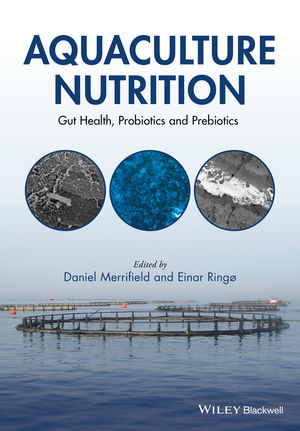
Aquaculture Nutrition (eBook)
John Wiley & Sons (Verlag)
978-1-118-89727-0 (ISBN)
Manipulation of the microbial gut content of farmed fishes and crustaceans can have a marked effect on their general health, growth, and quality. Expertly covering the science behind the use of prebiotics and probiotics this landmark book explains how the correct manipulation of the gut flora of farmed fishes and crustaceans can have a positive effect on their health, growth rates, feed utilization, and general wellbeing.
Aquaculture Nutrition: Gut Health, Probiotics and Prebiotics provides a comprehensive overview of the current knowledge of the gut microbiomes of fish and their importance with respect to host-fish health and performance, providing in-depth, cutting-edge fundamental and applied information.
Written by many of the world’s leading authorities and edited by Dr Daniel Merrifield and Professor Einar Ringø, this important book discusses in detail the common mechanisms for modulating microbiomes, particularly at the gut level (e.g. probiotics, prebiotics and synbiotics). The book is a key resource for an understanding of the historical development of these products, their known mechanisms of action and their degree of efficacy as presently demonstrated in the literature.
The fundamental material provided on the gut microbiota itself, and more broad aspects of microbe-live feed interactions, provide essential reading for researchers, academics and students in the areas of aquaculture nutrition, fish veterinary science, microbiology, aquaculture, fish biology and fisheries. Those involved in the development and formulation of aquaculture feeds and those with broader roles within the aquaculture industry will find a huge wealth of commercially-important information within the book’s covers. All libraries in universities and research establishments where biological sciences, nutrition and aquaculture are studied and taught, should have copies of this excellent book on their shelves.
Daniel Merrifield is a Lecturer in Aquatic Biosciences at Plymouth University, UK. His research specialises on fish-microbe interactions and gut health, within the context of aquaculture and fish production. He has published over 50 peer-reviewed papers on the gut microbiomes of fish and associated applications for fortifying these microbial communities, in order to improve the health, welfare and growth performance of important farmed fish species and model organisms.
Einar Ringø is a Professor at the Norwegian College of Fishery Science, Faculty of Biosciences, Fisheries and Economics, UiT The Arctic University of Norway. He is the author of numerous journal articles, reviews and book chapters. He received his M.S. degree (1982) in microbiology from the University of Tromsø and his Ph.D. degree (1994) in microbiology and lipid nutrition from the University of Tromsø.
Manipulation of the microbial gut content of farmed fishes and crustaceans can have a marked effect on their general health, growth, and quality. Expertly covering the science behind the use of prebiotics and probiotics this landmark book explains how the correct manipulation of the gut flora of farmed fishes and crustaceans can have a positive effect on their health, growth rates, feed utilization, and general wellbeing. Aquaculture Nutrition: Gut Health, Probiotics and Prebiotics provides a comprehensive overview of the current knowledge of the gut microbiomes of fish and their importance with respect to host-fish health and performance, providing in-depth, cutting-edge fundamental and applied information. Written by many of the world s leading authorities and edited by Dr Daniel Merrifield and Professor Einar Ring , this important book discusses in detail the common mechanisms for modulating microbiomes, particularly at the gut level (e.g. probiotics, prebiotics and synbiotics). The book is a key resource for an understanding of the historical development of these products, their known mechanisms of action and their degree of efficacy as presently demonstrated in the literature. The fundamental material provided on the gut microbiota itself, and more broad aspects of microbe-live feed interactions, provide essential reading for researchers, academics and students in the areas of aquaculture nutrition, fish veterinary science, microbiology, aquaculture, fish biology and fisheries. Those involved in the development and formulation of aquaculture feeds and those with broader roles within the aquaculture industry will find a huge wealth of commercially-important information within the book s covers. All libraries in universities and research establishments where biological sciences, nutrition and aquaculture are studied and taught, should have copies of this excellent book on their shelves.
Daniel Merrifield is a Lecturer in Aquatic Biosciences at Plymouth University, UK. His research specialises on fish-microbe interactions and gut health, within the context of aquaculture and fish production. He has published over 50 peer-reviewed papers on the gut microbiomes of fish and associated applications for fortifying these microbial communities, in order to improve the health, welfare and growth performance of important farmed fish species and model organisms. Einar Ringø is a Professor at the Norwegian College of Fishery Science, Faculty of Biosciences, Fisheries and Economics, UiT The Arctic University of Norway. He is the author of numerous journal articles, reviews and book chapters. He received his M.S. degree (1982) in microbiology from the University of Tromsø and his Ph.D. degree (1994) in microbiology and lipid nutrition from the University of Tromsø.
"The book presents key, up to date information about the
gut microbiota of aquatic animals, how they may be studied and
about the possible applications of probiotics and prebiotics in
aquaculture. The book's main advantage is that the
information is collated within a single volume, so Aquaculture
Nutrition: Gut health, probiotics and prebiotics is likely to find
a niche as a source of reference that will be used by fish
nutritionists and other aquaculture professionals."
(Aquaculture International, 10 December 2014)
Chapter 1
The Gastrointestinal Tract of Fish
Arun Kumar Ray1 and Einar Ringø2
1Department of Zoology, Visva-Bharati University, West Bengal, India
2Norwegian College of Fishery Science, UiT The Arctic University of Norway
ABSTRACT
The organization of the gastrointestinal (GI) tract of fish follows the basic features as in other vertebrate groups with a degree of variation in phylogeny and ontogeny, feeding habits, diet, nutrition, physiological conditions and the special functions the gut may perform. There are enormous variations in the morphology of the GI tract among various fish species. The variations in the organization of the GI tract ensure optimum utilization of dietary nutrients, which in many cases means efficient primary digestion and a large intestinal absorptive surface area. Different fish species have adapted different approaches to accommodate this objective. Of particular interest to fish nutritionists is the comparison of morphological features in relation to natural diets. In order to compare data obtained from one fish species with other species, it is essential to make divisions into a broad line of common morphological features.
1.1 INTRODUCTION
Detailed descriptions of the anatomy and physiology of GI tracts of numerous fish species have been covered in several reviews (Suyehiro 1942; Barrington 1957; Kapoor et al. 1975; Harder 1975; Fänge and Grove 1979; Smith 1989; Stevens 1988; Olsen and Ringø 1997; Wilson and Castro 2011). Fish have the ability to rapidly and reversibly adapt GI tract characteristics to match the changes in functional demands that occur during their life history (e.g. metamorphosis, anadrome or catadrome migrations) or more frequently (day-to-day or seasonal shifts in diet or environmental conditions); this ability is dependent on endocrine signalling pathways which are augmented by the enteric nervous system (Karila et al. 1998). The wide diversity and levels of hormones and signalling molecules secreted by the numerous types of GI tract and endocrine pancreas cells allow fish to rapidly and reversibly alter characteristics of the GI tract and other organ systems to adapt to changes in the contents of the GI tract (amounts and types of nutrients, pH, ionic composition etc.) and environmental conditions (Holst et al. 1996).
The key feature of the alimentary tract is its ability to digest foodstuffs to make them suitable for absorption by various transport mechanisms in the wall compartments of different GI sections (Bakke et al. 2011). Besides the hydrolytic reactions catalysed by endogenous enzymes secreted by the pancreas and cells in the gut wall, which are considered to play the major roles in digestion, fermentation plays key roles in digestive processes in many monogastrics. The role of fermentation in fish is less clear due to a lack of knowledge, but it is considered to be of minor quantitative importance for nutrient supply in cold water species. However, qualitative importance may be significant regarding specific nutrients and immune stimulating processes.
The anatomy and physiology of the GI tract are important determinants for the establishment and for the quantitative as well as the qualitative aspects of its microbiota. The microbial communities may seem to be assembled in predictable ways (Rawls et al. 2006). In this study the authors showed that microbial communities transplanted from mice to gnotobiotic zebrafish (Danio rerio) alter quantitatively in the direction of the normal biota of the zebrafish species and vice versa. This indicates that environmental conditions of the intestine, determined by species-specific parameters along the GI tract such as anatomy, endogenous inputs of digestive secretions, pH, osmolality, redox potential, compartment size and structure, passage rate and residence time, help to define and shape the GI tract microbiota. However, diet composition is also an important environmental condition for fish development. Diet composition is ideally species specific regarding available essential nutrients, but supplies variable amounts of unavailable material depending on the feedstuffs used in the diet formulations. The gut microbiota is also probably inevitably linked to digestion by the production of exogenous enzymes and vitamins produced which might aid host digestive function (Ray et al. 2012). This chapter summarizes the current state of knowledge highlighting the morphological and histological variations in the lower GI tract of fish associated with digestion and absorption; comprehensive reviews on the gut microbiota are presented in Chapters 4–6.
1.2 ANATOMY OF GI TRACT
The structure and functional characteristics of the GI tract vary widely among species (Suyehiro 1942) and seem, to a great extent, to match the wide diversity of feeding habits and environmental conditions exploited by fish. The structure of the alimentary canal varies in different species of fish, and is generally adapted in relation to the food and feeding habits. Depending on feeding habits and diet, fish are generally classified as carnivorous (eating fish and larger invertebrates), herbivorous (consuming mainly plant material), omnivorous (consuming a mixed diet) and detritivorous (feeding largely on detritus) (De Silva and Anderson 1995; Olsen and Ringø 1997; Ringø et al. 2003), together with the genera Panaque and Chochliodon which are capable of digesting wood. However, such division may not always be correct since most species consume mixed diets or their feeding habits may change through the life cycle (Olsen and Ringø 1997). The variation becomes obvious by comparing the GI tract characteristics of carnivorous and herbivorous fish and those from freshwater and seawater. The mucosal lining of the GI tract represents an interface between the external and internal environments, and in conjunction with the associated organs (e.g. pancreas, liver and gall bladder) provides the functions of digestion, osmoregulation, immunity, endocrine regulation of GI tract and systemic functions, and elimination of environmental contaminants and toxic metabolites. The GI tract is basically a tube that courses through the body. The GI tract in Atlantic cod (Gadus morhua L.) is shown in Figure 1.1. This tract is divided into the following characteristic regions: mouth, gill arch, oesophagus, stomach, mid intestine, distal intestine and fermentation chamber.
Figure 1.1 The alimentary tract of Atlantic cod (Gadus morhua L.). ST, stomach; PC, pyloric caeca; F, proximal intestine; M, mid intestine; B, distal intestine; HC, fermentation chamber.
(Source: Lisbeth Løvmo Martinsen.)
1.3 STOMACH AND INTESTINAL BULB
Two main groups of fish are commonly distinguished on the basis of presence or absence of stomach. The most remarkable feature of the digestive system of lampreys, hagfish, chimaeras, and many herbivorous fishes belonging to Cyprinidae, Cyprinodontidae, Balistidae, Labridae, Scomberesocidae and Scaridae, is the lack of a true stomach. In cyprinids, for example mrigal (Cirrhinus mrigala), the anterior part of the intestine becomes swollen to form a sac-like structure called the intestinal bulb or pseudogaster (Figure 1.2). In the absence of a stomach, the anterior intestine performs the function of temporary storage of ingested food (Sinha 1983). In stomachless fish the intestinal bulb apparently secretes mucus, and histologically the mucosa resembles closely that of the intestine and is devoid of any digestive components (Horn et al. 2006; Manjakasy et al. 2009). The mucosa of the intestinal bulb is thrown into prominent folds or villi (for lack of a better term; strictly speaking they are not true villi due to the absence of lacteals) that are lined with absorptive and mucus-secreting cells. The absence of stomach in many stomachless fish is compensated by the presence of pharyngeal teeth or gizzards for grinding food (Suyehiro 1942; Fänge and Grove 1979). Wood-eating fishes have specifically adapted spoon-shaped teeth for efficiently rasping wood (Nelson et al. 1999). The lack of a stomach in some species of fish raises questions regarding its significance. Several hypotheses have been put forward to explain the absence of a stomach which are often contradictory and speculative (for review, see Wilson and Castro 2011). The shape, size and structure of the stomach, when present, are related to the duration between meals and the nature of the diet (Suyehiro 1942; Smith 1989; De Silva and Anderson 1995). A stomach is defined as a portion of the digestive tract with distinctive cell lining, where acid is secreted, usually along with some digestive enzymes like pepsin (Olsen and Ringø 1997). In his early study, Suyehiro (1942) classified stomachs of fish into five categories according to their morphological appearance: (a) straight tube (Pleuronectidae, Esox), (b) U-shape (Salmonids), (c) V-shape (Plecoglossidae, Mugilidae, Salmonidae, Sparidae), (d) Y-shape (Mugilidae, Clupeidae), and (e) I-shape (Carangidae, Gadidae, Scombridae, Serranidae). The highest degree of modifications of the pyloric stomach have been reported in several members of Clupeoidei, Channidae, Mugilidae, Acipenseridae, Coregoninae and Chanidae (milkfish, Chanos chanos) where it acts as a ‘gizzard’ for trituration and mixing (Fänge and Grove 1979; Kapoor et al. 1975; Buddington 1985; De Silva and Anderson 1995). This development of a...
| Erscheint lt. Verlag | 13.8.2014 |
|---|---|
| Sprache | englisch |
| Themenwelt | Naturwissenschaften ► Biologie |
| Technik | |
| Weitere Fachgebiete ► Land- / Forstwirtschaft / Fischerei | |
| Schlagworte | Aquaculture • aquaculture feed industry • Aquaculture, Fisheries & Fish Science • Aquaculture nutrition • Aquakultur • Aquakultur, Fischereiwesen u. Fischforschung • Bass • breams • carps • Crabs • Crayfish • Crustaceans • Daniel L. Merrifield • gut flora of farmed fish and crustacean • Lobsters • microbial control of live feeds • prebiotics • Probiotics • Salmonids • Shrimps |
| ISBN-10 | 1-118-89727-7 / 1118897277 |
| ISBN-13 | 978-1-118-89727-0 / 9781118897270 |
| Informationen gemäß Produktsicherheitsverordnung (GPSR) | |
| Haben Sie eine Frage zum Produkt? |
 EPUB (Adobe DRM)
Kopierschutz: Adobe-DRM
Adobe-DRM ist ein Kopierschutz, der das eBook vor Mißbrauch schützen soll. Dabei wird das eBook bereits beim Download auf Ihre persönliche Adobe-ID autorisiert. Lesen können Sie das eBook dann nur auf den Geräten, welche ebenfalls auf Ihre Adobe-ID registriert sind.
Details zum Adobe-DRM
Dateiformat: EPUB (Electronic Publication)
EPUB ist ein offener Standard für eBooks und eignet sich besonders zur Darstellung von Belletristik und Sachbüchern. Der Fließtext wird dynamisch an die Display- und Schriftgröße angepasst. Auch für mobile Lesegeräte ist EPUB daher gut geeignet.
Systemvoraussetzungen:
PC/Mac: Mit einem PC oder Mac können Sie dieses eBook lesen. Sie benötigen eine
eReader: Dieses eBook kann mit (fast) allen eBook-Readern gelesen werden. Mit dem amazon-Kindle ist es aber nicht kompatibel.
Smartphone/Tablet: Egal ob Apple oder Android, dieses eBook können Sie lesen. Sie benötigen eine
Geräteliste und zusätzliche Hinweise
Buying eBooks from abroad
For tax law reasons we can sell eBooks just within Germany and Switzerland. Regrettably we cannot fulfill eBook-orders from other countries.
aus dem Bereich