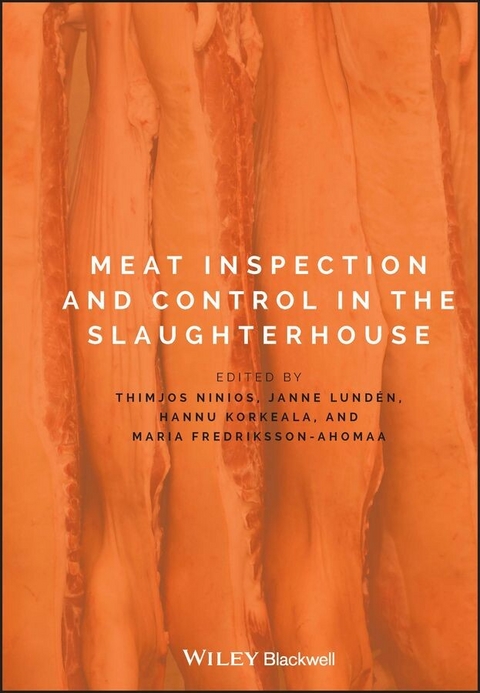
Meat Inspection and Control in the Slaughterhouse (eBook)
John Wiley & Sons (Verlag)
978-1-118-52585-2 (ISBN)
Meat inspection, meat hygiene and official control tasks in the slaughterhouse have always been of major importance in the meat industry, and are intimately related with animal diseases and animal welfare. The history of meat inspection has largely been a success story. Huge steps have been taken over more than a century to prevent the transmission of pathogenic organisms and contagious diseases from animals to humans. Various factors influence the quality and safety of meat including public health hazards (zoonotic pathogens, chemical substances and veterinary drugs), animal health and welfare issues during transport and slaughter.
Meat inspection is one of the most important programs in improving food safety, and its scope has enlarged considerably over the last decades. Globalization has affected the complexity of the modern meat chain and has provided possibilities for food fraud and unfair competition. During the last two decades many food fraud cases have been reported, which have caused concern among consumers and the industry. Subsequently meat inspection is faced with new challenges.
Meat Inspection and Control in the Slaughterhouse is an up-to-date reference book that responds to these changes and reflects the continued importance of meat inspection for the food industry. The contributors to this book are all international experts in the areas of meat inspection and the official controls limited to slaughterhouses, providing a rare insight into the international meat trade. This book will be of importance to students, professionals and members of the research community worldwide who aim to improve standards of meat inspection procedures and food safety.
Thimjos Ninios is a Senior Officer, Head of Section in the Import, Export and Organic Control Unit of the Finnish Food Safety Authority, Evira.
Janne Lundén is a Senior Lecturer and Docent in Food Hygiene at the University of Helsinki.
Hannu Korkeala is Professor of Food Hygiene and Head of the Department of Food Hygiene and Environmental Health at the University of Helsinki.
Maria Fredriksson-Ahomaa is Professor of Foodborne Bacterial Zoonoses at the University of Helsinki.
MEAT INSPECTION AND CONTROL IN THE SLAUGHTER HOUSE Meat inspection, meat hygiene and official control tasks in the slaughterhouse have always been of major importance in the meat industry and are intimately related to animal diseases and animal welfare. Huge steps have been taken over more than a century to prevent the transmission of pathogenic organisms and contagious diseases from animals to humans. Various factors influence the quality and safety of meat, including public health hazards (zoonotic pathogens, chemical substances and veterinary drugs) and animal health and welfare issues during transport and slaughter. Meat inspection is one of the most important programmes in improving food safety and its scope has enlarged considerably in recent decades. Globalization has affected the complexity of the modern meat chain and has provided possibilities for food frauds and unfair competition. During the last two decades many food fraud cases have been reported that have caused concern among consumers and the industry. Subsequently, meat inspection has been faced with new challenges. Meat Inspection and Control in the Slaughterhouse is an up-to-date reference book that responds to these changes and reflects the continued importance of meat inspection for the food industry. The contributors to this book are all international experts in the areas of meat inspection and the official controls limited to slaughterhouses, providing a rare insight into the international meat trade.This book will be of importance to students, professionals and members of the research community worldwide who aim to improve standards of meat inspection procedures and food safety.
THE EDITORS Thimjos Ninios is a Senior Officer and Head of Section in the Import, Export and Organic Control Unit of the Finnish Food Safety Authority, Evira. Janne Lundén is a Senior Lecturer and Docent in Food Hygiene at the University of Helsinki. Hannu Korkeala is Professor of Food Hygiene and Head of the Department of Food Hygiene and Environmental Health at the University of Helsinki. Maria Fredriksson-Ahomaa is Professor of Foodborne Bacterial Zoonoses at the University of Helsinki.
Cover 1
Title Page 5
Copyright 6
Contents 7
List of Contributors 21
Chapter 1 Introduction 27
Chapter 2 From Farm to Slaughterhouse 31
2.1 Scope 31
2.2 Animal health and welfare 31
2.2.1 Different farming systems 32
2.2.2 Good practices 33
2.2.3 Biosecurity measures 34
2.2.4 Prior to transport 34
2.3 Transport 35
2.3.1 Fitness for transport 36
2.3.2 Means of transport 36
2.3.3 Transport practices 37
2.4 Lairage 40
2.5 Food chain information 40
Summary 42
Chapter 3 Ante-Mortem Inspection 45
3.1 Scope 45
3.2 Introduction 45
3.3 Identification of animals 47
3.4 Abnormalities 48
3.5 Cleanliness of animals 51
3.6 Animal welfare 52
3.6.1 Animal welfare on the farm 52
3.6.2 Animal welfare in transit 53
3.6.3 Animal welfare at the slaughterhouse 54
Chapter 4 The Slaughter Process 55
4.1 Scope 55
4.2 General 55
4.3 Pigs 57
4.3.1 Moving the animals from the stable to stunning 57
4.3.2 Stunning 58
4.3.3 Bleeding 59
4.3.4 Scalding 59
4.3.5 Dehairing 60
4.3.6 Skin removal 60
4.3.7 Evisceration 61
4.3.8 Cooling/chilling 61
4.4 Cattle, horses, sheep and goats 62
4.4.1 Moving the animals from the stable to stunning 62
4.4.2 Stunning 64
4.4.3 Bleeding 65
4.4.4 Electrical stimulation 65
4.4.5 Dehiding and opening the carcass 65
4.4.6 Cooling/chilling 66
4.5 Poultry 67
4.5.1 Transport to slaughter 67
4.5.2 Stunning 67
4.5.3 Scalding 67
4.5.4 Plucking 68
4.5.5 Evisceration 68
4.5.6 Other poultry 68
4.5.7 Cooling/chilling 68
4.6 Treatment of slaughter by-products 69
Chapter 5 Animal Welfare-Stunning and Bleeding 73
5.1 Scope 73
5.2 Introduction 73
5.3 Pigs 75
5.3.1 Electrical stunning 75
5.3.2 Carbon dioxide stunning 81
5.3.3 Captive-bolt stunning 84
5.3.4 Bleeding 86
5.4 Cattle, sheep and goats 87
5.4.1 Captive-bolt stunning 87
5.4.2 Electrical stunning 90
5.4.3 Bleeding 92
5.5 Poultry 93
5.5.1 Electrical stunning 93
5.5.2 Gas stunning (controlled atmosphere stunning, CAS) 95
5.5.3 Bleeding 96
5.6 Conclusions 96
Chapter 6 Post-Mortem Inspection and Related Anatomy 99
6.1 Scope 99
6.2 Introduction 99
6.3 Anatomy of the head 100
6.3.1 Skeleton structures and viscera of the cranial cavity 100
6.3.2 Skeleton structures and viscera of the face 100
6.3.3 Lymph nodes of the head 101
6.3.4 Pigs 101
6.3.5 Bovine 104
6.3.6 Small ruminants 110
6.4 Anatomy of viscera 110
6.4.1 Viscera of the oral cavity 110
6.4.2 Viscera of the thoracic cavity 112
6.4.3 Viscera of the abdominal cavity 126
6.4.4 Gastrointestinal tube, mesentery and annexed lymph nodes 133
6.4.5 Viscera of the pelvic cavity 145
6.5 Anatomy of carcass 148
6.5.1 Musculoskeletal apparatus 148
6.5.2 Viscera annexed to the carcass 155
6.5.3 Specific characteristics in pig 158
6.5.4 Specific characteristics in bovine 162
6.5.5 Specific characteristics in small ruminants 169
6.6 Anatomy of poultry 171
6.6.1 Carcass 171
6.6.2 Viscera 171
6.7 Post-mortem inspection 179
6.7.1 Scope of the post-mortem inspection 179
6.7.2 Post-mortem inspection techniques 180
6.7.3 Visual meat inspection 180
Chapter 7 Risk-Based Meat Inspection 183
7.1 Scope 183
7.2 Introduction 183
7.3 Risk-based meat inspection 184
7.4 Visual-only post-mortem meat inspection 185
7.5 Food chain information (FCI) 186
7.6 Monitoring of diseases by serology in the slaughterhouse 186
7.7 Conclusions 186
Chapter 8 Meat Inspection Lesions 189
8.1 Scope 189
8.2 Introduction 189
8.3 Bovines 190
8.4 Domestic swine 199
8.5 Small ruminants 210
8.6 Poultry 214
Chapter 9 Sampling and Laboratory Tests 225
9.1 Scope 225
9.2 Introduction 225
9.3 Collecting and packaging samples 226
9.4 Boiling test 227
9.5 Measurement of pH 228
9.6 Bacteriological examination of carcasses 229
9.7 Zoonotic agents 230
9.7.1 Bacteria 230
9.7.2 Parasites 236
9.7.3 Transmissible spongiform encephalopathy 238
9.8 Animal diseases 240
9.9 Chemical residues 240
9.9.1 Detection of chemical residues and contaminants 240
9.9.2 Detection of antimicrobial residues in carcasses 241
9.10 Process and slaughterhouse environment controls 242
Chapter 10 Judgment of Meat 245
10.1 Scope 245
10.2 Meat inspection 245
10.2.1 Management of risks 246
10.3 Evaluation of the meat 247
10.3.1 How to evaluate 247
10.3.2 Conclusion of inspecting activities 248
10.3.3 Health mark 248
10.3.4 Examples of evaluation and judgment 248
10.4 Record keeping in meat inspection 249
Chapter 11 Classification of Carcasses 251
11.1 Scope 251
11.2 Classification of beef carcasses 251
11.2.1 Classification grid of the European Union 252
11.2.2 Category 252
11.2.3 Conformation class 255
11.2.4 Class of fat cover 260
11.3 Classification of pig carcasses 260
11.3.1 Steps of the classification 262
11.3.2 Calibration and verification of measurement equipment functionality 262
11.3.3 Presentation of the carcass at the slaughter line weighing station 262
11.3.4 Weighing of the chilled carcass 262
11.3.5 Use of the measuring instrument for the classification 263
11.3.6 Identification of carcasses 264
11.3.7 Classification according to EUROP 264
11.3.8 Labelling 265
11.4 Classification of sheep carcasses 265
11.4.1 Category 265
11.4.2 Conformation class 265
11.4.3 Degree of fat cover 269
11.4.4 Carcasses of lambs of less than 13 kg 270
11.4.5 Labelling 270
11.5 Classification of poultry carcasses 271
11.5.1 Definitions 271
11.5.2 Classification 272
Chapter 12 Control, Monitoring and Surveillance of Animal Health and Animal Infectious Diseases at the Slaughterhouse 275
12.1 Scope 275
12.2 Background 275
12.2.1 An example: UK FMD epidemic 2001 was detected at meat inspection 275
12.2.2 Initial purposes of meat inspection 276
12.3 Evolution of meat inspection 277
12.3.1 Meat inspection and control 277
12.3.2 Meat inspection: a part of MOSS and risk management of~the food chain 278
12.3.3 Meat inspection and disease outbreaks or other disruptive events 278
12.4 Additional purposes of meat inspection 280
12.5 Some useful concepts 281
12.5.1 Monitoring and surveillance systems (MOSS) 281
12.5.2 Population of interest, surveillance population and sample 283
12.5.3 Measures of disease occurrence 285
12.5.4 Diagnostic test characteristics 285
12.5.5 Apparent versus true prevalence 287
12.5.6 Parallel and serial interpretation of tests 287
12.6 Quantifying the MOSS of meat inspection 288
12.6.1 Detection fraction 288
12.6.2 Input- and output-based standards 288
12.6.3 A problem with meat inspection MOSS 291
12.7 Purposes of MOSS at meat inspection 292
12.7.1 Prevalence estimation 292
12.7.2 Case detection 293
12.7.3 Verify the absence of disease or infectious agent in a region, compartment or nation 294
12.7.4 Detect the emergence of diseases or infectious agents 294
12.7.5 Quantifying sensitivity for detection 296
12.8 EFSA reviews of meat inspection 297
12.9 Summary and conclusions 301
Chapter 13 Public Health Hazards 303
13.1 Scope 303
13.2 Bacteria 303
13.2.1 Bacillus anthracis and Bacillus cereus 304
13.2.2 Campylobacter spp. 308
13.2.3 Clostridium spp. 311
13.2.4 Listeria monocytogenes 313
13.2.5 Mycobacterium spp. 315
13.2.6 Salmonella spp. 319
13.2.7 Staphylococcus aureus 322
13.2.8 Shiga toxin-producing Escherichia coli (STEC) 324
13.2.9 Enteropathogenic Yersinia spp. 327
13.2.10 Literature and further reading 330
13.3 Viruses 332
13.3.1 Hepatitis E virus (HEV) 334
13.3.2 Influenza A viruses 338
13.3.3 Other viruses 339
13.3.4 Literature and further reading 339
13.4 Parasites 340
13.4.1 Toxoplasma gondii 341
13.4.2 Sarcocystis spp. 343
13.4.3 Trichinella spp. 344
13.4.4 Taenia spp. 346
13.4.5 Echinococcus spp. 348
13.4.6 Literature and further reading 349
13.5 Prions 349
13.5.1 Properties of prions 350
13.5.2 Human diseases 350
13.5.3 Bovine spongiform encephalopathy 351
13.5.4 Classical scrapie 352
13.5.5 Atypical scrapie 353
13.5.6 Surveillance in animals 354
13.5.7 Literature and further reading 354
13.6 Antimicrobial resistance in meat-borne bacteria 355
13.7 Scope 360
13.8 Introduction 360
13.9 Hazard identification 361
13.10 Prioritization (ranking) of meat-borne hazards 363
13.11 Carcass meat safety assurance framework 366
13.11.1 Targets to be achieved by slaughterhouses and farms in respect to priority meat-borne hazards 366
13.11.2 Control of meat-borne hazards at the slaughterhouse 369
13.11.3 Control of meat-borne hazards at the farm level 373
13.11.4 Principles of use of food chain information (FCI) including epidemiological indicators (EIs) in the carcass meat safety assurance framework 375
13.12 Scope 380
13.13 Introduction 380
13.14 Residues of veterinary medicine products 383
13.14.1 Antimicrobials 383
13.14.2 Antiparasitic drugs 386
13.14.3 Antihelmintics 387
13.14.4 Antiprotozoals 389
13.15 Substances having anabolic effects and unauthorized substances 390
13.15.1 Sexual steroids 390
13.15.2 Beta-agonists 394
13.15.3 Drugs used to mask signs and avoid collateral effects of sexual steroids and beta-agonists 395
13.15.4 Benzodiazepines 395
13.15.5 Thyreostats 395
13.15.6 Antibacterial synthetic quinoxaline compounds 396
13.15.7 Non-steroidal anti-inflammatory drugs (NSAIDs) 396
13.15.8 Arsanylic acid 397
13.15.9 Somatotropin (or growth hormone, GH) 397
13.16 Residues of feed additives 397
13.17 Environmental pollutants 398
13.17.1 Natural toxins (including mycotoxins and plant toxins) 398
13.17.2 Cadmium 400
13.17.3 Pesticides: plant protection products (PPP) and biocides 401
13.17.4 Industrial wastes, by-products and toxicants released from fires and accidental events 403
13.18 Analytical chemical methods and their validation 408
Chapter 14 Meat By-Products 411
14.1 Scope 411
14.2 Introduction 411
14.3 Advantages of adequate ABP management 413
14.4 Separation of animal by-products, storage and recommendations on best practices and hygiene requirements 414
14.5 Identification, transport and marking 416
14.6 Processing of by-products and methods of treatment and disposing of ABPs 417
14.6.1 Incineration 417
14.6.2 Composting 418
14.6.3 Anaerobic fermentation 418
14.6.4 Rendering 419
14.6.5 Oleochemical processes 419
14.6.6 Waste water from slaughterhouses 419
14.6.7 Treatment of different categories according to European standards 421
14.7 Materials obtained from animal by-products at the slaughterhouse 421
14.8 Conclusions 424
Chapter 15 The Conversion of Muscle to Meat 425
15.1 Scope 425
15.2 Introduction 425
15.3 Muscle structure, composition and function 426
15.4 Post-mortem muscle physiology rigor mortis and the conversion of~muscle to meat
15.4.1 Post-mortem muscle pH decline and ultimate pH values of the main meat animal species and major anomalies 430
15.5 Major sensory characteristics of meat 434
15.5.1 Colour of fresh meat 435
15.5.2 Tenderness of meat 437
15.5.3 The water holding of meat 442
15.5.4 The flavour of meat 444
15.6 Concluding remarks 445
Acknowledgements 446
Chapter 16 Microbial Contamination During Slaughter 449
16.1 Scope 449
16.2 Introduction 449
16.3 Contamination of carcasses 451
16.4 Microbial contamination during slaughter-pig slaughtering as an example 452
16.5 Microbial examinations of red meat carcasses at the end of slaughter 456
16.5.1 Pig and cattle carcasses 457
16.5.2 Sheep carcasses 461
16.6 Conclusions 463
Chapter 17 Decontamination of Carcasses 465
17.1 Scope 465
17.2 Introduction 465
17.3 Antibacterial decontamination treatments for carcasses 466
17.3.1 Physical decontamination treatments 466
17.3.2 Chemical decontamination treatments 468
17.3.3 Combinations of decontamination treatments 469
17.3.4 Biological decontamination treatments 470
17.4 Antibacterial activity of decontamination treatments for carcasses 470
17.4.1 Poultry carcasses 470
17.4.2 Bovine hides and carcasses 472
17.4.3 Pig carcasses 475
17.5 Conclusions 477
Chapter 18 Cleaning and Disinfection 479
18.1 Scope 479
18.2 Background to cleaning and disinfection 479
18.3 Cleaning in general 480
18.4 Disinfection in general 480
18.5 Main soil types and their removal 481
18.6 Cleaning procedure 482
18.6.1 Cleaning of processing environment 484
18.6.2 Cleaning of equipment 484
18.6.3 Choosing the cleaning temperature 485
18.6.4 Choosing the cleaning agents 485
18.6.5 Choosing the disinfectants 486
18.6.6 Surface materials with limitations in cleaning and disinfection 489
18.6.7 Efficacy testing of disinfectants against microbes 490
18.6.8 Chemical residue tested with microbes 491
18.6.9 Ultrasound cleaning-an alternative method for utensils and open process lines 491
18.6.10 Corrective action-power cleaning 491
18.6.11 Controlling the cleaning results 492
18.6.12 Interpreting the microbial results-limits for microbes on cleaned surfaces 494
18.6.13 Optimization of cleaning procedures 494
18.7 Improved cleaning possibilities through hygienic design 495
18.8 Concluding remarks 496
Chapter 19 Pest Control 499
19.1 Scope 499
19.2 Introduction 499
19.3 Control plan 499
19.4 Identification of the pest and inspection 500
19.5 Control techniques 501
19.6 Monitoring programme 504
Chapter 20 Working Hygiene 511
20.1 Scope 511
20.2 Introduction 511
20.3 Hygienic slaughtering 512
20.4 Motivation of workers 513
20.5 Hygiene practice at the slaughter line 515
20.5.1 Methods 515
20.5.2 Results 515
20.5.3 Effect of facilities 517
20.6 Conclusions 519
Chapter 21 Occupational Hazards 521
21.1 Scope 521
21.2 Introduction 521
21.3 Infections 523
21.3.1 Bacteria 524
21.3.2 Viruses 530
21.3.3 Parasites 532
21.3.4 Fungi 532
21.3.5 Prions 533
21.4 Prevention from infections 533
21.5 Non-infectious occupational hazards and their prevention 534
21.6 Control of occupational hazards 535
Chapter 22 Traceability 537
22.1 Scope 537
22.2 Traceability of food in the from-field-to-fork chain 537
22.3 Responsibility for safety of foods rests with food business operators 539
22.4 Health and identification mark 542
22.5 Unauthorized foods and foods posing a risk to food safety 542
22.6 Summary 544
Chapter 23 Own-Check System 547
23.1 Scope 547
23.2 Development of OCS 548
23.3 Implementation of OCS procedures 550
23.4 Verification of the OCS 558
23.5 Introduction 560
23.6 Own-check plan 560
23.7 Own-check implementation 563
23.8 Own-check documentation 563
23.9 Division of own-check components in SSOPs and SPSs 563
23.9.1 The SSOPs 564
23.9.2 The SPSs 564
23.10 History 566
23.11 The HACCP principles 568
23.11.1 Hazard analysis 568
23.11.2 Critical control points (CCPs) 570
23.11.3 Critical limits 570
23.11.4 Monitoring procedures 570
23.11.5 Corrective actions 572
23.11.6 Verification and validation 572
23.11.7 Documentation and recordkeeping 572
23.12 HACCP at the slaughterhouse 573
23.12.1 Livestock slaughter 573
23.12.2 Poultry slaughter 573
Chapter 24 Official Control 579
24.1 Scope 582
24.2 Structure of official organization 582
24.3 Requirements of the official control organization 583
24.4 Scope 588
24.5 Introduction 588
24.6 On-site risk-based control and own-check system 589
24.7 Verification of the own-check system 589
24.8 Systematic verification in practice 590
24.9 Practical views to on-site risk-based control in slaughterhouses 591
24.9.1 Small scale and large scale slaughterhouses 591
24.9.2 Slaughter order of animals with different status 592
24.9.3 Stunning and slaughter operations 592
24.9.4 Chilling 593
24.9.5 Sampling by the official veterinarian by on-site risk-based consideration 593
24.10 Scope 594
24.11 Why planning of official food control is important? 594
24.12 Planning food control in a slaughterhouse 594
24.12.1 Planning the frequency of control visits 595
24.12.2 Planning the content of the controls 595
24.12.3 Planning the control methods and techniques to be used during control visits 597
24.12.4 Planning the official sampling for analysis 599
24.12.5 Evaluating the duration of the control visits 599
24.13 Adjusting the control plan when needed 600
24.14 Scope 601
24.15 Why approve slaughterhouses beforehand? 601
24.16 Approval process 602
24.17 Granting approval 604
24.18 Health mark and identification mark 604
24.19 Listing of establishments 605
24.20 Withdrawal of approval 605
24.21 Scope 607
24.22 Inspection procedures 607
24.23 Challenging task of an inspector 609
24.24 When, what and how to inspect? 610
24.25 Preparing for inspection 610
24.26 Initiating the inspection and interviewing the personnel 611
24.27 Observing the premises and the facilities 612
24.28 Evaluating the surfaces 613
24.29 Observing the hygienic working practices of personnel 614
24.30 Evaluating the adequacy of the sanitation procedures 614
24.31 Inspecting the own-check system 615
24.32 Official veterinarian's exemplary behaviour 616
24.33 Giving feedback on the inspection 616
24.34 Documentation of official control 616
24.35 How to ensure the efficacy of inspections? 618
24.36 Scope 619
24.37 Good governance of enforcement measures 619
24.37.1 Principle of good governance 619
24.37.2 The legal principles of administration 620
24.37.3 The conflict of the basic rights 621
24.37.4 The principle of publicity 622
24.37.5 The hearing process 622
24.37.6 An opportunity to make an appeal 623
24.37.7 The knowledge and attitudes of authorities 623
24.37.8 The efficiency of food control norms 624
24.38 Forms and application of enforcement measures in slaughterhouses 624
24.38.1 Enforcement measures 624
24.38.2 Gradual and proportional use of enforcement measures 625
24.38.3 Decision on the enforcement measure 628
24.38.4 Verifying the outcome of the enforcement 628
24.38.5 Further procedures and consequences 628
24.38.6 Urgent measures 629
24.39 To advise or to use enforcement measures? 629
24.40 Scope 631
24.41 Background 631
24.42 Different types of audits 633
24.43 Why audit official controls? (What is the added value?) 634
24.44 Auditing processes and systems 636
24.45 Key principles 637
24.46 Auditor qualifications 639
24.47 The audit process 640
24.48 Concluding remarks 645
24.49 Scope 647
24.50 What is transparency? 647
24.51 Good governance 648
24.52 Objectives of transparency 649
24.53 Who needs transparency? 649
24.54 Benefits of being transparent 649
24.55 Degrees of transparency 650
24.56 Obstacles to transparency 651
24.57 What does this mean for meat inspection? 652
24.58 Concluding remarks 652
24.59 Scope 654
24.60 Definition 654
24.61 Slaughter chain and food fraud 655
24.61.1 Variations in trade 655
24.61.2 How fraud takes place 655
24.61.3 Trade promotion 656
24.62 Criminal acts and behaviour 656
24.62.1 Case 1, slaughter in an illegal slaughterhouse 656
24.62.2 Case 2, fraud concerning the origin of slaughter animals 658
24.62.3 Case 3, illegal slaughter in approved slaughterhouse 659
24.63 Organization in The Netherlands to combat food crime 661
24.63.1 The tools of enforcement 661
24.63.2 The divisions of the Authority 661
24.63.3 The legal framework of the IOD 662
24.63.4 The IOD structure 663
24.63.5 Investigative Powers 663
24.64 Conclusion 663
24.65 Scope 665
24.66 Introduction 665
24.67 Achieving flexibility by legislation 666
24.67.1 Derogations, exemptions and adaptation 666
24.67.2 Flexibility and uniformity in official controls 667
24.67.3 Food business operators' measures 667
24.67.4 Exclusions 668
Chapter 25 International Trade 669
25.1 Scope 669
25.2 International trade 669
25.2.1 Principles of international trade 669
25.2.2 SPS Committee 670
25.2.3 International organizations 670
25.3 European Union trade 670
25.3.1 Intra-community trade 670
25.3.2 Import 671
25.3.3 Export 672
25.3.4 European Union trade agreements 672
25.3.5 EU Trade Control and Expert System 674
25.4 Exporting procedures 674
25.4.1 Meeting the export conditions 674
25.4.2 Export certificates 674
25.4.3 Certification procedures 675
Chapter 26 Scientific Risk Assessment-Basis for Food Legislation 677
26.1 Scope 677
26.2 Introduction 677
26.3 Risk analysis standards are set by international organizations 679
26.4 Risk analysis is a decision making process 680
26.5 Risk assessment estimates the level of risk 681
26.6 Other parts of risk analysis: risk management and risk communication 687
26.7 Risk assessments of EFSA impact on EU food safety legislation 688
26.8 Concluding remarks 691
Chapter 27 Use of Meat Inspection Data 693
27.1 Scope 693
27.2 Use of meat inspection data 693
27.3 Requirements of collection and recording of meat inspection data 697
Index 701
Supplemental Images 725
| Erscheint lt. Verlag | 27.5.2014 |
|---|---|
| Sprache | englisch |
| Themenwelt | Naturwissenschaften ► Biologie |
| Technik ► Lebensmitteltechnologie | |
| Wirtschaft | |
| Weitere Fachgebiete ► Land- / Forstwirtschaft / Fischerei | |
| Schlagworte | animal • Arbeitssicherheit u. Umweltschutz i. d. Chemie • Century • Chemical and Environmental Health and Safety • Chemie • Chemistry • Control • Diseases • Factors • Fleischbeschau • Fleisch, Fisch, Geflügel • Fleisch, Fisch, Geflügel • Fleischware • Food Science & Technology • Health • History • huge • importance • Industry • Inspection • Intimately • Lebensmittelforschung u. -technologie • Major • meat • Meat, Fish & Poultry • Microbiology, Food Safety & Security • Mikrobiologie • Mikrobiologie u. Nahrungsmittelsicherheit • Organisms • Pathogenic • Pathogens • Public • Safety • Slaughterhouse • Story • Tasks • Transmission • various |
| ISBN-10 | 1-118-52585-X / 111852585X |
| ISBN-13 | 978-1-118-52585-2 / 9781118525852 |
| Informationen gemäß Produktsicherheitsverordnung (GPSR) | |
| Haben Sie eine Frage zum Produkt? |
 PDF (Adobe DRM)
Kopierschutz: Adobe-DRM
Adobe-DRM ist ein Kopierschutz, der das eBook vor Mißbrauch schützen soll. Dabei wird das eBook bereits beim Download auf Ihre persönliche Adobe-ID autorisiert. Lesen können Sie das eBook dann nur auf den Geräten, welche ebenfalls auf Ihre Adobe-ID registriert sind.
Details zum Adobe-DRM
Dateiformat: PDF (Portable Document Format)
Mit einem festen Seitenlayout eignet sich die PDF besonders für Fachbücher mit Spalten, Tabellen und Abbildungen. Eine PDF kann auf fast allen Geräten angezeigt werden, ist aber für kleine Displays (Smartphone, eReader) nur eingeschränkt geeignet.
Systemvoraussetzungen:
PC/Mac: Mit einem PC oder Mac können Sie dieses eBook lesen. Sie benötigen eine
eReader: Dieses eBook kann mit (fast) allen eBook-Readern gelesen werden. Mit dem amazon-Kindle ist es aber nicht kompatibel.
Smartphone/Tablet: Egal ob Apple oder Android, dieses eBook können Sie lesen. Sie benötigen eine
Geräteliste und zusätzliche Hinweise
Buying eBooks from abroad
For tax law reasons we can sell eBooks just within Germany and Switzerland. Regrettably we cannot fulfill eBook-orders from other countries.
aus dem Bereich