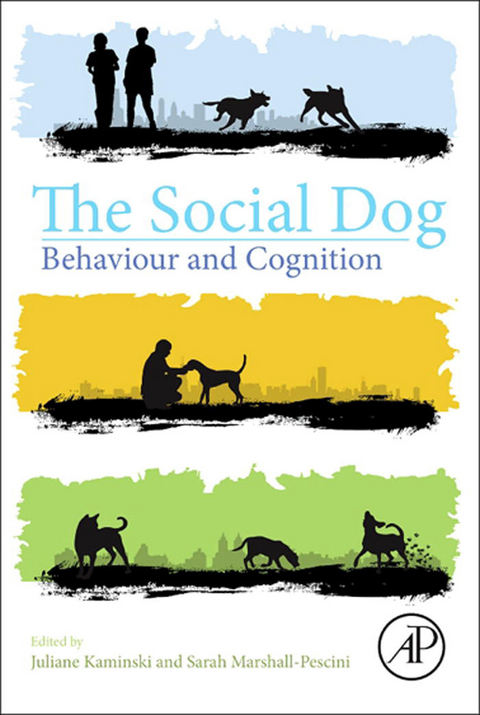
Social Dog (eBook)
418 Seiten
Elsevier Science (Verlag)
978-0-12-407931-1 (ISBN)
Dogs have become the subject of increasing scientific study over the past two decades, chiefly due to their development of specialized social skills, seemingly a result of selection pressures during domestication to help them adapt to the human environment. The Social Dog: Behaviour and Cognition includes chapters from leading researchers in the fields of social cognition and behavior, vocalization, evolution, and more, focusing on topics including dog-dog and dog-human interaction, bonding with humans, social behavior and learning, and more. Dogs are being studied in comparative cognitive sciences as well as genetics, ethology, and many more areas. As the number of published studies increases, this book aims to give the reader an overview of the state of the art on dog research, with an emphasis on social behavior and socio-cognitive skills. It represents a valuable resource for students, veterinarians, dog specialists, or anyone who wants deeper knowledge of his or her canine companion. - Reviews the state of the art of research on dog social interactions and cognition- Includes topics on dog-dog as well as dog-human interactions- Features contributions from leading experts in the field, which examine current studies while highlighting the potential for future research
Front Cover 1
The Social Dog: Behaviour and Cognition 4
Copyright 5
Contents 6
Preface 12
Contributors 14
Section I - Theoretical Aspects 16
Chapter 1 - The Social Dog: History and Evolution 18
1.1 WHERE DO DOGS’ SOCIALITY AND SOCIO-COGNITIVE ABILITIES COME FROM? THE CANID STORY 18
1.2 WHERE DO DOGS’ SOCIALITY AND SOCIO-COGNITIVE ABILITIES COME FROM? THE DOG–HUMAN STORY 25
1.3 CONCLUSIONS AND BOOK OVERVIEW 38
ACKNOWLEDGEMENTS 40
REFERENCES 41
Chapter 2 - On the Way to a Better Understanding of Dog Domestication: Aggression and Cooperativeness in Dogs and Wolves 50
2.1 DOG DOMESTICATION AND HUMAN EVOLUTION: THE ROLE OF WOLF–DOG COMPARISONS 50
2.2 HUMAN-LIKE BEHAVIOUR IN DOGS BUT NOT IN WOLVES: PART 1 54
2.3 EXPLAINING DOG–WOLF DIFFERENCES: DOMESTICATION HYPOTHESES 56
2.4 SELECTION FOR REDUCED AGGRESSION IN DOGS: BUT WHAT KIND OF AGGRESSION? 59
2.5 EARLIER ORIGINS OF DOG–HUMAN COOPERATION: CANINE COOPERATION HYPOTHESIS (RANGE ET AL., 2012 RANGE &
2.6 HUMAN-LIKE BEHAVIOUR IN DOGS BUT NOT IN WOLVES: PART 2 68
2.7 PRACTICAL RELEVANCE 71
REFERENCES 72
Section II - Social Behaviour 78
Chapter 3 - The Social Organisation of a Population of Free-Ranging Dogs in a Suburban Area of Rome: A Reassessment of the Effects of Domestication on Dogs’ Behaviour 80
3.1 INTRODUCTION 80
3.2 DOG POPULATION 84
3.3 WITHIN GROUP RELATIONSHIPS 87
3.4 INTERGROUP RELATIONSHIPS: SPACING PATTERN 104
3.5 VARIATION IN DOG SOCIETY 107
3.6 CONCLUSIONS 111
ACKNOWLEDGEMENTS 112
REFERENCES 112
Chapter 4 - Social Behaviour among Companion Dogs with an Emphasis on Play 120
4.1 INTRODUCTION 120
4.2 SOCIAL PLAY 120
4.3 DOMINANCE 132
4.4 DOG–DOG AGGRESSION AND RECONCILIATION 136
4.5 FRIENDLY BEHAVIOUR 139
4.6 CONCLUSIONS 140
ACKNOWLEDGEMENTS 141
REFERENCES 141
Chapter 5 - Auditory Communication in Domestic Dogs: Vocal Signalling in the Extended Social Environment of a Companion Animal 146
5.1 INTRODUCTION 146
5.2 HOW DOGS PRODUCE VOCAL SIGNALS 147
5.3 DESCRIPTION OF DOG VOCAL REPERTOIRE (AND COMPARISON WITH WOLVES, CANIS LUPUS) 149
5.4 THE COMMUNICATIVE FUNCTION OF ACOUSTIC VARIATION 157
5.5 THE PERCEPTION OF HUMAN VOCAL SIGNALS BY DOGS 163
5.6 CONCLUSIONS 171
REFERENCES 173
Chapter 6 - The Immaterial Cord: The Dog–Human Attachment Bond 180
6.1 BEING SOCIAL, BEING BONDED, BEING A DOG 180
6.2 ATTACHMENT: A BRIDGE BETWEEN ETHOLOGY AND PSYCHOLOGY 182
6.3 ON THE NATURE OF THE DOG–HUMAN BOND 185
6.4 ORIGIN OF DOG–HUMAN BOND: WHAT DO WE KNOW? 188
6.5 WHEN A BOND IS NOT FOREVER 193
6.6 CONCLUSIONS 197
ACKNOWLEDGEMENTS 199
REFERENCES 200
Chapter 7 - The Personality of Dogs 206
7.1 THE STUDY OF INDIVIDUALITY 206
7.2 THE CONCEPT OF PERSONALITY IN DOGS 210
7.3 NATURE AND NURTURE: THE ROLE OF GENETIC AND ENVIRONMENTAL FACTORS IN DOGS’ PERSONALITY 213
7.4 CONSISTENCY OF PERSONALITY TRAITS 226
7.5 CONCLUSIONS 229
ACKNOWLEDGEMENTS 230
REFERENCES 230
Chapter 8 - When the Bond Goes Wrong: Problem Behaviours in the Social Context 238
8.1 INTRODUCTION 238
8.2 AN INITIAL FRAMEWORK FOR CONSIDERING HUMAN–DOG SOCIAL RELATIONSHIPS 239
8.3 DIMENSIONS WITHIN HUMAN–DOG RELATIONSHIPS 240
8.4 ORIGINS OF TENSION WITHIN THE RELATIONSHIP: THEIR EXPRESSION AND CONSEQUENCES 245
8.5 COGNITIVE AND AFFECTIVE CONSIDERATIONS OF SOME MANIFESTATIONS OF A PROBLEMATIC RELATIONSHIP 247
8.6 COMMUNICATION WITHIN THE RELATIONSHIP 251
8.7 CONCLUSIONS 257
ACKNOWLEDGEMENTS 258
REFERENCES 258
Section III - Social Cognition 262
Chapter 9 - Social Learning in Dogs 264
9.1 INTRODUCTION: FROM SOCIAL BEHAVIOUR TO THE SOCIAL DOG 264
9.2 SOCIAL LEARNING AS AN ADAPTIVE MECHANISM 266
9.3 THE DOG AS A MODEL FOR STUDYING CON- AND HETEROSPECIFIC SOCIAL LEARNING 272
9.4 CONCLUSIONS 301
ACKNOWLEDGEMENTS 303
REFERENCES 303
Chapter 10 - What Dogs Understand about Humans 310
10.1 MONITORING 310
10.2 PERSPECTIVE TAKING 313
10.3 SEEING LEADS TO KNOWING 318
10.4 INTENTIONS 320
10.5 THEORY OF MIND IN DOMESTIC DOGS? 325
10.6 MIND READING OR BEHAVIOUR READING? 327
REFERENCES 328
Chapter 11 - Dogs’ Sensitivity to Human Ostensive Cues: A Unique Adaptation? 334
11.1 INTRODUCTION 334
11.2 HUMAN COMMUNICATION SYSTEM: A UNIQUELY POWERFUL WAY OF KNOWLEDGE TRANSMISSION 336
11.3 THE INTERACTIVE NATURE OF DOG–HUMAN COMMUNICATION AS A HALLMARK OF DOGS’ SOCIAL COMPETENCE 342
11.4 SUMMARY AND CONCLUSIONS ON THE ‘INFANT-LIKENESS’ OF DOGS’ COMMUNICATION SKILLS 352
ACKNOWLEDGEMENTS 356
REFERENCES 356
Chapter 12 - Do Dogs Show an Optimistic or Pessimistic Attitude to Life?: A Review of Studies Using the ‘Cognitive Bias’ Paradigm to Assess Dog Welfare 362
12.1 INTRODUCTION 362
12.2 COGNITIVE BIAS 365
12.3 POINTS OF CONSIDERATION 374
12.4 CONCLUSIONS 384
REFERENCES 385
Chapter 13 - Wagging to the Right or to the Left: Lateralisation and What It Tells of the Dog’s Social Brain 388
13.1 INTRODUCTION 388
13.2 BRAIN LATERALISATION AND DOGS’ EMOTIONS: THE TAIL-WAGGING EXPERIMENT 389
13.3 RIGHT AND LEFT IN THE CANINE WORLD: COMPLEMENTARY SPECIALISATIONS OF THE TWO SIDES OF THE DOG’S BRAIN 392
13.4 PAW PREFERENCE AND ITS IMPLICATIONS FOR DOG COGNITION 401
13.5 CONCLUSIONS 404
REFERENCES 405
Index 410
Color Plates 420
The Social Dog
History and Evolution
Abstract
The recent explosion of studies on dogs’ social behaviour and cognitive abilities are impressive, opening a new field of studies on a species that has economic, social, and emotional significance to humans across the globe. The origin of domestic dogs has been firmly established to be from an ancestor common to wolves, but the ‘where, when, and how’ of domestication, as well as the effects of this event on the dogs’ mind and behaviour have engendered lively debates in journals and at conferences. In this chapter, we aim to introduce the reader of this book to some of the more salient and some of the more neglected aspects in the field. Hence, in the first part of this chapter (Section 1.1), we set dogs within the framework of their canine family, presenting some of the intriguing features that appear to set canids apart from other mammal families and that may have set the ground on which the wolf–human encounter took place. We also highlight areas where more research is needed because so little has been carried out to compare different canid species from a behavioural and cognitive perspective. In the second part (Section 1.2), we focus more on the dog–human story, summarising the archaeological evidence and genetic data helping us to draw the picture of the early history of men and dogs and presenting a brief overview of the different hypotheses put forward as regards the effects of domestication on dogs’ social behaviour and cognition. Finally, in this section, we also outline some of the key issues that need to be addressed to assess the competing hypotheses and move the field of canine cognition forward. We conclude (in Section 1.3) by suggesting that dogs’ sociality and their potentially ‘special’ socio-cognitive skills likely emerge both from the specific characteristics of their canid ancestry and the unique event of having encountered and started living alongside humans. We further present an overview of the chapters in this book, highlighting how contributions cover studies looking at both dogs’ social behaviour and cognitive skills directed at both conspecifics and humans, because both are equally necessary for a well-rounded understanding of our four-legged companion.
Keywords
social doghistoryevolutionsocialitysocio-cognitive abilitycanine familysocially driven phenomenonpair bondingdefence strategyself-domesticationgenetic revolutiondomesticationsocial behaviourcognition
Where do Dogs’ Sociality and Socio-Cognitive Abilities Come from? The Canid Story
Introducing Dogs’ ‘Canine’ Family
Evolution of the Canid Brain: A Socially Driven Phenomenon?
FIGURE 1-1Branch colours identify the red fox–like clade (red), the South American clade (green), the wolf-like clade (blue), and the grey and island fox clade (orange). (From Lindblad-Toh et al., 2005.)
| Erscheint lt. Verlag | 20.5.2014 |
|---|---|
| Sprache | englisch |
| Themenwelt | Geisteswissenschaften ► Psychologie ► Allgemeine Psychologie |
| Geisteswissenschaften ► Psychologie ► Verhaltenstherapie | |
| Naturwissenschaften ► Biologie ► Zoologie | |
| Sozialwissenschaften ► Soziologie | |
| Technik | |
| Weitere Fachgebiete ► Land- / Forstwirtschaft / Fischerei | |
| ISBN-10 | 0-12-407931-8 / 0124079318 |
| ISBN-13 | 978-0-12-407931-1 / 9780124079311 |
| Informationen gemäß Produktsicherheitsverordnung (GPSR) | |
| Haben Sie eine Frage zum Produkt? |
 EPUB (Adobe DRM)
Kopierschutz: Adobe-DRM
Adobe-DRM ist ein Kopierschutz, der das eBook vor Mißbrauch schützen soll. Dabei wird das eBook bereits beim Download auf Ihre persönliche Adobe-ID autorisiert. Lesen können Sie das eBook dann nur auf den Geräten, welche ebenfalls auf Ihre Adobe-ID registriert sind.
Details zum Adobe-DRM
Dateiformat: EPUB (Electronic Publication)
EPUB ist ein offener Standard für eBooks und eignet sich besonders zur Darstellung von Belletristik und Sachbüchern. Der Fließtext wird dynamisch an die Display- und Schriftgröße angepasst. Auch für mobile Lesegeräte ist EPUB daher gut geeignet.
Systemvoraussetzungen:
PC/Mac: Mit einem PC oder Mac können Sie dieses eBook lesen. Sie benötigen eine
eReader: Dieses eBook kann mit (fast) allen eBook-Readern gelesen werden. Mit dem amazon-Kindle ist es aber nicht kompatibel.
Smartphone/Tablet: Egal ob Apple oder Android, dieses eBook können Sie lesen. Sie benötigen eine
Geräteliste und zusätzliche Hinweise
Buying eBooks from abroad
For tax law reasons we can sell eBooks just within Germany and Switzerland. Regrettably we cannot fulfill eBook-orders from other countries.
aus dem Bereich