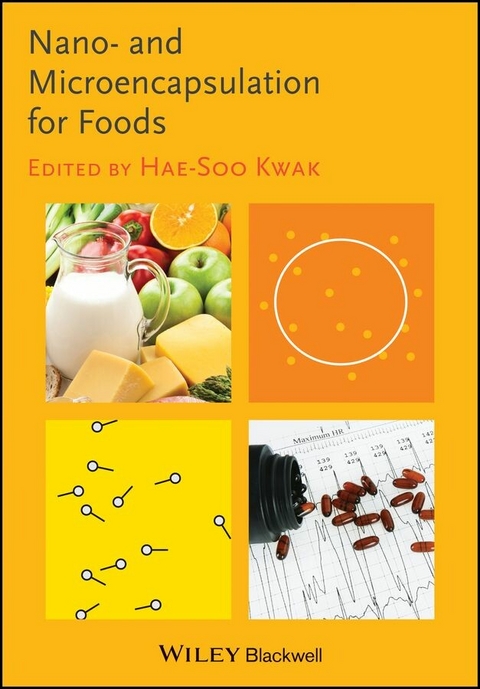
Nano- and Microencapsulation for Foods (eBook)
John Wiley & Sons (Verlag)
978-1-118-29229-7 (ISBN)
Today, nano- and microencapsulation are increasingly being utilized in the pharmaceutical, textile, agricultural and food industries. Microencapsulation is a process in which tiny particles or droplets of a food are surrounded by a coating to give small capsules. These capsules can be imagined as tiny uniform spheres, in which the particles at the core are protected from outside elements by the protective coating. For example, vitamins can be encapsulated to protect them from the deterioration they would undergo if they were exposed to oxygen.
This book highlights the principles, applications, toxicity and regulation of nano- and microencapsulated foods.
Section I describes the theories and concepts of nano- and microencapsulation for foods adapted from pharmaceutical areas, rationales and new strategies of encapsulation, and protection and controlled release of food ingredients.
Section II looks closely at the nano- and microencapsulation of food ingredients, such as vitamins, minerals, phytochemical, lipid, probiotics and flavors. This section provides a variety of references for functional food ingredients with various technologies of nano particles and microencapsulation. This section will be helpful to food processors and will deal with food ingredients for making newly developed functional food products.
Section III covers the application of encapsulated ingredients to various foods, such as milk and dairy products, beverages, bakery and confectionery products, and related food packaging materials.
Section IV touches on other related issues in nano- and microencapsulation, such as bioavailability, bioactivity, potential toxicity and regulation.
Hae-Soo Kwak is a Professor in the Department of Food Science and Technology, and Dean of the Graduate School of Industryat Sejong University in Seoul, Korea. Dr Kwak has devoted his research career in nano- and microencapsulation, nanoparticles in food, and dairy products research for the past 25 years, publishing more than 450 revered journal articles, book chapters, patents, invited papers and abstracts in national and international conferences
Today, nano- and microencapsulation are increasingly being utilized in the pharmaceutical, textile, agricultural and food industries. Microencapsulation is a process in which tiny particles or droplets of a food are surrounded by a coating to give small capsules. These capsules can be imagined as tiny uniform spheres, in which the particles at the core are protected from outside elements by the protective coating. For example, vitamins can be encapsulated to protect them from the deterioration they would undergo if they were exposed to oxygen. This book highlights the principles, applications, toxicity and regulation of nano- and microencapsulated foods. Section I describes the theories and concepts of nano- and microencapsulation for foods adapted from pharmaceutical areas, rationales and new strategies of encapsulation, and protection and controlled release of food ingredients. Section II looks closely at the nano- and microencapsulation of food ingredients, such as vitamins, minerals, phytochemical, lipid, probiotics and flavors. This section provides a variety of references for functional food ingredients with various technologies of nano particles and microencapsulation. This section will be helpful to food processors and will deal with food ingredients for making newly developed functional food products. Section III covers the application of encapsulated ingredients to various foods, such as milk and dairy products, beverages, bakery and confectionery products, and related food packaging materials. Section IV touches on other related issues in nano- and microencapsulation, such as bioavailability, bioactivity, potential toxicity and regulation.
Hae-Soo Kwak is a Professor in the Department of Food Science and Technology, and Dean of the Graduate School of Industryat Sejong University in Seoul, Korea. Dr Kwak has devoted his research career in nano- and microencapsulation, nanoparticles in food, and dairy products research for the past 25 years, publishing more than 450 revered journal articles, book chapters, patents, invited papers and abstracts in national and international conferences
Cover 1
Title Page 5
Copyright 6
Contents 7
List of Contributors 15
Preface 19
Chapter 1 Overview of Nano- and Microencapsulation for Foods 21
1.1 Introduction 21
1.2 Nano- or microencapsulation as a rich source of delivery of functional components 23
1.3 Wall materials used for encapsulation 23
1.4 Techniques used for the production of nano- or microencapsulation of foods 24
1.5 Characterization of nano- or microencapsulated functional particles 25
1.6 Fortification of foods through nano- or microcapsules 26
1.7 Nano- or microencapsulation technologies: industrial perspectives and applications in the food market 26
1.8 Overview of the book 28
Acknowledgments 32
References 32
Part I Concepts and rationales of nano- and microencapsulation for foods 35
Chapter 2 Theories and Concepts of Nano Materials, Nano- and microencapsulation 37
2.1 Introduction 37
2.2 Materials used for nanoparticles, nano- and microencapsulation 39
2.2.1 Polymers 39
2.3 Nano- and microencapsulation techniques 40
2.3.1 Chemical methods 40
2.3.2 Physico-chemical methods 43
2.3.3 Other methods 45
2.3.4 Factors influencing optimization 48
2.4 Pharmaceutical and nutraceutical applications 50
2.4.1 Various delivery routes for nano- and microencapsulation systems 50
2.5 Food ingredients and nutraceutical applications 55
2.5.1 Background and definitions 55
2.5.2 Nanomaterials, nano- and microencapsulation in nutraceuticals 56
2.6 Conclusion 57
References 58
Chapter 3 Rationales of Nano- and Microencapsulation for Food Ingredients 63
3.1 Introduction 63
3.2 Factors affecting the quality loss of food ingredients 65
3.2.1 Oxygen 65
3.2.2 Light 67
3.2.3 Temperature 68
3.2.4 Adverse interaction 69
3.2.5 Taste masking 70
3.3 Case studies of food ingredient protection through nano- and microencapsulation 70
3.3.1 Vitamins 71
3.3.2 Enzymes 72
3.3.3 Minerals 73
3.3.4 Phytochemicals 74
3.3.5 Lipids 75
3.3.6 Probiotics 75
3.3.7 Flavors 76
3.4 Conclusion 77
References 78
Chapter 4 Methodologies Used for the Characterization of Nano- and Microcapsules 85
4.1 Introduction 85
4.2 Methodologies used for the characterization of nano- and microcapsules 87
4.2.1 Particle size and particle size distribution 87
4.2.2 Zeta potential measurement 95
4.2.3 Morphology 97
4.2.4 Membrane flexibility 100
4.2.5 Stability 102
4.2.6 Encapsulation efficiency 103
4.3 Conclusion 108
Acknowledgements 108
References 108
Chapter 5 Advanced Approaches of Nano- and Microencapsulation for Food Ingredients 115
5.1 Introduction 115
5.2 Nanoencapsulation based on the microencapsulation technology 116
5.3 Classification of the encapsulation system 117
5.3.1 Nanoparticle or microparticle 117
5.3.2 Structural encapsulation systems 120
5.4 Preparation methods for the encapsulation system 126
5.4.1 Emulsification 126
5.4.2 Precipitation 127
5.4.3 Desolvation 128
5.4.4 Ionic gelation 129
5.5 Application of the encapsulation system in food ingredients 129
5.6 Conclusion 130
References 131
Part II Nano- and microencapsulations of food ingredients 137
Chapter 6 Nano- and Microencapsulation of Phytochemicals 139
6.1 Introduction 139
6.2 Classification of phytochemicals 140
6.2.1 Flavonoids 140
6.2.2 Carotenoids 144
6.2.3 Betalains 146
6.2.4 Phytosterols 147
6.2.5 Organosulfurs and glucosinolates 148
6.3 Stability and solubility of phytochemicals 149
6.4 Microencapsulation of phytochemicals 150
6.4.1 Spray-drying 151
6.4.2 Freeze-drying 155
6.4.3 Liposomes 156
6.4.4 Coacervation 158
6.4.5 Molecular inclusion complexes 161
6.5 Nanoencapsulation 166
6.5.1 Nanoemulsions 167
6.5.2 Nanoparticles 168
6.5.3 Solid lipid nanoparticles (SLN) 170
6.5.4 Nanoparticles through supercritical anti-solvent precipitation 172
6.6 Conclusion 173
References 173
Chapter 7 Microencapsulation for Gastrointestinal Delivery of Probiotic Bacteria 187
7.1 Introduction 187
7.2 The gastrointestinal (GI) tract 189
7.2.1 Microbiota of the adult GI tract 189
7.2.2 Characteristics of the GI tract for probiotic delivery 190
7.3 Encapsulation technologies for probiotics 193
7.4 Techniques for probiotic encapsulation 195
7.4.1 Microencapsulation (ME) in gel particles using polymers 195
7.4.2 The extrusion technique 195
7.4.3 The emulsion technique 197
7.4.4 Spray-drying, spray-coating and spray-chilling technologies 199
7.4.5 Microencapsulation technologies for nutraceuticals incorporating probiotics 202
7.5 Controlled release of probiotic bacteria 202
7.6 Potential applications of encapsulated probiotics 203
7.6.1 Yoghurt 204
7.6.2 Cheese 205
7.6.3 Frozen desserts 206
7.6.4 Unfermented milks 206
7.6.5 Powdered formulations 207
7.6.6 Meat products 207
7.6.7 Plant-based (vegetarian) probiotic products 208
7.7 Future trends and marketing perspectives 209
References 211
Chapter 8 Nano-Structured Minerals and Trace Elements for Food and Nutrition Applications 219
8.1 Introduction 219
8.2 Special characteristics of nanoparticles 220
8.3 Nano-structured entities in natural foods 222
8.4 Nano-structured minerals in nutritional applications 222
8.4.1 Iron 222
8.4.2 Zinc 227
8.4.3 Calcium 229
8.4.4 Magnesium 230
8.4.5 Selenium 231
8.4.6 Copper 231
8.5 Uptake of nano-structured minerals 232
8.6 Conclusion 233
References 234
Chapter 9 Nano- and Microencapsulation of Vitamins 243
9.1 Introduction 243
9.2 Vitamins for food and nutraceutical applications 244
9.2.1 Vitamins: nutritional requirement and biological functions 244
9.2.2 Vitamins: formulation challenges and stability issues 244
9.3 Colloidal encapsulation (nano and micro) in foods: principles of use 247
9.3.1 Solid-in-liquid dispersions 249
9.3.2 Liquid-in-liquid dispersions 252
9.3.3 Dispersions of self-assembled colloids 254
9.3.4 Encapsulation in dry matrices 258
9.3.5 Molecular encapsulation of vitamins in cyclodextrins 259
9.4 Conclusion and future trends 260
References 241
Chapter 10 Nano- and Microencapsulation of Flavor in Food Systems 269
10.1 Introduction 269
10.2 Flavor stabilization in food nano- and microstructures 270
10.2.1 Application of encapsulated flavors 270
10.2.2 Interactions between flavor compounds and carrier matrices 271
10.2.3 Flavor retention in colloidal systems 271
10.2.4 Flavor retention in food gel 272
10.2.5 Flavor inclusion in starch nanostructure 273
10.3 Flavor retention and release in an encapsulated system 274
10.3.1 Mass transfer at the liquid-gas interface 274
10.3.2 Mass transfer at a solid-gas interface 278
10.4 Nano- and microstructure processing 279
10.4.1 Spray-drying 280
10.4.2 Freeze-drying 282
10.4.3 Complex coacervation 284
10.5 Conclusion 286
Acknowledgements 287
References 287
Chapter 11 Application of Nanomaterials, Nano- and Microencapsulation to Milk and Dairy Products 293
11.1 Introduction 293
11.2 Milk 294
11.2.1 Microencapsulation of functional ingredients 294
11.2.2 Microencapsulation of vitamins 298
11.2.3 Microencapsulation of iron 299
11.2.4 Microencapsulation of lactase 301
11.2.5 Nanofunctional ingredients 305
11.2.6 Nanocalcium 307
11.3 Yogurt 307
11.3.1 Microencapsulation of functional ingredients 307
11.3.2 Microencapsulation of iron 308
11.3.3 Nanofunctional ingredients 309
11.4 Cheese 311
11.4.1 Microencapsulation for accelerated cheese ripening 311
11.4.2 Microencapsulation of iron 312
11.4.3 Nanopowdered functional ingredients 312
11.5 Others 313
11.5.1 Microencapsulation of iron 313
11.6 Conclusion 313
References 294
Chapter 12 Application of Nano- and Microencapsulated Materials to Food Packaging 321
12.1 Introduction 321
12.2 Nanocomposite technologies 322
12.2.1 Layered silicate nanocomposites 322
12.2.2 Mineral oxide and organic nanocrystal composites 325
12.2.3 Material properties' enhancement of biodegradable/compostable polymers 326
12.3 Intelligent and active packaging based on nano- and microencapsulation technologies 327
12.3.1 Product quality and shelf-life indicators 328
12.3.2 Nano- and microencapsulated antimicrobial composites 332
12.3.3 TiO_2 ethylene scavenger for shelf-life extension of fruits and vegetables 337
12.4 Conclusion 338
References 339
Part III Bioactivity, toxicity, and regulation of nanomaterial, nano- and microencapsulated ingredients 345
Chapter 13 Controlled Release of Food Ingredients 347
13.1 Introduction 347
13.2 Fracturation 348
13.3 Diffusion 349
13.4 Dissolution 351
13.5 Biodegradation 353
13.6 External and internal triggering 354
13.6.1 Thermosensitive 355
13.6.2 Acoustic sensitive 356
13.6.3 Light-sensitive 357
13.6.4 pH-sensitive 358
13.6.5 Chemical-sensitive 359
13.6.6 Enzyme-sensitive 359
13.6.7 Other stimuli 360
13.7 Conclusion 360
References 360
Chapter 14 Bioavailability and Bioactivity of Nanomaterial, Nano- and Microencapsulated Ingredients in Foods 365
14.1 Introduction 365
14.2 Bioavailability of nano- and microencapsulated phytochemicals 367
14.3 Bioavailability of other nano- and microencapsulated nutraceuticals 372
14.4 Bioavailability of nano- and microencapsulated bioactive components 375
14.5 Conclusion 377
References 378
Chapter 15 Potential Toxicity of Food Ingredients Loaded in Nano- and Microparticles 383
15.1 Introduction 383
15.2 Factors influence the toxicity of nano- and microparticles 385
15.2.1 Size of the nano- and microparticles 386
15.2.2 Shape of the nano- and microparticles 387
15.2.3 Solubility of the nano- and microparticles 387
15.2.4 Chemical composition of the nano- and microparticles 387
15.3 Behavior and health risk of nano- and microparticles in the gastrointestinal (GI) tract 390
15.3.1 Absorption 390
15.3.2 Distribution 391
15.3.3 Excretion/elimination 391
15.4 Toxicity studies of nano- and microparticles 391
15.4.1 Oral exposure studies for toxicity 391
15.4.2 In vitro studies for toxicity 392
15.4.3 Lack of an analytical method model to evaluate the safety of micro- and nanoparticles 393
15.5 Risk assessment of micro- and nanomaterials in food applications 394
15.5.1 Risk assessment 395
15.6 Conclusion 397
References 397
Chapter 16 Current Regulation of Nanomaterials Used as Food Ingredients 403
16.1 Introduction 403
16.2 The European Union (EU) 404
16.2.1 Definition 404
16.2.2 The EFSA Guidance 405
16.2.3 Regulation 406
16.3 The United Kingdom (UK) 408
16.4 France 409
16.5 The United States of America (USA) 409
16.6 Canada 411
16.7 Korea 412
16.8 Australia and New Zealand 413
References 413
Index 415
Supplemental images 431
"This book will help food companies to develop new
nanotechnology for major problems such as the development of
functional coatings to enhance the long-term suitability of food
products." (South African Food Science and
Technology magazine, 1 February 2015)
Chapter 1
Overview of Nano- and Microencapsulation for Foods
Hae-Soo Kwak
Department of Food Science and Technology, Sejong University, Seoul, South Korea
1.1 Introduction
Nano- or microencapsulation technology is a rapidly expanding technology offering numerous beneficial applications in the food industries. Nano- or microencapsulation technology is the process by which core materials enriched with bioactive compounds are packed within wall materials to form capsules. This method helps to protect many functional core compounds, such as antioxidants, enzyme, polyphenol, and micronutrients, to deliver them to the controlled target site and to protect them from an adverse environment (Gouin, 2004; Lee et al., 2013). Based on the capsule size, the name and the technology of the encapsulation are different: the capsules which range from 3 to 800 µm in size are called microcapsules and the technology is called microencapsulation technology (Ahn et al., 2010). If the particle size ranges from 10 to 1,000 nm, these are called nanospheres and the technology involved to encapsulate the bioactive compounds within the nano size range is termed nanoencapsulation technology (Lopez et al., 2006). Nanocapsules differ from nanospheres when the bioactive systems are dispersed uniformly (Couvreur et al., 1995). The development of the nanotechnology on the nanometer scale has led to the development of many technological, commercial, and scientific opportunities for the industry (Huang et al., 2010).
Application of nanotechnology in the food industry involves many characteristic changes on the macroscale, such as texture, taste, and color, which have led to the development of many new products. This also improves many functions, such as oral bioavailability, water solubility, and the thermal stability of functional compounds (McClements et al., 2009). It is claimed that the functional compounds provide many health benefits in the prevention and treatment of many diseases, and these compounds can easily be seen on the market in various forms. However, the sustainability of the delivery of functional bioactive compounds to the target site is very low, particularly lipophilic compounds. Improving the availability of the functional compounds enhances the absorption of the functional compounds in the gastrointestinal tract, which is a critical requirement. The development of nano- or microencapsulation technologies offers possible solutions to improve the bioavailability of many functional compounds (Chau et al., 2007). The methods used to develop the encapsulation technologies, to enclose the functional compound encapsulated along with its applications in food, and its regulatory framework are described in various chapters in this volume.
1.2 Nano- or microencapsulation as a rich source of delivery of functional components
Nano- or microencapsulation techniques are one of the most interesting fields in that they can act as a carriers or delivery systems for functional components, such as antioxidants, flavor, and antimicrobial agents (Wissing et al., 2004; Sanguansri and Augustin, 2006; McClements et al., 2009; Weiss et al., 2008). The major functional compounds that often need to be incorporated in foods can be divided into four categories: (1) fatty acids (e.g., omega three fatty acids); (2) carotenoids (e.g., β-carotene); (3) antioxidants (e.g., tocopherol); and (4) phytosterols (e.g., stigmasterol). Table 1.1 shows a list of functional compounds that have been encapsulated into nano- or microemulsion systems, their expected benefits, and their fields of application. Applications of the nano- or microencapsulation technologies in the food industries are mainly based on the stability of the capsules. During various environmental conditions, such as chilling, freezing, and thermal processing, which commonly occur during food processing, the capsules are susceptible to instability. The properties of physical stability are at different levels during the encapsulation process, such as stability required in the food ingredients or in the food matrix. Furthermore, stability also varies with the type of food system in which it is incorporated (McClements et al., 2009).
Table 1.1 Nano-encapsulation techniques of various functional materials.
| Techniques | Functional compounds | Coating materials | Particle size (nm) | References |
| Emulsification | Pine seed oil (L) | W: Eudragit L 100-55 | 457–1,288 | Averina and Allémann., 2013 |
| d-Limonene (L) | W: maltodextrin; E: modified starch (Hi-Cap 100) | 543–1,292 | Jafari et al., 2007 |
| Flax seed oil (L) | E: Tween-40 | 135 | Kentish et al., 2008 |
| Sunflower oil (L) | E: Tween-80, Span-80, and sodium dodecyl sulfate | 40 | Leong et al., 2009 |
| Salmon oil (L) | O: marine lecithin, α-tocopherol, quercetin, chloroform, methanol, diethylic ether, hexane | 160–207 | Belhaj et al., 2010 |
| Curcumin (L) | E: Tween-20, ethyl acetate | 125–1083 | Souguir et al., 2013 |
| MCT (L) | W: OSA starch, chitosan, and lambda-carrageenan | 130 | Preetz et al., 2008 |
| Inclusion complexation | DHA (L) | W: beta-lactoglobulin and low methoxyl pectin | 100 | Zimet and Livney, 2009 |
| Curcumin (L) | W: β-cyclodextrin | 260–300 | Sun et al., 2013 |
| Linoleic acid (L) | W: α- and β-cyclodextrin | 236 | Hadaruga et al., 2006 |
| Emulsification–solvent evaporation | α-Tocopherol (L) | E: Tween-20 | 90–120 | Cheong et al., 2008 |
| Quercetin | W: poly-d,l-lactide | 170 | Kumari et al., 2010 |
| Quercetin | W: poly-d,l-lactide and polyvinyl alcohol | 250 | Kumari et al., 2011 |
| Phytosterol (L) | E: Tween-20; other materials: hexane, isopropyl alcohol, ethanol, and acetone | 50–282 | Leong et al., 2011 |
| Astaxanthin | E: sodium caseinate | 115–163 | Anarjan et al., 2011 |
| β-carotene (L) | E: Tween-20 | 9–280 | Silva et al., 2011 |
| Coacervation | Capsaicin (L) | W: gelatin, maltodextrin and tannins; E: Tween-60; other material: glutaraldehyde | 100 | Wang et al., 2008 |
| BSA (H) | W: gelatin, acacia, and tannins; E: Tween-60; other material: glutaraldehyde | 200–580 | Gan and Wang, 2007 |
| Curcumin (L) | E: palmitic, myristic | <300–500 | Chirio et al., 2011 |
| Capsaicin (L) | W: gelatin, acacia, and tannins; E: Tween-60; other material: glutaraldehyde | 100 | Jincheng et al., 2010 |
1.3 Wall materials used for encapsulation
Nano- or microencapsulation techniques are mainly used in the delivery of functional compounds to the target sites and largely depend on the carrier wall materials used. The effectiveness of the functional compounds wholly depends on the preservation of the compounds (Chen et al., 2006). Microencapsulation greatly helps in the delivery with a suitable wall material, however, reducing the particle size to the nanosize greatly increases the delivery properties due to the increase in surface area per unit volume (Shegokar and Muller, 2010). Based on solubility, the functional compounds used for encapsulation can be classified as either lipophilic or hydrophilic. Water-soluble functional compounds which are insoluble in lipids or organic solvents are termed hydrophilic functional compounds. The hydrophilic functional compounds are listed as polyphenols, ascorbic acids (Lakkis, 2007; Dube et al., 2010). Functional compounds which are insoluble in water and soluble in lipids and organic solvents are termed lipophilic which includes lycopene, and β-carotene (Zimet and Livney, 2009; Leong et al., 2011). In the polymeric matrix system, the solubility also determines the release rate of their functional compounds. A hydrophilic compound shows a faster release rate and low permeability, which is absorbed by active transport. Lipophilic compounds show high permeability through the intestine and are absorbed by active transport, and facilitate diffusion with a lower release rate (Varma et al., 2004; Kuang et al., 2010). Various kinds of wall materials are used in the delivery of functional lipophilic or hydrophilic compounds for nano- or microencapsulation techniques. The...
| Erscheint lt. Verlag | 2.4.2014 |
|---|---|
| Sprache | englisch |
| Themenwelt | Naturwissenschaften ► Biologie |
| Technik ► Lebensmitteltechnologie | |
| Weitere Fachgebiete ► Land- / Forstwirtschaft / Fischerei | |
| Schlagworte | area • Body • bodys reactions • Characteristics • Concept • Control • Dose • Drug • ENCAPSULATED • encapsulation • Example • familiar • Food • food engineering • Foods • Food Science & Technology • Food Science & Technology Special Topics • Functional Food, Nutraceuticals • Functional Foods & Nutraceuticals • Interest • Lebensmittelforschung u. -technologie • Lebensmitteltechnik • Material • Nano • Nanotechnologie • particular • Pharmaceutical • possible • Principle • Rate • Release • slow release • Spezialthemen Lebensmittelforschung u. -technologie • various |
| ISBN-10 | 1-118-29229-4 / 1118292294 |
| ISBN-13 | 978-1-118-29229-7 / 9781118292297 |
| Informationen gemäß Produktsicherheitsverordnung (GPSR) | |
| Haben Sie eine Frage zum Produkt? |
 PDF (Adobe DRM)
Größe: 14,0 MB
Kopierschutz: Adobe-DRM
Adobe-DRM ist ein Kopierschutz, der das eBook vor Mißbrauch schützen soll. Dabei wird das eBook bereits beim Download auf Ihre persönliche Adobe-ID autorisiert. Lesen können Sie das eBook dann nur auf den Geräten, welche ebenfalls auf Ihre Adobe-ID registriert sind.
Details zum Adobe-DRM
Dateiformat: PDF (Portable Document Format)
Mit einem festen Seitenlayout eignet sich die PDF besonders für Fachbücher mit Spalten, Tabellen und Abbildungen. Eine PDF kann auf fast allen Geräten angezeigt werden, ist aber für kleine Displays (Smartphone, eReader) nur eingeschränkt geeignet.
Systemvoraussetzungen:
PC/Mac: Mit einem PC oder Mac können Sie dieses eBook lesen. Sie benötigen eine
eReader: Dieses eBook kann mit (fast) allen eBook-Readern gelesen werden. Mit dem amazon-Kindle ist es aber nicht kompatibel.
Smartphone/Tablet: Egal ob Apple oder Android, dieses eBook können Sie lesen. Sie benötigen eine
Geräteliste und zusätzliche Hinweise
Zusätzliches Feature: Online Lesen
Dieses eBook können Sie zusätzlich zum Download auch online im Webbrowser lesen.
Buying eBooks from abroad
For tax law reasons we can sell eBooks just within Germany and Switzerland. Regrettably we cannot fulfill eBook-orders from other countries.
 EPUB (Adobe DRM)
Kopierschutz: Adobe-DRM
Adobe-DRM ist ein Kopierschutz, der das eBook vor Mißbrauch schützen soll. Dabei wird das eBook bereits beim Download auf Ihre persönliche Adobe-ID autorisiert. Lesen können Sie das eBook dann nur auf den Geräten, welche ebenfalls auf Ihre Adobe-ID registriert sind.
Details zum Adobe-DRM
Dateiformat: EPUB (Electronic Publication)
EPUB ist ein offener Standard für eBooks und eignet sich besonders zur Darstellung von Belletristik und Sachbüchern. Der Fließtext wird dynamisch an die Display- und Schriftgröße angepasst. Auch für mobile Lesegeräte ist EPUB daher gut geeignet.
Systemvoraussetzungen:
PC/Mac: Mit einem PC oder Mac können Sie dieses eBook lesen. Sie benötigen eine
eReader: Dieses eBook kann mit (fast) allen eBook-Readern gelesen werden. Mit dem amazon-Kindle ist es aber nicht kompatibel.
Smartphone/Tablet: Egal ob Apple oder Android, dieses eBook können Sie lesen. Sie benötigen eine
Geräteliste und zusätzliche Hinweise
Buying eBooks from abroad
For tax law reasons we can sell eBooks just within Germany and Switzerland. Regrettably we cannot fulfill eBook-orders from other countries.
aus dem Bereich