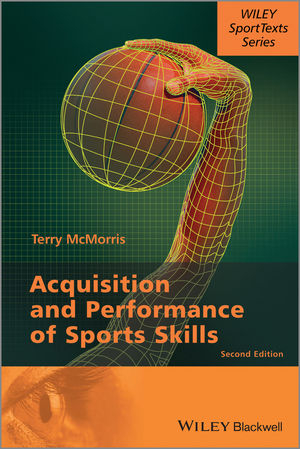
Acquisition and Performance of Sports Skills (eBook)
John Wiley & Sons (Verlag)
978-1-118-44465-8 (ISBN)
Terry McMorris University of Chichester, UK
An extensive update of a successful textbook on skill acquisition for sport students. Praised for its clarity of writing style and presentation the new edition will be an essential buy for those needing a practical, sport-focused introduction to the theory and application of human motor skills.
Terry McMorris University of Chichester, UK
Prologue
1. Skill, Ability and Performance.
2. Sensation and Perception of External Information
3. Decision Making and Working Memory
4. Reaction Time
5. Anticipation
6. Motor Control
7. Memory
8. Learning I: Types, Theories, Styles and Measurement
9. Learning II: Instruction, Practice, Transfer of Training and Feedback
10. Motivation, Arousal and Learning and Performance
11. Conclusion
Appendix 1. Writing an Academic Paper
Appendix 2. Test Your Knowledge Answers
Appendix 3. Calculating Variable Error
References
Index
Preface
To those of us interested in sport, the performance of skills brings a great deal of pleasure. This may be our own performance of a skill or it may be observing others perform. To most people, I think that their own performance brings the greatest pleasure, even if the level is not particularly high. Our efforts may not be seen by many other people but, nevertheless, they still bring pleasure to us. Some individuals reach the top and their performances thrill, not only themselves, but also millions of spectators around the world. Generally, we most readily appreciate the performance of skills in our own sport; however, observation of great performances in other activities can also bring us much pleasure. Even though our knowledge of the sport may be limited, we ‘just know’ that what we are seeing is of high quality. As far as gymnastics are concerned, I am definitely in the same class as the comic character Mr Bean, but during the 2012 Olympic Games I took great pleasure from watching some unbelievable performances. Some of the skills leave you thinking ‘How did they do that?’ Hopefully, reading this book will help explain.
Another source of pleasure from watching skilled performance comes as a coach. Seeing someone perform a skill that you taught them is a very enjoyable experience, especially if it was the result of a great deal of hard work. This book examines what is happening, mentally and neuropsychologically, when we perform skills and how we are able to acquire such skills. The study of these phenomena has made me more appreciative of top-class performance and I hope that it also helps you to enjoy playing, spectating, and/or teaching and coaching even more than you do at present.
This book is primarily designed for those of you embarking on the study of the acquisition and performance of sports skills at degree level. It should also be useful to those who have passed the beginner stage. I hope, however, that it might also be of interest to those who are not formally studying the subject but who have an interest in it. You may be a player, coach or spectator. As the book is primarily aimed at students, it follows the basic format of a textbook. Each chapter begins with a brief outline of the Learning Objectives of reading the chapter. At the end of the chapter, there is a summary of the content in note form, which I hope will help with revisions. Also, there are questions, which will test your understanding and help prepare you for formal examinations. I have used a variety of methods of testing. Many you will have come across previously but some may be new to you. At the end of each chapter, I have given some additional readings which I recommend to you. Some of these are at the same level as this book; others take the study of a particular topic further.
Within the text, I have occasionally suggested that you try some things out for yourself. Although I know that many of you will not do this, I strongly urge you to do so because these little activities are designed to help your understanding of the acquisition and performance of skill. I have also set some practical problems for you to solve. These are designed to help you develop the ability to apply theory to practice. They are of particular use to those of you hoping to become coaches (you may already be a coach) or physical education teachers. In each chapter there is a review of a typical research report on an aspect of the topics being discussed. I would, also, encourage you to take time to think about your own experiences and examine to what extent they can be explained by the theories and research covered in this book. Similarly, it is a good idea to talk to other people about their experiences, especially if their backgrounds in sport differ from yours.
This book is part of a series, published by Wiley-Blackwell, and as such will follow the same format as the other books in the series. The idea is to write a ‘user friendly’ text. Many students find the academic style of writing used in many textbooks, even those for beginners, very daunting. Therefore, the books in this series are written in more accessible English. Similarly, we have deliberately refrained from excessive citation of authors. Constantly citing authors is off-putting to beginners and can make the text difficult to read. Despite this, I am well aware that, as you develop your knowledge base and become more experienced, you will be expected to write in a more academic style. There are several styles, which are accepted by sports psychologists. The most commonly used is that described in the Publication Manual of the American Psychology Association (APA). Those of you who are at university should consult with your own tutors and examine your institution’s guidelines to see what style they recommend. In Appendix 1, I have written a short passage in the style that I have used in this book. Following it, I have re-written the passage using APA style. Perhaps the most important factor for you to note is that, in a formal academic style, you must cite authors to support your claims. You cannot, as I have done on some occasions in this text, simply state ‘research has shown’. You need to say which research.
Almost all introductory texts on the acquisition and performance of sports skills follow an information processing theory approach. Although other theories have been known for some time, this theory has had the greatest following. In the first edition of this book, I focused, not only, on information processing theory but also on ecological psychology theories, especially dynamical systems theory. Both approaches remain popular and it is impossible for you to read research and theory papers in the area without coming across both of them. Therefore, I feel that we must include both in this edition.
Information processing theory is based on a cognitive approach to explaining our actions. Information processing theorists try to explain the role of the brain in the acquisition and performance of skills. Most of the evidence for what is happening in the brain has come from theoretical inputs, research with animals using pharmacological interventions and observation of humans with brain damage. In recent times, we have seen dramatic improvements in technology which have led to the development of devices such as functional magnetic resonance imaging (fMRI) and positron emission tomography (PET) scanners, which have improved our knowledge of brain activity tremendously and allowed for a neuroscientific study of skill acquisition and performance. In the first edition of this book, I occasionally included comments on the functional roles of different regions of the brain involved in skilled performance and skill acquisition, in this edition I continue with that but to a greater extent.
Unlike information processing theory, ecological psychology theories are not interested in cognition; they are more concerned with explaining performance from what we can actually see. Ecological psychologists like to talk about what we observe directly. Due to the fact that the two theories differ in their fundamental approaches, sometimes they are complementary, other times they are diametrically opposed and sometimes the explanations of action are simply from different perspectives. Each of the theories has its strengths and weaknesses, and explains certain factors very well but others not so well, or even not at all. This latter point leads me to another aspect of the study of skill acquisition and performance, and indeed the study of almost all sports science. Many phenomena can only be partially explained. There is a great deal that is not be fully understood at this moment in time. To some students this is galling. They expect answers. To others it is exciting. You may be the person that explains some phenomenon that has puzzled scientists for years. While this might be unlikely, the chance of increasing knowledge about a topic, just a small amount, is not as remote as you might think. As you progress through your studies, the opportunity to carry out research projects occurs. These will not be great Nobel Prize winning studies but may still advance our knowledge. Some of my past undergraduate students have carried out research projects that have subsequently been published in academic journals. You too could achieve that distinction. Many of you will not aspire to publications but simply want to increase your own knowledge base. Whatever your reasons for reading this book, I hope that you get even half as much pleasure from studying skill as I do. I must admit that studying it does not beat actually performing the skills.
Content and changes from the first edition
The content of the individual chapters and the changes to the chapter texts from the first edition, are outlined in the subsections below. In general, the book follows the same pattern as the first edition, with each chapter beginning with a brief summary of the expected learning outcomes; followed by the main body of the chapter; then follows a summary of the content in note form; and finally a series of questions to test your learning. There are two format changes within the body of the text; the addition of tasks to be undertaken by the reader and, in each chapter, a report and very short critique of a typical research paper in that particular area of motor learning and control. With regard to the questions at the end of each chapter, I have added some essay-type questions to most of the chapters. Within the body of the text in most chapters, specific subsections have been added on the regional brain functions involved in the processes being examined and developmental...
| Erscheint lt. Verlag | 2.4.2014 |
|---|---|
| Sprache | englisch |
| Themenwelt | Sachbuch/Ratgeber ► Sport |
| Geisteswissenschaften ► Psychologie | |
| Naturwissenschaften ► Biologie ► Humanbiologie | |
| Technik | |
| Weitere Fachgebiete ► Sportwissenschaft | |
| Schlagworte | acquisition • Anatomie u. Physiologie • Anatomy & Physiology • Angewandte Psychologie • Applied Psychology • Approach • author • Background • Basics • Biowissenschaften • clarity • Debate • Ecological • Edition • includes examples • Life Sciences • Major • Medical Science • Medizin • Necessary • New • Performance • Practical • problemsolving • provides • Psychologie • Psychology • psychomotor • Researchers • Skill • Skills • Sports Science • Sportwissenschaft • Text • Theoretical • Update |
| ISBN-10 | 1-118-44465-5 / 1118444655 |
| ISBN-13 | 978-1-118-44465-8 / 9781118444658 |
| Informationen gemäß Produktsicherheitsverordnung (GPSR) | |
| Haben Sie eine Frage zum Produkt? |
 EPUB (Adobe DRM)
Kopierschutz: Adobe-DRM
Adobe-DRM ist ein Kopierschutz, der das eBook vor Mißbrauch schützen soll. Dabei wird das eBook bereits beim Download auf Ihre persönliche Adobe-ID autorisiert. Lesen können Sie das eBook dann nur auf den Geräten, welche ebenfalls auf Ihre Adobe-ID registriert sind.
Details zum Adobe-DRM
Dateiformat: EPUB (Electronic Publication)
EPUB ist ein offener Standard für eBooks und eignet sich besonders zur Darstellung von Belletristik und Sachbüchern. Der Fließtext wird dynamisch an die Display- und Schriftgröße angepasst. Auch für mobile Lesegeräte ist EPUB daher gut geeignet.
Systemvoraussetzungen:
PC/Mac: Mit einem PC oder Mac können Sie dieses eBook lesen. Sie benötigen eine
eReader: Dieses eBook kann mit (fast) allen eBook-Readern gelesen werden. Mit dem amazon-Kindle ist es aber nicht kompatibel.
Smartphone/Tablet: Egal ob Apple oder Android, dieses eBook können Sie lesen. Sie benötigen eine
Geräteliste und zusätzliche Hinweise
Buying eBooks from abroad
For tax law reasons we can sell eBooks just within Germany and Switzerland. Regrettably we cannot fulfill eBook-orders from other countries.
aus dem Bereich