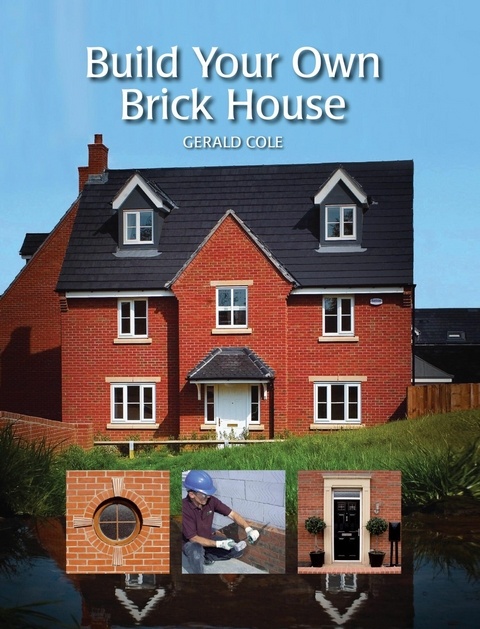
Build Your Own Brick House (eBook)
520 Seiten
Crowood (Verlag)
978-1-84797-628-4 (ISBN)
Build Your Own Brick House follows the process of a self-build, using traditional brick and block techniques, enabling the self-builder to understand both the individual stages and the nature of the build as a whole. It takes a practical approach, focusing on the best use of time, abilities and budget, and on communicating more clearly and effectively with designers and tradespeople in order to make the build as smooth as possible.
CHAPTER 1 Why Build in Brick?
Walk down virtually any modern British street and you walk down an avenue of brick. Brick is Britain’s most ubiquitous and most conspicuous building material for new homes. Even if the internal structure is timber or steel frame, chances are the outside walls will be brickwork. That’s partly because the great majority of local planning authorities prefer it that way, partly because mortgage lenders and insurers grow irrationally nervous at any hint of ‘non-standard’ construction, but mainly because that’s the way we like it.
We may coo appreciatively over the picturesque clapboard of Essex coastal cottages or the organic curves of Devonshire cob houses, but when it comes to putting down roots, most of us opt for bricks and mortar. It’s easy to see why – bricks have a solidity and a permanence matched only by concrete or stone; but stone is largely confined to areas where it occurs naturally, while concrete smacks of public works and wartime bunkers, and its appearance is not enhanced with age.
Ageing is what brick does particularly well. Over the years its colours mellow and improve, yet it needs no regular maintenance. Its strength provides exceptional protection against wind, rain, snow and flood. Its density enables it to retain the heat of the day or the cool of the night, evening out internal temperature variations. It also provides excellent sound insulation and protection against fire.
This selfbuild, from Wimbledonbased architects Andrew Pinchin Associates, combines elements of brickwork and clay tile to create a style that’s both modern and wholly traditional.
Despite all these qualities, however, brick remains breathable. Unlike timber-frame construction – brick’s main rival – the structure of the house is not contained within an air-tight, plastic vapour barrier, designed to prevent water vapour from penetrating the timber and causing it to rot. Moisture passes through brickwork, albeit slowly, contributing to a naturally comfortable and healthy interior atmosphere.
More significantly for the builder, brick is one of the easiest of building materials to use and the most forgiving. The size of individual bricks is small compared to that of an entire home. As a result, variations from plumb that would prove disastrous for a precisely calculated timber- or steel-frame building can be compensated for with relative ease.
But it’s in the look and the feel of brick where its appeal is greatest. Bricks can range in colour from bright yellow to red to dark blue, with every variation in between – sometimes within the same brick. Yet combinations of even the plainest and most common varieties can create striking effects out of all proportion to the costs involved.
Bricks can also range in texture from silky smooth to the roughness of naked rock – and here, perhaps, is where their appeal is most basic. Brick, in essence, is the clay at our feet turned to stone, the artificial acceleration of a process that occurs naturally over millions of years.
Traditional clamp fired brick-making at Ibstock’s Chailey Brickworks in the Sussex Weald, where local clays have been used since 1711.
Today most brick-making is concentrated among a small number of large manufacturers whose products are used countrywide. But less than a century ago, Britain was dotted with much smaller, brickworks using locally available clays to make bricks for local building. They produced the hard red, blue and yellow bricks of the South Wales valleys, the cream and light red bricks of Nottinghamshire and Leicestershire, and the grey and yellow bricks of London stocks. Homes built with these materials were rooted in the landscape from which they sprung. They expressed its colours and its texture, its unique character. If you’re planning a home that will look and feel ‘right’ for its location, that promises stability and permanence, is low maintenance and economical to build, brick is hard to beat.
Why Build Your Own Home?
Perhaps a more relevant question is: why not? That would certainly be the response of would-be homeowners in other European countries, as well as Australia, Japan, Canada and the United States. In Germany, for example, a common wedding gift for a son or daughter is a serviced building plot, one of a number set aside periodically by local authorities for individual home-builders.
Self-build is the major form of house-building in Germany where companies like WeberHaus and Baufritz specialize in designing and building bespoke prefabricated homes. At their factories, customers can view demonstration houses and visit permanent exhibitions, where they can choose virtually every aspect of their new home from the interior design to details of roofing, guttering and even door and window handles.
What Do We Mean by a ‘Brick’ House?
To the building trade, a traditional brick house means ‘brick and block’. In other words, it consists of an inner wall built with concrete blocks, which supports the floors and the roof, and an outer wall built from bricks. This supports the doors and windows, keeps out the wind and rain, and presents, hopefully, an attractive face to the world. The two walls are separated by a cavity, which prevents any moisture that penetrates the brickwork from reaching the interior. More recently, it’s also been used to accommodate insulation.
The blocks used in construction are essentially bricks made from cement mixed with water and aggregates. The aggregates can include sand, stone or pulverized fuel ash (PFA), a waste product from power stations. Blocks are cheaper than clay bricks and larger, the standard size being the equivalent of six bricks, making them quicker and easier to lay. They can also be used to build floors, a method known as ‘beam and block’ (see Chapter 17 for details).
Aerated or ‘aircrete’ blocks are their latest development. Because they are honeycombed with air pockets, they provide good insulation and are so light they can even form solid roofs.
Walls built entirely of brickwork fell out of favour after 1945, largely because of a post-war shortage of bricks and bricklayers.
The plot owners can do much of the building work themselves, engage their own architect and builder, or approach one of the Germany’s 100-plus catalogue house-builders. Typically, a manufacturer might have up to seventy house designs to view in a show village. Depending on the company, customers can buy a standard design, request a variation or commission a house
based on their own design.
Customers can then view displays of every aspect of their new home, from heating systems to roof tiles to door knobs and window catches – all on the same site and usually at discounted prices. By the end of the process, the new home will be planned and priced to a level of detail we would find astonishing in the UK.
In fact, the nearest British equivalent has nothing at all to do with houses; it’s how we would expect to buy a car.
SO WHY ARE THINGS SO DIFFERENT IN THE UK?
In Germany, self-build accounts for around 55 per cent of the house-building market. Speculative building by commercial developers is around 30 per cent.
In Britain the situation is reversed. Speculative developers account for around 80 per cent of the market, which is dominated by a small number of large companies. Self-build accounts for around 8 per cent, the lowest proportion in Europe.
Many of the reasons for this can be traced back to the 1930s. Before then most Britons rented their homes, but rising incomes and cheap credit fuelled a home-owning boom. Speculative house-builders rushed to meet the demand, setting a pattern that survives to this day.
Commercial builders have undoubtedly been successful at producing large numbers of homes, but it’s been at a price. Individuality has not been a hallmark of the average ‘executive’ estate. Stereotypically, buyer choice has been limited to a small variety of bathroom suite colour schemes.
More importantly, most buyers have not been satisfied. In 2009 a survey by the now defunct Commission for Architecture and the Built Environment (CABE) found that 80 per cent of all new housing was regarded by its owners as mediocre or poor. The most common complaint was lack of space. With an average size of 76 square metres, new British homes are the smallest in Europe.
Serviced plots, where the developer simply provides plots with utilities in place, leaving design and construction of the house to the buyer, are common in the USA, Australia and much of Europe, though they are slowly becoming more available in the UK.
Meanwhile, a highly conservative planning system ensures a continuing shortage of building land, which keeps house prices high and gives little incentive to developers to improve their products.
As an architect once told me: ‘House-builders in the UK do not build homes; they add value to land.’ So, if you’re intent on obtaining a new house that meets all your needs from day one, is built to the highest standards and is genuinely the best value for the price you can afford, there really is only one option. It’s time to swap sides, to move from being a consumer to a producer – of your own home.
HAVE I GOT WHAT IT TAKES TO...
| Erscheint lt. Verlag | 30.6.2013 |
|---|---|
| Verlagsort | London |
| Sprache | englisch |
| Themenwelt | Sachbuch/Ratgeber ► Freizeit / Hobby ► Hausbau / Einrichten / Renovieren |
| Sachbuch/Ratgeber ► Freizeit / Hobby ► Heimwerken / Do it yourself | |
| Recht / Steuern ► Öffentliches Recht | |
| Technik ► Bauwesen | |
| Weitere Fachgebiete ► Handwerk | |
| ISBN-10 | 1-84797-628-X / 184797628X |
| ISBN-13 | 978-1-84797-628-4 / 9781847976284 |
| Informationen gemäß Produktsicherheitsverordnung (GPSR) | |
| Haben Sie eine Frage zum Produkt? |
 EPUB (Adobe DRM)
Kopierschutz: Adobe-DRM
Adobe-DRM ist ein Kopierschutz, der das eBook vor Mißbrauch schützen soll. Dabei wird das eBook bereits beim Download auf Ihre persönliche Adobe-ID autorisiert. Lesen können Sie das eBook dann nur auf den Geräten, welche ebenfalls auf Ihre Adobe-ID registriert sind.
Details zum Adobe-DRM
Dateiformat: EPUB (Electronic Publication)
EPUB ist ein offener Standard für eBooks und eignet sich besonders zur Darstellung von Belletristik und Sachbüchern. Der Fließtext wird dynamisch an die Display- und Schriftgröße angepasst. Auch für mobile Lesegeräte ist EPUB daher gut geeignet.
Systemvoraussetzungen:
PC/Mac: Mit einem PC oder Mac können Sie dieses eBook lesen. Sie benötigen eine
eReader: Dieses eBook kann mit (fast) allen eBook-Readern gelesen werden. Mit dem amazon-Kindle ist es aber nicht kompatibel.
Smartphone/Tablet: Egal ob Apple oder Android, dieses eBook können Sie lesen. Sie benötigen eine
Geräteliste und zusätzliche Hinweise
Buying eBooks from abroad
For tax law reasons we can sell eBooks just within Germany and Switzerland. Regrettably we cannot fulfill eBook-orders from other countries.
aus dem Bereich