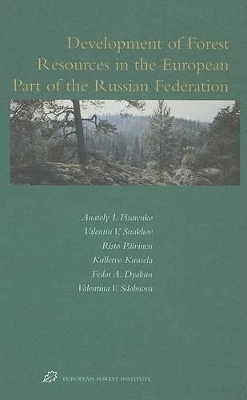
Development of Forest Resources in the European Part of the Russian Federation
Brill (Verlag)
978-90-04-11979-6 (ISBN)
- Titel ist leider vergriffen;
keine Neuauflage - Artikel merken
According to the FAO's State of the world's forests 1999, the total forest area in Russia is 764 million hectares. In the international statistics the forest resource of Russia is treated as one unit. One quarter of this vast forest area, approximately as much forest as all the other European countries together, is in the European part of Russia, west of the Ural mountains. This report will complete the picture of European Forests given in the EFI Research Report No 1 by Kullervo Kuusela in 1994.
The first aim of this study is to describe the distribution and development of forest resources in the European part of Russia. Due to the availability of basic information, this study concentrates on lands under the authority of the Federal Forest Service of Russia, which cover more than 80% of the forest area. The emphasis is on wood resources, non-wood goods and benefits have not been discussed in detail.
Secondly, the study is an effort towards better comparability between forest statistics in Russia and other European countries. The traditions of Russian forestry and forest inventory concepts differ from the other European countries, which, in the past, have caused misinterpretations in the comparison of the statistics between the countries.
The third aim has been to 'cross check' the consistency of available information by analysing the dynamics of the forest resources from 1966 to 1993.
It is hoped that this study is able to fill in some voids in the information about Russian forest resources and that forest researchers, students, forestry experts, policy makers and the public will be able to see more clearly the historical development and future potentials of Russian forestry.
It must be kept in mind that forestry is not only wood production, it deals with nature conservation, protective and recreational functions of forests, and other non-wood benefits and services which, in some forests, play the main role. However, due to the availability of quantitative data, high potential for creating income, and its indirect effects on other types of forest utilisation, analysis of wood production is one of the basic elements in describing the potentials for utilising forest resources as a whole.
Anatoly I. Pisarenko, Professor, President of the Russian Association of Foresters; Full Member of the Russian Academy of Agricultural Sciences, Russia. Valentin V. Strakhov, Doctor of Science, Director All-Russian Research and Information Centre for Forest Resources (ARICFR), Moscow, Russia. Risto Päivinen, Professor, Director of the European Forest Institute, Joensuu, Finland. Kullervo Kuusela, emeritus Professor, Finland. Fedor A. Dyakun, Doctor of Science, Head Division of Forest Resources’ Account and Assessment, All-Russian Research and Information Centre for Forest Resources (ARICFR), Moscow, Russia. Valentina V. Sdobnova, Ph.D., Head Section of Forest Resources’ Account, All-Russian Research and Information Centre for Forest Resources (ARICFR), Moscow, Russia.
Foreword vii
Executive summary ix
Abbreviations xi
Terms and definitions xiii
Chapter 1. Introduction 1
1.1. A history of forestry 1
1.2. Forest vegetation zones 4
1.2.1. General overview 4
1.2.2. Vegetation zones 5
1.3. State Forest Account 8
1.4. Forest fund 9
1.5. Forest management groups I, II and III 12
Chapter 2. Forest area, main tree species and growing stock volume in the EUPR in 1966-1998 15
2. I. Forest area 15
2.2. Tree species composition in the EUPR 18
2.2.1. Regional distribution of the stands by principal tree species 20
2.2.2. Regional distribution of the coniferous and broad-leaved stands 25
2.3. Growing stock volume 28
2.4. Development-stage structure and growing stock volume 31
Chapter 3. Increment of the growing stock volume 35
3.1. Concepts 35
3.1.1. The mean annual increment and the total annual increment 35
3.1.2. The gross annual increment and the net annual increment 36
3.1.3. The difference between increment concepts 37
3.2. Derivation of gross and net annual increments 37
Chapter 4. Utilisation of the wood resources 43
4.1. Harvesting in Russia and EUPR 43
4.2. The dynamics of removals in EUPR in 1966--1993 44
Chapter 5. Forest balance 49
5.1. Attributes and equations 49
5.2. Analysis of forest balance 50
5.3. Comparison between the European part of Russia and Europe 54
Chapter 6. Observations and conclusions 57
6.1. State of the forest resources in the European Part of the Russian Federation 57
6.2. Biological potentials for sustainable use of wood in the EUPR 58
6.3. Reliability of the data presented 59
6.4. Development needs for the State Forest Account 60
6.5. Sustainability of wood resources 60
References 63
Appendices 65
| Erscheint lt. Verlag | 7.12.2000 |
|---|---|
| Reihe/Serie | European Forest Institute Research Reports ; 11 |
| Verlagsort | Leiden |
| Sprache | englisch |
| Gewicht | 379 g |
| Themenwelt | Weitere Fachgebiete ► Land- / Forstwirtschaft / Fischerei |
| ISBN-10 | 90-04-11979-5 / 9004119795 |
| ISBN-13 | 978-90-04-11979-6 / 9789004119796 |
| Zustand | Neuware |
| Informationen gemäß Produktsicherheitsverordnung (GPSR) | |
| Haben Sie eine Frage zum Produkt? |
aus dem Bereich