


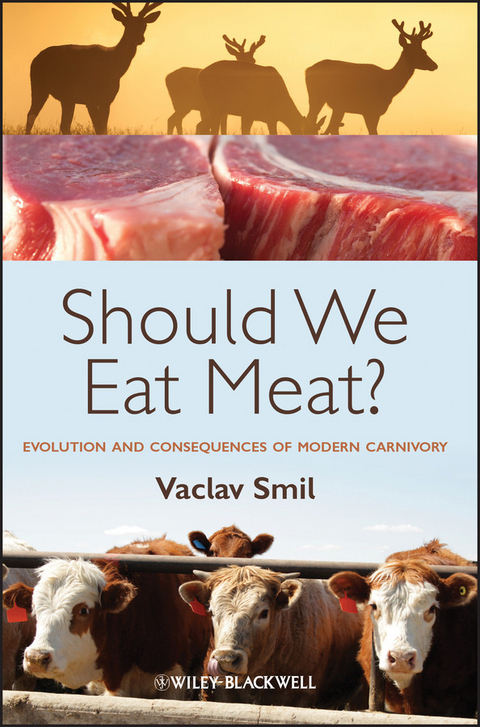
Should We Eat Meat? (eBook)
John Wiley & Sons (Verlag)
978-1-118-27869-7 (ISBN)
Meat eating is often a contentious subject, whether considering the technical, ethical, environmental, political, or health-related aspects of production and consumption.
This book is a wide-ranging and interdisciplinary examination and critique of meat consumption by humans, throughout their evolution and around the world. Setting the scene with a chapter on meat’s role in human evolution and its growing influence during the development of agricultural practices, the book goes on to examine modern production systems, their efficiencies, outputs, and impacts. The major global trends of meat consumption are described in order to find out what part its consumption plays in changing modern diets in countries around the world. The heart of the book addresses the consequences of the “massive carnivory” of western diets, looking at the inefficiencies of production and at the huge impacts on land, water, and the atmosphere. Health impacts are also covered, both positive and negative. In conclusion, the author looks forward at his vision of “rational meat eating”, where environmental and health impacts are reduced, animals are treated more humanely, and alternative sources of protein make a higher contribution.
Should We Eat Meat ? is not an ideological tract for or against carnivorousness but rather a careful evaluation of meat’s roles in human diets and the environmental and health consequences of its production and consumption. It will be of interest to a wide readership including professionals and academics in food and agricultural production, human health and nutrition, environmental science, and regulatory and policy making bodies around the world.
Dr Vaclav Smil is Distinguished Professor Emeritus in the Faculty of Environment at the University of Manitoba. His interdisciplinary research interests encompass a broad area of energy, environmental, food, population, economic, historical, and public policy studies. Dr Smil has published in more than 30 books, over 400 papers, and contributed to more than 30 edited volumes
Meat eating is often a contentious subject, whether considering the technical, ethical, environmental, political, or health-related aspects of production and consumption. This book is a wide-ranging and interdisciplinary examination and critique of meat consumption by humans, throughout their evolution and around the world. Setting the scene with a chapter on meat s role in human evolution and its growing influence during the development of agricultural practices, the book goes on to examine modern production systems, their efficiencies, outputs, and impacts. The major global trends of meat consumption are described in order to find out what part its consumption plays in changing modern diets in countries around the world. The heart of the book addresses the consequences of the "e;massive carnivory"e; of western diets, looking at the inefficiencies of production and at the huge impacts on land, water, and the atmosphere. Health impacts are also covered, both positive and negative. In conclusion, the author looks forward at his vision of rational meat eating , where environmental and health impacts are reduced, animals are treated more humanely, and alternative sources of protein make a higher contribution. Should We Eat Meat? is not an ideological tract for or against carnivorousness but rather a careful evaluation of meat's roles in human diets and the environmental and health consequences of its production and consumption. It will be of interest to a wide readership including professionals and academics in food and agricultural production, human health and nutrition, environmental science, and regulatory and policy making bodies around the world.
Dr Vaclav Smil is Distinguished Professor Emeritus in the Faculty of Environment at the University of Manitoba. His interdisciplinary research interests encompass a broad area of energy, environmental, food, population, economic, historical, and public policy studies. Dr. Smil has published in more than 30 books, over 400 papers, and contributed to more than 30 edited volumes.
Preface ix
1 Meat in Nutrition 3
Meat Eating and Health: Benefits and Concerns 4
Meat and its nutrients 6
Meat as a source of food energy 11
High-quality protein and human growth 17
Carnivory and civilizational diseases 20
Diseased meat 24
2 Meat in Human Evolution 31
Hunting Wild Animals: Meat in Human Evolution 33
Primates and hominins 35
Meat consumption during the Paleolithic period 39
Extinction of the late Pleistocene megafauna 42
Hunting in different ecosystems 45
Wild meat in sedentary societies 49
Traditional Societies: Animals, Diets and Limits 51
Domestication of animals 53
Population densities and environmental imperatives 56
Long stagnation of typical meat intakes 59
Avoidances, taboos and proscriptions 63
Meat as a prestige food 66
3 Meat in Modern Societies 71
Dietary Transitions: Modernization of Tastes 72
Urbanization and industrialization 74
Long-distance meat trade 77
Meat in the Western dietary transition 81
Transitions in modernizing economies 84
Globalization of tastes 86
Output and Consumption: Modern Meat Chain 89
Changing life cycles 91
Slaughtering of animals 94
Processing meat 98
Consuming and wasting meat 102
Making sense of meat statistics 107
4 What It Takes to Produce Meat 113
Modern Meat Production: Practices and Trends 117
Meat from pastures and mixed farming 118
Confined animal feeding 122
Animal feedstuffs 127
Productivity efficiencies and changes 135
Treatment of animals 141
Meat: An Environmentally Expensive Food 145
Animal densities and aggregate zoomass 147
Changing animal landscapes 150
Intensive production of feedstuffs 155
Water use and water pollution 160
Meat and the atmosphere 168
5 Possible Futures 177
Toward Rational Meat Eating: Alternatives and Adjustments 181
Meatless diets 183
Meat substitutes and cultured meat 188
Protein from other animal foodstuffs 192
Less meaty diets 200
A large potential for rational meat production 203
Prospects for Change 210
References 217
Index 251
Vaclav Smil receives 2015 OPEC Award for Research
"Summing Up: Recommended. Upper-division undergraduates and above." (Choice, 1 January 2014)
Pieter Brueghel the Elder filled his rich kitchen with obese diners devouring suckling pigs, hams and sausages. Detail of the engraving produced by Hans Liefrinck in 1563.
Preface
Carnivory of modern Western societies is constantly on display. Supermarkets have meat counters that are sometimes tens of meters long, full of scores of different cuts (or entire eviscerated carcasses) of at least half a dozen mammalian and avian species (cattle, pig, sheep, chicken, turkey, duck). Some of them, and many specialty shops, also carry bison, goat and ostrich meat, as well as pheasants, rabbit and venison. Then there are extensive delicatessen sections with an enormous variety of processed meat products. Fast-food outlets – dominated by ubiquitous burger chains – were built on meat, and despite their recent diversification into seafood and vegetarian offerings, they remain based on beef and chicken. Consumption statistics confirm this all too obvious extent of carnivory, with annual per capita supply of meat at retail level (including bones and trimmable fat) surpassing typical adult body weights (65–80 kg) not only in the US and Canada and in the richer northern EU nations but now also in Spain. In fact, Spanish per capita meat supply has been recently the Europe’s highest.
What all but a few typical (i.e., urban) carnivores do not realize is the extent to which the modern Western agriculture turns around (a better way to express this would be to say: is subservient to) animals: both in terms of the total cultivated area and overall crop output, it produces mostly animal feed (dominated by corn and soybeans) rather than food for direct human consumption (staple grains dominated by wheat, tubers, oilseeds, vegetables). But, if they are so inclined, modern Western urbanites can find plenty of information about the obverse of their carnivory, about poor treatment of animals, about environmental degradation and pollution attributable to meat production, and about possible health impacts. Vegetarianism has been an increasingly common (but in absolute terms it is still very restricted) choice among the Western populations, and vegetarian publications and websites have been a leading source of information on the negatives of carnivory. Vegans in particular enumerate the assorted sins of meat eating in an often strident manner on many Internet sites. These contrasting attitudes have been reflected in the published record.
On one hand, there are hundreds of meat cookbooks – unabashed and colorfully illustrated celebrations of meat eating ranging from several “bibles” that are devoted to meat in general (Lobel et al. 2009; Clark and Spaull 2010) and to meatballs and ribs in particular (Brown 2009; Raichlen 2012) or to Grilling Gone Wild (Couch 2012) – all promising the best-ever, classic, succulent, complete meat repasts. The middle ground of meaty examinations is occupied by what I would call mission books of many gradations, the mildest ones imploring their readers to eat less meat (Boyle 2012) or arguing the benefits of becoming a flexitarian, that is, only an occasional meat eater (Berley and Singer 2007). The more ambitious ones are trying to convert meat eaters into vegetarians, even vegans, in ways ranging from straightforward (de Rossi et al. 2012) to enticing (O’Donnel 2010). And the same contrasts and arguments have been replayed in yet another genre of books that examine meat’s roles in national and global history (Rimas and Fraser 2008; Ogle 2011).
Finally, there is a venerable tradition of books as instruments of indictment. This genre began in 1906 with Upton Sinclair’s novel uncovering the grim realities of Chicago’s stockyards and meatpacking (Sinclair 1906). A reader entirely unfamiliar with the revolting nature of Sinclair’s descriptions will find an extended quote in a section about meat processing. More than a century later, critics of anything associated with meat include such disparate groups as activists agitating for animal rights, environmental scientists worried about cattle taking over the planet and nutritionists convinced (not quite in accord with the complete evidence) that eating meat undermines health and hastens the arrival of death.
Some of these writings portray modern meat industry in truly gruesome terms, and many have unsubtle titles or subtitles that make it clear that meat production and animal slaughtering are components of a despicable, if not outright criminal, enterprise and that meat eating is a reprehensible habit, a deplorable ride that must end: meat is madness (Britton 1999); meat animals are devouring a hungry planet (Tansey and D’Silva 1999); meat production is a matter of crimes unseen (Jones 2004); and eating meat is our society’s greatest addiction (Ford 2012). Others, including books by Schlosser (2001) and Pollan (2006), are more measured in their condemnation. But in terms of extreme positions and incendiary language, few texts can beat The Sexual Politics of Meat by Carol Adams first published in 1990: the book’s subtitle claims to offer a feminist-vegetarian critical theory; it abounds in such deliberately provocative phrases as “the rape of animals” and “the butchering of women.”
And this is how it ends: “Eat Rice Have Faith in Women. Our dietary choices reflect and reinforce our cosmology, our politics. It is as though we could say, ‘Eating rice is faith in women.’ On this grace may we all feed” (Adams 2010, 202). Of course, the nation where rice had a more prominent place in social identity, self-perception and culture than anywhere else – and where the plant has been a cherished symbol of wealth, power and beauty (Ohnuki-Tierney 1993) – would be left entirely unmoved by that argument: average per capita consumption of rice in Japan is now, in mass terms, lower than the intake of dairy products (less than 65 vs. more than 80 kg/year), and the country’s accurate food balance sheets show the per capita supply of meat and seafood at nearly 100 kg/year, or 50% higher than rice (Smil and Kobayashi 2012). And Japan has been a model followed by other traditionally rice-eating Asian nations whose rice consumption appears to fall by about a third with every doubling of income (Smil 2005a).
What are we to make of these contending and contradictory conclusions? Should we eat meat – or should we try to minimize its consumption and aim at its eventual eliminations from human diets? My answers will be based on long-term perspectives and on complex and multidisciplinary considerations: my appraisals of the evolution of meat eating, historical changes and modern modalities of this practice and its benefits as well as its undesirable consequences are based on findings from disciplines ranging from archaeology to animal science and from evolutionary biology to environmental and economic studies. This is a book rooted in facts and realities, not in predetermined posturing and sermonizing, a book that looks at benefits of meat eating as well as at the failures and drawbacks, and that does not aspire to fit into any pre-cast categories, pro or contra, positively programmatic or aggressively negative. I do not approach the reality of modern large-scale carnivory with any pre-conceived notions, and I did not write this book in order to advocate any particular practice or point of view but merely in order to follow the best evidence to its logical conclusions. At its end, a reader will know quite clearly where I stand – but I thought that at its beginning it might be interesting to explain where I come from, that is, to make my full meat-eating disclosure.
As a child, adolescent and a young man I ate a wide variety of meat, but never in large individual portions or in large cumulative quantities: realities of post-WW II Europe (in some countries food rationing was in place until 1954), my mother’s cooking and my food preferences (I have always disliked large and thick pieces of meat and all fatty cuts) explain that. But this moderation went along with a great variety, and before I left Europe for North America at the age of 25, I had eaten pork, beef, veal, mutton, lamb, goat, horse, rabbit, chicken, duck, pigeon, goose, turkey and pearl hen, and as a boy the meat I loved best came from the animals my father shot during the hunting season, pheasants, wild hares and, above all, deer.
Also as a child I attended with my parents a number of village winter pig killings at the houses of my father’s acquaintances. In many traditional European societies, these used to be (and in some places still remain) festive social and culinary events: Schlachtfest in Germany, maialata in Italy, matanza in Spain and zabíjačka in Bohemia. They are crowned by eating a remarkable variety of foodstuffs prepared expertly from the killed animal – including blood soup, blood sausages, white sausages and headcheese – and the attendants then take home assorted lean and fat cuts to be roasted or boiled or processed into lard. Other meat-related memories of my childhood include: my grandmother force-feeding geese (a practice I disliked); my father placing fragrant evergreen boughs into the cavity of deer carcass before hanging it to age in cold air (so learning as a child that fresh meat is not really fresh); my mother cooking beef rouladen stuffed with carrots, onions, boiled eggs and gherkins (yielding a colorful combination of fillings that is beautifully revealed on cooked cross-cut).
And as in any traditional society,...
| Erscheint lt. Verlag | 18.3.2013 |
|---|---|
| Sprache | englisch |
| Themenwelt | Sozialwissenschaften |
| Technik ► Lebensmitteltechnologie | |
| Weitere Fachgebiete ► Land- / Forstwirtschaft / Fischerei | |
| Schlagworte | Aspects • Bauingenieur- u. Bauwesen • Book • Civil Engineering & Construction • contentious subject • critique • Development • Environmental impact • Ernährung • Ernährung • Evolution • Examination • examine modern • Fleisch • Fleisch, Fisch, Geflügel • Fleisch, Fisch, Geflügel • Food Science & Technology • Human • humans • Influence • Lebensmittelforschung u. -technologie • meat • meat consumption • Meat, Fish & Poultry • meats • Nutrition • Production • Role • Scene • Systems • technical • Umweltbelastung • wideranging • World |
| ISBN-10 | 1-118-27869-0 / 1118278690 |
| ISBN-13 | 978-1-118-27869-7 / 9781118278697 |
| Informationen gemäß Produktsicherheitsverordnung (GPSR) | |
| Haben Sie eine Frage zum Produkt? |
 EPUB (Adobe DRM)
Kopierschutz: Adobe-DRM
Adobe-DRM ist ein Kopierschutz, der das eBook vor Mißbrauch schützen soll. Dabei wird das eBook bereits beim Download auf Ihre persönliche Adobe-ID autorisiert. Lesen können Sie das eBook dann nur auf den Geräten, welche ebenfalls auf Ihre Adobe-ID registriert sind.
Details zum Adobe-DRM
Dateiformat: EPUB (Electronic Publication)
EPUB ist ein offener Standard für eBooks und eignet sich besonders zur Darstellung von Belletristik und Sachbüchern. Der Fließtext wird dynamisch an die Display- und Schriftgröße angepasst. Auch für mobile Lesegeräte ist EPUB daher gut geeignet.
Systemvoraussetzungen:
PC/Mac: Mit einem PC oder Mac können Sie dieses eBook lesen. Sie benötigen eine
eReader: Dieses eBook kann mit (fast) allen eBook-Readern gelesen werden. Mit dem amazon-Kindle ist es aber nicht kompatibel.
Smartphone/Tablet: Egal ob Apple oder Android, dieses eBook können Sie lesen. Sie benötigen eine
Geräteliste und zusätzliche Hinweise
Buying eBooks from abroad
For tax law reasons we can sell eBooks just within Germany and Switzerland. Regrettably we cannot fulfill eBook-orders from other countries.
aus dem Bereich


