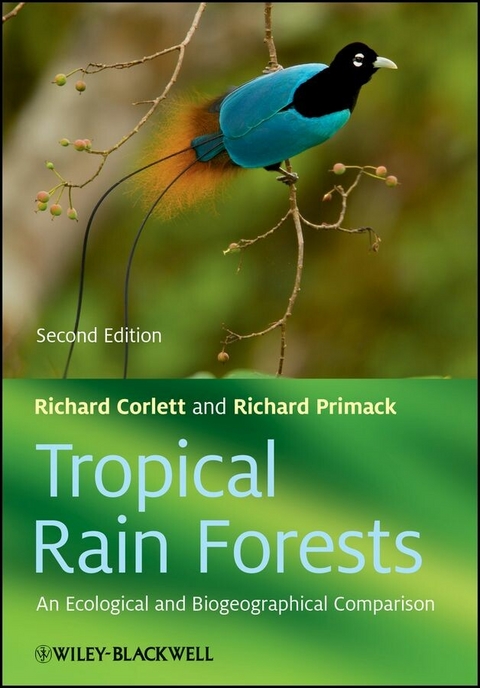
Tropical Rain Forests (eBook)
336 Seiten
John Wiley & Sons (Verlag)
978-1-4443-9228-9 (ISBN)
Biogeographical Comparison exploded the myth of 'the rain
forest' as a single, uniform entity. In reality, the major
tropical rain forest regions, in tropical America, Africa,
Southeast Asia, Madagascar, and New Guinea, have as many
differences as similarities, as a result of their isolation from
each other during the evolution of their floras and faunas. This
new edition reinforces this message with new examples from recent
and on-going research.
After an introduction to the environments and geological
histories of the major rain forest regions, subsequent chapters
focus on plants, primates, carnivores and plant-eaters, birds,
fruit bats and gliding animals, and insects, with an emphasis on
the ecological and biogeographical differences between regions.
This is followed by a new chapter on the unique tropical rain
forests of oceanic islands. The final chapter, which has been
completely rewritten, deals with the impacts of people on tropical
rain forests and discusses possible conservation strategies that
take into account the differences highlighted in the previous
chapters. This exciting and very readable book, illustrated
throughout with color photographs, will be invaluable reading for
undergraduate students in a wide range of courses as well as an
authoritative reference for graduate and professional ecologists,
conservationists, and interested amateurs.
Richard Corlett, a Professor at the National University of Singapore, has studied tropical rain forests in New Guinea, Southeast Asia, and southern China. His major current research interest is in how rain forest plants and animals survive in human-dominated landscapes. He has previously taught ecology at the University of Chiang Mai, in Thailand, and the University of Hong Kong, in China, and is author or co-author of several books on the ecology of the Asian tropics. Richard B. Primack, a Professor at Boston University, is the author of two leading textbooks in conservation biology and is the Editor in Chief of the journal, Biological Conservation. He has carried out research in Central America, Malaysia, and Australia, and is currently studying the impact of climate change on plant and animal communities. He is a former President of the Association for Tropical Biology and Conservation.
Preface to the first edition.
Preface to the second edition.
Acknowledgments.
1 Many Tropical Rain Forests.
What are tropical rain forests?
Where are the tropical rain forests?
Rain forest environments.
Rain forest histories.
Origins of the similarities and differences among rain
forests.
Many rain forests.
Conclusions.
2 Plants: Building Blocks of the Rain Forest.
Plant distributions.
Rain forest structure.
How many plant species?
Widespread plant families.
Neotropical rain forests.
Asian rain forests.
Rain forests in New Guinea and Australia.
African rain forests.
Madagascan rain forests.
Conclusions and future research directions.
3 Primate Communities: A Key to Understanding Biogeography
and Ecology.
What are primates?
Old World versus New World primates.
Primate diets.
Primate communities.
Primates as seed dispersal agents.
Conclusions and future research directions.
4 Carnivores and Plant-eaters.
Carnivores.
Herbivores of the forest floor.
Conclusions and future research directions.
5 Birds: Linkages in the Rain Forest Community.
Biogeography.
Little, brown, insect-eating birds.
Forest frugivores.
Fruit size and body size.
Flower visitors.
Ground-dwellers.
Woodpeckers.
Birds of prey.
Scavengers.
Night birds.
Migration.
Comparison of bird communities across continents.
Conclusions and future research directions.
6 Fruit Bats and Gliding Animals in the Forest
Canopy.
Fruit- and nectar-feeding bats.
Flying behavior.
Foraging behavior.
Bats as pollinators and seed dispersal agents.
Gliding vertebrates.
Conclusions and future research directions.
7 Insects: Diverse, Abundant, and Ecologically
Important.
Butterflies.
Ants.
Termites.
Bees.
Conclusions and future research directions.
8 Island Rain Forests.
Pacific islands.
Evolution on islands.
Indian Ocean islands.
Atlantic islands.
Caribbean islands.
Natural disasters.
Human impacts.
Conclusions and future research directions.
9 The Future of Tropical Rain Forests.
Different forests, different threats.
The major threats.
The forces behind the threats.
Global climate change.
Saving the many rain forests.
Conclusions and future research directions.
References.
Index.
"This well-written, superbly illustrated, book should be
compulsory reading for politicians and international bureaucrats,
because, however good the ecological science conducted in
rainforest, it will be a matter of preaching to the converted if it
remains in scientific journals and does not reach the broader
public." (Austral Ecology, 11 July 2013)
"Recommended. Lower-division undergraduates
through graduate student; general readers." (Choice, 1
May 2012)
"In summary: this is a fascinating book. I enjoyed it, I learned
from it and I recommend it. It will be of value to academics,
researchers and students, and, due to its accessible style and
illustrations, it will appeal to many others too. Columbus would
have found it helpful-but over half a millennium later so might
many of us." (Frontiers of biogeography, 3 January 2011)
| Erscheint lt. Verlag | 4.3.2011 |
|---|---|
| Sprache | englisch |
| Themenwelt | Naturwissenschaften ► Biologie ► Ökologie / Naturschutz |
| Naturwissenschaften ► Geowissenschaften ► Geografie / Kartografie | |
| Technik | |
| Weitere Fachgebiete ► Land- / Forstwirtschaft / Fischerei | |
| Schlagworte | Ãkologie • Ãkologie / Tropen • Biowissenschaften • Life Sciences • Ökologie • Ökologie / Tropen • Regenwald • Tropenwald • Tropical Ecology |
| ISBN-10 | 1-4443-9228-X / 144439228X |
| ISBN-13 | 978-1-4443-9228-9 / 9781444392289 |
| Informationen gemäß Produktsicherheitsverordnung (GPSR) | |
| Haben Sie eine Frage zum Produkt? |
 EPUB (Adobe DRM)
Kopierschutz: Adobe-DRM
Adobe-DRM ist ein Kopierschutz, der das eBook vor Mißbrauch schützen soll. Dabei wird das eBook bereits beim Download auf Ihre persönliche Adobe-ID autorisiert. Lesen können Sie das eBook dann nur auf den Geräten, welche ebenfalls auf Ihre Adobe-ID registriert sind.
Details zum Adobe-DRM
Dateiformat: EPUB (Electronic Publication)
EPUB ist ein offener Standard für eBooks und eignet sich besonders zur Darstellung von Belletristik und Sachbüchern. Der Fließtext wird dynamisch an die Display- und Schriftgröße angepasst. Auch für mobile Lesegeräte ist EPUB daher gut geeignet.
Systemvoraussetzungen:
PC/Mac: Mit einem PC oder Mac können Sie dieses eBook lesen. Sie benötigen eine
eReader: Dieses eBook kann mit (fast) allen eBook-Readern gelesen werden. Mit dem amazon-Kindle ist es aber nicht kompatibel.
Smartphone/Tablet: Egal ob Apple oder Android, dieses eBook können Sie lesen. Sie benötigen eine
Geräteliste und zusätzliche Hinweise
Buying eBooks from abroad
For tax law reasons we can sell eBooks just within Germany and Switzerland. Regrettably we cannot fulfill eBook-orders from other countries.
aus dem Bereich