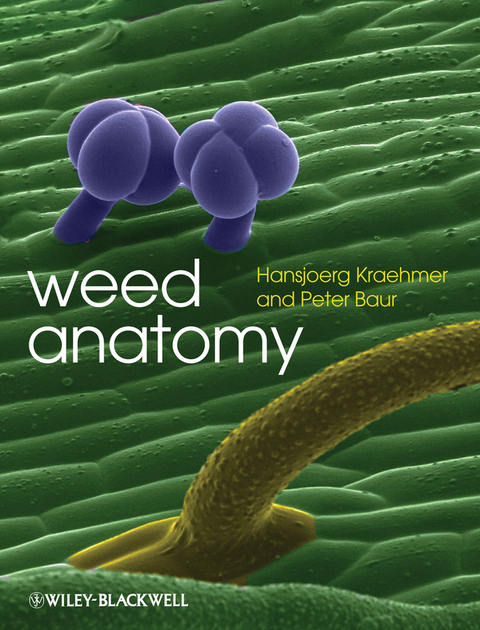
Weeds affect everyone in the world by reducing crop yield and crop quality, delaying or interfering with harvesting, interfering with animal feeding (including poisoning), reducing animal health, preventing water flow, as plant parasites, etc. Weeds are common everywhere and cause many $ billions worth of crop losses annually, with the global cost of controlling weeds running into $ billions.
The anatomy of plants is generally well understood, but the examples used for explanations in most books are often restricted to non-weed species. Weeds have many features that make them more competitive, for example enabling them to more quickly recover after herbicide treatment. Some of these adaptations include rhizomes, adapted roots, tubers and other special structures. Until now,
no single book has concentrated on weeds' anatomical features. A comprehensive understanding of these features is, however, often imperative to the successful implementation of many weed control measures.
Beautifully and comprehensively illustrated, in full colour throughout, Weed Anatomy provides a comprehensive insight into the anatomy of the globally-important weeds of commercial significance. Commencing with a general overview of anatomy, the major part of the book then includes sections covering monocotyledons, dicotyledons, brackens and horsetails, with special reference to their anatomy. Ecological and evolutionary aspects of weeds are also covered and a number of less common weeds such as Adonis vernalis, Caucalis platycarpos and Scandix pecten-veneris are also included.
The authors of this book, who have between them many years of experience studying weeds, have put together a true landmark publication, providing a huge wealth of commercially-important information. Weed scientists, plant anatomists and agricultural scientists, including personnel within the agrochemical and crop protection industry, will find a great deal of useful information within
the book's covers. All libraries in universities and research establishments where agricultural and biological sciences are studied and taught should have copies of this exceptional book on their shelves.
Hansjoerg Kraehmer is Past President of the European Weed Research Society and is based at Bayer CropScience, Frankfurt, Germany.
Peter Baur heads the Competence Center Crop Protection, Clariant, Frankfurt, Germany. He is external Professor at the Faculty of Natural Sciences, Leibniz University of Hannover, Germany, and Past President of the International Society for Agrochemical Adjuvants.
Weeds affect everyone in the world by reducing crop yield and crop quality, delaying or interfering with harvesting, interfering with animal feeding (including poisoning), reducing animal health, preventing water flow, as plant parasites, etc. Weeds are common everywhere and cause many $ billions worth of crop losses annually, with the global cost of controlling weeds running into $ billions. The anatomy of plants is generally well understood, but the examples used for explanations in most books are often restricted to non-weed species. Weeds have many features that make them more competitive, for example enabling them to more quickly recover after herbicide treatment. Some of these adaptations include rhizomes, adapted roots, tubers and other special structures. Until now, no single book has concentrated on weeds anatomical features. A comprehensive understanding of these features is, however, often imperative to the successful implementation of many weed control measures. Beautifully and comprehensively illustrated, in full colour throughout, Weed Anatomy provides a comprehensive insight into the anatomy of the globally-important weeds of commercial significance. Commencing with a general overview of anatomy, the major part of the book then includes sections covering monocotyledons, dicotyledons, brackens and horsetails, with special reference to their anatomy. Ecological and evolutionary aspects of weeds are also covered and a number of less common weeds such as Adonis vernalis, Caucalis platycarpos and Scandix pecten-veneris are also included. The authors of this book, who have between them many years of experience studying weeds, have put together a true landmark publication, providing a huge wealth of commercially-important information. Weed scientists, plant anatomists and agricultural scientists, including personnel within the agrochemical and crop protection industry, will find a great deal of useful information within the book s covers. All libraries in universities and research establishments where agricultural and biological sciences are studied and taught should have copies of this exceptional book on their shelves.
Hansjoerg Kraehmer is Past President of the European Weed Research Society and is based at Bayer CropScience, Frankfurt, Germany. Peter Baur heads the Competence Center Crop Protection, Clariant, Frankfurt, Germany. He is external Professor at the Faculty of Natural Sciences, Leibniz University of Hannover, Germany, and Past President of the International Society for Agrochemical Adjuvants.
"The authors are to be com-pli-men-ted on a most worthy endeav-our and an assuredly worth-while enter-prise (allay-ing the authors' con-cerns on p. 4...): Thank you!." (Aob Blog, 24 September 2015)
"Despite its limitations, the book could complement more basic and fundamental treatises on plant anatomy. Summing Up: Recommended. With reservations. Only comprehensive botany collections, lower-division undergraduates through researchers/faculty." (Choice, 1 December 2013)
| Erscheint lt. Verlag | 4.2.2013 |
|---|---|
| Sprache | englisch |
| Themenwelt | Naturwissenschaften ► Biologie ► Botanik |
| Technik | |
| Weitere Fachgebiete ► Land- / Forstwirtschaft / Fischerei | |
| Schlagworte | affect everyone • Agriculture • anatomy • animal • billions • Biowissenschaften • books • Botanik • Botanik / Physiologie • Common • Controlling • Cost • Crop • crop losses • everywhere • Examples • explanations • generally • Global • interfering • Landwirtschaft • Life Sciences • many • Pests, Diseases & Weeds • Pflanzenanatomie • Plant Physiology • plants • restricted • Schädlinge, Krankheiten u. Unkräuter • Schädlinge, Krankheiten u. Unkräuter • species • Unkraut • weeds • World • Worth |
| ISBN-10 | 1-118-50343-0 / 1118503430 |
| ISBN-13 | 978-1-118-50343-0 / 9781118503430 |
| Informationen gemäß Produktsicherheitsverordnung (GPSR) | |
| Haben Sie eine Frage zum Produkt? |
 PDF (Adobe DRM)
Kopierschutz: Adobe-DRM
Adobe-DRM ist ein Kopierschutz, der das eBook vor Mißbrauch schützen soll. Dabei wird das eBook bereits beim Download auf Ihre persönliche Adobe-ID autorisiert. Lesen können Sie das eBook dann nur auf den Geräten, welche ebenfalls auf Ihre Adobe-ID registriert sind.
Details zum Adobe-DRM
Dateiformat: PDF (Portable Document Format)
Mit einem festen Seitenlayout eignet sich die PDF besonders für Fachbücher mit Spalten, Tabellen und Abbildungen. Eine PDF kann auf fast allen Geräten angezeigt werden, ist aber für kleine Displays (Smartphone, eReader) nur eingeschränkt geeignet.
Systemvoraussetzungen:
PC/Mac: Mit einem PC oder Mac können Sie dieses eBook lesen. Sie benötigen eine
eReader: Dieses eBook kann mit (fast) allen eBook-Readern gelesen werden. Mit dem amazon-Kindle ist es aber nicht kompatibel.
Smartphone/Tablet: Egal ob Apple oder Android, dieses eBook können Sie lesen. Sie benötigen eine
Geräteliste und zusätzliche Hinweise
Buying eBooks from abroad
For tax law reasons we can sell eBooks just within Germany and Switzerland. Regrettably we cannot fulfill eBook-orders from other countries.
aus dem Bereich