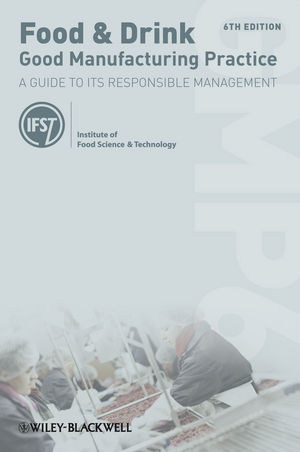
Food and Drink - Good Manufacturing Practice (eBook)
John Wiley & Sons (Verlag)
978-1-118-31823-2 (ISBN)
Good Manufacturing Practice (GMP) refers to advice and guidance put in place to outline the aspects of production and testing that can impact the quality and safety of a product. In the case of food and drink, GMP is aimed at ensuring that products are safe for the consumer and are consistently manufactured to a quality appropriate to their intended use. Manufacturers have for several years been driving towards such goals as Total Quality Management (TQM), lean manufacturing and sustainability - GMP is bound up with these issues. The ever-increasing interest amongst consumers, retailers and enforcement authorities in the conditions and practices in food manufacture and distribution, increases the need for the food manufacturer to operate within clearly defined policies such as those laid down in GMP. The ability to demonstrate that Good Manufacturing Practice has been fully and effectively implemented could, in the event of a consumer complaint or a legal action, reduce the manufacturer's liability and protect them from prosecution.
First launched in 1986, IFST's Good Manufacturing Practice Guide has been widely recognized as an indispensable reference work for food scientists and technologists. It sets out to ensure that food manufacturing processes deliver products that are uniform in quality, free from defects and contamination, and as safe as it is humanly possible to make them. This 6th edition has been completely revised and updated to include all the latest standards and guidance, especially with regard to legislation-driven areas such as HACCP.
The Guide is a must have for anyone in a managerial or technical capacity concerned with the manufacture, storage and distribution of food and drink. It is also a valuable reference for food education, training and for those involved in food safety and enforcement. Food scientists in academic and industry environments will value its precision, and policy makers and regulatory organizations will find it an indispensable guide to an important and multifaceted area.
About IFST
IFST is the leading independent qualifying body for food professionals in Europe and the only professional body in the UK concerned with all aspects of food science and technology. IFST members are drawn from all over the world and from all ages and backgrounds, including industry (manufacturing, retailing and food service), universities and schools, government, research and development, quality assurance and food law enforcement. IFST qualifications are internationally recognised as a sign of proficiency and integrity.
IFST is the leading independent qualifying body for food professionals in Europe and the only professional body in the UK concerned with all aspects of food science and technology. IFST members are drawn from all over the world and from all ages and backgrounds, including industry (manufacturing, retailing and food service), universities and schools, government, research and development, quality assurance and food law enforcement. IFST qualifications are internationally recognised as a sign of proficiency and integrity.
Good Manufacturing Practice (GMP) refers to advice and guidance put in place to outline the aspects of production and testing that can impact the quality and safety of a product. In the case of food and drink, GMP is aimed at ensuring that products are safe for the consumer and are consistently manufactured to a quality appropriate to their intended use. Manufacturers have for several years been driving towards such goals as Total Quality Management (TQM), lean manufacturing and sustainability GMP is bound up with these issues. The ever-increasing interest amongst consumers, retailers and enforcement authorities in the conditions and practices in food manufacture and distribution, increases the need for the food manufacturer to operate within clearly defined policies such as those laid down in GMP. The ability to demonstrate that Good Manufacturing Practice has been fully and effectively implemented could, in the event of a consumer complaint or a legal action, reduce the manufacturer s liability and protect them from prosecution. First launched in 1986, IFST s Good Manufacturing Practice Guide has been widely recognized as an indispensable reference work for food scientists and technologists. It sets out to ensure that food manufacturing processes deliver products that are uniform in quality, free from defects and contamination, and as safe as it is humanly possible to make them. This 6th edition has been completely revised and updated to include all the latest standards and guidance, especially with regard to legislation-driven areas such as HACCP. The Guide is a must have for anyone in a managerial or technical capacity concerned with the manufacture, storage and distribution of food and drink. It is also a valuable reference for food education, training and for those involved in food safety and enforcement. Food scientists in academic and industry environments will value its precision, and policy makers and regulatory organizations will find it an indispensable guide to an important and multifaceted area. About IFST IFST is the leading independent qualifying body for food professionals in Europe and the only professional body in the UK concerned with all aspects of food science and technology. IFST members are drawn from all over the world and from all ages and backgrounds, including industry (manufacturing, retailing and food service), universities and schools, government, research and development, quality assurance and food law enforcement. IFST qualifications are internationally recognised as a sign of proficiency and integrity.
IFST is the leading independent qualifying body for food professionals in Europe and the only professional body in the UK concerned with all aspects of food science and technology. IFST members are drawn from all over the world and from all ages and backgrounds, including industry (manufacturing, retailing and food service), universities and schools, government, research and development, quality assurance and food law enforcement. IFST qualifications are internationally recognised as a sign of proficiency and integrity.
Acknowledgements ix
Prefaces ix
Decision Makers' Summary xiii
Part I General Guidance
1 Introduction 1
2 Quality Management System 7
3 Hazard Analysis Critical Control Point (HACCP) 13
4 Food Allergens 23
5 Foreign Body Controls 31
6 Manufacturing Activities 39
7 Management Review and Internal Audit 49
8 Product and Process Development and Validation 53
9 Documentation 57
10 Product Identifi cation and Traceability 65
11 Personnel and Training 69
12 Premises and Equipment 85
13 Water Supply 101
14 Cleaning and Sanitation 105
15 Infestation Control 113
16 Purchasing 119
17 Packaging Materials 125
18 Internal Storage 129
19 Crisis Management, Complaints and Product Recall 133
20 Corrective Action 139
21 Reworking Product 143
22 Waste Management 147
23 Warehousing, Transport and Distribution 149
24 Contract Manufacture 155
25 Calibration 157
26 Product Control, Testing and Inspection 161
27 Labelling 165
28 Electronic Data Processing and Control Systems 169
29 Good Control Laboratory Practice
and Use of Outside Laboratory Services 173
30 Environmental Issues 181
31 Health and Safety Issues 185
Part II Supplementary Guidance on Some Specifi c Production
Categories
32 Heat-Preserved Foods 189
33 Chilled Foods 197
34 Frozen Foods 207
35 Dry Products and Materials 213
36 Compositionally Preserved Foods 217
37 Foods Critically Dependent on Specific Ingredients 219
38 Irradiated Foods 221
39 Novel Foods and Processes 227
40 Foods for Catering and Vending Operations 231
41 The Use of Food Additives and Processing Aids 233
42 Responsibilities of Importers 237
43 Export 239
Part III Mechanisms for Review of This Guide
Appendix I Defi nition of Some Terms Used in This Guide 243
Appendix II Abbreviations Used in the Guide 251
Appendix III Legislation and Guidance 255
Appendix IV Additional References 257
Appendix V List of Organisations and Individuals from Whom Help,
Information or Comment Has Been Received 261
1
INTRODUCTION
1.1
The purpose of this Guide is to outline the responsibilities of managers in relation to the efficient manufacture and control of food and drink products, thereby ensuring that such products are safe, wholesome and of the nature and quality intended. While it addresses manufacture of food and drink for use in the catering and vending industries, it does not deal with catering and retail activities per se. The Guide is therefore particularly concerned with advice to management on:
- matters affecting product safety, including health and hygiene of personnel relating thereto;
- product manufacture in terms of product and process control and handling under hygienic conditions in conformity with product, packaging and labelling specifications; and
- associated matters such as training of personnel, documentation and record keeping, supplier approval, suitability of premises and equipment and site standards, waste avoidance, recovery and reworking of materials, laboratory management, traceability, verification activities, and preventive and corrective action and the management of customer complaints and product recall.
1.2
It is emphasised that the Guide is concerned with advice on principles, and it is recognised that methods other than those described, but which achieve the same ends, may be equally acceptable. Personnel and premises hygiene, because of its importance, is treated as a continuous theme and a subject for consideration throughout the document.
The Guide is in three parts:
1.3
The Guide does not deal directly with such matters as operative safety and welfare, ethical matters, animal welfare or environmental issues including water and energy conservation. It refers to resource management and waste control, engineering, maintenance and transport and distribution only in respect of those aspects that have a bearing on product safety and integrity. In general it does not deal with matters unrelated to scientific, technological and organisational aspects affecting product quality and safety.
1.4
EU Regulation (EC) 853/2004, laying down specific hygiene rules for the hygiene of foodstuffs, requires Approval of any establishment producing foods of animal origin. Any change in production may affect the status of such Approval. This includes (although not exclusively so) changes to product range and to product descriptions, changes in the production process, changes in equipment and in establishment design and layout. In such cases re-approval may be required and FBO’s should contact their Local Food Authority.
The Leading case Allan Rich Seafoods v. Lincoln Magistrates’ Court [2009] EWHC 3391 confirmed that changes in the Food Business Operator (FBO) also require re-approval of such an establishment.
Any change in production may affect the status of Approval under Regulation (EC) 853/2004. This includes (although not exclusively so) changes to product range and to product descriptions, changes in the production process, changes in equipment and in establishment design and layout. In such cases re-approval may be required and FBO’s should contact their Local Food Authority.
1.5
The Guide will also make reference to international standards such as those developed by the Codex Alimentarius Commission. It is then the responsibility of the reader to refer to current legislation itself or review with the support of a competent adviser, and not to rely on an interpretation or an abridged version of the requirements as given in this document.
In addition to mandatory legal requirements, the Guide is concerned with advisable practices some of which may already be contained in published guidelines or codes of practice. The Guide outlines general principles and gives references that the reader is advised to consult in full.
1.6
The initial adoption of the EC Official Control of Foodstuffs Directive and the advent of the UK Food Safety Act 1990 as well as existing provisions of the UK Trade Descriptions Act and the UK Weights and Measures Act gave increasing emphasis to the need for a manufacturer to be able to prove that (s)/he did everything necessary to comply with the law. Thus under the Food Safety Act 1990, and other subsequent legislation such as the General Food Regulations 2004 and the Food Hygiene Regulations 2006, a manufacturer, retailer or importer charged with an offence may enter the legal defence that (s)/he ‘took all reasonable precautions and exercised all due diligence to avoid the commission of the offence by himself or by a person under his control’. In this context, it can be considered that ‘precautions’ are the measures taken and ‘diligence’ is the activities undertaken to ensure their effective application. The wording puts the onus of proof on the defendant, and both must be proved and the use of the word ‘all’ implies that ‘some’ or ‘most’ will not be enough. What constitutes ‘all reasonable precautions and all due diligence’ in a particular instance must relate to the nature of the offence and to other related circumstances. Nevertheless in the case of a safety or a ‘nature, substance or quality’ offence, a manufacturer who can prove that (s)/he has diligently installed and appropriately applied all the relevant measures in the Institute of Food Science & Technology (IFST) Guide to Good Manufacturing Practice (GMP) will stand a very good chance of a successful defence. It must also be pointed out that a manufacturer who does not employ appropriate technically competent personnel to specify the product formulation, factory processes and procedures, to design and control the continuous monitoring of their correct operation and undertake such validation and verification activities cannot be said to have exercised either adequate precautions or adequate diligence and is unlikely to have a successful defence.
1.7
Responsibility for enforcement within the EU varies from country to country. In the UK it is shared between central and local government bodies. While the making of legislation in the UK is the function of central government, the enforcement of food law is primarily (but not solely) the responsibility of more than 400 local authorities (LAs) in the UK, and more specifically environmental health officers (EHOs) and trading standards officers (TSOs).
The responsibilities of all the enforcement authorities in the UK are set out in the Single Integrated National Control Plan for the UK; this demonstrates the complexity of structures of enforcement across the UK, and the paragraphs below are a broad overview for those in food manufacturing and arrangements may be different within your geographical area or industry sector.
The Food Standards Agency (FSA) interaction with enforcement officers is set out in the Framework Agreement on Local Authority Enforcement. This document gives a structure to the Agency’s supervision of LA enforcement work.
The Food Law Code of Practice (FLCP) sets out the way LAs should apply food law, and how they should work with food businesses. Practical guidance is also provided as a further help to enforcement officers.
The EHOs and TSOs have to be authorised by their LAs to enforce the food legislation. Once they achieve certain qualifications, detailed under the FLCP, they are authorised to carry out certain tasks and are provided with powers (under the Food Safety Act 1990) to, for example, enter premises, take samples, gather evidence, issue notices and, under certain circumstances, close premises.
Depending on the structure of the Local Government in the area in England and Wales, food visits may be from TSOs to examine labelling, compositional standards and food contaminants, and EHOs to check on food hygiene; however in Scotland, Northern Ireland and some Welsh and English authorities, EHOs are responsible for all the food legislation with TSOs responsible for weights and measures checks. Visits to manufacturing sites are to ensure compliance with legislation; the frequency of interventions (visits) is assessed according to the risk assessment system detailed in the FLCP, and most manufacturing units can expect a visit at least once a year.
The actual policy and resources allocated to the inspection premises and sampling of product will depend on the LA and therefore there are variations in delivery. However businesses should be able to benefit from a positive relationship with enforcement authorities receiving detailed written feedback following inspections and receive results of sampling exercises. Companies who develop a ‘Home Authority’ or ‘Primary Authority’ agreement with their LAs can expect a more detailed and possibly, a more supportive relationship with the benefits of the Better Regulation agenda.
1.8
Absolute terms, such as ‘ensure that’, ‘avoid’, ‘prevent’, ‘absence of … ’ and so on, have been used in various parts of the Guide. To dispense with them would detract from the intentions of the Guide...
| Erscheint lt. Verlag | 26.11.2012 |
|---|---|
| Sprache | englisch |
| Themenwelt | Naturwissenschaften ► Biologie |
| Technik ► Lebensmitteltechnologie | |
| Wirtschaft ► Betriebswirtschaft / Management | |
| Weitere Fachgebiete ► Land- / Forstwirtschaft / Fischerei | |
| Schlagworte | appropriate • Aspects • Bound • CASE • consistently • consumer • ensuring • Food • Food Management • Food Processing, Production & Manufacture • Food Science & Technology • GMP • gmp refers • goals • Good • Herstellung u. Verarbeitung von Lebensmitteln • Issues • Lebensmittelforschung u. -technologie • Lebensmittel-Management • Lebensmitteltechnik • manufactured • Manufacturers • Manufacturing • Microbiology, Food Safety & Security • Mikrobiologie u. Nahrungsmittelsicherheit • Place • Practice • Production • Products • quality • SAFE • Several • Total • towards • TQM • years |
| ISBN-10 | 1-118-31823-4 / 1118318234 |
| ISBN-13 | 978-1-118-31823-2 / 9781118318232 |
| Informationen gemäß Produktsicherheitsverordnung (GPSR) | |
| Haben Sie eine Frage zum Produkt? |
 EPUB (Adobe DRM)
Kopierschutz: Adobe-DRM
Adobe-DRM ist ein Kopierschutz, der das eBook vor Mißbrauch schützen soll. Dabei wird das eBook bereits beim Download auf Ihre persönliche Adobe-ID autorisiert. Lesen können Sie das eBook dann nur auf den Geräten, welche ebenfalls auf Ihre Adobe-ID registriert sind.
Details zum Adobe-DRM
Dateiformat: EPUB (Electronic Publication)
EPUB ist ein offener Standard für eBooks und eignet sich besonders zur Darstellung von Belletristik und Sachbüchern. Der Fließtext wird dynamisch an die Display- und Schriftgröße angepasst. Auch für mobile Lesegeräte ist EPUB daher gut geeignet.
Systemvoraussetzungen:
PC/Mac: Mit einem PC oder Mac können Sie dieses eBook lesen. Sie benötigen eine
eReader: Dieses eBook kann mit (fast) allen eBook-Readern gelesen werden. Mit dem amazon-Kindle ist es aber nicht kompatibel.
Smartphone/Tablet: Egal ob Apple oder Android, dieses eBook können Sie lesen. Sie benötigen eine
Geräteliste und zusätzliche Hinweise
Buying eBooks from abroad
For tax law reasons we can sell eBooks just within Germany and Switzerland. Regrettably we cannot fulfill eBook-orders from other countries.
aus dem Bereich