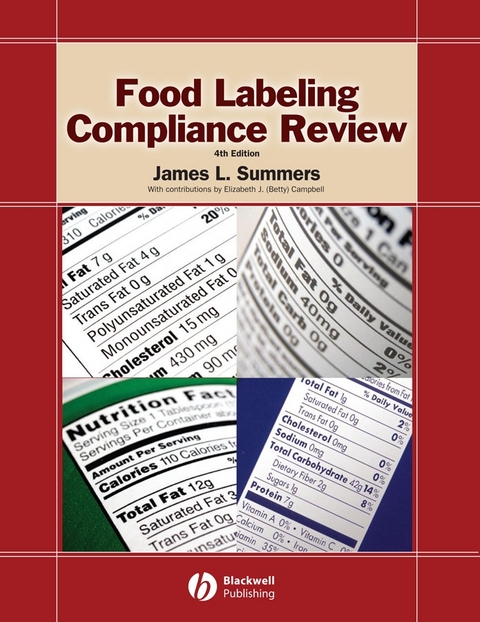
Food Labeling Compliance Review (eBook)
Wiley (Verlag)
978-0-470-75250-0 (ISBN)
The new fourth edition of Food Labeling Compliance Review fully covers recently enacted provisions requiring labeling for allergens, trans fats, and qualified health claims. Clearly illustrated with dozens of charts, sample label panels and “Nutrition Facts” boxes, Food Labeling Compliance Review is the practical, no-nonsense tool needed by both the experienced and inexperienced food label reviewer.
- Current, complete, and accurate food labeling guidance concerning FDA regulations
- Covers new requirements for labeling allergens, trans fats, and qualified health claims
- Essential for all food manufacturers, packers, labelers, relabelers, and distributors
- Fully illustrated with clear Q and A explanations
- Fully-searchable CD-ROM enables quick look ups
Author: James L. Summers is Senior Consultant with EAS Consulting Group, LLC (Alexandria, VA), a leading provider of regulatory services to the food, dietary supplement, and cosmetic industries. He is a former FDA food labeling expert with 32 years tenure at FDA. He has held positions as Aquatic Sampling Specialist, Supervisory Microbiologist, Public Health Sanitarian, General Biologist, FDA Inspector, Regional Shellfish Specialist, and Consumer Safety Officer (Division of Regulatory Guidance). His most recent positions with the FDA were as Supervisory Consumer Safety Officer, Branch Chief, and Senior Consumer Safety Officer in the Office of Food Labeling, where he handled the most controversial, complex, and precedent-setting problems involving regulatory compliance issues dealing with food labeling. He participated in the development of policies and regulatory strategies regarding the enforcement of NLEA and other food labeling regulations.
Contributor: Elizabeth J. (Betty) Campbell now serves as Vice President of EAS Consulting Group, LLC (Alexandria, VA), following a 35-year career with the FDA where she worked as Director of Programs and Enforcement Policy in the Office of Food Labeling in the Center for Food Safety and Applied Nutrition and as Acting Director of the Office of Food Labeling. Ms. Campbell played a key role in writing the Nutrition Labeling and Education Act (NLEA) regulations in the early 1990s, and then had major responsibility for implementing those regulations.
Consultant and long-time Food and Drug Administration (FDA) food labeling expert James Summers answers the many questions surrounding FDA food labeling regulations and compliance in Food Labeling Compliance Review. Now in its third edition, the manual is a comprehensive food labeling compliance handbook designed to aid in understanding the requirements of the FDA. This reference is a must-have for regulatory officials, industry personnel, and others responsible for assuring that the label and labeling of domestic and imported food products in interstate commerce comply with the requirements of the Federal Food, Drug and Cosmetic Act, as amended. The manual is available in book or searchable CD-ROM formats (or both together if you order the first choice on the right). The text is composed of three essential parts: 1.) Introduction and how-to information, including the outline of a compliance review. 2.) Compliance step-by-step review procedure (in the form of questions and answers) for the food label reviewer to establish the degree to which a product s label complies with applicable laws and regulations. These sections also provide a basis for developing a label for prospective food products, as well as a foundation for responding to label deviations observed during the review. 3.) Guidance and information for decision making such as ready references, charts, illustrations, regulations, Federal Register indexes and tables of content for related publications. Clearly illustrated with dozens of charts, sample label panels and Nutrition Facts boxes, Food Labeling Compliance Review is the practical, no-nonsense tool needed by both the experienced and inexperienced food label reviewer. About the Author: James L. Summers is a senior consultant at AAC Consulting Group, Inc. (Rockville, MD), a firm providing consulting services in food, dietary supplement, cosmetics and other areas which fall under the jurisdiction of FDA. He has been offering expert labeling and compliance advice to AAC clients since he ended his 32-year tenure at FDA. He has held positions as Aquatic Sampling Specialist, Supervisory Microbiologist, Public Health Sanitarian, General Biologist, FDA Inspector, Regional Shellfish Specialist, and Consumer Safety Officer (in the Division of Regulatory Guidance). In his last position at FDA, he served as Supervisory Consumer Safety Officer, Branch Chief in the Office of Food Labeling. There he was the focal point for handling the most controversial, complex, and precedent-setting problems involving regulatory compliance issues dealing with food labeling. He participated in the development of policies and regulatory strategies regarding the enforcement of NLEA and other food labeling regulations. Contributor: Elizabeth J. (Betty) Campbell joined AAC after a 35-year career with the FDA where she served as Director of Programs and Enforcement Policy in the Office of Food Labeling in the Center for Food Safety and Applied Nutrition, and as Acting Director of the Office of Food Labeling. Ms. Campbell played a key role in writing the Nutrition Labeling and Education Act (NLEA) regulations in the early 1990s, and then had major responsibility for implementing those regulations.
James L. Summers is a senior consultant at AAC Consulting Group, Inc. (Rockville, MD), a firm providing consulting services in food, dietary supplement, cosmetics and other areas which fall under the jurisdiction of FDA. He has been offering expert labeling and compliance advice to AAC clients since he ended his 32-year tenure at FDA. He has held positions as Aquatic Sampling Specialist, Supervisory Microbiologist, Public Health Sanitarian, General Biologist, FDA Inspector, Regional Shellfish Specialist, and Consumer Safety Officer (in the Division of Regulatory Guidance). In his last position at FDA, he served as Supervisory Consumer Safety Officer, Branch Chief in the Office of Food Labeling. There he was the focal point for handling the most controversial, complex, and precedent-setting problems involving regulatory compliance issues dealing with food labeling. He participated in the development of policies and regulatory strategies regarding the enforcement of NLEA and other food labeling regulations
I. Introduction.
II. Overview of the History of Food Labeling.
III. Definitions.
IV. Changes in Food Labeling Regulations.
A. Ingredient Labeling.
B. Certified Color Additives.
C. Common or Usual Names for Nonstandardized Foods.
D. Standardized Foods.
E. Nutrition Labeling.
F. Descriptive Claims: Fresh, Freshly Frozen, Fresh Frozen,
Frozen Fresh.
G. Other Noncertified Color Additives, and Spices and
Flavorings.
H. Food and Drug Administration Modernization Act (FDAMA) of
1997.
V. Outline for Compliance Review.
A. Establish Jurisdiction.
B. Determine the Completeness and Accuracy of the Required Label
Information.
C. Determine the Degree of Compliance with Applicable
Regulations.
D. Advise Responsible Firm of Label(s) Needing Corrections.
VI. Compliance Label Review Program.
A. Identity Statement.
B. Designation of Ingredients.
C. Name and Place of Business.
D. Net Quantity of Contents Statements.
E. Nutrition Labeling.
F. Nutrient Content Claims.
G. Health Claims.
H. Statements Made Concerning the Effect of Product on the
Structure or Function of the Body.
I. Authoritative Statements (FDAMA).
J. Labeling of Foods in Special Categories.
VII. Administrative Rules, Decisions and Special Labeling
Requirements.
A. Salt and Iodized Salt.
B. Fresh, Freshly Frozen, Fresh Frozen, Frozen Fresh.
C. Natural.
D. Organic.
VIII. Exemptions from FDA Requirements for Foods.
A. Procedures for Requesting Variations and Exemptions from
Required Label Statements.
B. Exemptions from Required Label Statements.
C. Petitions Requesting Exemption from Preemption for State or
Local Requirements.
D. Exemptions When it is Technologically Impractical to
Nutrition Label.
E. Nutrition Labeling of Food: Exemptions/Special Labeling
Provisions.
F. Food: Exemption from Labeling.
G. Temporary Exemption for Purposes of Conducting Authorizing
Food Labeling Experiments.
H. Temporary Permits for Interstate Shipment of Experimental
Packs of Food Varying from the Requirements of Definitions and
Standards of Identity.
IX. Compliance Provisions.
A. Failure to Reveal Material Facts.
B. Misleading Containers.
C. Food with a Label Declaration of Nutrients.
D. Food Subject to Nutrition Labeling.
E. Food: Prominence of Required Statements.
F. Misbranding of Food.
G. Substantial Compliance of Food Retailers with the Guidelines
for the Voluntary Nutrition Labeling of Raw Fruits, Vegetables, and
Fish.
X. Special Food Issues.
A. Food Allergy.
B. Food Bioengineering.
C. Botanical and Other Novel Ingredients in Conventional
Foods.
XI. Charts, Illustrations, Statements, Regulations.
XII. Index to the January 6, 1993 Federal Register Preamble and
Final NLEA Regulations.
XIII. Index to the August 18, 1993 Federal Register Preamble:
Nutrition Labeling Technical Amendments.
XIV. Table of Contents for Chapter 5 - Foods, Colors, and
Cosmetics for the Compliance Policy Guide, DHHS, PHS, FDA, ORA, OF,
DCP.
XV. Table of Contents for Food Labeling Questions and Answers
for Guidance to Facilitate the Process of Developing or Revising
Labels for Foods Other than Dietary Supplements, U.S. DHHS, PHS,
FDA, August 1993.
XVI. Table of Contents for Food Labeling Questions and Answers,
Volume II, A Guide for Restaurants and Other Retail Establishments,
U.S. DHHS, PHS, FDA, August 1995Index
"Designed to aid in understanding the FDA food labelling
regulations."
International Food Information Service
| Erscheint lt. Verlag | 28.2.2008 |
|---|---|
| Sprache | englisch |
| Themenwelt | Recht / Steuern ► EU / Internationales Recht |
| Recht / Steuern ► Privatrecht / Bürgerliches Recht ► Medizinrecht | |
| Recht / Steuern ► Wirtschaftsrecht ► Handelsrecht | |
| Technik ► Lebensmitteltechnologie | |
| Wirtschaft ► Betriebswirtschaft / Management | |
| Weitere Fachgebiete ► Land- / Forstwirtschaft / Fischerei | |
| Schlagworte | Compliance • Comply • Comprehensive • Consultant • Domestic • Expert • FDA • Food • Food Legislation • Food Packaging • Food Science & Technology • Handbook • James • Label • Lebensmittelforschung u. -technologie • Lebensmittel-Gesetzgebung • Lebensmittel / Verpackung • Manual • many • musthave • officials • Products • questions • Reference • Regulatory • Requirements • summers • surrounding • Third |
| ISBN-10 | 0-470-75250-5 / 0470752505 |
| ISBN-13 | 978-0-470-75250-0 / 9780470752500 |
| Informationen gemäß Produktsicherheitsverordnung (GPSR) | |
| Haben Sie eine Frage zum Produkt? |
 PDF (Adobe DRM)
Kopierschutz: Adobe-DRM
Adobe-DRM ist ein Kopierschutz, der das eBook vor Mißbrauch schützen soll. Dabei wird das eBook bereits beim Download auf Ihre persönliche Adobe-ID autorisiert. Lesen können Sie das eBook dann nur auf den Geräten, welche ebenfalls auf Ihre Adobe-ID registriert sind.
Details zum Adobe-DRM
Dateiformat: PDF (Portable Document Format)
Mit einem festen Seitenlayout eignet sich die PDF besonders für Fachbücher mit Spalten, Tabellen und Abbildungen. Eine PDF kann auf fast allen Geräten angezeigt werden, ist aber für kleine Displays (Smartphone, eReader) nur eingeschränkt geeignet.
Systemvoraussetzungen:
PC/Mac: Mit einem PC oder Mac können Sie dieses eBook lesen. Sie benötigen eine
eReader: Dieses eBook kann mit (fast) allen eBook-Readern gelesen werden. Mit dem amazon-Kindle ist es aber nicht kompatibel.
Smartphone/Tablet: Egal ob Apple oder Android, dieses eBook können Sie lesen. Sie benötigen eine
Geräteliste und zusätzliche Hinweise
Buying eBooks from abroad
For tax law reasons we can sell eBooks just within Germany and Switzerland. Regrettably we cannot fulfill eBook-orders from other countries.
aus dem Bereich