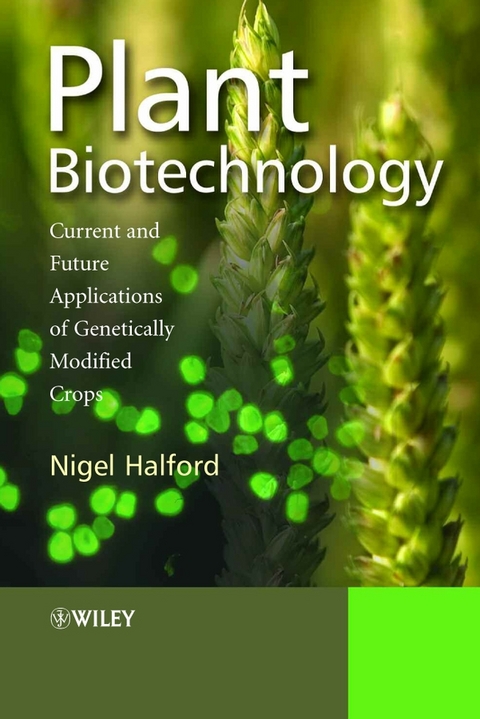
Plant Biotechnology (eBook)
John Wiley & Sons (Verlag)
978-0-470-02182-8 (ISBN)
Key features:
- Covers the topic in depth and addresses key subject areas
- Takes a broad view of the current situation in different countries
- Examines the commercial application of plant biotechnology in the USA and China
- Covers two major areas of public concern: allergenicity and gene flow
- Covers new developments in plant research, safety and legislation aspects
This book is essential reading for postgraduates and researchers in plant biotechnology and related sciences in Departments of Plant Science, Biotechnology, Bioscience, Environmental Science, Food Biosciences and Chemistry. It is also of interest for professionals working in the plant biotechnology industry or government professionals working in environmental policy.
Dr. Nigel Halford is principal research scientist in the Crop Performance and Improvement Division at Rothamsted Research (a BBSRC centre). He has achieved renown as an expert in the GM field, and has strong collaborative research links within academia and industry, and is regularly involved in public debates on GM crops.
Plant Biotechnology: Current and Future Uses of Genetically Modified Crops covers in detail the development, use and regulation of GM crops. Split into three sections, Part 1 introduces GM crops and describes the GM crops that are used commercially. Part 2 looks at new developments and methodologies in areas including potential applications of GM crops for the production of vaccines, enhanced nutritional value of GM food, and engineering resistance to fungal pathogens. Part 3 concludes by considering the key issues of safety and legislation, including allergenicity, environmental impacts, risk assessment and labelling. Key features: Covers the topic in depth and addresses key subject areas Takes a broad view of the current situation in different countries Examines the commercial application of plant biotechnology in the USA and China Covers two major areas of public concern: allergenicity and gene flow Covers new developments in plant research, safety and legislation aspects This book is essential reading for postgraduates and researchers in plant biotechnology and related sciences in Departments of Plant Science, Biotechnology, Bioscience, Environmental Science, Food Biosciences and Chemistry. It is also of interest for professionals working in the plant biotechnology industry or government professionals working in environmental policy.
Dr. Nigel Halford is principal research scientist in the Crop Performance and Improvement Division at Rothamsted Research (a BBSRC centre). He has achieved renown as an expert in the GM field, and has strong collaborative research links within academia and industry, and is regularly involved in public debates on GM crops.
List of Contributors.
Preface.
PART I: THE CURRENT SITUATION.
1.1 From Primitive Selection to Genetic Modification, Ten
Thousand Years of Plant Breeding (Nigel G. Halford).
1.2 Crop Biotechnology in the United States: Experiences and
Impacts (Sujatha Sankula).
1.3 Development of Biotech Crops in China (Qingzhong Xue, Yuhua
Zhang and Xianyin Zhang).
PART II: NEW DEVELOPMENTS.
2.1 Advances in Transformation Technologies (Huw D. Jones).
2.2 Enhanced Nutritional Value of Food Crops (Dietrich Rein and
Karin Herbers).
2.3 The Production of Long-Chain Polyunsaturated Fatty Acids in
Transgenic Plants (Louise V. Michaelson,
Frédéric Beaudoin, Olga Sayanova and
Johnathan A. Napier).
2.4 The Application of Genetic Engineering to the Improvement of
Cereal Grain Quality (Peter R. Shewry).
2.5 Improvements in Starch Quality (Michael M. Burrell).
2.6 Production of Vaccines in GM Plants (Liz Nicholson, M.
Carmen Can~izares and George P. Lomonossoff).
2.7 Prospects for Using Genetic Modification to Engineer Drought
Tolerance in Crops (S.G. Mundree, R. Iyer, B. Baker, N. Conrad,
E.J. Davis, K. Govender, A.T. Maredza and J.A. Thomson).
2.8 Salt Tolerance (Eduardo Blumwald and Anil Grover).
2.9 Engineering Fungal Resistance in Crops (Maarten
Stuiver).
PART III: SAFETY AND REGULATION.
3.1 Plant Food Allergens (E.N. Clare Mills, John A. Jenkins and
Peter R. Shewry).
3.2 Environmental Impact and Gene Flow (P.J.W. Lutman and K.
Berry).
3.3 Risk Assessment, Regulation and Labeling (Nigel G.
Halford).
Index.
"The book provides an overview of the development, use and
regulation of GM crops." (Food Science and Technology
Abstracts, September 2008)
"...very important and useful for anyone interested in
the subject." (Plant Science Bulletin, 11/06)
| Erscheint lt. Verlag | 1.5.2006 |
|---|---|
| Sprache | englisch |
| Themenwelt | Naturwissenschaften ► Biologie ► Genetik / Molekularbiologie |
| Naturwissenschaften ► Chemie | |
| Technik ► Lebensmitteltechnologie | |
| Technik ► Umwelttechnik / Biotechnologie | |
| Weitere Fachgebiete ► Land- / Forstwirtschaft / Fischerei | |
| Schlagworte | Agriculture • Antigens • Artificially • Between • Biotechnologie i. d. Biowissenschaften • Biotechnology • Biowissenschaften • Control • controversial • Crop • DNA • established technique • flow • Food Science & Technology • Gene • genes • Genetic • Group • inadvertent • Issue • Issues • Landwirtschaft • Lebensmittelforschung u. -technologie • Life Sciences • modification • organism • Plant • Public • Regulations • relatives • Risk • Single • synthesis • World |
| ISBN-10 | 0-470-02182-9 / 0470021829 |
| ISBN-13 | 978-0-470-02182-8 / 9780470021828 |
| Informationen gemäß Produktsicherheitsverordnung (GPSR) | |
| Haben Sie eine Frage zum Produkt? |
 PDF (Adobe DRM)
Kopierschutz: Adobe-DRM
Adobe-DRM ist ein Kopierschutz, der das eBook vor Mißbrauch schützen soll. Dabei wird das eBook bereits beim Download auf Ihre persönliche Adobe-ID autorisiert. Lesen können Sie das eBook dann nur auf den Geräten, welche ebenfalls auf Ihre Adobe-ID registriert sind.
Details zum Adobe-DRM
Dateiformat: PDF (Portable Document Format)
Mit einem festen Seitenlayout eignet sich die PDF besonders für Fachbücher mit Spalten, Tabellen und Abbildungen. Eine PDF kann auf fast allen Geräten angezeigt werden, ist aber für kleine Displays (Smartphone, eReader) nur eingeschränkt geeignet.
Systemvoraussetzungen:
PC/Mac: Mit einem PC oder Mac können Sie dieses eBook lesen. Sie benötigen eine
eReader: Dieses eBook kann mit (fast) allen eBook-Readern gelesen werden. Mit dem amazon-Kindle ist es aber nicht kompatibel.
Smartphone/Tablet: Egal ob Apple oder Android, dieses eBook können Sie lesen. Sie benötigen eine
Geräteliste und zusätzliche Hinweise
Buying eBooks from abroad
For tax law reasons we can sell eBooks just within Germany and Switzerland. Regrettably we cannot fulfill eBook-orders from other countries.
aus dem Bereich