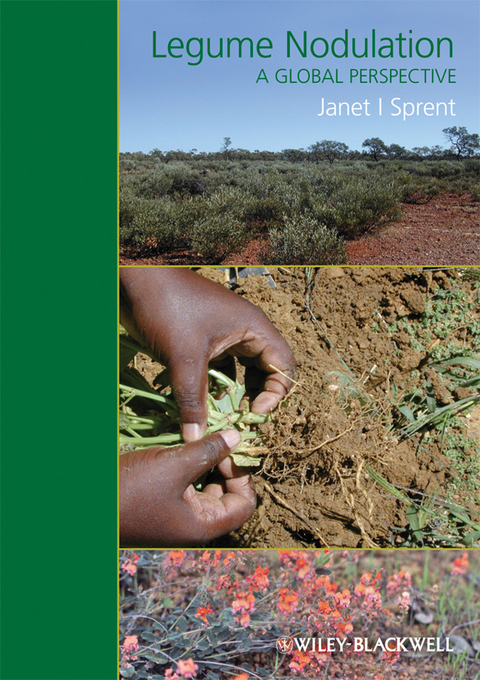
Legume Nodulation (eBook)
200 Seiten
John Wiley & Sons (Verlag)
978-1-4443-1639-1 (ISBN)
* An up to date review of legume taxonomy and a full list of the world's genera
* Details of how legumes are distributed throughout the world
* A review of the evolution of legume nodulation
* Comprehensive details of all microorganisms known to be symbiotic with legumes
* Ecological and environmental aspects of legume-bacteria symbiosis
Legume Nodulation is an essential purchase for plant scientists, agronomists, ecologists and microbiologists. Libraries in all universities and research establishments where biological and agricultural sciences are studied and taught should have copies of this landmark publication.
Janet Sprent, OBE, Emeritus Professor of Plant Biology, University of Dundee, Scotland, UK.
1. Nodulation in a Taxonomic Context
1.1 Caesalpinioideae
1.2 Mimosoideae
1.2.1 Acacieae
1.2.2 Ingeae
1.2.3 Mimoseae
1.3 Papilionoideae
1.3.1 Non-nodulation in the Papilionoideae
1.3.2 Nodulating papilionoids with primitive nodule
structure
1.3.3 Tribes with the 50kb inversion
1.3.4 The Dalbergioid clade
1.3.5 The Mirbelioid clade
1.3.6 The Millettioid clade
1.3.7 The Robinioid clade
1.3.8 The Inverted Repeat Lacking Clade (IRLC)
2. Global Distribution of Legumes
2.1 Deserts
2.2 Savannas
2.2.1 African savannas
2.2.2 Neotropical savannas
2.2.3 Australian savannas
2.3 Seasonally dry tropical forests (succulent biome)
2.3.1 Caatinga
2.3.2 Other areas
2.4 Rainforests
2.4.1 Atlantic forest
2.4.2 Temperate rainforests
2.4.3 Tropiucal rainforrests
2.5 Temperate regions
2.5.1 Mediterraqnean ecosystems
2.5.2 Temperate, boreal and high altitude legumes
2.6 Invasive legumes
3. Evolution of Nodulation
3.1 When did nodulation first occur?
3.2 Where did nodulation first occur? Where are nodulated
legumes going?
3.2.1 Madagascar as a special case
3.2.2 Recent evolution
3.3 How was the information for nodulation acquired?
3.3.1 Ancient genes that have been recruited for symbiotic
purposes
3.3.2 Gene duplication
3.4 Why was nodulation necessary?
3.5 Model legumes
4. Bacteria Nodulating Legumes
4.1 alpha-Proteobacteria
4.4.1 Rhizobium
4.1.2 Sinorhizobium and Ensifer
4.1.3 Other members of Rhizobiaceae
4.1.4 Bradyrhizobium
4.1.5 Azorhizobium and Devosia
4.1.6 Methylobacterium
4.1.7 Ochrobactrum
4.1.8 Mesorhizobium
4.1.9 Phyllobacterium
4.2 beta-Proteobacteria
4.3 Other bacterial nodule occupants
4.4 Specificity
4.5 Competition
4.6 Stability and genetic exchange
5. Development and Functioning of Nodules
5.1 Root hair infection
5.2 The role of hormones
5.3 Autoregulation
5.4 Formation of symbiosomes
Bacteroid size and shape
The role of polybetahydroxybutyrate (PHB)
5.5 Nodules lacking root hair infection
5.5.1 Dalbergioid legumes
5.5.2 Genisteae and Crotalarieae
5.5.3 The special case of Sesbania
5.6 Other variations on nodule structure
5.7 Functioning nodules. The critical role of oxygen
5.8 Nitrogen fixation and export of products
5.8.1 The hydrogen enigma
5.9 Nodule effectiveness
5.10 The bacteria within the nodules- control by the bacteria,
plant or both?
5.11 Constraints on nitrogen fixation in agriculture and the
environment
5.11.1 Waterlogging drought and salinity
5.11.2 Temperature
5.11.3 Edaphic factors
5.12. Legumes, pests and pathogens
6. Some Legumes for the Future?
6.1 Human food
6.1.1 Vigna spp
6.1.2 Other phaseoloid legumes
6.2 Forage legumes
6.3 Pharmaceutical uses
6.4 Other uses
"This book by Janet I. Sprent, a leading world authority on nitrogen fixation, is a comprehensive review of current knowledge. It starts with an up-to-date review of nodulation in a taxonomic context, with details of nodulating genera and species. There are extensive descriptions of the tribes, genera and species of the three sub-families of the Leguminosae involved, with good further descriptive and detailed texts on their reported nodulation characteristics." (The Cambridge Press, August 2010)
"This book provides a comprehensive review of the world's leguminous plants and their symbiotic bacteria. It is intended for plant scientists, agronomists, ecologists and microbiologists." (Food Science and Technology Abstracts, July 2010)
"Summarizes current knowledge ... and provides details on aspects that have not been covered in depth in other volumes. A more global perspective on legume nodulation." (Book News, December 2009)
| Erscheint lt. Verlag | 8.9.2009 |
|---|---|
| Sprache | englisch |
| Themenwelt | Naturwissenschaften ► Biologie ► Botanik |
| Technik | |
| Weitere Fachgebiete ► Land- / Forstwirtschaft / Fischerei | |
| Schlagworte | Agricultural Economics & Resource Management • Agriculture • Ãkonomie u. Ressourcenmanagement i. d. Landwirtschaft • Biowissenschaften • Botanik • Botanik / Physiologie • Hülsenfrüchte • Hülsenfrüchte • Landwirtschaft • Life Sciences • Ökonomie u. Ressourcenmanagement i. d. Landwirtschaft • Plant Physiology |
| ISBN-10 | 1-4443-1639-7 / 1444316397 |
| ISBN-13 | 978-1-4443-1639-1 / 9781444316391 |
| Informationen gemäß Produktsicherheitsverordnung (GPSR) | |
| Haben Sie eine Frage zum Produkt? |
 PDF (Adobe DRM)
Kopierschutz: Adobe-DRM
Adobe-DRM ist ein Kopierschutz, der das eBook vor Mißbrauch schützen soll. Dabei wird das eBook bereits beim Download auf Ihre persönliche Adobe-ID autorisiert. Lesen können Sie das eBook dann nur auf den Geräten, welche ebenfalls auf Ihre Adobe-ID registriert sind.
Details zum Adobe-DRM
Dateiformat: PDF (Portable Document Format)
Mit einem festen Seitenlayout eignet sich die PDF besonders für Fachbücher mit Spalten, Tabellen und Abbildungen. Eine PDF kann auf fast allen Geräten angezeigt werden, ist aber für kleine Displays (Smartphone, eReader) nur eingeschränkt geeignet.
Systemvoraussetzungen:
PC/Mac: Mit einem PC oder Mac können Sie dieses eBook lesen. Sie benötigen eine
eReader: Dieses eBook kann mit (fast) allen eBook-Readern gelesen werden. Mit dem amazon-Kindle ist es aber nicht kompatibel.
Smartphone/Tablet: Egal ob Apple oder Android, dieses eBook können Sie lesen. Sie benötigen eine
Geräteliste und zusätzliche Hinweise
Buying eBooks from abroad
For tax law reasons we can sell eBooks just within Germany and Switzerland. Regrettably we cannot fulfill eBook-orders from other countries.
aus dem Bereich