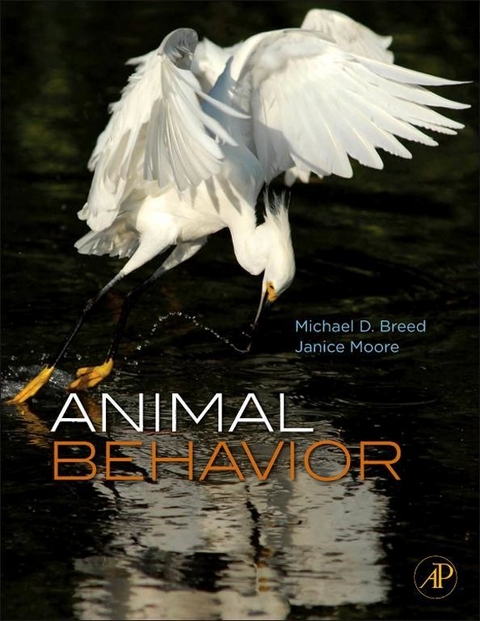
Animal Behavior (eBook)
496 Seiten
Elsevier Science (Verlag)
978-0-08-091992-8 (ISBN)
After receiving his PhD from the University of Kansas in 1977, Dr. Breed began work as a faculty member at the University of Colorado, Boulder and taught as a Professor in the Department of Ecology and Evolutionary Biology until his retirement in 2019. He taught courses in general biology, animal behavior, insect biology, and tropical biology. His research program focused on the behavior and ecology of social insects, and he worked on ants, bees, and wasps. He studied many aspects of social behavior, including nestmate recognition, division of labor, the genetics of colony defense, the behavior of defensive bees, and communication during colony defense. Dr. Breed was the Executive Editor of the scientific journals Animal Behaviour from 2006-2009 and Insectes Sociaux from 2014-2018.
Animal Behavior covers the broad sweep of animal behavior from its neurological underpinnings to the importance of behavior in conservation. The authors, Michael D. Breed and Janice Moore, bring almost 60 years of combined experience as university professors to this textbook, much of that teaching animal behavior. An entire chapter is devoted to the vibrant new field of behavior and conservation, including topics such as social behavior and the relationship between parasites, pathogens, and behavior. Thoughtful coverage has also been given to foraging behavior, mating and parenting behavior, anti-predator behavior and learning. This text addresses the physiological foundations of behavior in a way that is both accessible and inviting. Each chapter begins with learning objectives and concludes with thought-provoking questions. Additionally, special terms and definitions are highlighted throughout. The book provides a rich resource for students (and professors) from a wide range of life science disciplines. - Provides a solid background in the neurophysiological and endocrinological bases of animal behavior as well as exceptionally strong coverage of social behavior- Includes behavior and homeostatic mechanisms, behavior and conservation, and behavioral aspects of disease- Highlights aspects of behavior that relate to domestic animals in particular- Lab manual with fully developed and tested laboratory exercises available for courses that have labs (http://www.elsevierdirect.com/product.jsp?isbn=9780123725820)- Companion site for faculty and students to enhance their learning experience at: www.elsevierdirect.com/companions/9780123725813
Front Cover 1
Animal Behavior 4
Copyright Page 5
Contents 8
Preface 12
Chapter 1. Of Cockroaches and Wolves: Framing Animal Behavior 16
1.1 Introduction: Animal Behavior 17
1.2 Wolves: Lessons in Social Behavior 19
1.3 Cockroaches: Models for Animal Behavior 22
1.4 The Four Questions Revisited 24
1.5 Evolution: A Review 26
1.6 The Study of Animal Behavior: Where Did It Come From? 32
1.7 Umwelt: The World in Which Animals Behave 37
Summary 37
Study Questions 38
Chapter 2. Neurobiology and Endocrinology for Animal Behaviorists 40
2.1 Neurobiology, Endocrinology, and Sensory Systems: An Overview 41
2.2 What Does an Animal Behaviorist Need to Know about Neurobiology? 42
2.3 What Does an Animal Behaviorist Need to Know about Endocrinology? 53
2.4 What Does an Animal Behaviorist Need to Know about Sensory Systems? 65
Summary 78
Study Questions 79
Chapter 3. Behavioral Genetics 82
3.1 Introduction: Principles of Behavioral Genetics and the Evolution of Behavior 83
3.2 The Nature versus Nurture Debate 86
3.3 Evolution and Behavior 89
3.4 The Behavioral Genetics Toolbox 89
Summary 110
Study Questions 111
Chapter 4. Homeostasis and Time Budgets 114
4.1 Introduction 115
4.2 Behavior and Homeostasis 117
4.3 Biological Clocks and Circadian Rhythms 124
4.4 Modern Concepts of Homeostatic Regulation 127
4.5 Time Budgets and Trade-Offs: Balancing Demands in How Animals Budget Their Time 133
Summary 137
Study Questions 137
Chapter 5. Learning 140
5.1 Introduction 141
5.2 Learning and Memory 142
5.3 Basic Models for Learning 146
5.4 Social Learning: Traditions and “Cultural” Transmission of Information in Animals 155
5.5 Play, Learning, and Development 158
Summary 161
Study Questions 162
Chapter 6. Cognition 166
6.1 Introduction: What Is Cognition? 167
6.2 The Concept of Self 174
6.3 Thought, Foresight, and Problem Solving 178
6.4 Intelligence and Social Cognition 185
6.5 Personality and Behavioral Syndromes 187
6.6 The Frontal Lobe and Impulse Control 189
6.7 Animal Emotions 190
6.8 Are Cognitive Abilities Under- or Over-Attributed to Animals? 192
Summary 194
Study Questions 194
Chapter 7. Communication 198
7.1 Introduction: Communication Theory 199
7.2 The Evolution of Communication 202
7.3 Modes of Communication 204
7.4 Multimodal Signaling and Encoding Complex Messages 220
7.5 Runaway Sexual Selection and Signaling 223
7.6 Deceit versus Honest Signaling 223
7.7 Game Theory and Communication 225
7.8 Interspecific Signaling 228
Summary 229
Study Questions 229
Chapter 8. Movement: Search, Navigation, Migration, and Dispersal 234
8.1 Introduction 235
8.2 Sources of Navigational Information 239
8.3 Sensing the Environment in Time and Space 241
8.4 How to Respond to Sensory Information: A Toolbox for Finding the Way 244
8.5 Search 250
8.6 Homing 251
8.7 Migration 253
8.8 Dispersal 261
Summary 263
Study Questions 264
Chapter 9. Foraging 268
9.1 Introduction 269
9.2 Diet Choice and Food Selection 270
9.3 How Animals Get Food 272
9.4 Willing Food 279
9.5 Manipulation of Prey 280
9.6 Parasitic Life Cycles 281
9.7 Foraging and Optimality Theory 283
9.8 Optimal Patch Choice 285
9.9 Optimal Prey Choice 289
9.10 Nutritional Constraints 290
Summary 291
Study Questions 292
Chapter 10. Self-Defense 296
10.1 Introduction 297
10.2 Cryptic Behavior: Camouflage 298
10.3 Vigilance and Alarm 304
10.4 Mimicry and Diversion 306
10.5 Evasion 310
10.6 Predator Deterrence and Fighting Back 311
10.7 Pathogen Avoidance/Deterrence and Sickness Behavior 314
Summary 317
Study Questions 317
Chapter 11. Mating Systems 322
11.1 Introduction 323
11.2 The Evolution of Sex: Why Some Animals Are Called Male and Others Female 324
11.3 Sexual Selection 329
11.4 Variance in Mating Success 333
11.5 Mate Choice 334
11.6 Mating Systems: How Many Males, How Many Females? 335
11.7 Hormones and Sexual Behavior 342
11.8 Hormones, Territoriality, and Aggression 344
11.9 Sperm Competition 344
11.10 Good Genes Models for Choosing a Mate 346
11.11 Forced Copulations 349
Summary 350
Study Questions 350
Chapter 12. Nesting, Parenting, and Territoriality 356
12.1 Introduction 357
12.2 Nests and Nesting 358
12.3 Parental Investment 362
12.4 Patterns of Parental Care 364
12.5 Hormones and Parental Behavior 368
12.6 Parenting and Conflicts of Interest 369
12.7 Begging and Weaning Conflict 370
12.8 Sibling Conflict 371
12.9 Infanticide 373
12.10 Aggression and Territoriality 374
Summary 377
Study Questions 378
Chapter 13. Social Behavior, Cooperation, and Kinship 382
13.1 Introduction 383
13.2 Altruism or Selfish Interests? 385
13.3 Schools, Flocks, Hordes, and Herds 386
13.4 Explaining Cooperation 393
13.5 Extreme Cooperation: Eusociality 399
13.6 Lack of Ecological Choice in Aid-Giving Decisions 403
13.7 Social Recognition, Kin Recognition, and Cooperation with Close Relatives 403
13.8 Social Symbioses 406
Summary 409
Study Questions 409
Chapter 14. Comparative Social Behavior 414
14.1 Introduction 415
14.2 Vertebrate Social Systems 416
14.3 Invertebrate Eusociality: Workers and the Division of Labor 423
14.4 Invertebrate Eusociality: Queens and Reproduction 429
14.5 Invertebrate Eusociality: Colony Defense 432
14.6 Eusocial Invertebrates 434
Summary 443
Study Questions 444
Chapter 15. Conservation and Behavior 448
15.1 Introduction: Conservation and the Future of Animal Behavior 449
15.2 Species Protection in Natural Habitats 451
15.3 Extinctions and Behavior 456
15.4 Reserve Design 460
15.5 Captive Breeding Programs and Reintroductions 467
15.6 The Human–Wildlife Interface in the Suburbs 474
Summary: The Future and Conservation Behavior 478
Study Questions 479
Index 484
| Erscheint lt. Verlag | 4.1.2011 |
|---|---|
| Sprache | englisch |
| Themenwelt | Naturwissenschaften ► Biologie ► Zoologie |
| Sozialwissenschaften ► Soziologie | |
| Technik | |
| Weitere Fachgebiete ► Land- / Forstwirtschaft / Fischerei | |
| ISBN-10 | 0-08-091992-8 / 0080919928 |
| ISBN-13 | 978-0-08-091992-8 / 9780080919928 |
| Informationen gemäß Produktsicherheitsverordnung (GPSR) | |
| Haben Sie eine Frage zum Produkt? |
 EPUB (Adobe DRM)
Kopierschutz: Adobe-DRM
Adobe-DRM ist ein Kopierschutz, der das eBook vor Mißbrauch schützen soll. Dabei wird das eBook bereits beim Download auf Ihre persönliche Adobe-ID autorisiert. Lesen können Sie das eBook dann nur auf den Geräten, welche ebenfalls auf Ihre Adobe-ID registriert sind.
Details zum Adobe-DRM
Dateiformat: EPUB (Electronic Publication)
EPUB ist ein offener Standard für eBooks und eignet sich besonders zur Darstellung von Belletristik und Sachbüchern. Der Fließtext wird dynamisch an die Display- und Schriftgröße angepasst. Auch für mobile Lesegeräte ist EPUB daher gut geeignet.
Systemvoraussetzungen:
PC/Mac: Mit einem PC oder Mac können Sie dieses eBook lesen. Sie benötigen eine
eReader: Dieses eBook kann mit (fast) allen eBook-Readern gelesen werden. Mit dem amazon-Kindle ist es aber nicht kompatibel.
Smartphone/Tablet: Egal ob Apple oder Android, dieses eBook können Sie lesen. Sie benötigen eine
Geräteliste und zusätzliche Hinweise
Buying eBooks from abroad
For tax law reasons we can sell eBooks just within Germany and Switzerland. Regrettably we cannot fulfill eBook-orders from other countries.
aus dem Bereich