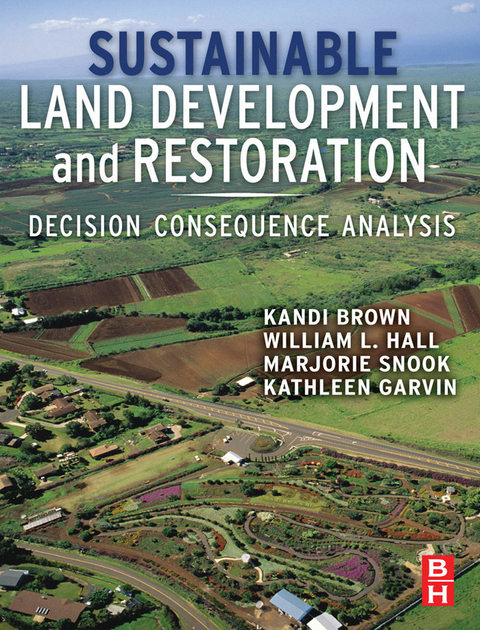
Sustainable Land Development and Restoration (eBook)
528 Seiten
Elsevier Science (Verlag)
978-0-08-096301-3 (ISBN)
This book provides a toolbox to both the novice and experienced environmental practitioner of valuable techniques for addressing site specific environmental issues, as well as managing a portfolio of liabilities on an international scale. Ultimately, the authors are addressing the critical issue of balancing environmental asset balance sheets, whether on the scale of an individual project, across a company's portfolio, or for a community. The environmental manager who adopts the principles in this book will have greater confidence that environmental protection or restoration activities are providing measurable utility. The goal is that, through multidimensional resource management analysis and practices companies and societies can achieve sustainable maintenance of a balanced environmental system.
Descriptions of technical, contracting and implementation processes are supported by detailed case studies to provide real world context rather than an academic exchange of theories.
Techniques for addressing site specific environmental issues
Multidimensional resource management analysis
Case narrative, data base, and GIS linked
Decision Consequence Analysis (DCA) is a framework for improving the quality of decision results. The framework is a systematic, multi-criteria quantification of uncertainties and the opportunities for managing and reducing the potential negative consequences of such uncertainties. DCA is demonstrated throughout Sustainable Land Development and Restoration for each stage of system based management of environmental issues. DCA links disciplines and incorporates components of risk modelling, probability modelling and the psychology of decision making. Its goal is to provide a comprehensive unbiased decision making framework. Its foundation is accurately defining your problem statement and clearly vetting your objectives to build a structure for meaningful analysis of data. Employment of DCA consistently throughout the environmental industry can reduce decibel-driven, agenda-laden decision making, streamline expenditure of resources (financial, human, natural), and provide a clear path to the sustainable maintenance of balanced environmental systems as the penultimate objective. Sustainable Land Development and Restoration provides a toolbox to both the novice and experienced environmental practitioner of valuable techniques for addressing site specific environmental issues, as well as managing a portfolio of liabilities on an international scale. Ultimately, the authors are addressing the critical issue of balancing environmental asset balance sheets, whether on the scale of an individual project, across a company's portfolio, or for a community. The environmental manager who adopts the principles in this book will have greater confidence that environmental protection or restoration activities are providing measurable utility. The goal is that, through multidimensional resource management analysis and practices companies and societies can achieve sustainable maintenance of a balanced environmental system. Descriptions of technical, contracting and implementation processes are supported by detailed case studies to provide real world context rather than an academic exchange of theories. - Techniques for addressing site specific environmental issues- Multidimensional resource management analysis- Case narrative, data base, and GIS linked
| Erscheint lt. Verlag | 7.1.2010 |
|---|---|
| Sprache | englisch |
| Themenwelt | Naturwissenschaften ► Biologie ► Ökologie / Naturschutz |
| Naturwissenschaften ► Geowissenschaften | |
| Recht / Steuern ► EU / Internationales Recht | |
| Recht / Steuern ► Privatrecht / Bürgerliches Recht ► Sachenrecht | |
| Technik ► Elektrotechnik / Energietechnik | |
| Technik ► Umwelttechnik / Biotechnologie | |
| Weitere Fachgebiete ► Land- / Forstwirtschaft / Fischerei | |
| ISBN-10 | 0-08-096301-3 / 0080963013 |
| ISBN-13 | 978-0-08-096301-3 / 9780080963013 |
| Informationen gemäß Produktsicherheitsverordnung (GPSR) | |
| Haben Sie eine Frage zum Produkt? |
 EPUB (Adobe DRM)
Kopierschutz: Adobe-DRM
Adobe-DRM ist ein Kopierschutz, der das eBook vor Mißbrauch schützen soll. Dabei wird das eBook bereits beim Download auf Ihre persönliche Adobe-ID autorisiert. Lesen können Sie das eBook dann nur auf den Geräten, welche ebenfalls auf Ihre Adobe-ID registriert sind.
Details zum Adobe-DRM
Dateiformat: EPUB (Electronic Publication)
EPUB ist ein offener Standard für eBooks und eignet sich besonders zur Darstellung von Belletristik und Sachbüchern. Der Fließtext wird dynamisch an die Display- und Schriftgröße angepasst. Auch für mobile Lesegeräte ist EPUB daher gut geeignet.
Systemvoraussetzungen:
PC/Mac: Mit einem PC oder Mac können Sie dieses eBook lesen. Sie benötigen eine
eReader: Dieses eBook kann mit (fast) allen eBook-Readern gelesen werden. Mit dem amazon-Kindle ist es aber nicht kompatibel.
Smartphone/Tablet: Egal ob Apple oder Android, dieses eBook können Sie lesen. Sie benötigen eine
Geräteliste und zusätzliche Hinweise
Buying eBooks from abroad
For tax law reasons we can sell eBooks just within Germany and Switzerland. Regrettably we cannot fulfill eBook-orders from other countries.
aus dem Bereich