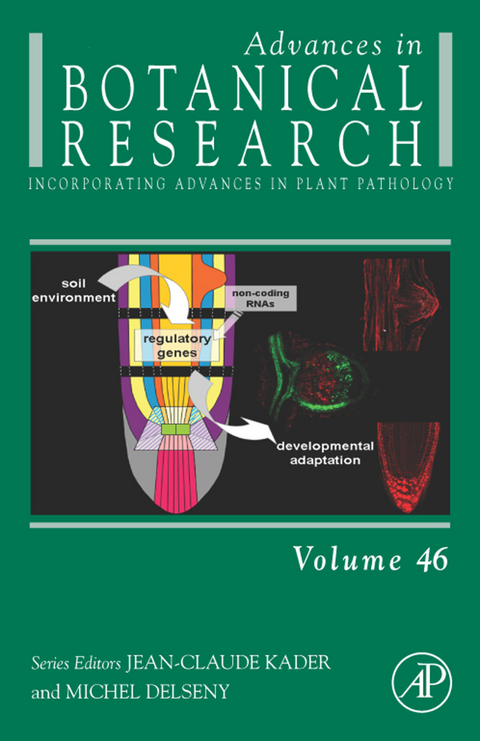
Advances in Botanical Research (eBook)
312 Seiten
Elsevier Science (Verlag)
978-0-08-056063-2 (ISBN)
* Multidisciplinary reviews written from a broad range of scientific perspectives
* For over 40 years, series has enjoyed a reputation for excellence
* Contributors internationally recognized authorities in their respective fields
Edited by Jean-Claude Kader and supported by an international Editorial Board, Advances in Botanical Research publishes in-depth and up-to-date reviews on a wide range of topics in plant sciences. Currently in its 46th volume, the series features a wide range of reviews by recognized experts on all aspects of plant genetics, biochemistry, cell biology, molecular biology, physiology and ecology. This eclectic volume features four reviews on cutting-edge topics of interest to post-graduates and researchers alike. - Multidisciplinary reviews written from a broad range of scientific perspectives- For over 40 years, series has enjoyed a reputation for excellence- Contributors internationally recognized authorities in their respective fields
Cover 1
Contents 6
Contributors to Volume 46 10
Contents of Volumes 35-45 14
Chapter 1: Nitric Oxide and Plant Growth Promoting Rhizobacteria: Common Features Influencing Root Growth and Development 24
I. Introduction 25
II. NO Is a Regulator of Root Growth and Developmental Processes 26
A. NO Induces Adventitious Root Formation 26
B. NO and Lateral Root Development: NO Is Downstream Auxin in Triggering LRD 28
C. General Features Associated to Root Hair Formation 29
D. The Effects of PGPR on Root Architecture 33
III. Perspectives 44
Acknowledgments 46
References 47
Chapter 2: How the Environment Regulates Root Architecture in Dicots 58
I. Introduction 59
II. The Root System and the Model A. thaliana 61
A. The RAM: Establishment and Patterning 62
B. Radial Organization of Root Tissues 64
C. LR Organogenesis 64
III. Root Growth in the Soil Environment 65
A. Endogenous Signals Regulating Root Growth 65
B. The Peculiar Legume Root System and its Symbiotic Interactions 69
IV. Changing Root Architecture: Adaptive Responses to the Soil Environment 70
A. Water Availability and the Osmotic Potential of the Medium 71
B. Water Excess and Adventitious Rooting 74
C. Nutrient Availability 75
D. Effects of Abiotic Stresses on Legume Roots 77
V. Root Growth and Differentiation in Response to Environmental Conditions: Small Noncoding RNAs as New Posttranscriptional Regulators 78
VI. Concluding Remarks 82
Acknowledgments 84
References 84
Chapter 3: Aquaporins in Plants: From Molecular Structure to Integrated Functions 98
I. Introduction 99
II. Significance of Aquaporin Molecular Structure for Transport Specificity and Gating 101
A. Aquaporins Are Tetrameric Transmembrane Channels 101
B. Methods for Functional Characterization of Plant Aquaporins 103
C. Plant Aquaporins Are Not Just Water Channels 105
D. Molecular and Structural Bases of Aquaporin Selectivity 107
E. Molecular Mechanisms of Aquaporin Gating 109
III. Aquaporins in Roots 114
A. Principles of Root Water Uptake 114
B. Aquaporin Expression in Roots 116
C. Measurements of Root Water Transport 117
D. Evidence for Water Transport by Aquaporins in Roots 119
E. Effects of Stimuli on Root Water Transport 123
F. Transport of Nutrients 128
IV. Aquaporins in Leaves 129
A. Aquaporin Expression in Leaves 130
B. Measurements of Water Transport in Leaves 131
C. Water Transport Pathways in Leaves 133
D. Functions of Aquaporins in Leaf Water Transport 135
E. Physiological Regulations of Kleaf 136
F. CO2 Transport 139
V. Aquaporins in Reproductive Organs 140
A. Aquaporins in Flowers 141
B. Aquaporins in Seeds 143
VI. Conclusion 145
References 146
Chapter 4: Iron Dynamics in Plants 160
I. Introduction 161
II. Iron Mobilization After Germination 163
A. Metabolic-Induced Dynamics of Iron After Germination: An Example 163
B. Evidences for Seed Iron Mobilization after Germination 164
C. Molecular Aspects of Seed Iron Remobilization After Germination 164
III. Iron Acquisition and Circulation During Vegetative Growth 166
A. Plant/Soil/Microorganisms Interactions in the Rhizosphere 166
B. Iron Uptake by Roots 169
C. Long Distance Iron Circulation Within the Plant 176
D. Subcellular Compartmentation of Iron 178
E. Cross Talks Between Iron and Zinc Uptake and Compartmentation in Plants 180
IV. Iron and Photosynthesis 181
A. Photosynthesis Impairment due to Iron Deficiency 181
B. Overview of Heme and Fe-S Cluster Biosynthesis in Chloroplasts 183
V. Iron and Reproduction in Plants 187
A. Iron During Flowering 187
B. Iron Unloading and Storage in Seeds 188
VI. Conclusion 190
References 191
Chapter 5: Plants and Arbuscular Mycorrhizal Fungi: Cues and Communication in the Early Steps of Symbiotic Interactions 204
I. Introduction 205
II. Rhizosphere Signaling in Symbiotic Interactions 207
A. Plant Signals in the Presymbiotic Stage: The Case of Flavonoids 209
B. Nonflavonoid Rhizosphere Signals 211
C. Identification of the Hyphal Branching Factor: The Strigolactone Story 213
D. Fungal Signaling to Host Roots: Myc Factors 215
III. Plant Genetic Programs: Mycorrhiza-Defective Mutants 216
IV. Molecular Cross Talk and Signaling Pathways 220
V. Plant Cell Responses to Fungal Colonization: Tissue and Cell Specificity 224
VI. Interface Biogenesis: New Facts/New Hypotheses 227
VII. Conclusions 229
Acknowledgments 230
References 231
Chapter 6: Dynamic Defense of Marine Macroalgae Against Pathogens: From Early Activated to Gene-Regulated Responses 244
I. Introduction 245
II. Dynamic Defense of Marine Algae 247
A. Pathogen Perception in Higher Eukaryotes 247
B. Recognition of the Attacker(s) in Seaweeds 249
III. The Oxidative Burst Machinery in Marine Algae 251
A. Oxidative Burst in Higher Plants: Definition, Effects, and Involved Enzymes 251
B. DPI-Sensitive Oxidative Burst in Algae-Pathogen Interactions 252
C. NADPH Oxidase-Like Genes in Algae 253
D. Other Sources of ROS in Algae-Pathogen Interactions 255
IV. The Defensive Role of Halogenation in Marine Algae 256
A. Halogen Metabolism and Halogenating Enzymes in Algae 256
B. A Direct Role in Cell Protection 258
C. Chemical Defense Molecules 259
V. Oxylipins as Mediators of Defense Responses in Marine Algae 261
A. Lipase-Activated Release and Lipoxygenase-Mediated Transformation of FFAs 262
B. Oxylipin Pathways in Marine Algae 263
C. Biological and Ecological Functions of Oxylipins 265
VI. Transcriptional Responses in Marine Algae: Mining Defense Genes 268
A. Genomic and Transcriptomic Data in Marine Algae 268
B. Mining Defense-Related Gene in Brown Algae 270
C. Mining Defense-Related Gene in Red Algae 273
VII. Conclusions and Prospects 275
Acknowledgments 277
References 277
Author Index 290
Subject Index 302
Color Plate Section 310
| Erscheint lt. Verlag | 5.11.2007 |
|---|---|
| Mitarbeit |
Herausgeber (Serie): Michel Delseny, Jean-Claude Kader |
| Sprache | englisch |
| Themenwelt | Sachbuch/Ratgeber |
| Studium ► 1. Studienabschnitt (Vorklinik) ► Physiologie | |
| Naturwissenschaften ► Biologie ► Biochemie | |
| Naturwissenschaften ► Biologie ► Botanik | |
| Naturwissenschaften ► Biologie ► Ökologie / Naturschutz | |
| Technik | |
| Weitere Fachgebiete ► Land- / Forstwirtschaft / Fischerei | |
| ISBN-10 | 0-08-056063-6 / 0080560636 |
| ISBN-13 | 978-0-08-056063-2 / 9780080560632 |
| Informationen gemäß Produktsicherheitsverordnung (GPSR) | |
| Haben Sie eine Frage zum Produkt? |
 PDF (Adobe DRM)
Kopierschutz: Adobe-DRM
Adobe-DRM ist ein Kopierschutz, der das eBook vor Mißbrauch schützen soll. Dabei wird das eBook bereits beim Download auf Ihre persönliche Adobe-ID autorisiert. Lesen können Sie das eBook dann nur auf den Geräten, welche ebenfalls auf Ihre Adobe-ID registriert sind.
Details zum Adobe-DRM
Dateiformat: PDF (Portable Document Format)
Mit einem festen Seitenlayout eignet sich die PDF besonders für Fachbücher mit Spalten, Tabellen und Abbildungen. Eine PDF kann auf fast allen Geräten angezeigt werden, ist aber für kleine Displays (Smartphone, eReader) nur eingeschränkt geeignet.
Systemvoraussetzungen:
PC/Mac: Mit einem PC oder Mac können Sie dieses eBook lesen. Sie benötigen eine
eReader: Dieses eBook kann mit (fast) allen eBook-Readern gelesen werden. Mit dem amazon-Kindle ist es aber nicht kompatibel.
Smartphone/Tablet: Egal ob Apple oder Android, dieses eBook können Sie lesen. Sie benötigen eine
Geräteliste und zusätzliche Hinweise
Buying eBooks from abroad
For tax law reasons we can sell eBooks just within Germany and Switzerland. Regrettably we cannot fulfill eBook-orders from other countries.
aus dem Bereich