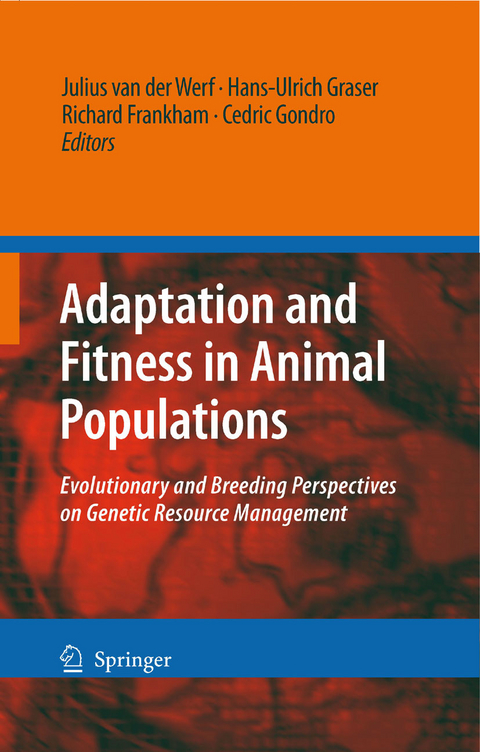
Adaptation and Fitness in Animal Populations (eBook)
258 Seiten
Springer Netherland (Verlag)
978-1-4020-9005-9 (ISBN)
Fitness and adaptation are fundamental characteristics of plant and animal species, enabling them to survive in their environment and to adapt to the inevitable changes in this environment. This is true for both the genetic resources of natural ecosystems as well as those used in agricultural production.
Extensive genetic variation exists between varieties/breeds in a species and amongst individuals within breeds. This variation has developed over very long periods of time. A major ongoing challenge is how to best utilize this variation to meet short-term demands whilst also conserving it for longer-term possible use.
Many animal breeding programs have led to increased performance for production traits but this has often been accompanied by reduced fitness. In addition, the global use of genetic resources prompts the question whether introduced genotypes are adapted to local production systems. Understanding the genetic nature of fitness and adaptation will enable us to better manage genetic resources allowing us to make efficient and sustainable decisions for the improvement or breeding of these resources.
This book had an ambitious goal in bringing together a sample of the world’s leading scientists in animal breeding and evolutionary genetics to exchange knowledge to advance our understanding of these vital issues.
Fitness and adaptation are fundamental characteristics of plant and animal species, enabling them to survive in their environment and to adapt to the inevitable changes in this environment. This is true for both the genetic resources of natural ecosystems as well as those used in agricultural production.Extensive genetic variation exists between varieties/breeds in a species and amongst individuals within breeds. This variation has developed over very long periods of time. A major ongoing challenge is how to best utilize this variation to meet short-term demands whilst also conserving it for longer-term possible use.Many animal breeding programs have led to increased performance for production traits but this has often been accompanied by reduced fitness. In addition, the global use of genetic resources prompts the question whether introduced genotypes are adapted to local production systems. Understanding the genetic nature of fitness and adaptation will enable us to better manage genetic resources allowing us to make efficient and sustainable decisions for the improvement or breeding of these resources.This book had an ambitious goal in bringing together a sample of the world s leading scientists in animal breeding and evolutionary genetics to exchange knowledge to advance our understanding of these vital issues.
Preface 6
Contents 9
Modelling Fitness 11
Defining Fitness in Natural and Domesticated Populations 12
1 Introduction 12
2 Fitness and Related Concepts 14
3 Meanings of Fitness 15
4 Genetics of Fitness 20
5 Quantitative Genetics, Animal Breeding and Fitness 21
References 21
Genetic Architecture of Reproductive Fitness and its Consequences 24
1 Introduction 25
2 Equilibrium Theory for Wild Populations 26
3 Empirical Data 27
4 QTL Mapping and Microarray Studies 29
5 Domestic Animals are Unlikely to be in Equilibrium 34
6 Discussion and Implications for Livestock Breeding 40
7 Conclusions 42
References 42
Fitness Traits in Animal Breeding Programs 49
1 Introduction 49
2 Has Fitness Declined? 50
3 Why Has Fitness Declined? 50
4 Inbreeding 51
5 Selection 53
6 Long Term Response 54
7 Recommended Policy 56
8 Conclusions 58
References 58
9 Appendix Effect of Selection for Milk Yield on Fertility in Dairy Cows 60
Discussion 61
Maintaining Fitness 64
Maintaining Genetic Variation in Fitness 65
1 Introduction 66
2 Genetic Variance in Fitness in Natural Populations 67
3 Artificial Selection on Fitness 69
4 Fitness as a Correlated Trait in Artificial Selection 75
5 Maintenance of Variation in Fitness: Role of Mutation 78
6 Genetic Variation in Phenotypic and Environmental Variance 79
7 Discussion 81
References 84
Spherical Cows Grazing in Flatland: Constraints to Selection and Adaptation 88
1 Adaptation and the Multivariate Phenotype 88
2 Spherical Cows: Geometric Models for the Adapativeness of New Mutations 89
3 Multivariate Phenotypes and Selection Response 92
4 Living in Flatland: The Misleading Univariate World 94
5 Constraints and Consequences 96
6 Using Matrix Subspace Projection to Measure Constraints 98
7 The Dimensionality of the G Matrix 101
8 Evolution Under Constraints or Evolution of Constraints? 102
9 Closing Comments: G is Dead, Long Live G 103
References 105
Maintaining Fitness by Within Breed Selection 107
1 Introduction 107
2 Response to Selection 110
3 Social Interactions 118
References 127
Discussion 129
The Genetic Basis of Adaptation 132
Some Evolutionary Consequences of Niche Construction with Genotype- Environment Interaction 133
1 Introduction 133
2 An Empirical Context of Niche Construction 136
3 Phenotypic Plasticity to the Constructed Environment: Interactions Between Flowering and Germination Time 137
4 Plasticity and Environment-Dependent Heritability: Seed Dispersal as a Simple Case of One Niche- Constructing Character Influencing Itself 138
5 Consequences of Environment-Dependent Heritability to Evolutionary Dynamics with Niche Construction 140
6 Discussion 147
References 149
Genotype by Environment Interaction in Farm Animals 152
1 Introduction 152
2 Types of Interaction 153
3 FalconerÌs Contribution 154
4 Statistical Approaches to Analysis of G × E Interactions 156
5 Reaction Norms 159
6 Strain Evaluation over Several Environments 160
7 Strain Improvement Across Environments 162
8 Discussion 165
References 167
Drosophila and Selection in Nature: From Laboratory Fitness Components to Field Assessments 169
1 Introduction 169
2 Constant to Variable Laboratory Environments 172
3 Selection in Outdoor Cages 173
4 Selection in Open Field Environments: Adults 174
5 Selection in Open Field Environments: Other Life Stages 178
6 Concluding Remarks 179
References 179
Discussion 183
Strategies for Managing Diversity 189
Strategies to Exploit Genetic Variation While Maintaining Diversity 190
1 What is Genetic Variation? 190
2 Why Maintain Genetic Variation? 192
3 Simple Measures of Genetic Diversity 193
4 How to Maintain Genetic Variation 194
References 198
Managing Genetic Diversity, Fitness and Adaptation of Farm Animal Genetic Resources 200
1 Introduction 200
2 Objectives in Diversity Preservation 201
3 Measuring Genetic Diversity 203
4 Tools for Managing Genetic Diversity 211
5 Relationships Between Molecular and Quantitative Variation 216
6 Conclusion 220
References 222
Livestock Genetic Resources: Preserving Genetic Adaptations for Future Use 227
1 Extended Summary 227
References 229
Discussion 231
Concluding Summary 233
Stuart BarkerÌs Contributions to Population Genetics and Animal Breeding: Exploring Fitness, Evolution and Animal Genetics 235
1 Introduction 236
2 Casting the Die 236
3 A Foot in Both Camps 242
4 Conclusion 250
References 250
Index 255
Strategies to Exploit Genetic Variation While Maintaining Diversity (p. 191-192)
Brian P. Kinghorn, Robert Banks, Cedric Gondro, Valentin D. Kremer, Susan A. Meszaros, Scott Newman, Ross K. Shepherd, Rod D. Vagg and Julius H. J. van der Werf
Abstract How we should manage genetic diversity depends on why we want to manage it. The most generally useful strategy is to maintain variation across the genome, using methods that consider one or more of: population size, population structure, animal selections, mate allocations and information from genetic markers. A key reason to maintain genetic diversity is to facilitate longer-term genetic gains, and this means that most breeding programs need to consider genetic diversity as well as shorter-term genetic gains. This paper discusses these issues, and presents developments in methods to integrate genetic gains, genetic diversity and other issues within breeding programs.
Keywords Diversity · genetic variation · inbreeding · mate allocation
1 What is Genetic Variation?
This question seems quite easy to answer – genetic variation is the variation among individuals and/or populations in genetic constitution. In this context we often think of variation summed over single polymorphisms for mutations such as single nucleotide substitutions or small deletions. But we can move up the functional chain to consider co-variation among many polymorphisms, variation in functionality of biochemical pathways or other such biological networks, and on to variation in the impact of the whole (epi)genotype on phenotype in defined environments. Taking another angle, we can use genome-wide markers to make inference about genetic variation and maintenance of genetic variation, and their association with selection history as driven by fitness – without using explicit phenotypic information (e.g. Borevitz et al. 2007).
How we should define genetic variation depends on why we want to manage it, and the future opportunities we might have to exploit it. The less we know about these things, the more we resort to defining genetic variation in simple terms based, for example, on data from neutral genetic markers, and/or on population structure. Alternatively, if we want to manage genetic variation for a given trait in a given environment, we may elect to focus purely on the prevailing genetic component of variance for that trait, as derived from phenotypes and relationships.
Consider the somewhat optimistic scenario where we have conducted a genome scan for the population of interest, with sufficient genotypes and phenotypes to develop a reliable handle on QTL or marker associations that explain almost all of the genetic variation in a trait of interest. It is reasonably clear how to use this information to make early genetic gains in a breeding program. But how would we use this information to help maintain genetic variation for this trait? Driving towards intermediate or optimal allele frequencies across multiple loci would take many generations, especially if we are focusing on more loci because of attention to multiple traits. Assortative mating on genotypes to generate extra divergence would help reveal variation, making it more accessible later on, but again that takes many generations, and in fact extra variation is being unlocked, rather than created.
| Erscheint lt. Verlag | 17.10.2008 |
|---|---|
| Zusatzinfo | XII, 258 p. |
| Verlagsort | Dordrecht |
| Sprache | englisch |
| Themenwelt | Mathematik / Informatik ► Mathematik |
| Naturwissenschaften ► Biologie ► Evolution | |
| Naturwissenschaften ► Biologie ► Ökologie / Naturschutz | |
| Naturwissenschaften ► Biologie ► Zoologie | |
| Technik | |
| Weitere Fachgebiete ► Land- / Forstwirtschaft / Fischerei | |
| Schlagworte | Adaptation • Animal breeding • Animal breeding programs • ecosystem • Environment • Evolution • Genetics |
| ISBN-10 | 1-4020-9005-6 / 1402090056 |
| ISBN-13 | 978-1-4020-9005-9 / 9781402090059 |
| Informationen gemäß Produktsicherheitsverordnung (GPSR) | |
| Haben Sie eine Frage zum Produkt? |
 PDF (Wasserzeichen)
Größe: 4,5 MB
DRM: Digitales Wasserzeichen
Dieses eBook enthält ein digitales Wasserzeichen und ist damit für Sie personalisiert. Bei einer missbräuchlichen Weitergabe des eBooks an Dritte ist eine Rückverfolgung an die Quelle möglich.
Dateiformat: PDF (Portable Document Format)
Mit einem festen Seitenlayout eignet sich die PDF besonders für Fachbücher mit Spalten, Tabellen und Abbildungen. Eine PDF kann auf fast allen Geräten angezeigt werden, ist aber für kleine Displays (Smartphone, eReader) nur eingeschränkt geeignet.
Systemvoraussetzungen:
PC/Mac: Mit einem PC oder Mac können Sie dieses eBook lesen. Sie benötigen dafür einen PDF-Viewer - z.B. den Adobe Reader oder Adobe Digital Editions.
eReader: Dieses eBook kann mit (fast) allen eBook-Readern gelesen werden. Mit dem amazon-Kindle ist es aber nicht kompatibel.
Smartphone/Tablet: Egal ob Apple oder Android, dieses eBook können Sie lesen. Sie benötigen dafür einen PDF-Viewer - z.B. die kostenlose Adobe Digital Editions-App.
Zusätzliches Feature: Online Lesen
Dieses eBook können Sie zusätzlich zum Download auch online im Webbrowser lesen.
Buying eBooks from abroad
For tax law reasons we can sell eBooks just within Germany and Switzerland. Regrettably we cannot fulfill eBook-orders from other countries.
aus dem Bereich